February 20, 2013
By Lisa Hewitt
“We could go out right now and pull 5 random people and ask them is there a difference between public schools in this country that serve poor children and public schools in this nation that serve wealthy children and everyone would say yes. So everyone knows. Then to me that’s deliberate, it’s not an accident, it’s not a mystery everyone knows. Everyone knows [schools] are fundamentally unequal in almost everyway. And yet the narrative of meritocracy, narrative of opportunity persists. Even though everyone knows it’s a myth. It’s a rigged game. And you don’t have a choice to play; everybody’s on the same Monopoly board trying to get home, but there are a group of people that everybody knows starts with way more money in their bank and then we act as though we’re all playing the same game under the same set of rules.”–Jeff Duncan-Andrade Ph.D
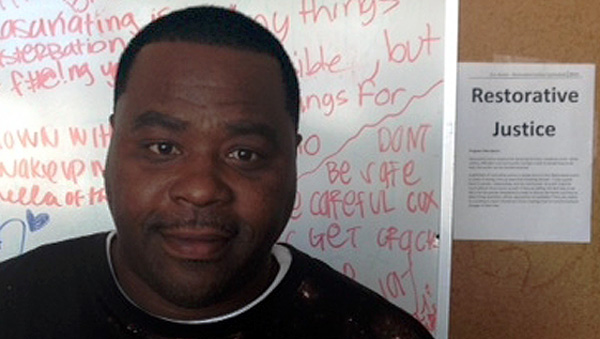
Jeff Duncan-Andrade Ph.D, is an Associate Professor of Raza Studies, Education Administration and Interdisciplinary Studies at San Francisco State University. He serves as Director of the Educational Equity Initiative at the Wangari Maathai Institute for Sustainable Cities and Schools. He is an English teacher at Mandela High School, where he is the director of the East Oakland Step to College Program. Working as a middle school and high school teacher for 21 years, while researching urban school pedagogy, has inspired a new project, Roses in Concrete, a charter school, which redesigns many of the standardized practices of the modern educational system.
On Improving Teacher Recruitment, Training and Professional Support and Development
With almost half of new teachers estimated to leave the profession within five years, Jeff Duncan-Andrade suggests some solutions to the staggering teacher turnover rate. First, teacher recruitment needs to be a priority of colleges or universities the way they pursue students of other disciplines. He asserts, “There are certainly relationships between colleges and communities, but it’s not about finding the best educators.” Duncan-Andrade concedes colleges are no strangers to recruiting; athletes are sought out from middle school. He believes colleges should be recruiting educators the same way they recruit athletes. It’s important to be able to recognize who potentially would be the best educators and without a strong recruitment system, it’s impossible to actively find them. District wide policies should require recruiting teachers who know what’s happening on the ground and are culturally responsive to the area.
Beyond recruitment, training and education are areas Duncan-Andrade believes need a complete overhaul. In California, an undergraduate student cannot major in Education. The belief is, if you have content expertise then you must be able to teach it; the art of teaching is highly undervalued. Our system for training teachers needs to be rethought, “[Learning how to teach is] crammed into two semesters and a few weeks of student teaching and then you’re handed keys to go and serve the community that has the highest needs and the least amount of resources and we have a 50% leave rate for teachers in their first two years. No surprise why.” Duncan-Andrade proposes a teacher training system modeled on the medical field: teachers are trained for 4-6 years and do a minimum of a two-year apprenticeship. “Just like in the medical field, you do your residency and at the end of your residency if you’re chief resident decides that you’re not fit, you don’t become a doctor.”
The third tier pertains to professional development and teacher longevity. Often the best training comes from experience, Duncan-Andrade explains, “What we know from the fairly extensive body of research about longevity is a lot of teachers leave the classroom because of the working conditions. So it wasn’t about their training, it wasn’t about their recruitment, it was about, ‘now I got my own site, I’m getting no support, I’m not getting meaningful professional development and…frankly a lot of the stuff that I was actually trained in, I believe in, things like social justice, around things like care, loving your students, building a family environment. All those things I received in my training, those things are not allowed…” Duncan-Andrade has set about to develop a set of tools that identify who are the most successful teachers and to begin positioning them as leaders in policy-making practices. “We do [recruitment, training, retention] badly, I mean really badly. And everybody knows, that’s the thing that makes me upset. Everybody knows. At best it’s been benign neglect, at worst it’s deliberate.”
On Full Service Community Schools
“I think the people who are talking about [community full service schools] are so far removed from the reality of the classroom.”
Duncan-Andrade explains there’s a gap in education between theory and practice, between imagining how issues can be addressed and how they should realistically be addressed. “On the white board everything works. On the ground it’s messier… and I think the problem is the people having those conversations don’t understand the ground, because you don’t have the top 100 teachers. You couldn’t even say who the top 100 teachers in Oakland are. How are you going to develop school wide, city wide, district wide policies that are reflective of what actually works on the ground?” Duncan-Andrade points to the health clinic at Fremont High School. He explains, “My kids won’t go to the health clinic because it’s staffed by people who don’t understand them. They have all the medical training, they’re from UCSF and Berkeley. All that training they don’t understand our community, they don’t understand our kids. So our kids go there, they get referred there and they come back and they’re like ‘I’m not going back there.’ So I have to get them medical referrals to community doctors that I know that are culturally responsive that actually understand what it’s like to be a black woman or what it’s like to be a Latino immigrant. That’s the gap. Do I think [Superintendent Smith] ideas are right headed? Yes. Do I think they have a long way to go to understanding how to actually take those really good ideas and make them manifest on the ground? Yes.”
On Roses in Concrete Charter School
“I don’t think the point of education is escape poverty. I think the point of education is to end it, but we’re not taught that in our schools. Not when you grow up poor. School is your way out and I think that’s why poverty persists because the people who are most able to understand poverty and be able to fundamentally attack it and change it with the way that they think and the way that they’re educated, they are encouraged to escape it and attack it from the distance with a checkbook. I think ideologically, our school will be fundamentally different than say Head Royce [a private school in Oakland, Ca.]. Cosmetically it might look somewhat similar…but ideologically, it will be different. The kinds of students we’ll produce and the sense of purpose about their lives they’ll have, will be somewhat different than what a lot of schools produce.”
The planned Roses in Concrete Charter School is modeled on the Maori educational system in New Zealand. It’s centered on the belief that everyone in the school is a family. Maori schools are overseen by their own school board and by local members of the community. Duncan-Andrade explains, “[With local control] the accountability changes… they control the food, they control the building design.” The Maori classrooms have no walls, which is very much a part of the their cultural traditions and norms; they have several classes occurring in one large area. They don’t separate students by age, often 16 year olds can be seen working with 8 year olds. The students don’t rotate from teacher to teacher. Duncan-Andrade goes on to explain, “When we thought about building this school…[we thought] about what does it mean to be a family? How does it actually operate? We eat together. A couple nights a week kids and faculty stay at the school. They go to sleep at the school.”
He plans to build a state of the art campus, that responds to and reflects the cultural values of Oakland’s community. It’ll focus on an Ethnic Studies driven model of education, which concentrates on the student’s sense of self and cultural identity; the students must know themselves, love themselves first and understand their own greatness. This allows them to enter a diverse society in a much more meaningful way. His vision includes a full serve community center within the school similar to the model set out by the Oakland Unified School District, “It’s not just about having doctors, it’s about having doctors that really understand our community. It’s not just about having access to housing, it’s about having access to having housing that’s responsive to the needs of our community. I think those are the conversations that we’re most interested in having with people. It’s not only about the kind of resources you can bring, but how can they fit into the particular contexts of East Oakland.”
For more information please visit: rosesinconcrete.org
 By Justin Richmond