Category Archives: Local

SF Gate: Tiny Marin County district clings to struggling school

0Story: Jill Tucker

Photo: Paul Chinn

Despite the state’s economic recovery, a Marin County school district is struggling to make ends meet and is planning to cut teachers, administrators and special programs in the coming months.

While unusual, that wouldn’t normally be noteworthy save for one not-so-minor detail: The Sausalito Marin City School District, thanks to a property tax loophole, has almost $30,000 a year to spend on each of the 150 students at its single school.

That’s triple or quadruple the amount spent by most public schools and several thousand more than elite private schools. It’s also just shy of the cost for a year of college at UC Berkeley, including room and board.

And it’s still not enough to pay the bills – or lure the area’s middle- and upper-class families to send their kids there.

How then does a metropolitan school district with huge piles of cash, along with money woes, mediocre test scores and one under-enrolled school continue to exist?

The situation in Sausalito Marin City exemplifies the staying power of tiny and expensive school districts arguably clinging to community control and historical precedence rather than common sense.

Read more.

Mind/Shift: 7 Big Hurdles In Education and Ideas For Solving Them

7Katrina Schwartz

An infographic can hardly contain enough space to tackle the big, hairy challenges of American education. But the non-profit, Digital Promise, has tried to identify some of the biggest challenges — and ideas for solutions — identified by the 46 schools in their League of Innovative Schools that are trying new techniques. They address issues like competency-based learning and personalized professional development, as well as students’ ownership of their learning.

Read more.

SF Gate: June Jordan School for Equity gets a break on testing

Story by Jill Tucker

Photos by Mike Kepka

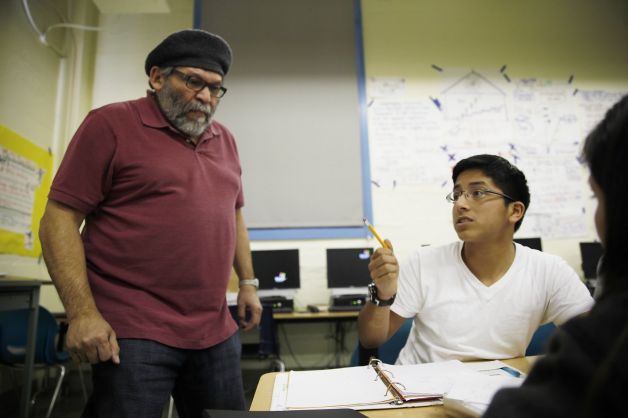
Mike KapkaNormally at this time of year, teachers and administrators at San Francisco’s June Jordan School for Equity would be starting to gear up for the standardized tests given to students early in the spring.

And the educators would be hoping that this time, unlike in years past, the school’s abysmal scores would really go up. But that won’t happen.

This year, the Excelsior neighborhood high school will get a welcome reprieve from the predictable cycle of testing.

It’s a practice year for California schools as the state transitions to a new computerized testing system based on the new Common Core curriculum adopted by most states. While students will take the new tests, the scores won’t count or even be reported to parents or the public.

For June Jordan, it wipes an ugly test-score slate clean and offers a shot at redemption.

District officials had high hopes for June Jordan.

Read more.

Oakland Local: Parents, students give their say in school budgeting

Oakland Local
Story by Barbara Grady
March 2, 2014

2march

The first test of Oakland Unified School District’s ability to include parents and students in making budget decisions — something now required by state law — happened Wednesday night when about 100 people asked the school board to let schools, rather than the central administration, decide how to spend a pot of money.

The students and parents won.

At issue was $1.5 million — a paltry sum within an overall $589 million budget for the district — but it was the subject of great debate, because the Board of Education had decided last June to gives schools this money, and $3 million more, to spend as they see fit, but then faced increased expenses, so considered rescinding that decision.

Read more.

Inside Bay Area: San Leandro woman headed to Ivy League school after overcoming challenges

Story by Rebecca Parr

SILIN HUANGSAN LEANDRO — SiLin Huang is headed to an Ivy League school in the fall after overcoming the challenges of speaking no English when she immigrated at age 8, growing up poor and missing two years of high school because of a mysterious illness.

“I’m the only child, so my parents viewed me as the hope for the family,” she said. “My goal was to get a good education and do well in school, because my parents only completed high school, and I wanted to help them.”

That goal was set back because of a still-undiagnosed illness. The straight-A San Leandro High student could not attend school — she was too sick to even take online courses — her junior and senior years. But when she recovered, she earned her high school diploma in one year at adult school and has been accepted by Columbia University in New York. In recognition of her accomplishments, she is one of 12 women chosen for the Alameda County Women’s Hall of Fame.

Read more.

Oakland Local: Oakland School District considering new parcel tax

Story by Barbara Grady

bgrady

Oakland’s school board is considering putting a parcel tax on the November ballot to fund improvement in its high schools.

Although it’s made progress lowering the high school drop out rate and adding more rigor to its curriculum, Oakland Unified School District still sees more than 25 percent of high schoolers drop out. And not all of those who graduate are prepared for college or for starting a career. So the district wants to embark on a new approach to high school education.

It wants to bring to all schools a pedagogy called Linked Learning, in which students both pursue college preparatory academic subjects and work in internships at local employers in government, education, media, healthcare and business. Under the proposal in consideration, it would ask voters to approve a parcel tax of $150 per household to pay for this program and to raise teacher salaries at high schools to help in retaining and recruiting good teachers.

The district already offers some Linked Learning programs at most of its high schools, and the curriculum at two schools Life Academy and MetWest High School is built entirely around Linked Learning. The possible parcel tax would raise money to expand the program to all eight high schools in the district and made it available to all students.

Read more.

SF Gate: SF seen as model in blinigual education over English only

bilingualStory by Jill Tucker

In the 15 years since voters essentially banned bilingual education in state schools, teaching English learners to read, write and do arithmetic first in their native language has nearly disappeared from California classrooms.

Since Proposition 227 overwhelmingly passed in June 1998, it’s been all about learning English, first and foremost – but not in San Francisco. Nearly 30 percent of the city’s 17,000 English learners are in bilingual education programs, compared with 5 percent on average statewide, according to the most recent data available.

And it’s working, according to a recently published Stanford University study commissioned by the San Francisco Unified School District.

Districts can get around the Prop. 227 ban by having parents sign a waiver authorizing their children to be in bilingual education programs.

Bilingual education students, who learn to read and write in their native language and then transfer those academic skills into English, are – after a slower start – as fluent by sixth grade as those focused on and immersed in English with minimal support in their home language, according to the study.

Read more.

Oakland Local: Startup Weekend Oakland/Black Male Achievement produces 14 apps, lots of inspiration

Story by Barbara Grady

techyouth1-300x168“This is history y’all,” said software engineer Ayori Selassie from the platform at Startup Weekend/Black Male Achievement on Sunday night. “This is the first event that has happened like this in the entire world. So if you are here, you are in the middle of making history.”

This past weekend, hundreds of people poured into Impact HUB Oakland’s new headquarters for a hackathon that not only produced 14 viable computer applications/ business startups but also turned about 40 African-American teenagers into potential entrepreneurs after they spent two days coding, problem-solving and business planning alongside engineering and business professionals.

By Sunday night, 50 ideas that participants had pitched Friday night had been honed, through brainstorming and coding, into 14 actual apps, most designed for use on smartphones. Then, 14 teams pitched their apps and business plans to a panel of venture capital and investment professionals.

Read more.

Audio: Perspectives: Education Interrupted

By Morgan Boeder

MorganBoederI was sitting in my boyfriend’s room in my pajamas, picking out classes when I opened the email informing me that my school had lost its accreditation and might close its doors next year.

It was definitely a shock and I immediately felt sad. Just getting to college had been a struggle for me.

I dropped out of high school my sophomore year. I had a lot going on in my life. And even though I always planned to go back and get my diploma, there was still a fear in the back of my mind that somehow it wouldn’t work out.

Eventually I found a program called Gateway to College. It’s for high school students to get their diplomas and college credits at the same time, and it came with a full scholarship to City College.

This May, I got my high school diploma, and I began looking forward to eventually earning my bachelor’s degree. But then I found out about the school’s loss of accreditation, and now I’m not sure what to think about my educational future.

Listen to the story here.