The 2012 YES Conference

New Image2January 31, 2013
By Lisa Hewitt

The Gay-Straight Alliance Network (GSA Network) is a national organization which links school-based Gay-Straight Alliances across the country with each other, to community partners, as well as aids in leadership development and activist training. Jill Marcellus, the Communications Manager at GSA Network based in San Francisco, explains how deeply involved youth are in their organization, “GSA Network is a youth-driven organization, and we operate on a model of youth-adult partnership. This carries all the way to the top of the organization: young people comprise about half of GSA Network’s Board of Directors. There are a number of opportunities for youth to become leaders within the organization, from becoming a youth trainer and leading the peer-to-peer workshops that are at the heart of our work to joining a regional Youth Council and helping shape our program work for the year. We train young people not only to change their schools, but to become leaders in LGBT and other social justice movements.”

One component of the work the GSA Network does is the Youth Empowerment Summit (YES) held annually. December 5, 2012 marked the 8th YES summit and drew over 700 allied youth and adults to Mission High School in San Francisco. Those who attended heard four keynote speakers, attended over 40 workshops, met with community partners in a resource fair, participated in discussion groups and students could take part in a youth only drag show and dance.New Image1
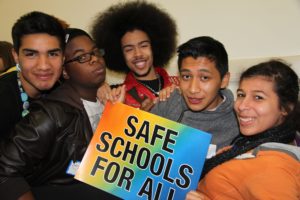
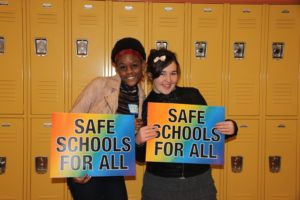
As part of the conference, three panelists, Emery Cohen, Espii Gutierrez, Raymond Ferronato, T. Murray, and moderator Isaias Guzman discussed this year’s theme: the school-to-prison pipeline and how it affects their community and themselves. As one GSA member, Sabina Jacobs, a senior at Sequoia High School in Redwood City, explains, “the…pipeline is polices and practices that school districts use to unintentionally push out LGBT, people of color, people with disabilities, or low income youth.” Sabina believes this year was a huge success and in the years to come would like to see the workshops’ topics expand. Sabina explains, “[I’d like to see] more comprehensive workshops on gender identity in general,” and beyond the YES conference, Sabina expresses the need for a system to be put in place to educate young people about the gay, lesbian, bisexual, and transgender community and demystify the continuing stigma. “We need to educate people and make school a safe place for learning. While it is a safe place for some, it’s not for all. Especially if you’re going to school and worried about getting beat up in the locker room for how you’re dressing or who you’re dating. We need to make school an actual safe place and help people out who need the help.”New Image
If you’d like to get involved with the GSA Network please visit:
gsanetwork.org
facebook.com/gsanetwork
twitter.com/gsanetwork
To learn more about the YES Conference:
http://www.gsanetwork.org/news/blog/2012-yes/12/19/12
Oakland North: Today’s Future Sound teaches kids coping skills … with a beat

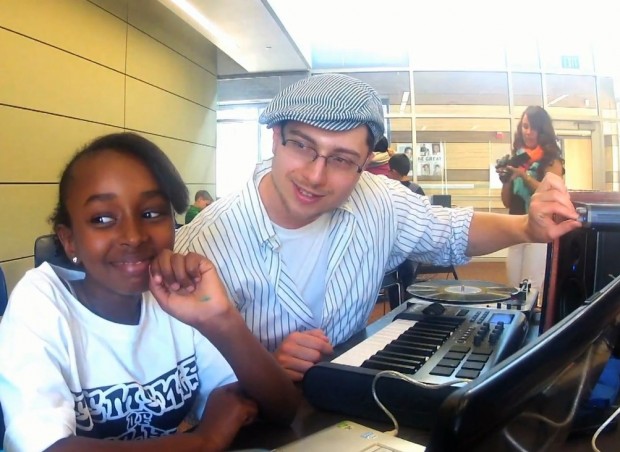
Dr. Elliot Gann and a student work on beat making at a workshop in San Jose. Photo by Carlos De Leon.By Justin Richmond
January 16, 2013

Dr. Elliot Gann is standing in front of his beat-up and stickered black Mazda Protégé in the parking lot of West Oakland Middle School. In his left ear is a Bluetooth earpiece, which, as he eats a Trader Joes sandwich wrap, enables him to lament to a friend the parking ticket he just received. To his side is a worn green Atlantic suitcase that wobbles with a broken wheel. Inside, its contents are packed tight: two sets of studio monitors, two audio interfaces, wires, cables, and cords, and a few MIDI controllers. All of these tools he needs to conduct the workshops he puts on several times a week in Bay Area middle schools.

“Dr. Elliot,” as the children he teaches affectionately call him, is the founder of Today’s Future Sound, a non-profit he started seven months ago to serve under-privileged youth by teaching them music production skills, or beat making. Gann, who received his Ph.D. in psychology from the Wright Institute in 2010, views his service as an alternative to traditional psychology. “It’s an effective way to deliver services that maybe a traditional therapist can’t,” says Gann. What he seeks to accomplish with his non-profit is not simply to improve kids’ music skills, but also to help their own personal development. “It’s teaching kids coping mechanisms. It’s teaching them to regulate themselves,” says Gann. “I think it’s a really healthy way to help kids process trauma.”

To read more.

American Graduate Student Film Festival

Deadline for Entries: March 1st, 2013

What is the American Graduate Student Film Festival?

The American Graduate Student Film Festival (AGFF) is an online video competition for students ages 10 to 19 to engage youth about the high student dropout crisis. AGFF is a program of the National Black Programming Consortium and the American Graduate initiative supported by the Corporation for Public Broadcasting (CPB). You can learn more about the drop out issue atamericangraduate.org.

Are there prizes?

Yes! Members of each winning team can win up cool prizes like an iPad, iPod Touch or $100 gift certificate. Prizes are awarded to individuals and teams consisting of a maximum of five members. The winning team will be flown with a chaperone to Washington, DC to receive their prize.

Who can enter the competition?

Submissions can come from students currently enrolled in middle or high school. Individuals or a group with a maximum of five team members are also eligible to submit a project.

What can I do to win?

You can create your own original short form video, PSA, music video, or animation (including animated graphic novel). The maximum length is five minutes (including 60 seconds max credits).
You will be competing with students from around the country, so be creative and innovative. Give us something we haven’t seen before on the subject.

What must be the themes of videos submitted to the festival?

Any of the following themes will be acceptable when judging for official selections into AGFF 2013.

  • Vulnerable Students: Why are some students more vulnerable to dropping out? What are their stories and how have some overcome these challenges? What are the external forces that keep students from succeeding and how can young people over come them?
  • The Role of Youth in Dropout Prevention: Young people can play an important role in saving themselves and/or helping each other.
  • Not so Old School: How can schools, parents and communities be more effective in helping students facing academic or social challenges succeed in school?

As you can see, we want your videos to challenge us with exciting stories, new ways of addressing the issues, and bring new solutions to bear from a youth perspective.

For more info.

KQED Forum: Teaching Social and Emotional Learning

January 18, 2013

Oakland schools have launched programs to help students manage their emotions, establish positive relationships and resolve conflicts. One of the programs, Roots of Empathy, brings infants and their mothers into school to help students recognize emotions and experience empathy. We discuss the social and emotional learning movement, which aims to teach fundamental life skills in schools, and how it’s being used in Oakland.

Listen here.

OUSD's College and Career Readiness Office


Media Academy from OUSD Fremont High School at KQED

January 14, 2013
By Lisa Hewitt

“What kids need in college, to get into college, and to get through college without remediation is pretty much all the same skills that you need in a career. You need to be able to collaborate, you need to be able to synthesize your own learning, you need to be creative, and show initiative. You need to have 21st century skills. What employers, industry sectors are telling us is, ‘We’re not really concerned about the technical skills that a student comes out of high school with.’ What they really want us to teach kids is how to learn, how to work, how to be persistent, how to show initiative, how to be a good person who is contributing to a company, a community, and a classroom. Those are universal skills.”–Susan Benz

The College and Career Readiness Office of Oakland Unified School District’s Linked Learning model is an innovative approach to education, comprised of four aspects of education, targeted to prepare high school students for college and the world of work. They can explore fields such as healthcare, engineering, as well as arts and media, while each student follows a chosen pathway through their time in high school. The pathways consists of four core components, an academic module, (all students must take the necessary course load to make them eligible to attend a CSU or UC) a technical component or vocational training, worked based learning (internship, externship, or apprenticeship) and as well as social and emotional supports, that can consist of intervention for struggling students through counseling or tutoring.

Gretchen Livesey, the Director of the College and Career Readiness Office and Susan Benz, the Coordinator of Career Readiness, want to reimagine how students experience high school. They realize school can seem boring and pointless to many teenagers, so their goal is to make the high school experience feel relevant. Livesey explains the purpose of the pathway model,

“It’s all right in 8th grade that you don’t know exactly what you want to do. We always say, ‘You’re not deciding the rest of your life today’. People often go through college and have a variety of careers. But hopefully something sparks your interest. Maybe you have a grandparent who is in and out of the hospital with diabetes and you have an interest in figuring out what that’s all about so you choose a health pathway…You’ve always been artistic so you gravitate to the performing arts. What we’re hoping is that when you’re able to express that passion in a series of courses that integrate both [academics and your passion] that you’ll be more successful through high school.”

Through the pathway model, the goal is to make learning more concrete. In order to expose students to life outside the classroom, the College and Career Readiness Office works with outside partners to bring in guest speakers from businesses and organizations, take students on tours of operating businesses in order to help them understand what career opportunities are available. Benz continues, “It’s really going out and finding partners and saying, ‘Will you please take part in the education of Oakland’s children? Will you please step up and get your needs met for an educated, ready to work workforce and help our teachers and help our kids.’ And honestly, Oakland has been more than willing and generous, it’s a good time to be in Oakland because industry, businesses, local businesses [say] ‘yeah, we’ll do it. We’ll do whatever we can’.” From big corporations like AT&T and Clorox, government agencies like Caltrans, to entrepreneurs and small business owners such as filmmakers and designers, the opportunities to meet with professionals in different industries are vast. Benz explains, “If you can get those kids outside of class or if you can get the world to come into a class and make that learning really tangible, that does more or as much as anything else you can do to keep a kid in school, to keep them interested, and to keep them coming back. Oakland has a really hard time doing that,” but with work based learning opportunities increasing, OUSD’s graduation rates rising, and the drop out rate falling, the district has made some significant gains.

If you’re interested in getting involved as a community partner please visit linkedlearningousd.org.

KQED: Oakland Unified Changes Attendance Boundaries of Some Grade Schools

January 10, 2013
By Barbara Grady

A year after expanding the attendance boundaries of several schools to accommodate kids from four schools it closed, the Oakland school board on Wednesday voted to shrink the boundaries of Crocker Highland Elementary School area after huge enrollment in September led the school to scramble to open a fourth kindergarten.

Figuring it would have “chronic oversubscription” at the school based on 2010 U.S. Census data showing the number of toddlers in the neighborhood and realtor reports of new families moving in, district staff recommended making the boundaries a smaller circumference around that  school and widening the attendance area of nearby Cleveland Elementary School. Cleveland is a similarly high performing school with an education program that is much like Crocker Highland’s, district staff said. Crocker Elementary had an Academic Performance Index score of 953 last year and Cleveland a score of 837. Both of those numbers are considered high.

Dozens of parents showed up to the Oakland Unified School District board meeting. Most of them have children who are not yet old enough to attend school, but the spoke of worries about where their kids would go. Many agreed with the plan that eventually was adopted by the board. It can be read on the board’s agenda HERE as the fourth. It takes a triangular area that stretches from Lakeshore Avenue to Grand Avenue up to Rosal/Fairbanks avenues and puts that in the Cleveland Elementary School attendance area. Most of the triangle used to be part of the Lakeview Elementary School attendance neighborhood before Lakeview was closed last summer.

The OUSD has struggled with adjusting to ever changing enrollment. With its total enrollment rapidly declining, it voted in 2012 – amid much protest – to close five elementary school buildings over the summer and reassign the students. The parents and teachers of one school transformed their school to a charter school rather than accept the closure. Now some schools in the district are over subscribed, typically the highest performing ones.

Wednesday’s board meeting was the first for newly-elected members Roseann Torres and James Harris. Both were quiet and voted in tandem with other board members in approving this plan, as well as other items.

To read more.

Bay Area Video Coalition (BAVC)

January 7, 2013
By Lisa Hewitt

The Bay Area Video Coalition (BAVC) has a long history in Oakland, San Francisco and surrounding areas, beginning 36 years ago as a small media arts nonprofit, the organization was founded by community organizers and artists. They aimed to tell social justice stories and support independent filmmaking.  Over the last four decades, BAVC has grown as technology developed; originally focusing largely on the PortaPak video camera, BAVC now works with a multitude of technologies, from filmmaking to music recording tools.

BAVC’s original mission still remains, to facilitate storytelling. They do this through alternative technical education in order to contribute to social change and justice. It is a complex and highly inclusive organization with a common purpose through all the departments, whether it’s preservation, adult education or the youth programs. Ian Davis, a Digital Pathways instructor for BUMP Records explains,

“Though there are a few different departments throughout the organization, the linking thread throughout is to bring the community in and help people who otherwise might not have, or mostly likely, would not have the opportunity to tell their stories…It gives them an opportunity to keep these stories alive…A tree falls, no one hears it, it doesn’t make a sound? I think [BAVC] helps the trees make sound.”

Much of the work BAVC does centers around youth educational training, their Next Gen Youth program offers instruction in audio engineering, video production and filmmaking for students 14-24 years old. BAVC seeks to level the playing field for youth who may not have the resources or opportunities to acquire emerging technical skills elsewhere. Chris Runde, the Manager of BUMP Records explains,

“I think that in current economy especially, we’ve seen a real emergence of where jobs actually exist. There is really a need for really specific skill sets in the technology sector. And the ability to jump in and navigate this world and provide services that are valuable to corporations, companies, [and the] government…People who don’t have those skills or the access to the training are really being left behind. Access to that kind of training tends to favor people from privilege backgrounds, so I think the work that we do here, we’re really trying to bridge that gap and provide some of those same opportunities for folks who in other cases wouldn’t have that access to it.”

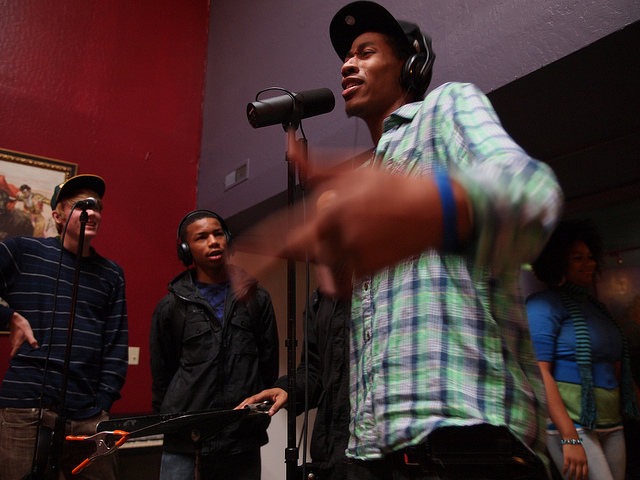
BAVC aims to help students become well rounded artists, producers, or filmmakers possessing skills that enable them to find work in the tech industry. If the student is a singer or rapper they learn to record music, or if they’re a filmmaker they learn design. The work that students produce comes from their perspective; the work is compelling because it’s relevant to their lives and their communities. As part of KQED’s American Graduate initiative, the station partnered with BAVC’s Bump Records (the advanced recording program) and The Factory (the advanced video program) to produce an album entitled An American Graduate and a series of short films which examine the current dropout crisis in Oakland. Runde and Davis assert it challenged the students to work outside their comfort zones and address an issue that is very pertinent to their lives. An American Graduate album and the short films Stay the Course, Checkmate, and There is No Crisis in American Education address issues such as education, incarceration, student alienation, and one song on the album explores the teachers’ perspectives.

Ingrid Dahl, the Director of Next Gen Programs explains how BAVC’s youth programs can serve as alternative to the traditional high school experience, “I also think that Chris and Ian and all the staff of BAVC are more situated as mentors to students, [they] are much closer to a colleague or peer. It’s very different from the power structure unfortunately of… traditional education. I think all of us are sensitive to the fact that high school can be very hard. A lot of us didn’t like high school. I didn’t like high school at all. And there are reasons for that. We’ve spent most of our early adult lives having to break that down, dismantle it and try to understand it and the intersection of sexism, racism, classism, discrimination homophobia, hatred and why people need to categorize themselves so much and so deeply…We’re…creating an alternative way of being, way of seeing and that too is why students come back. They understand this is a place that they can be understood better. And maybe it’s a break from the pressure and the exhaustion that surviving in high school requires.”

To learn more please visit: http://www.bavc.org/

“This series of short videos profiles four parents whose students have pursued a STEM (Science Technology Engineering Math) field career through the Bay Area Video Coalition’s NextGen programs.”: http://bavcfactory.tumblr.com/post/30338539979/parents-talk-stem-directed-by-jacob-hirsohn-owen

KQED / FACTORY American Graduate films: http://bavcfactory.tumblr.com/

BUMP/American Graduate compilation: http://bumprecords.bandcamp.com/album/bump-records-and-kqed-present-an-american-graduate