Tag Archives: Students

Oakland Tribune: East Oakland program helps youth become `agents of change’

April 19, 213
By Katherine Brown
In looking at the negative perception many people have of East Oakland, one would think that there was no opportunity for success, especially among youth. With limited resources and outlets to support youth in their professional and academic development, the future seems to be very bleak for young people.

However, organizations like the Alameda County Health Pipeline Partnership (ACHPP) work to counter this perception, by creating healthy pathways for East Oakland youth to be agents of change in their city.

The program recruits middle school to college-aged youth that have an interest in health care careers.

“Sometimes they may not know or understand these careers, ” says ACHPP Workforce Development Coordinator Sequoia Hall, “but ACHPP’s initiative is to expose youth to the field.”

Career opportunities range from Emergency Medical Technicians to careers in the biotech industry. The partnering organizations that offer this exposure include Bay Area Youth EMT Program, UC Berkeley’s Biology Scholars Program, Biotech Partners, and CHAMPS — Children’s Hospital Oakland.

Launched in 2007, ACHPP developed as a coalition with health-related organizations that serve young people. Each of those groups had the similar mission of increasing diversity in the health care workforce.

The ACHPP coalition decided to design a program that created a pathway for youth to gain careers in the health care field.

Dr. Jocelyn Freeman-Garrick — Alameda County Medical Center’s Emergency Medical Services Base Director helped push forward the effort, and has received funding from East Oakland Building Health Communities (EOBHC).

ACHPP Program Manager Jacqueline León explains, “there is a huge need to have a coalition to address health disparities that are unique to Oakland. We feel that they can be combated with diversity in the workforce.”

Health concerns that plague East Oakland communities include alcohol abuse, substance abuse, mental health challenges, domestic violence, and obesity. “We are a very rich community,” says León, “but the health statistics don’t support that.”

The ACHPP is looking to address those disparities by recruiting young people from those neighborhoods and training them to be health care professionals.

While offering paid internships, ACHPP recognizes the importance of making sure that youth are academically and professionally prepared as they continue on their career paths. For example, partnering organization EMS Corps offers EMT courses, and in addition to a stipend, they provide professional development and life coaching — where youth are supported in navigating their internal and external environments.

As of 2012, ACHPP has served over 1,000 youth, and they continue to work hard to create more paid internships, especially for youth of East Oakland.

One youth that has benefited from ACHPP is Ivan Arreola. The 16 year-old East Oakland native has always had aspirations of becoming a physician, and the program, “solidified my desire to become and doctor. It’s also broadened my eyes of careers in health, and how they each provide support and care for patients.”

ACHPP has, “provided me with a path I should follow and how to get to the next steps to reach my dream,” he adds.

The Alameda Science and Technology Institute student also takes classes at Alameda Community College, and will have completed eight college level science courses by the time he graduates from high school.

Soon to be a first-generation college student, Arreola joined ACHPP in the 8th grade Model Neighborhood Program.

In the summer of 2012, he participated in ACHPP’s Mentoring in Medicine and Science. The monthlong internship provided him the opportunity to shadow staff in Oakland’s Highland Hospital and the University of California at San Francisco.

Through his work as a physician, Arreola hopes to give back to East Oakland. “It’s important to give back to the community,” he said. “All you see about Oakland is violence, but it’s also a place that brings people together in a positive way.”

With East Oakland youth that are passionate about creating better health outcomes for the community, the perception of the city will be much brighter.

Read article.

The 2012 YES Conference

New Image2January 31, 2013
By Lisa Hewitt

The Gay-Straight Alliance Network (GSA Network) is a national organization which links school-based Gay-Straight Alliances across the country with each other, to community partners, as well as aids in leadership development and activist training. Jill Marcellus, the Communications Manager at GSA Network based in San Francisco, explains how deeply involved youth are in their organization, “GSA Network is a youth-driven organization, and we operate on a model of youth-adult partnership. This carries all the way to the top of the organization: young people comprise about half of GSA Network’s Board of Directors. There are a number of opportunities for youth to become leaders within the organization, from becoming a youth trainer and leading the peer-to-peer workshops that are at the heart of our work to joining a regional Youth Council and helping shape our program work for the year. We train young people not only to change their schools, but to become leaders in LGBT and other social justice movements.”

One component of the work the GSA Network does is the Youth Empowerment Summit (YES) held annually. December 5, 2012 marked the 8th YES summit and drew over 700 allied youth and adults to Mission High School in San Francisco. Those who attended heard four keynote speakers, attended over 40 workshops, met with community partners in a resource fair, participated in discussion groups and students could take part in a youth only drag show and dance.New Image1

As part of the conference, three panelists, Emery Cohen, Espii Gutierrez, Raymond Ferronato, T. Murray, and moderator Isaias Guzman discussed this year’s theme: the school-to-prison pipeline and how it affects their community and themselves. As one GSA member, Sabina Jacobs, a senior at Sequoia High School in Redwood City, explains, “the…pipeline is polices and practices that school districts use to unintentionally push out LGBT, people of color, people with disabilities, or low income youth.” Sabina believes this year was a huge success and in the years to come would like to see the workshops’ topics expand. Sabina explains, “[I’d like to see] more comprehensive workshops on gender identity in general,” and beyond the YES conference, Sabina expresses the need for a system to be put in place to educate young people about the gay, lesbian, bisexual, and transgender community and demystify the continuing stigma. “We need to educate people and make school a safe place for learning. While it is a safe place for some, it’s not for all. Especially if you’re going to school and worried about getting beat up in the locker room for how you’re dressing or who you’re dating. We need to make school an actual safe place and help people out who need the help.”New Image

If you’d like to get involved with the GSA Network please visit:
gsanetwork.org
facebook.com/gsanetwork
twitter.com/gsanetwork
To learn more about the YES Conference:
http://www.gsanetwork.org/news/blog/2012-yes/12/19/12

American Graduate Student Film Festival

Deadline for Entries: March 1st, 2013

What is the American Graduate Student Film Festival?

The American Graduate Student Film Festival (AGFF) is an online video competition for students ages 10 to 19 to engage youth about the high student dropout crisis. AGFF is a program of the National Black Programming Consortium and the American Graduate initiative supported by the Corporation for Public Broadcasting (CPB). You can learn more about the drop out issue atamericangraduate.org.

Are there prizes?

Yes! Members of each winning team can win up cool prizes like an iPad, iPod Touch or $100 gift certificate. Prizes are awarded to individuals and teams consisting of a maximum of five members. The winning team will be flown with a chaperone to Washington, DC to receive their prize.

Who can enter the competition?

Submissions can come from students currently enrolled in middle or high school. Individuals or a group with a maximum of five team members are also eligible to submit a project.

What can I do to win?

You can create your own original short form video, PSA, music video, or animation (including animated graphic novel). The maximum length is five minutes (including 60 seconds max credits).
You will be competing with students from around the country, so be creative and innovative. Give us something we haven’t seen before on the subject.

What must be the themes of videos submitted to the festival?

Any of the following themes will be acceptable when judging for official selections into AGFF 2013.

  • Vulnerable Students: Why are some students more vulnerable to dropping out? What are their stories and how have some overcome these challenges? What are the external forces that keep students from succeeding and how can young people over come them?
  • The Role of Youth in Dropout Prevention: Young people can play an important role in saving themselves and/or helping each other.
  • Not so Old School: How can schools, parents and communities be more effective in helping students facing academic or social challenges succeed in school?

As you can see, we want your videos to challenge us with exciting stories, new ways of addressing the issues, and bring new solutions to bear from a youth perspective.

For more info.

KQED: Education Nonprofit to Help Expand Math, Science Program in Oakland Middle Schools

December 21, 2012
By Barbara Grady

Oakland Unified School District this week became a beneficiary of a major federal grant that will bring science, technology, engineering and math – STEM – educational experiences to as many as two thousand OUSD students.

It is one of many efforts underway to close a “digital divide” in Oakland in which low-income students have less access to the Internet and connected computers.

The U.S. Department of Education this week awarded a $3 million “Investing in Innovation” grant to Citizens Schools, a non-profit that plans to use it in 23 school districts across the country including Oakland Unified. Citizen Schools winning proposal, Closing Inspiration and Achievement Gaps in STEM with Volunteer-Led Apprenticeships, will set up and expand after-school programs in Oakland to be apprenticeships with tech professionals who would involve them in hands-on engineering and computer science projects.  Citizen Schools will be recruiting tech volunteers in Oakland.

“These hands-on STEM apprenticeships not only help students build skills but also spark their interest in STEM subjects,” said Stacey Gilbert Lee of Citizen Schools when asked about the program that has not yet been formally announced. In Oakland, Citizen Schools will expand a program it already started in three middle schools.

Much is being done in Oakland to try to close the digital divide, with a host of non-profit organizations collaborating with the school district to bring computers into classrooms and train students in digital tools. Yet other organizations work over the summer through summer camps and programs at recreation centers.

This happens as the stakes for being left behind in digital literacy and Internet access become increasingly high in a world that revolves around the Internet.

“As more information becomes electronic, the inability to get online can leave entire communities at an extremely dangerous disadvantage,” notes Kimberly Bryant, founder of Black Girls Who Code, which ran a summer camp in Oakland last June.

Yet, according to estimates of Oakland Mayor Jean Quan’s administration and the Pew Research Center, about 50 percent of OUSD children whose families earn less than $30,000 a year do not have Internet access at home. That income is the benchmark for qualifying for the federal free and reduced lunch program and 69 percent of OUSD students qualify.

In a loose survey of West Oakland residents done this year by Oakland Technology Exchange West (OTX), another non-profit working hard to close the digital divide, only 22 percent had both Internet access and a currently working computer. Some had Internet access but not a currently working computer. Others had no computer at home. OTX as the non-profit is called, gives away free computers to OUSD high school and middle school students who take its one afternoon course.

OTX is yet another of the plethora of organizations trying to bridge the divide.

At OTX’s vast West Oakland warehouse, retired IBM executive and OTX founder Bruce Buckelew, along with his small staff of local hires, arrange for thousands of refurbished computers to be delivered to public schools across Oakland.  Collecting computers from corporations when they replace their stock and then refurbishing them to new condition, OTX through the years has provided 35,000 computers to Oakland school children and low-income adults. It has delivered 18,000 computers to OUSD schools alone, charging the school district about $240 per computer. Then it has handed out another 17,000 to Oakland kids who come with a parent to take a one-afternoon computer course in computer basics at OTX’s plant. OTX has also supplied free computers to adults who volunteer time refurbishing donated computers.

See more and for ways to get involved.

The Education Report: Oakland’s new youth theater company opens its season Dec. 6

Gritty City Rep rehearsal

November 28, 2012
By Katy Murphy

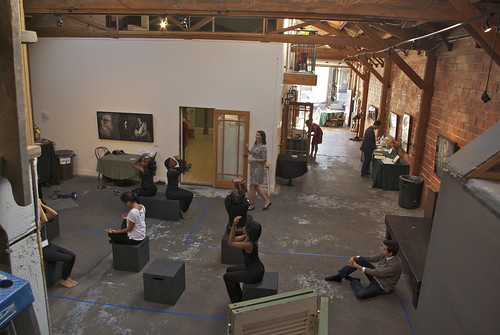
Gritty City Rep opened in January, and its executive artistic director, Lindsay Krumbein, says it’s the first stand-alone youth theater company in Oakland.

The group rehearses six hours a week in downtown Oakland. Its first show of the season opens at the Berkeley City Club Theatre on Dec. 6 and runs for two weeks. The actors will be performing “Anon(ymous)” by Naomi Iizuka, which Krumbein describes as “very physical, minimalist, dealing with issues of war and immigration, exploitation of refugees – relevant stuff. Not your typical `high school theatre’ by any stretch of the imagination.”

To read more.

Oakland North: Oakland Raiders, students sort food at Alameda County food banks

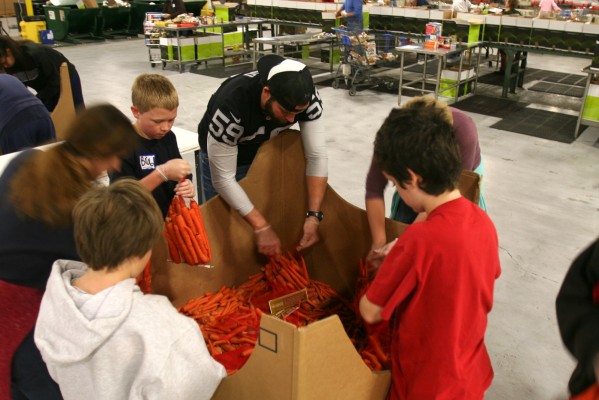
Long snapper Jon Condo sorts carrots.

November 21, 2012
By Sam Rolens

When Brad Lubeck, 11, and his mother Stacey showed up at the Alameda County Community Food Bank for an afternoon of volunteering with his Boy Scout troop, he didn’t expect much in the way of thrills. Food bank staff showed Brad and the others what to do with the broccoli and carrots they’d be unloading, and said it would be the Scouts’ job to teach the process to another group of volunteers arriving shortly.

Then the surprise was sprung. Six giants in black and silver strolled up to the boys and asked for instructions. The Oakland Raiders had arrived.

Brad, who is something of a football fan, would be beaming for the rest of the day as he packed up carrots. “We have a cat named Raider,” said his mother. “He got to name it.”

On the Tuesday before Thanksgiving, Oakland Raiders quarterback Terrelle Pryor, long snapper Jon Condo, wide receiver Derek Hagan, linebacker Aaron Curry, defensive end Matt Shaugnessy and running back Taiwan Jones sorted donated food alongside local high school students, Girl Scouts, and Boy Scouts at the Food Bank’s warehouse across the highway from the Coliseum.

“I wear the black and silver on TV every Sunday,” said Condo. “Kids look up to us. Adults look up to us. This shows people watching that we’re in this together for the cause of our community.” Condo said that every Tuesday, which is the only day off from workouts for the Raiders, members of the team are volunteering somewhere in the city. Condo, originally from Pennsylvania, said the community spirit he’s seen in Oakland has impressed him. “They’re very dedicated people,” he said. “It’s a close-knit community committed to helping each other.”

The Oakland Raiders are also hosting a virtual food drive over the holiday season in partnership with the Food Bank that collects money for food and supplies.

The cavernous warehouse is kept cold inside. Volunteering kids wore warm beanies and coats on Tuesday, while the Raiders wore their jerseys without pads or helmets. Conversation was lively, as kids clustered around one or two towering players at each of the cardboard boxes holding donated vegetables.

Big hands and small hands worked quickly through the veggies, while conversation covered primarily school and football. “They’re tough,” said Condo, who was paired with Brad’s Scout troop. “They’re hard little workers—packing carrots just as fast as I was.”

Food Bank communications manager Mike Altfest said the facility needs all the help it can get from volunteers in the weeks leading up to the holiday season. “The operation is ticking this time of year the way we’d want it to be ticking all year,” said Altfest. The Food Bank provides food for 49,000 people (enough food for roughly 300,000 meals) each week through its 275 partner food pantries, soup kitchens and other facilities.

But the amount of donations peaks at this time of year, said Altfest, and so does the Food Bank’s need for volunteers. People tend to sign up for shifts during the holiday season, he said, but interest starts flagging by January. He encourages anyone who wants to volunteer to sign up for shifts after the holidays by using the Food Bank’s volunteer webpage.

“The Raiders have been helping us out a lot this year,” said Altfest. “It’s a great morale booster, and it helps bring awareness to hunger in Oakland.”

Not far from the Food Bank’s warehouse, at the Columbian Gardens Food Pantry, pro-bowl defensive tackle Richard Seymour was handing out frozen chickens, canned corn and collard greens, and boxed stuffing mix with the help of his family. Altfest said Seymour had specifically asked to pass out food, and that the appearance was “just something Richard wanted to do.” Seymour was helped by his wife Tanya, his kids Richard, Kayla, Kennedy and London, and other friends and family.

To read more.

YouTube Offers All Schools Education-Only Link, Beefs Up K-12 Content

MindShift Blog
December 12, 2011
Written By

All schools can now use the YouTube educational video site, youtube.com/education, without having to jump over Internet filtering hurdles.
For schools that choose to opt in to the YouTube for Schools Program, YouTube will redirect Web users who go to the site straight over to youtube.com/education. On this portion of the site, all comments are disabled and the only related videos are those that can be found in the Education portal of the site. The option has been created for parents, teachers, and administrators who fear children will be exposed to inappropriate materials on the site.
Continue reading the article on YouTube/education on the MindShift blog.