Tag Archives: Education

Oakland Local: A Better Chance Celebrates 50 Years of Increasing High-Quality Education for Youth of Color

Image_0May 2, 2013
By Corey Olds

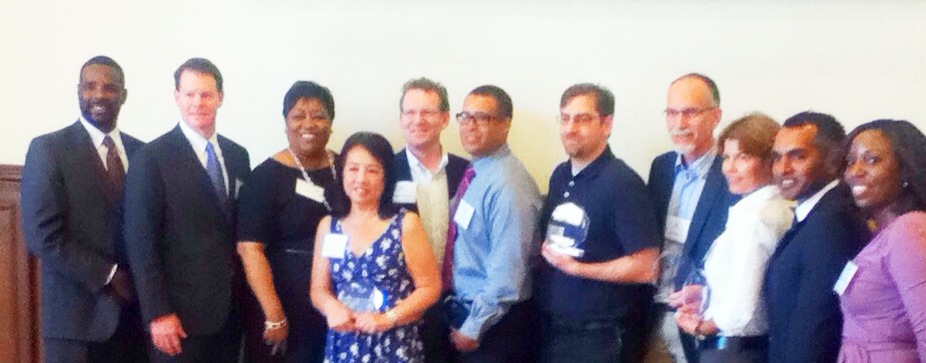
Approximately 75 directors of admission and diversity from Bay Area independent schools gathered for breakfast at the UC-Berkeley, Clark Kerr Campus Wednesday to celebrate the 50th anniversary of A Better Chance (ABC), a national organization headquartered in New York City, that annually places 500 or so academically-promising students of color in grades 6-12 in more than 300 ABC Member Schools throughout 27 states.

In 1963, A Better Chance partnered with 16 prestigious independent schools (14 of them in New England) to provide talented, but economically-disadvantaged students access to the best education available.

Over the decades, ABC and its Member Schools such as Milton Academy, the Ethical Culture Fieldston School, and Phillips Academy have produced nationally-renowned figures like Massachusetts Governor Deval Patrick, NAACP Legal and Educational Defense Fund president Debo P. Adegbile, founder and president of the Fellowship of Latino Pastors of New England Dr. Roberto Miranda, and creator of the Violence Prevention Program and trauma surgeon at the University of Maryland Medical Center Dr. Carnell Cooper. Including these distinguished men, ABC boasts 13,800 alumni nationwide.

Yesterday’s “50th Anniversary Member School Breakfast” marked the second of four such celebrations planned for this year. Earlier this spring, a celebration breakfast was held in Washington, D.C., and there will be one in Atlanta, prior to the June 11, 2013, “50th Anniversary A Better Chance Awards” in New York City.

Besides honoring the 16 original member schools, Roger W. Ferguson Jr., Chief Executive Officer of TIAA-CREF, will receive the Chairman’s Award and ABC alumnus Theo Killion, Chief Executive Officer of Zale Corporation, will accept the DreamBuilder Award.

A local educational leader, Kareem J. Weaver, who serves as executive director for the San Francisco office of New Leaders, a nonprofit that develops transformational school leaders and designs leadership policies for school systems nationwide, delivered the keynote address.

Oakland Local: East Bay College Fund matches mentors with students for community success

dsc_4582April 10, 2013
By Jon Leckie

By the end of his junior year, Jameil Butler was a promising high school student. He was sociable, popular and a rising star on championship teams in basketball and football. Butler knew he had talent, and he knew that talent could help him take the next step from Oakland Technical High School to the halls of higher education. But after a trip to Sacramento in 2004, Butler would find the life he had imagined for himself out of reach.

“I was having some issues at home, and wanted to get out of town. So I went to visit my brother at Sacramento State,” Butler said. “We were waiting outside a club meeting people and talking to girls. A week before some people from Oakland had killed someone from Sacramento, so these guys weren’t too happy when they found out where I was from.”

Butler says he tried to walk away, but was followed through the parking lot and down the street. “I tried to ignore it,” he said, “but after two blocks I got tired of it and turned around. He pulled a gun and shot me twice in the stomach.”

After two weeks in the hospital, and the loss of one of his kidneys, Butler would return home. But doctors told him the risk of blood clots made it too dangerous to continue to play football; ending any shot he had at an athletic scholarship.

Leaning on the support and encouragement of his mother, Butler was still determined to get a college education. That was when he ran across the East Bay College Fund.

“The East Bay College Fund was started in 2003 by a group of citizens who really wanted to support change in Oakland,” Diane Dodge, the fund’s executive director, said. “We started serving seniors in high school by supporting them through college with the goal of having them graduate and give back to the community.”

In addition to rewarding scholarships to students and helping them find and use resources to get through college, such as the Free Application for Federal Student Aid and navigating them through the college application process, the East Bay College Fund also supports students with one-on-one mentoring for the entirety of their college career.

“I hit some roadblocks personally and academically, but my mentor had my back and made sure I made progress as a student and as a man,” Butler said. “They invested time and energy in me, and that really meant a lot.”

This year, The East Bay College Fund will add 40 scholars to the 150 students they are currently helping through college.

“That means we’re giving out a $16,000 scholarship to each scholar, or $4000 per year over four years. And we’re matching them with a mentor who will be their support and their guide through their entire college journey,” Dodge said. “We have 30 mentors, but need 10 more. We’re looking for community members who have graduated from college and are looking to give back by guiding scholars and supporting them through all the things they will go through in college.”

Mentors at The East Bay College Fund commit to attending two retreats a year with their scholars, and involving themselves in the life of the scholar through regular conversations.

“It’s an art, not a science,” Dodge said. “Mentoring is a privilege. Towards the end people talk about the student like they are their own children, but there are also a lot of challenges with class and race and self-doubt. We let our students know ‘yes, you can’ and we believe in you, and the mentor is the person that reminds them of that.”

Read more.

KQED Forum: Teaching Social and Emotional Learning

January 18, 2013

Oakland schools have launched programs to help students manage their emotions, establish positive relationships and resolve conflicts. One of the programs, Roots of Empathy, brings infants and their mothers into school to help students recognize emotions and experience empathy. We discuss the social and emotional learning movement, which aims to teach fundamental life skills in schools, and how it’s being used in Oakland.

Listen here.

Bay Area Video Coalition (BAVC)

January 7, 2013
By Lisa Hewitt

The Bay Area Video Coalition (BAVC) has a long history in Oakland, San Francisco and surrounding areas, beginning 36 years ago as a small media arts nonprofit, the organization was founded by community organizers and artists. They aimed to tell social justice stories and support independent filmmaking.  Over the last four decades, BAVC has grown as technology developed; originally focusing largely on the PortaPak video camera, BAVC now works with a multitude of technologies, from filmmaking to music recording tools.

BAVC’s original mission still remains, to facilitate storytelling. They do this through alternative technical education in order to contribute to social change and justice. It is a complex and highly inclusive organization with a common purpose through all the departments, whether it’s preservation, adult education or the youth programs. Ian Davis, a Digital Pathways instructor for BUMP Records explains,

“Though there are a few different departments throughout the organization, the linking thread throughout is to bring the community in and help people who otherwise might not have, or mostly likely, would not have the opportunity to tell their stories…It gives them an opportunity to keep these stories alive…A tree falls, no one hears it, it doesn’t make a sound? I think [BAVC] helps the trees make sound.”

Much of the work BAVC does centers around youth educational training, their Next Gen Youth program offers instruction in audio engineering, video production and filmmaking for students 14-24 years old. BAVC seeks to level the playing field for youth who may not have the resources or opportunities to acquire emerging technical skills elsewhere. Chris Runde, the Manager of BUMP Records explains,

“I think that in current economy especially, we’ve seen a real emergence of where jobs actually exist. There is really a need for really specific skill sets in the technology sector. And the ability to jump in and navigate this world and provide services that are valuable to corporations, companies, [and the] government…People who don’t have those skills or the access to the training are really being left behind. Access to that kind of training tends to favor people from privilege backgrounds, so I think the work that we do here, we’re really trying to bridge that gap and provide some of those same opportunities for folks who in other cases wouldn’t have that access to it.”

BAVC aims to help students become well rounded artists, producers, or filmmakers possessing skills that enable them to find work in the tech industry. If the student is a singer or rapper they learn to record music, or if they’re a filmmaker they learn design. The work that students produce comes from their perspective; the work is compelling because it’s relevant to their lives and their communities. As part of KQED’s American Graduate initiative, the station partnered with BAVC’s Bump Records (the advanced recording program) and The Factory (the advanced video program) to produce an album entitled An American Graduate and a series of short films which examine the current dropout crisis in Oakland. Runde and Davis assert it challenged the students to work outside their comfort zones and address an issue that is very pertinent to their lives. An American Graduate album and the short films Stay the Course, Checkmate, and There is No Crisis in American Education address issues such as education, incarceration, student alienation, and one song on the album explores the teachers’ perspectives.

Ingrid Dahl, the Director of Next Gen Programs explains how BAVC’s youth programs can serve as alternative to the traditional high school experience, “I also think that Chris and Ian and all the staff of BAVC are more situated as mentors to students, [they] are much closer to a colleague or peer. It’s very different from the power structure unfortunately of… traditional education. I think all of us are sensitive to the fact that high school can be very hard. A lot of us didn’t like high school. I didn’t like high school at all. And there are reasons for that. We’ve spent most of our early adult lives having to break that down, dismantle it and try to understand it and the intersection of sexism, racism, classism, discrimination homophobia, hatred and why people need to categorize themselves so much and so deeply…We’re…creating an alternative way of being, way of seeing and that too is why students come back. They understand this is a place that they can be understood better. And maybe it’s a break from the pressure and the exhaustion that surviving in high school requires.”

To learn more please visit: http://www.bavc.org/

“This series of short videos profiles four parents whose students have pursued a STEM (Science Technology Engineering Math) field career through the Bay Area Video Coalition’s NextGen programs.”: http://bavcfactory.tumblr.com/post/30338539979/parents-talk-stem-directed-by-jacob-hirsohn-owen

KQED / FACTORY American Graduate films: http://bavcfactory.tumblr.com/

BUMP/American Graduate compilation: http://bumprecords.bandcamp.com/album/bump-records-and-kqed-present-an-american-graduate

 

KQED: Education Nonprofit to Help Expand Math, Science Program in Oakland Middle Schools

December 21, 2012
By Barbara Grady

Oakland Unified School District this week became a beneficiary of a major federal grant that will bring science, technology, engineering and math – STEM – educational experiences to as many as two thousand OUSD students.

It is one of many efforts underway to close a “digital divide” in Oakland in which low-income students have less access to the Internet and connected computers.

The U.S. Department of Education this week awarded a $3 million “Investing in Innovation” grant to Citizens Schools, a non-profit that plans to use it in 23 school districts across the country including Oakland Unified. Citizen Schools winning proposal, Closing Inspiration and Achievement Gaps in STEM with Volunteer-Led Apprenticeships, will set up and expand after-school programs in Oakland to be apprenticeships with tech professionals who would involve them in hands-on engineering and computer science projects.  Citizen Schools will be recruiting tech volunteers in Oakland.

“These hands-on STEM apprenticeships not only help students build skills but also spark their interest in STEM subjects,” said Stacey Gilbert Lee of Citizen Schools when asked about the program that has not yet been formally announced. In Oakland, Citizen Schools will expand a program it already started in three middle schools.

Much is being done in Oakland to try to close the digital divide, with a host of non-profit organizations collaborating with the school district to bring computers into classrooms and train students in digital tools. Yet other organizations work over the summer through summer camps and programs at recreation centers.

This happens as the stakes for being left behind in digital literacy and Internet access become increasingly high in a world that revolves around the Internet.

“As more information becomes electronic, the inability to get online can leave entire communities at an extremely dangerous disadvantage,” notes Kimberly Bryant, founder of Black Girls Who Code, which ran a summer camp in Oakland last June.

Yet, according to estimates of Oakland Mayor Jean Quan’s administration and the Pew Research Center, about 50 percent of OUSD children whose families earn less than $30,000 a year do not have Internet access at home. That income is the benchmark for qualifying for the federal free and reduced lunch program and 69 percent of OUSD students qualify.

In a loose survey of West Oakland residents done this year by Oakland Technology Exchange West (OTX), another non-profit working hard to close the digital divide, only 22 percent had both Internet access and a currently working computer. Some had Internet access but not a currently working computer. Others had no computer at home. OTX as the non-profit is called, gives away free computers to OUSD high school and middle school students who take its one afternoon course.

OTX is yet another of the plethora of organizations trying to bridge the divide.

At OTX’s vast West Oakland warehouse, retired IBM executive and OTX founder Bruce Buckelew, along with his small staff of local hires, arrange for thousands of refurbished computers to be delivered to public schools across Oakland.  Collecting computers from corporations when they replace their stock and then refurbishing them to new condition, OTX through the years has provided 35,000 computers to Oakland school children and low-income adults. It has delivered 18,000 computers to OUSD schools alone, charging the school district about $240 per computer. Then it has handed out another 17,000 to Oakland kids who come with a parent to take a one-afternoon computer course in computer basics at OTX’s plant. OTX has also supplied free computers to adults who volunteer time refurbishing donated computers.

See more and for ways to get involved.

KQED: Oakland Schools' New Effort to Fight Soaring Suspension Rates


December 26, 2012
By Ana Tintocalis

Oakland’s public schools are heading into the New Year with an ambitious plan to curb a skyrocketing student suspension rate.

The vast majority of Oakland’s suspended kids are African-American, even though they make up just a third of the school population.

Federal civil rights officials investigated the suspension rate. And that led the school district to adopt a plan requiring all teachers to use so-called “Restorative Justice” practices in the classroom.

That approach keeps kids in school, encouraging them to examine their attitudes and the impact of their behavior.

But faculty members like Benjie Achtenburg, who teaches eighth grade at Melrose Leadership Academy, says the district is not providing enough resources and training.

“Being a public school teacher in Oakland,” Achtenburg says, “you are already overwhelmed by everything you have to do, no matter how many years you’ve taught in this district.”

Superintendent Tony Smith says teacher buy-in is one of the district’s big hurdles.

OUSD has five years to reverse the troubling discipline trend or face sanctions.

View article.

Mercury News: Election 2012: Oakland schools get out the youth vote

November 1, 2012
By Katy Murphy

This week, a group of boisterous teenagers marched down to a ballot box a few blocks from their school. The first-time voter contingent and their sign-holding supporters whooped and chanted all the way to the Alameda County Courthouse, eliciting friendly toots from passing cars.

“I feel like I’m always complaining about what’s wrong with the world,” said Di’Jahnay Stewart, a Dewey Academy student who turned 18 on May 23 and registered to vote shortly thereafter. “I feel like if I vote, at least it’ll mean something.”

Many young Americans aren’t as quick to exercise their new electoral power. Although they voted in larger numbers in 2004 and 2008 than they had in decades, their turnout was still the lowest of any age group. For all the buzz surrounding the 2008 presidential race, for all the YouTube videos and the plugs on MTV, just 41 percent of 18- to 20-year-olds and 47 percent of 21- to 24-year-olds reported voting in that election. By contrast, 58 percent of all age groups and 68 percent of those 65 and older went to the polls that year, according to a survey of noninstitutionalized adults by the U.S. Census Bureau.

“I’m finding a shocking number of young people who just won’t vote,” said Deanita Lewis, a parent leader who has long been involved in Oakland’s public schools. The reasons she most often hears? “‘My vote doesn’t count. It doesn’t matter. Nothing’s going to change.'”

To read more.

The Education Report: Weinberg: Rules requiring struggling schools to replace half their teachers are misguided

October 29, 2012
By Steven Weinberg

One of the most divisive elements of the “turnaround model” being used to improve test score results in many low scoring schools throughout the country, is the requirement that half the teaching staff be replaced.

State and federal projects that funnel increased funding to those schools often require such staff changes, arguing that they are necessary for school improvement, while teacher unions and parents oppose them because of the disruption they create.

Now a study, reported in Education Week, says that provision doesn’t seem to make any difference at all.

The requirement that half the teaching staff of a school be replaced assumed that less effective teachers would be removed and more effective teachers would stay. It does not work that way, according to Michael Hansen of the American Institutes for Research, which has conducted the most complete research on such programs to date. The study looked at 111 chronically low-performing elementary and middle schools in Florida and North Carolina between 2002 and 2008.

According to the Education Week article, Hansen found that “teachers who left schools during improvement were not always the worst performers; in fact, they ran the gamut of effectiveness.”

To read more.

I-SEEED Guest Youth Blogger: Prevailing by Pelesani Sua

October 6, 2012
By Pelesani Sua, youth representative of the Institute for Sustainable Economic, Educational and Environmental Design (I-SEEED)

It only took one person to stop me from believing that I could go to college.

When your teacher passes you up for a school funded college tour because she says she knows you’re not going to make it to college, let alone graduate high school it falls right into the category of oppression. Although this would be a great learning opportunity you won’t even have the chance to experience it because your teacher has already decided your future. Or when your teacher doesn’t believe that you could’ve gotten everything correct on a test and accuses you of cheating, because of your race.   I’ve been in situations like this one many times.

I now know that some people don’t believe in encouraging others that don’t belong in the same racial background as them. So from that day on I told myself that I wasn’t going to diminish someone else’s education just because I wasn’t good enough myself. I would just pick myself up and keep trying to prove that I could be the best. It didn’t matter to me whether or not that teacher believed in me because the years afterwards I met better teachers who believed in and encouraged me to become the intelligent young lady I am today.  In a way I would like to thank that one teacher, because the racism and institutionalized oppression she showed to me in middle school actually gave a me an extra push to do better as I got older.  But not every student responds the way that I did, and they shouldn’t have to.

It’s a dream of mine to see a world of equality not only in education but in government and the communities around me. People need to not just know how to unite with their own, but with all people. I would love to wake up to a world where people know their neighbors, school officials, and people in office. When a person knows when the next election is, not the next football game. Where people don’t settle for satisfactory, but they push the limit.  When people get together not only to support themselves, but also the elderly and disabled. It would be wonderful to be able to walk around my neighborhood and know I’m safe and think “which park will I go to?” and not “which fast food restaurant is the closest?”. These are the issues close to my heart and I hope I will be one of the many people to unite to fight against these detrimental issues at hand.

I would like to end by saying that it starts here with me. I will someday lead an army of people who believe in the same issues as me and want to unite against it all to protect our future generations from falling to the hands that the government has given us.