Tag Archives: Oakland Local

Oakland Local: From prison to Phi Theta Kappa: How one Oakland youth is helping change the juvenile justice system

20130528_212916-659x497June 6, 2013
By Jon Leckie

When Jonathan Roach graduated from high school, he was thirsty for higher education, but as an inmate in Alameda County’s Juvenile Hall, the opportunity didn’t exist. Yet despite his lack of resources, Roach became the first person in Alameda County to begin his college career while still a prisoner of the juvenile justice system.

In 2010, Roach was arrested and charged with armed robbery. He was only 15, living life in poverty with his single mother and five other siblings.

“I made a mistake,” he admits. “I was on the wrong path, wasn’t going to school and ended up making a big mistake and going to prison.”

During the two years Roach spent in juvenile hall, he got back in school, attending daily classes and taking on independent study before accumulating enough credits to earn his high school diploma. But as Roach reached this major milestone in his life there were no caps, no gowns and he had little to look forward to except extended hours in his jail cell.

“After you graduate you’re just in your room because you don’t have to go to school,” he said, “and what you have is a lot of violent young men without anything to do.”

Roach, however, was not about to sit around letting time pass him by. Eager to continue his education, he sought out avenues that could lead him from his cell to college commencement.

On his search, he would eventually met Dr. Siri Brown, chair of Merritt College’s African-American studies department.

“The Department of African-American Studies at Merritt College has a long history of understanding the connection between academics and community organizing,” Brown said. “Two years ago we started offering college courses in juvenile hall. Students take correspondence or online courses, we use volunteer student tutors and try to create an environment where there is an intellectual exchange.”

Brown learned about Roach from Amy Cheney, the head librarian inside juvenile hall. After attending an event put on by Merritt’s African-American Studies Department on issues related to prison and death row, Cheney reached out to Brown about an inmate who wanted to go to college.

“I was looking for great speakers to talk with our youth. I had met Dr. Brown years ago and we had talked about her coming up and doing presentations,” Cheney said. “The situation taking place with realignment and the California Youth Authority shutting down created a situation in which there are kids here for a longer period of time.”

With the help of David Muhammad, Oakland’s former chief probation officer, Brown and Cheney developed a program to bring higher education to youth incarcerated in the juvenile justice system, and, in May 2011, Roach became the first inmate in Alameda County to earn college credit while inside juvenile hall.

To read more.

Oakland Local: A Better Chance Celebrates 50 Years of Increasing High-Quality Education for Youth of Color

Image_0May 2, 2013
By Corey Olds

Approximately 75 directors of admission and diversity from Bay Area independent schools gathered for breakfast at the UC-Berkeley, Clark Kerr Campus Wednesday to celebrate the 50th anniversary of A Better Chance (ABC), a national organization headquartered in New York City, that annually places 500 or so academically-promising students of color in grades 6-12 in more than 300 ABC Member Schools throughout 27 states.

In 1963, A Better Chance partnered with 16 prestigious independent schools (14 of them in New England) to provide talented, but economically-disadvantaged students access to the best education available.

Over the decades, ABC and its Member Schools such as Milton Academy, the Ethical Culture Fieldston School, and Phillips Academy have produced nationally-renowned figures like Massachusetts Governor Deval Patrick, NAACP Legal and Educational Defense Fund president Debo P. Adegbile, founder and president of the Fellowship of Latino Pastors of New England Dr. Roberto Miranda, and creator of the Violence Prevention Program and trauma surgeon at the University of Maryland Medical Center Dr. Carnell Cooper. Including these distinguished men, ABC boasts 13,800 alumni nationwide.

Yesterday’s “50th Anniversary Member School Breakfast” marked the second of four such celebrations planned for this year. Earlier this spring, a celebration breakfast was held in Washington, D.C., and there will be one in Atlanta, prior to the June 11, 2013, “50th Anniversary A Better Chance Awards” in New York City.

Besides honoring the 16 original member schools, Roger W. Ferguson Jr., Chief Executive Officer of TIAA-CREF, will receive the Chairman’s Award and ABC alumnus Theo Killion, Chief Executive Officer of Zale Corporation, will accept the DreamBuilder Award.

A local educational leader, Kareem J. Weaver, who serves as executive director for the San Francisco office of New Leaders, a nonprofit that develops transformational school leaders and designs leadership policies for school systems nationwide, delivered the keynote address.

Oakland Local: GO Public Schools: reading, teaching and OUSD's progress towards goals (Community Voices)

Healey Pic

April 25,2013
By Caitlin Healey

Which Oakland schools are producing promising results and raising achievement for all students? Who are the people teaching in our schools and what are they like? How is OUSD meeting its goals for operational excellence and student achievement?

We are running a series of blogs at GO Public Schools Leadership Center and our sister organization, GO Public Schools:


• Oakland achieves bright spot schools

• Getting to know Oakland teacher policy fellows

• OUSD scorecard updates

Here’s a sampling of each:

Oakland achieves bright spot schools

Where are Oakland students thriving? And what are these schools doing right? The Oakland Achieves report identifies “bright spots” – areas in which Oakland schools are beating expectations. In this post, Manzanita SEED third grade teacher Anne Perrone discusses how reading is an essential part of the school day at her school:

“Students are processing language at SEED throughout the day, and using their expertise in one language to help understand another. This makes reading and rereading text, even more essential, as students absorb and process vocabulary and concepts they may only be hearing, talking, reading and writing about at school.

“Students soon learn that they are experts for part of the day and depend on the expertise of classmates for another part of the day. This need to collaborate also makes SEED unique, as students support each other as they process difficult texts and concepts.”

To read more.

Oakland Local: East Bay College Fund matches mentors with students for community success

dsc_4582April 10, 2013
By Jon Leckie

By the end of his junior year, Jameil Butler was a promising high school student. He was sociable, popular and a rising star on championship teams in basketball and football. Butler knew he had talent, and he knew that talent could help him take the next step from Oakland Technical High School to the halls of higher education. But after a trip to Sacramento in 2004, Butler would find the life he had imagined for himself out of reach.

“I was having some issues at home, and wanted to get out of town. So I went to visit my brother at Sacramento State,” Butler said. “We were waiting outside a club meeting people and talking to girls. A week before some people from Oakland had killed someone from Sacramento, so these guys weren’t too happy when they found out where I was from.”

Butler says he tried to walk away, but was followed through the parking lot and down the street. “I tried to ignore it,” he said, “but after two blocks I got tired of it and turned around. He pulled a gun and shot me twice in the stomach.”

After two weeks in the hospital, and the loss of one of his kidneys, Butler would return home. But doctors told him the risk of blood clots made it too dangerous to continue to play football; ending any shot he had at an athletic scholarship.

Leaning on the support and encouragement of his mother, Butler was still determined to get a college education. That was when he ran across the East Bay College Fund.

“The East Bay College Fund was started in 2003 by a group of citizens who really wanted to support change in Oakland,” Diane Dodge, the fund’s executive director, said. “We started serving seniors in high school by supporting them through college with the goal of having them graduate and give back to the community.”

In addition to rewarding scholarships to students and helping them find and use resources to get through college, such as the Free Application for Federal Student Aid and navigating them through the college application process, the East Bay College Fund also supports students with one-on-one mentoring for the entirety of their college career.

“I hit some roadblocks personally and academically, but my mentor had my back and made sure I made progress as a student and as a man,” Butler said. “They invested time and energy in me, and that really meant a lot.”

This year, The East Bay College Fund will add 40 scholars to the 150 students they are currently helping through college.

“That means we’re giving out a $16,000 scholarship to each scholar, or $4000 per year over four years. And we’re matching them with a mentor who will be their support and their guide through their entire college journey,” Dodge said. “We have 30 mentors, but need 10 more. We’re looking for community members who have graduated from college and are looking to give back by guiding scholars and supporting them through all the things they will go through in college.”

Mentors at The East Bay College Fund commit to attending two retreats a year with their scholars, and involving themselves in the life of the scholar through regular conversations.

“It’s an art, not a science,” Dodge said. “Mentoring is a privilege. Towards the end people talk about the student like they are their own children, but there are also a lot of challenges with class and race and self-doubt. We let our students know ‘yes, you can’ and we believe in you, and the mentor is the person that reminds them of that.”

Read more.

Oakland Local: Join us March 20 for release of study on teaching practices in Oakland (Community Voices)

Teaching Matters PlainMarch 14, 2013

By Marc Tafolla

As a community, we know that no other in-school factor affects students as much as effective teaching. Therefore, Oakland’s parents, teachers and community leaders have expressed a strong desire to help the city’s children access effective teaching in their classrooms. We also know that our children will do best when we work in deep partnership with their teachers to support their work in the classroom.

On March 20, our coalition will be gathering for Teaching Matters: The NCTQ Study Release to talk about the release of a study by the National Council on Teacher Quality, and actions we all can take to support effective teaching in every Oakland classroom (see below for more info).

The Effective Teaching Coalition — which includes Oakland Community Organizations (OCO), SEIU Local 1021, Youth Together, Youth Uprising, The Education Trust-West, GO Public Schools Leadership Center, and the Lawyers’ Committee for Civil Rights — will host this event to highlight the importance of supporting our teachers.

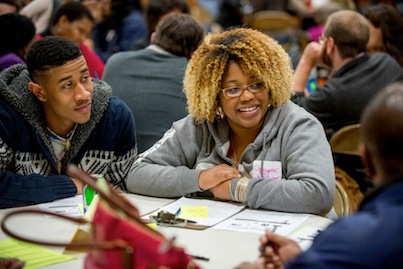
Last Thursday night, more than 150 Oaklanders braved the cold and rain to join the Effective Teaching Coalition at its first event: “Teaching Matters, Series 1: “The Importance of Supporting Teachers So All Children Succeed.”

Around tables, we shared memories of our favorite teachers and what made them effective. We also talked about roadblocks to effective teaching in Oakland and heard from experts, and a representative from each of the coalition members.

View article.

Oakland Local: Oakulture: Respect Our City helps bring peace to First Fridays; The Coup shadowboxes SF, Berkeley’s Birdland winds down

libationMarch 5, 2013
By Eric K. Arnold

The red outline of a neon cross from the nearby Korean Community Christian Church church emanated above 1-O.A.K.’s head like an electric halo, as the Oakland singer stood at the Telegraph and 24th St. Peace Stage, wearing a green RespectOurCity t-shirt and performing a cover of William DeVaughn’s R&B classic, “Be Thankful for What You’ve Got.”

The lyrics—you may not have a car at all, but remember, brothers and sisters, you can still stand tall—seemed thoroughly appropriate, considering the circumstances: Following the prior month’s First Friday celebration, gunfire erupted, leaving 18 year-old Kiante Campbell dead and several wounded, and causing event organizers (myself included), concerned stakeholders, and city officials, to rethink the future of the event, and institute numerous changes, the most salient of which was tightly-curated antiviolence messaging throughout the entire FF footprint.

***

Just moments earlier, District 3 City Councilperson Lynette Gibson-McElhaney led the Peace Stage crowd, which conservatively looked to number upwards of a thousand people, in observing a moment of silence in honor of Campbell, and other victims of gun violence in Oakland. Gibson-McElhaney called for everyone in the crowd to raise the peace sign in the air; a sea of hands followed suit. The hands remained held high for what seemed like an eternity, but was in actuality just a couple of minutes.

No one said a word.

“When that happened, I could feel, this city is still–from [24th st.] to [14th],” said Amber McZeal, a member of the FF organizing group. “It was a change… I didn’t recognize how many people were in the audience [because] all I could feel was stillness.”

The moment of silence was followed by an invocation led by Hub Oakland’s Ashara Ekundayo, who poured several libations into a large bowl, held by McZeal. The peace vibe had been set earlier in the day—aided by the widespread presence of ROC shirts, worn by community members, artists, DJs, event organizers, and Mayor Quan’s volunteer monitors—and was maintained throughout the night, which ended quietly and without incident, around 9 pm. (disclosure: I’m one of the ROC organizers as well.)
***

Even with the new guidelines and thematic programming, First Fridays was still a celebration of Oakland artists and homegrown culture, a point brought home by 1-O.A.K., and all the other inspired Peace Stage performers: Jennifer Johns, The Kev Choice Ensemble, Los Rakas, The Seshen, Chinaka Hodge, DNas, Do D.A.T., Chris Riggins, DJ Aebl Dee, DJ Tap-10, La Gente, and Candelaria. The music was a diverse mix of conscious hip-hop, reggaeton, jazz, funk, electronic, cumbia and R&B.

March 1’s event had less music programming overall; only two amplified sound areas were permitted by the city, the other one being the “Heal the Hood” stage curated by original First Fridays vendor Needa Bee, which featured DJs ((Local 1200)), Ras Ceylon, and numerous spoken word artists, poets, and youth organizers.

There was still lots of art on display, including the interactive paint wall at “the Art Zone,” along with local artisans and vendors. I did see less public drinking, though I wouldn’t say there was 100% compliance with zero tolerance. Overall, the event seemed less chaotic than in previous months, and the reduced number of sound systems resulted in less aural bombardment from every direction.

If heads can remain cool and calm, First Fridays might have a future after all.

View entire article.

Oakland Voices: Oakland Teacher Alison Ball Breathes Life into Math & Science

Alison Ball and her friendly classroom skeleton Photo: Oakland Voices/January 2013February 22, 2013
By Debora Gordon

After early teaching stints in far flung locales from Ecuador and China to New York and Sunnyvale, 4th year middle school teacher Alison Ball, 29, came to Urban Promise Academy (UPA), where she is having a blast teaching seventh grade.
Aside from computation and life science, Alison is excited about Crew, a UPA program focusing on the social and emotional learning skills that are part of OUSD’s strategic plan.
“What drives my work,” Alison said, “is that it’s such a time of self discovery, with students getting to discover themselves as people, figuring out, ‘what do I stand for as a person? How can I navigate the social world that I’m in?’”
Allison helps provide opportunities for students to talk with one another about what they are studying. “What I find is that in general students will have the conversation when they have the skills to have the conversation. If sometimes there’s some goofing off, it’s because they don’t know how to have that conversation or they don’t know how to explain their thinking.”
She uses a variety of strategies to help prepare students to talk about their thinking and how they arrive at conclusions.
“The math,” she explained, “is about the element of logic – students being able to see the logic and predictability, being able to solve problems, to ask what are my tools, beyond math, figure out possible outcomes. That element of mathematical thinking provides reasoning beyond math. Those kinds of things can be really empowering for students.”
Alison finds that the greatest reward of teaching is getting to spend time with young people. “My job never gets old, it’s never boring. There is always something that I‘m working on professionally, always new goals I’m setting.”
Although Alison did not originally set out to be a teacher, she says she tries to emulate her 3rd grade teacher Mr. Kramer. “He had a sense of wonder in the classroom. There were always weird, gooey, crawly things around the classroom – worms and brine shrimp, and I loved the ‘ew, gross!’ factor.” She also values the high standard he had for his students.
Alison advises new teachers not to take on too much that first year, which can often backfire, she says. She also reminds them to “breathe. At that moment, when you have a decision to make in the classroom, about how to respond to a student, that can feel really overwhelming, watching yourself making a decision, I definitely can and do breathe, on many occasions.”

See original post.