Belly dance is one of the oldest known forms of dance, believed to have originated in the Middle East. In El Cerrito, California, belly dancers flock to a modern day mecca — the dance studio of legendary performer and teacher Suhaila Salimpour, who is from a belly-dancing dynasty. Her mother, Jamila Salimpour, ran the Baghdad Cabaret, a popular venue for Middle Eastern dance and music in the 1960s in San Francisco’s North Beach. Jamila went on to become a pioneering belly dance instructor, writing the first manual to categorize Middle Eastern dance movements.
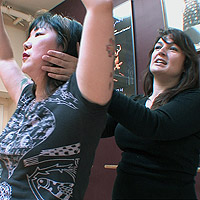
Suhaila started dancing at the age two, and as a young woman toured the Middle East and Europe. When she returned to California she opened her school to teach a new generation of dancers, but she continued choreographing and performing. At one of her shows she attracted a talented fan, comedian Margaret Cho, who is now one of her pupils. Spark captures Suhaila giving Cho a private lesson, as well as Suhaila performing with her young daughter Isabella at Rakkasah West, the largest belly dance festival in the world.
San Francisco-based conceptual artist Stephanie Syjuco believes that politically engaged art can also be fun. Often dealing with issues of globalization and outsourcing, Syjuco’s work intersects with some of the most heated debates of the 21st century but does so in a ways that are often surprising and playful. Spark checks in on Syjuco as she exhibits the “Counterfeit Crochet Project (Critique of a Political Economy)” at Yerba Buena Center for the Arts.
Much of Syjuco’s work deals with what she likes to call “improper ways of interfacing with capitalism” — bootlegs, knockoffs, and otherwise reworked commodities, taking high-tech or luxury items and remaking them as low-tech and debased. She has used simple, cheap materials like foam core, contact paper, scrap wood, and glue to make cheap, non-functional replicas of expensive consumer goods like digital cameras, cell phones, and mp3 players.
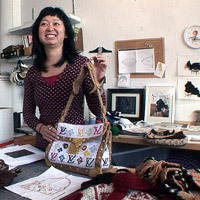
Playing on the booming black market trade of designer handbags and accessories, the “Counterfeit Crochet Project” assembles copies of these luxury items ironically — and often beautifully — rendered in the medium of crochet, a technique more closely associated with homespun creations. Syjuco began the project by creating a Web site to reach out to the crafting community and soon was able to enlist makers from all over the world to participate in her project.
Organizing and collecting the resulting works, Syjuco has presented the exhibition of the collection and associated workshops across the globe. Before the show in San Francisco, Syjuco exhibited the collection in locations across Europe and Asia, including Turkey, China, and the Philippines.
Syjuco’s process loosely mirrors that of outsourced labor, by enlisting the work of producers abroad. But while corporations outsource manufacturing in order to take advantage of cheaper means of production, the works that Syjuco elicits from her manufacturers is never offered for sale but remains the property of the people who make them. Syjuco’s exhibitions underline this aspect of the project and the workshops allow the participants to get together to work, exchange ideas, and learn to crochet these unique versions of luxury goods.
Stephanie Syjuco earned a B.F.A. from the San Francisco Art Institute and an M.F.A. from Stanford University. She has shown nationally and internationally at P.S.1 Contemporary Arts Center, the Whitney Museum of American Art, The New Museum, SFMOMA, The San Diego Museum of Contemporary Art, and The Contemporary Museum Honolulu. Her work was included in the California Biennial at the Orange County Museum of Art. She has held residencies The Atlantic Center for the Arts, Headlands Center for the Arts, KALA Art Center, Skowhegan, and the Center for Metamedia, Czech Republic.
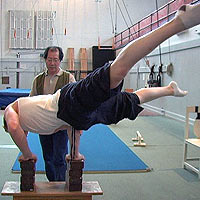
Lu Yi is transplanting the centuries-old art of Chinese circus to the Bay Area. Since the early 1990s, the former star performer and artistic director of the world-renowned Nanjing Acrobatic Troupe has turned the Circus Center into the most comprehensive Chinese acrobatics program outside of China. Spark checks in on Lu Yi as two of his American protégés, Olga Kosova and Philip Rosenberg, share their professional debut in the Pickle Circus’s “The Birdhouse Factory.”
Before coming to America, Lu Yi was well-known in China, as both an acrobat and an artistic director, for his whimsical tricks that stunned circus audiences. His skills in this traditional art form, however, were not popular with the Communist regime. In 1970, followers of Mao Tse Tung’s Cultural Revolution ransacked his house and demanded that he give up his art. When Lu Yi refused, he was locked away, unable to see family or loved ones for an entire year. After the Tiananmen Square Massacre in 1989, Lu Yi decided to leave China for good, to establish his art in the United States and eventually, he hopes, across the world.
Chinese circus is a far cry from the loud spectacles of lion tamers and human cannonballs most often associated with Western big tops. Chinese acrobats spend a lifetime studying the subtle, even spiritual principles of force, balance and agility. Learning the acrobatic arts is excruciatingly difficult, and Lu Yi teaches his students to always keep in mind the traditional Chinese saying “Training is bitter.” But years of tireless effort have paid off for Lu Yi’s students, as their debut is met with resounding success. The circus’s careful combination of theater, dance and art direction produces an unusual, lyrical performance unlike any other.
San Francisco School of Circus Arts was founded as a project of the Pickle Family Circus in 1984 by Wendy Parkman and Judy Finelli. Lu Yi became a trainer and artistic director of the school in 1990 and established the San Francisco Circus in 1996 to give his students performing opportunities. The school changed its name in 2001 to the Circus Center, which now encompasses the San Francisco School of Circus Arts, the New Pickle Circus and the San Francisco Youth Circus. The Circus Center is the only school outside of China that specializes in Chinese acrobatics.
Fletcher Benton moved from a small town in Ohio to San Francisco in the late 1950s to pursue his dream of becoming a painter, yet found success as a sculptor. In the 1960s he began experimenting with kinetic sculpture, or art that moves. It was the golden age of kinetic art, and Benton’s colorful sculptures made of metal and plastic won him accolades from the art world.
In the late 1970s Benton abandoned kinetic art as quickly as he had picked it up, switching to a more traditional sculptor’s palette — bronze and steel. Today, Benton makes large-scale sculptures for private and public commissions, as well as collectors and museums. In 2008, the International Sculpture Center honors Benton with their lifetime achievement award.
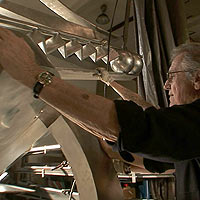
Over the years, the materials and the scale of Benton’s work have radically changed, yet he has remained committed to geometric abstraction, drawing inspiration from the circle, the square, letters, and numbers. Spark visits Benton in his sculpture studio, and at the de Saisset Museum in Santa Clara during their exhibits “Flashing Back” and “Eye on the Sixties,” which feature an eclectic mix of paintings, drawings, and sculptures made in the 1960s.
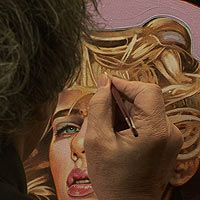
Mel Ramos began making his mark on the art world in the early 1960s as part of the Pop Art movement exhibiting alongside artists like Andy Warhol, Claes Oldenburg, and Roy Lichtenstein. The imagery of Ramos’s work is borrowed from popular culture and mass media ranging from comic book heroes and celebrities to nude women provocatively posed with over-sized mass consumed products such as soda bottles, cigarette packs, and candy bars.
Ramos was born in Sacramento in 1935 into a Portuguese-American family. At his high school’s career day, he was introduced to painter Wayne Thiebaud, who became Ramos’s mentor for the next four years. Initially, Ramos had dreamt of becoming an abstract expressionist but decided that he “wasn’t depressed enough to be a good abstract expressionist” and wanted to do “something that’s fun.” As a result, his work is humorous and teeters between eroticism, camp and classic portraiture.
Ramos divides his time between Oakland, CA and Cataluna, Spain. He works in his studio every day and has been working on a new collection of work entitled “The Lost Paintings of 1965,” as well as a sculpture series based on his paintings of the female form with large-scale commercial objects. He is represented by Modernism in San Francisco and Louis K. Meisel Gallery in New York. Spark visits Ramos as he plans a retrospective of his work with at Modernism.
View Spark segment on Mark Fiore. Original air date: February 2008. (Running Time: 8:15)
View the segment on Mark Fiore. A co-production of Spark and PBS NewsHour for This Week in Northern California. Original air date: May 2010. (Running Time: 6:59)
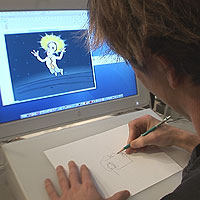
In an era where audiences prefer more comedic news sources like the Jon Stewart Show and the Colbert Report, political cartoonist Mark Fiore believes that animation gives him a bigger arsenal to both captivate and inform. His hectic production process for a two-minute cartoon consists of researching, storyboarding, creating a soundtrack, drawing caricatures, and animating — crammed into three days so that he can stay current with the latest headlines.
When selecting his subject matter, he explains, “I just go after something that makes me mad. If I can’t believe what I’m reading, those are always the best starting points for a cartoon.” Spark visits with Fiore as he creates a cartoon riffing on Hillary Clinton’s emotional moment before the 2008 New Hampshire primary, and the media frenzy that followed.
Mark Fiore began his career as a print cartoonist at the San Jose Mercury News. He left in 2001 to turn his attention to the animated realm. His cartoons appear on a variety of online news sites including SF Gate, CBS News, and Slate. He has been awarded a Robert F. Kennedy Journalism Award and has also received an Online Journalism Award from the Online News Association and the Columbia Graduate School of Journalism.
South African playwright Athol Fugard‘s “The Blood Knot” was first performed in Johannesburg in 1961, in a makeshift theater inside an old factory. The performance was both historic and illegal being the first public performance under Apartheid with a black and white actor on stage together. Over the years Fugard’s radical plays have brought international attention to the inhumanity of apartheid, but his plays are far from being purely political; they are also explorations of family and relationships focusing on the deep bonds between people that cannot be severed.
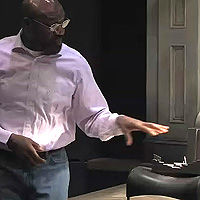
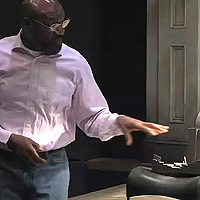
Spark goes behind the scenes of the 2008 production of “Blood Knot” at the American Conservatory Theater (A.C.T.). Directed by Charles Randolph-Wright and featuring original music composed by singer/songwriter Tracy Chapman, the play has only two characters — a pair of mixed-race brothers played by actors Steven Anthony Jones, and Jack Willis. To prepare for these complex roles, Willis and Jones traveled to Fugard’s homeland, to absorb the sights, sounds, and smells of South African township life.
More about the American Conservatory Theater
Founded in 1965 by William Ball, A.C.T. opened its first San Francisco season at the Geary Theater in 1967. Since then, more than 300 A.C.T. productions have been performed, along the way winning a Tony Award for outstanding theater performance and training. A.C.T.’s conservatory was the first training program in the United States not affiliated with a college or university that is accredited to award a master of fine arts degree. Danny Glover, Annette Bening, Denzel Washington, Benjamin Bratt and Winona Ryder are among the conservatory’s distinguished former students. A.C.T.’s performance, education and outreach programs reach more than 250,000 people in the San Francisco Bay Area every year.
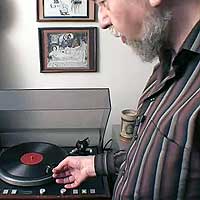
For the past 30 years, Martin Schwartz has gathered an impressive collection of rare 78 rpm records, many of them klezmer, a type of instrumental music originating from Eastern European Jews. In the 1970s, Schwartz met some Berkeley musicians who shared his passion for klezmer. They began learning from the old recordings and started a band called Klezmorim, fostering a burgeoning nationwide revival of the genre.
Meaning literally “vessel of song,” klezmer can be played on a variety of instruments – including trombone, clarinet, violin, accordion, tsimbl (a kind of hammered dulcimer), drums, bass viol – but is most commonly associated with the violin and the clarinet. These lead instruments are played in a style that mimics the human voice, common to liturgical singing styles.
Klezmer harkens back to a time when music was an integral part of daily life, supporting weddings, bar mitzvahs, and other sacred and secular celebrations. Today, Schwartz is on the Advisory Council of KlezCalifornia, which was founded in 2003 to celebrate klezmer music and Yiddish culture in the San Francisco Bay Area.
KlezCalifornia offers workshops on music, dance and singing. Participants learn the music by listening and playing back what they hear — no written music is handed out, which is true to the way klezmer has been passed down for hundreds of years. Spark explores this revival at KlezCalifornia shedding light on a tradition that has endured through time and hardships to prove its vitality and relevance to new generations.
Charismatic, versatile and eloquently formidable, the Delroy Lindo that most audiences know is a dynamic force on both stage and screen. Whether playing manic West Indian Harlem numbers-runner Archie in Spike Lee’s “Malcolm X” or sympathetic jazz musician and father Woody Carmichael in “Crooklyn,” Lindo’s sensitivity and ability to uncover what makes people tick has long been admired. A prolific actor, Lindo has been in more than 45 films and television shows as well as dozens of stage productions.
Spark goes inside the development and rehearsal process as Lindo adds the role of director to his impressive list of credits, with a critically acclaimed 2007 production of Tanya Barfield’s “The Blue Door” for Berkeley Repertory Theatre. For this two-man tour de force production, Lindo directs the actors through a journey in time told through the eyes of an African American mathematics professor haunted by the stories and dreams of his ancestors.
Lindo’s film career, which has interspersed with his theater work, started in 1979 with a small role in “More American Graffiti.” Throughout the 1990s, Lindo appeared in a wide range of good guy and bad guy roles in both mainstream and indie films, from Rodney Little in “Clockers” to the colonel in John Woo’s “Broken Arrow” to Mr. Rose in “Cider House Rules,” for which he earned a Screen Actor’s Guild nomination. In 2006, Lindo starred as FBI agent Latimer King in the short-lived NBC drama “Kidnapped.”
The only son of Jamaican immigrants, Delroy Lindo was born and raised in England, but he has lived in the Bay Area since the 1970s and is a graduate of the American Conservatory Theater. In 1982, Lindo made his Broadway debut in Athol Fugard’s “Master Harold and the Boys,” playing the role of Willie. In 1987, playing Walter Lee Younger in “A Raisin in the Sun” won him a Helen Hayes Award nomination as well as an NAACP Image Award for Best Actor. He earned additional nominations for the NAACP Image Award (one in 1992 for his role in “Malcolm X” and two in 1996, for his work in HBO’s “Soul of the Game” and for his role opposite Mel Gibson in “Ransom”). In 1988, Lindo earned a Tony nomination for his work as Herald Loomis in August Wilson’s “Joe Turner’s Come and Gone.”
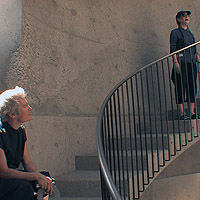
Ann Hamilton‘s eight-story tower, built on the grounds of the Oliver Ranch in Geyserville, Calif., is more than just a work of art to be observed. With its cylindrical walls, staggered windows, open ceiling and winding stairways, the space also serves as a unique venue for performance art. Spark visits with Hamilton and Meredith Monk for the unveiling of “The Tower.”
The product of almost nine years of discussion and three years of construction, Hamilton’s tower was inspired by a 16th-century Italian well that led farm animals down to water via one staircase and — because they couldn’t turn around on their own — back to the top via another. Yet unlike a well deep in the ground, Hamilton’s work rises high above the landscape.
In the structure’s center, a reflecting pool sets the stage for the two spiral staircases, which shaped like a double helix never connect or cross each other in a seemingly M.C. Escher fashion. Adding to the illusion, the 128 steps in each of the staircases get progressively narrower as they ascend.
Poured from more than 2,000 tons of concrete and sandblasted for an instant antiquing effect, “The Tower” features windows in various shapes and sizes that, much like the holes on a woodwind instrument, allow sound to escape. At the same time, these openings provide an unconventional seating schema for audiences.
“What interested me about the form of the double helix in this situation is that it means that one stairway can be a moving performance and one can be a static or moving audience. But you’re wound within each other, in the same space,” Hamilton explains.
Steve and Nancy Oliver’s 100-acre ranch has become one of the most prestigious private art preserves in the country over the last two decades. Hamilton’s tower is the 18th site-specific structure that the Olivers have commissioned on their Sonoma property.
Based in Columbus, Ohio, Ann Hamilton earned an M.F.A. in sculpture from Yale University. She was awarded a MacArthur Fellowship in 1993 and was the 1999 American representative to the Venice Biennale. She is a faculty member at the University of Ohio.
Living in an age of information overload, Scott Kildall sees a cultural shift moving towards a media information economy. He also perceives the artist as a gatherer, so to create an original media object, Kildall often repurposes materials to give them a whole new meaning. Spark accompanies Kildall as he works on his ongoing video project called “Something to Remind Me.”
Being a multi-media artist, Kidall’s talents include welding, editing video, programming microcontrollers, building electronics and developing controlled pyrotechnic systems. He earned a B.A. in political philosophy from Brown University and an M.F.A. in art and technology studies at The School of the Art Institute of Chicago. His work has been exhibited around the world.
With a body of work noted for its pulsing athleticism and intelligent composition, Benjamin Levy has become one of the Bay Area’s most sought-after choreographers, creating a style marked by personal inspiration distilled into pure movement.
In his 2007 work tentatively called “Bone Lines,” Levy translates into dance the story of his own family, Persian Jewish immigrants who fled Iran during the religious revolution of the 1970s. Levy brings Spark inside the process of creating this piece premiering at the Jewish Community Center in San Francisco. For this production, he collaborates with his five-member troupe along with designers Colleen Quen and Rick Lee and composer Keeril Makan, whose original score will be recorded by the Kronos Quartet.
Born and raised in California, Levy studied dance as a teen, appearing with Janet Roston’s Advanced Dance Theater Group at Beverly Hills High School. His love of dance solidified when he encountered the work of Martha Graham as a student in the dance department at the University of California at Berkeley, where he earned his bachelor’s degree.
As a dancer, Levy has trained with such noted Bay Area choreographers and teachers as Janice Garrett, Ellie Klopp and Robert Moses. He has also performed with Marni Woods’s Bay Area Dance Repertory Company and the Lula Washington Dance Theater, and he spent two seasons as a company member of the Joe Goode Performance Group.
His creative and choreographic spirit, however, led him to form his own company, LEVYdance, in 2002, while he was still at UC Berkeley. The following year, the young company made a splash with its residency and performances during ODC Theater’s “House Special” series, for which he created LEVYdance’s acclaimed “Holding Pattern.” The very next year, Levy was named among the “25 to Watch” artists by “Dance Magazine.”
Within only five years, Levy’s company garnered national attention, appearing not only throughout the Bay Area, but also at the Joyce SoHo in New York, at the Dance Place in Washington, D.C., and with the Los Angeles Philharmonic in the Minimalist Jukebox Festival. Described by “Dance Magazine” contributor Heather Wisner as “a balance of brain and brawn,” Levy’s work buzzes with life and intensity.
For more than a decade, Favianna Rodriguez has been creating posters and graphics supporting social justice movements and political activism. Carrying on the tradition of the Chicano arts movement of the 1960s and 1970s, Rodriguez is part of a new generation of artists devoted to public awareness and community involvement in grassroots causes.
A largely self-taught artist, Rodriguez learned about silk-screening in her teens by taking free art classes offered in the Fruitvale district of Oakland, where she grew up. For Rodriguez, silk-screening is an art of the people, as evidenced by its use in social and political movements throughout the last 100 years to educate and organize the masses. Along with her longtime collaborator, Jesus Barraza, Rodriguez designs posters to raise awareness on issues ranging from genetically modified foods to immigration rights to globalization.
As an activist, Rodriguez goes far beyond creating posters and other graphic work. She helped found the EastSide Arts Alliance, an organization that supports Oakland neighborhoods through arts programs and by making available performance and studio space and even a number of affordable housing units. In addition to her work with EastSide, Rodriguez is a co-owner of TUMIS, an East Oakland-based design firm that provides design, technology and communication strategy services for social justice organizations and nonprofits.
One of Rodriguez’s latest projects is the compilation of images for a book entitled “Reproduce and Revolt: Radical Images for the 21st Century.” The images, which will also be made available online, are offered for free to be used for noncommercial activist purposes. For Rodriguez, it’s a way to put powerful graphics in the hands of anyone interested in supporting progressive struggles globally.
While working as an artist-in-residence at Berkeley’s Kala Art Institute, Favianna Rodriguez put together a poster for the California Day Laborer’s conference held at San Francisco State University. Based on a series of snapshots Rodriguez took of day laborers, the image suggests the workers’ experience while conveying a sense of both struggle and dignity. Spark follows Rodriguez as she presents the poster at the conference and solicits feedback that will help her to refine the image and make it more effective.
Bay Area vocalist and lyricist Laurie Antonioli has traveled the world and performed with some legendary jazz artists, including Cedar Walton, Bobby McFerrin, and Joe Henderson. After a four-year stint as a professor in the vocal jazz department at KUG University in Graz, Austria, Antonioli is back in the Bay Area teaching aspiring vocalists at the Jazzschool in Berkeley.
After musical studies at Mt. Hood Community College in Portland, Oregon, Antonioli joined saxophonist and vocalist Pony Poindexter on a European tour. When she returned stateside with considerable experience under her belt, she performed regularly and released such albums as “Soul Eyes” (Catero Records) and “The Duo Sessions” (Nabel Records).
Antonioli also thrives as a lyricist, penning words to such jazz standards as “Blue In Green” (Davis/Evans), as well as works by contemporary composers like Charlie Haden, Richie Beirach, and John Pattitucci. During her time in Austria, she wrote the lyrics to a body of compositions by pianist Fritz Pauer, which was made into “The Pauer-Antonioli Songbook.” Spark gets a front row seat as she debuts of some of these songs along with a quartet consisting of pianist Peter Horvath, bassist John Shifflett, and drummer Jason Lewis.

 South African playwright Athol Fugard‘s “The Blood Knot” was first performed in Johannesburg in 1961, in a makeshift theater inside an old factory. The performance was both historic and illegal being the first public performance under Apartheid with a black and white actor on stage together. Over the years Fugard’s radical plays have brought international attention to the inhumanity of apartheid, but his plays are far from being purely political; they are also explorations of family and relationships focusing on the deep bonds between people that cannot be severed.