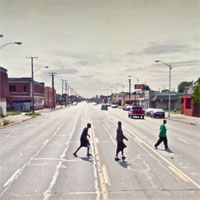
The work of contemporary artist Doug Rickard signifies a new era for the photographic medium while referencing a rich history of street photography. Google Street View technology allows Rickard to study street scenes from around the country — without leaving his studio. He appropriates the scenes captured by Google’s automated lens and edits the images to reveal a lifestyle often hidden from our gaze.
Google launched Street View in 2007. Their vans mounted with nine-lens, 360-degree cameras roam every street capturing unauthorized panoramas of places and people, posting them online to be accessed by anyone on the Internet. Some find this practice intrusive and degrading, others see beauty in the grainy and gritty quality of the photographs. Rickard saw an opportunity to document the American reality. After studying the works of Depression Era photographers like Walker Evans, Dorothea Lange, Robert Frank, and Ben Shahn, Rickard wanted to extend their tradition of strikingly real, emotionally stirring portraiture into the 21st century. He says, “I was interested in photographing America in the same context, with the same poetry and power, that has been done in the past.”
Doug Rickard was born in San Jose, CA and studied U.S. history and sociology at the University of California, San Diego. He is the founder of American Suburb X and These Americans, web sites that aggregate essays on contemporary photography and historical photographic archives. In 2011, his series A New American Picture was included in the annual New Photography exhibition at the Museum of Modern Art, New York. His work is represented in New York by the Yossi Milo Gallery and by Stephen Wirtz Gallery in San Francisco.
Following the 1979 Soviet invasion of Afghanistan, 5 million refugees left the country; some seeking refuge in the US. From 2006 to 2011, the Afghan population in the US has grown from 66,000 to 300,000, due to the US invasion and war following 9/11. The Bay Area is home to the largest community of Afghan Americans in the US and has become a cultural haven for a growing number of Afghan artists and musicians. The Centerville district of Fremont, known as Little Kabul, has its own mosque, shops, restaurants, food stores, and bookstores.
Artist Shokoor Khusrawy is among the latest wave of refugees, settling in the US in 2010 in order to escape the ongoing violence in his home city of Kabul. In Afghanistan he made a living selling portraits and landscapes to American servicemen at the ISAF base near the US Embassy in Kabul. Now he is attempting to start over, living with his brother Jelani in a tiny apartment in Fremont with the balcony doubling as his art studio.
Crippled by fall at the age of 7, Shokoor’s leg never healed, so he does all of his painting seated on the floor, using a palette knife in place of a brush to achieve his impressionistic style. Since his escape from the war, his subject matter has changed to reflect his new surroundings. He’s drawn to the bright colors of San Francisco, visiting again and again to take photos of its iconic buildings and landmarks.
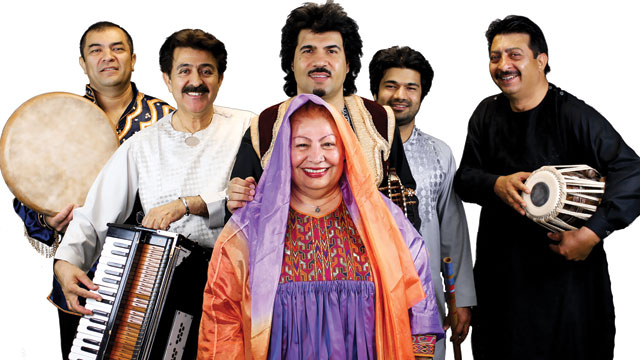
Musician Homayoun Sakhi is world-renowned for his mastery of the rubab, a double-chambered lute with origins that can be traced back 2,000 years. His repertoire spans classical Afghan folk music, with lyrics derived from the poetry of Rumi, to his own contemporary fusion compositions. Sakhi also leads “Voices of Afghanistan,” a touring and recording group of Afghan musicians and singers who perform traditional folk songs representing the diverse regions of their homeland. Taking center stage with the ensemble is Afghan diva Ustad Farida Mahwash, one of very few women to achieve the title of “Ustad,” considered a master of music in the Afghan community.
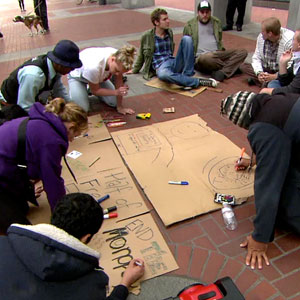
Since its inception in September 2011, the Occupy movement has resonated with artists and photojournalists worldwide, resulting in a distinct visual aesthetic of imagery designed to inspire and mobilize support. Occupy Bay Area at Yerba Buena Center for the Arts (from July 7 through October 14, 2012) is an exhibition that brings together Bay Area artists to illustrate the power of art to cut across language and social barriers.
Spark focuses on three of the poster artists who are featured in the exhibit. Though he’s most famous for his artwork for The New Yorker magazine, Eric Drooker has been designing political street art since he was a teenager. His iconic image of a woman stepping over the Brooklyn Bridge became one of the first rallying images adopted by the “Occupy Wall Street” movement. The Berkeley-based artist’s design is a call to action for the “Occupy Caravan” currently en route to a national gathering in Philadelphia.
Young Oakland-based artists Jesus Barraza and Melanie Cervantes screen-print their bold, high-contrast posters in the 30-year tradition of Chicano graphic art activism. Thousands of their posters helped rally the Latino community for May Day marches throughout the Bay Area. Barraza and Cervantes encourage free downloading of their designs; as a result other social justice movements around the globe often use their imagery.
Long before the first tents were pitched at Occupy Oakland and San Francisco, the Bay Area was home to other landmark political struggles. From the Free Speech and Civil Rights Movements of the 1960’s to the Occupation of Alcatraz in 1969-71 and the AIDS Vigils from 1985 – 1995, using historic videos, photos, and other artifacts, the exhibition provides historical context for the theme of art as a vehicle for social change.
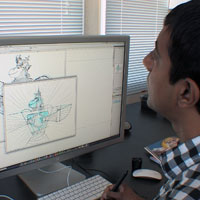
Pixar, the Bay Area’s Oscar Award-winning animation studio, is responsible for such modern classics as A Bug’s Life, Monsters, Inc., and Up. Sanjay Patel is a supervising animator and storyboard artist at Pixar and has worked on such films as The Incredibles, Ratatouille, and Toy Story 3. He also has created a series of works that draw upon his Indian heritage, illustrating adaptations of ancient Hindu epics. Spark catches up with Patel on the occasion of the Oakland Museum of California exhibit Pixar: 25 Years of Animation.
Patel was a student at CalArts’s renowned animation program, founded by Walt Disney to train his animators, when he was recruited by Pixar, not long after Toy Story‘s 1995 release. Patel was amazed by how Pixar’s films were able to tell compelling, emotionally engaging stories through the use of computer animation. He traded in his pencil for animation software and a mouse and began working at Pixar.
Pixar encourages its artists to grow creatively, offering classes in drawing, painting, and sculpture, and to pursue projects outside work. Since 2006, Patel has been illustrating retellings of ancient Hindu mythology. Under the brand name Ghee Happy (named for the clarified butter commonly used in Indian cooking), Patel has created a line of books, apparel, and other products that celebrate Indian traditions through his distinctly fun and modern design sensibility.
Ghee Happy finds its roots in Patel’s upbringing. Growing up in San Bernardino, California, in a Gujarati family, Patel found himself surrounded by two sets of compelling iconography: the Hindu gods and scenes that populated his family home and the Warner Bros. and Disney cartoons that he watched obsessively on television. Patel absorbed everything he could from these programs and started to draw his own comics, often spending hours at a time working on them. Patel recounts that as he began to see himself as an artist, he felt in some ways a disconnection from both the broader Southern California culture and the Indian community in which he lived. His work with Ghee Happy reconciles these two iconographies that were so influential to his development, creating a unique and fresh expression of his experience.
Spark checks in with Patel as he develops his latest book, about the Hindu deity Ganesha and Ganesha’s legendary love of sweets. When creating these projects for Ghee Happy, Patel often finds himself drawing on the skills he acquired while working at Pixar. Important story points are reduced to single panels in the book format, so he takes into consideration animation concerns like acting, narrative arc, and the importance of illustrating moments that reveal character and transformations.
The Fisher Collection of Contemporary Art is widely considered to be one of the most impressive private art collections in the world. Beginning in June 2010, a preview entitled Calder to Warhol: Introducing the Fisher Collection debuts in a major exhibition during a three-month presentation at the San Francisco Museum of Modern Art. Calder to Warhol is culled from the more than 1,100 works collected over four decades by Doris and the late Donald Fisher, founders of Gap.
Part of the museum?s yearlong 75th anniversary celebration, the preview of approximately 160 works by artists such as Alexander Calder, Any Warhol, and Chuck Close marks the arrival of the collection at its new home after multiple years of controversy surrounding its fate. The Fishers initially sought to build a new museum to house the collection in San Francisco?s Presidio, but the project was ultimately stymied by community opposition. In September 2009, an agreement to house the collection at SFMOMA was reached just days before Donald Fisher?s death.
Begun in 1969 as a collection of graphic art prints to decorate the offices of their then-small retail company, the Fisher Collection grew into one of the world?s premiere private art collections as the apparel company expanded from a single San Francisco storefront into a multibillion-dollar household name. Choosing to select works themselves instead of relying on brokers, the Fishers as collectors have been noted both for the personal manner in which they added items to their holdings and for their talent at selecting important works from key moments in the decades-long careers of some of the 20th century?s most respected artists.
The collection includes works from 1928 to the present by 185 American and European artists and represents movements ranging from pop art to minimalism and photorealism. It is especially esteemed for its large number of career-spanning works by Alexander Calder, Ellsworth Kelly, Roy Lichtenstein, Chuck Close, Gerhard Richter, and Andy Warhol.
The preview exhibition alone will occupy the entire fourth and fifth floors of SFMOMA as well as its recently opened Rooftop Garden. In coming years, the museum plans to undergo a large-scale expansion project in order to house the massive collection alongside its current holdings. Many art experts and enthusiasts expect the presence of the Fisher Collection at SFMOMA to put the museum on par with such internationally recognized institutions as the Museum of Modern Art in New York and London?s Tate Modern.
The short story collection The Pastures of Heaven isn’t the first title that springs to mind when you talk about author John Steinbeck, but his sharp-eyed portraits of human nature and life in a Salinas Valley farming community in the 1920s have inspired a new play by San Francisco-based playwright Octavio Solis.
Commissioned by the California Shakespeare Theater as part of their New Works, New Communities series, John Steinbeck’s The Pastures of Heaven takes viewers on a journey into the heart of the American Dream as seen through the eyes of the Munroe family and the other ordinary folks of Las Pasturas del Cielo, a small village situated along the stretch of Highway 68 between Monterey and Salinas. Spark follows Solis as he explores Salinas and the stunning valley of Corral de Tierra, the real-life setting for The Pastures of Heaven, in order to draw inspiration for his adaptation.
Solis, a native of El Paso, Texas, has seen his poetic dramas produced at festivals and venues all over the country, from the Oregon Shakespeare Festival to the Magic Theater in San Francisco, from the New York Summer Play Festival to the Yale Repertory Theatre. He is the literary heir of a generation of Chicano playwrights, and his works, such as El Paso Blue and Lydia, trace a Latino experience that might not be prominent in The Pastures of Heaven. But in Steinbeck’s brief vignettes, Solis finds a dark undercurrent of human foibles and struggles that transcends culture.
The verdant pastures of green that inspired Steinbeck’s short story cycle were discovered accidentally in 1776 by a Spanish corporal, whose name has been lost to history. Throughout the 19th and early 20th centuries, ranchers and homesteaders established a loose community in the area, but from the late 1950s onward, development in the lush valley and the establishment of the posh Corral de Tierra Country Club gradually eroded the remnants of the farm community, as wealthy Silicon Valley businessmen built multimillion-dollar estates on the subdivided plots of land where cattle once grazed.
Partnering with the Word for Word Performing Arts Company, Solis and his fellow collaborators began extensive research and workshops in October 2007, all leading to the play’s premiere at the Bruns Amphitheater in Orinda in June 2010. The community outreach aspect of the project took the cast and crew to Salinas to work in the fields and learn firsthand about the world Steinbeck portrays, one that, even in 1932, Steinbeck saw slowly vanishing, like the dreams of his characters.
“If I have any vision, I tell you this,” says one of Steinbeck’s characters, in the author’s uncannily accurate voice, “some day there’ll be big houses in that valley, stone houses and gardens, golf links, and big gates and iron work. Rich men will live there, men that are tired of working away in town, men that have made their pile and want a quiet place to settle down to rest and enjoy themselves.”
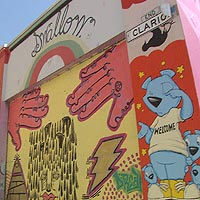
San Francisco’s Mission District is home to a high concentration of street art, bearing witness to an artistic community as vibrant as it is diverse. A heady mix borrowed in equal parts from the Mexican muralistas, 1930s WPA murals, graffiti, skater graphics, hip hop, and the alternative comics that emerged in the 1960s and 1970s, the street art of the Mission reflects the concerns, aspirations, celebration, and anguish of a dynamic and vital neighborhood. Spark takes a tour through the Mission’s famous decorated streets.
The diverse background of Mission residents is staggering, encompassing every economic and social stratum — from loft-dwelling urban professionals to undocumented day laborers. Residents range from newly landed 20-somethings fresh out of college to families whose roots in the neighborhood run generations deep. Decades of changing demographics and diversity have created a kind of cultural laboratory that has produced more than 500 murals since the Mission mural movement began in the 1960s.
Balmy Alley, located off 24th Street’s bustling commercial strip, is a one-block stretch of fences and residential structures covered with a dynamic series of murals. The project dates back to 1972, with the work of Patricia Rodriquez and Graciela Carillo, who collectively came to be known as Las Mujeres Muralistas. Their project grew in 1984, when Ray Patlan led an initiative that resulted in 25 additional murals, connected through the common themes of celebrating the indigenous cultures of Central America and protesting U.S. intervention in the region. Since then, artists have continued to add to the project, making the alley an ongoing visual record of cultural and social developments.
The other major mural concentration in the Mission is Clarion Alley, a narrow passage that runs from Valencia Street to Mission Street, just south of 17th Street. Clarion has been a center of artistic activity and bohemian culture at least as far back as the early 1960s, when acclaimed minimalist composer Terry Riley occupied a warehouse space on Clarion. In 1992, inspired by Balmy Alley, a group of street artists came together to form the Clarion Alley Mural Project (CAMP). But whereas Balmy Alley grouped its murals together around a common theme, CAMP’s goals were social inclusiveness and aesthetic variety. CAMP works primarily with young artists — some are muralists, some are creating public work for the first time. CAMP has become something of a rite of passage for many artists who have gone on to establish themselves internationally.
The street art of the Mission District is available for viewing anytime. Guided tours can be booked through Precita Eyes Mural Arts and Visitor Center.
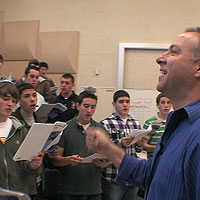
Ken Abrams has been the choir director at San Ramon Valley High School (SRVHS) in Danville, California since the 1980s. Under his direction are several choirs, including the SRVHS Concert Choir and the Treble Clef Choir, which were both first place winners at the 2009 Golden State Choral Competition. Many of the SRVHS choirs tour the country in the summer as well as record an annual CD. Spark visits with the 82-member SRVHS Concert Choir as they prepare for their 2010 spring concert, which features selections from Antonio Carlos Jobim, George Gershwin, and Freddie Mercury.
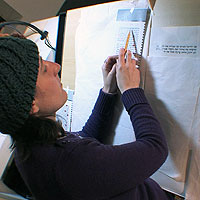
Art figures into the work scribe-in-residence Julie Seltzer creates at the Contemporary Jewish Museum in more ways than one. Commissioned by the San Francisco museum to write the Torah, Judaism’s sacred text, from beginning to end using scribal techniques and traditions passed down for thousands of years, Seltzer must follow strict rules governing the document’s production. And she faces the added challenge of completing the lengthy spiritual practice in plain view of museum visitors observing her progress.
One of very few soferets — a soferet is a woman trained to write the Torah — Seltzer is performing the ritual as part of the museum’s As It Is Written: Project 304,805, a yearlong living exhibition allowing public access to a private religious act almost exclusively performed by male scribes. According to tradition, Seltzer will handwrite the 304,805 letters of the Torah on 62 sheets of paper using parchment ink and feather quills she sharpens by hand.
As she works, Seltzer follows tradition and states out loud the words she is about to write. She then creates the sacred text using calligraphy lettering techniques learned during an apprenticeship with Brooklyn-based soferet Jen Taylor Friedman, widely considered to be the first known woman to write a Torah from beginning to end. Rules dictate how many columns of text appear on each page, how many lines make up a column, and the spacing and formation of each letter.
Seltzer’s work is as potentially controversial as it is methodic and meditative. Performing an act long reserved for men, Seltzer is producing a text that many conservative Jewish communities will not consider Kosher or suitable for religious use. Ultimately, the Torah she completes will be given to a Jewish congregation that is accepting of its origins.
Before becoming the scribe-in-residence at the museum, Seltzer was a baker at a Jewish retreat center, where she often created challah bread depicting Torah scenes and letters from the Torah. Seltzer started her writing of the Torah at the museum in October 2009. The project continues through October 2010.
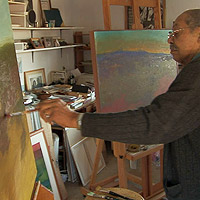
Though he’s considered by many in the art world to be one of the most important abstract landscape artists of the 20th century, Richard Mayhew is more likely to describe his approach not in traditional art terms, but rather in terms more closely associated with jazz music. Frequently referring to himself as an improvisationalist, Mayhew, a one-time jazz singer himself, has been painting dream-like landscapes since his start amid the abstract expressionists of 1950s New York.
By the early 1960s, Mayhew had joined such artists as Romare Bearden, Hale Woodruff, Charles Alston, and Alvin Hollingsworth to become a founding member of Spiral, an influential group of African American artists that sought to use the arts as a vehicle in the fight for civil rights and racial equality. And while continuing to garner critical praise, Mayhew taught in art programs around the country, including a 14-year professorship at Penn State University.
Interestingly for an artist so closely associated with landscapes, Mayhew is less concerned with issues of place than with the spontaneity of the mind, nature, and spirituality. A lone tree, an image rife with symbolic overtones, occupies many works. Its colors and abstractions rove from muted and hazy to brilliant and arresting and back again, sometimes in the space of a single piece.
Spark visits Mayhew at his home studio outside Santa Cruz, California, in 2009. During this time, his work is appearing concurrently at the Museum of the African Diaspora in San Francisco, the Santa Cruz Museum of Art and History, and the de Saisset Museum of Santa Clara as part of a three-part retrospective tracing his career chronologically from the 1950s onward. His work is featured in the permanent collections of such museums as the Whitney Museum of American Art, the Smithsonian Institution, the Metropolitan Museum of Art, and the Los Angeles County Museum, among others.
Spark visits California Shakespeare Theater’s Jonathan Moscone and Berkeley Repertory Theatre’s Tony Taccone at the first read-through of their play at the Oregon Shakespeare Festival. Their collaboration on American Revolutions: The United States History Cycle is inspired by the turbulent 1970s, brought into focus by the assassination of Moscone’s father, George Moscone, the San Francisco mayor who was shot, along with gay rights activist City Supervisor Harvey Milk on November 27, 1978. Aiming less to put George Moscone’s story into historical perspective, than to investigate what it means to be father and son, the play is scheduled to debut in 2011.
A New York native and graduate of Boston College, Tony Taccone arrived at Berkeley Rep in 1988, after directing San Francisco’s Eureka Theater for six years. As one of the leading directors in American regional theater, Taccone has developed a reputation for finding and nurturing unusual new works that have gone on to critical acclaim, including The Convict’s Return, Culture Clash in AmeriCCa, The First 100 Years, Geni(us), Ravenshead, and Virgin Molly. For some productions — like Tony Kushner’s Angels in America, Stew’s Passing Strange, Carrie Fisher’s Wishful Drinking and Sarah Jones’s Bridge and Tunnel — Taccone has shaped and honed them before they made successful moves to off-Broadway and Broadway. Others have successfully gone on to different arenas, such as David Edgar’s Continental Divide, which transferred to London’s Barbican Theater and garnered international praise.
Taccone and Jonathan Moscone worked with each other during Moscone’s directorial internship at Berkeley Rep in 1989 before he left to pursue an M.F.A at Yale School of Drama. In 2000, Moscone assumed the directorship of Orinda’s California Shakespeare Festival, expanding the repertoire of the company to include award-winning productions of works by George Bernard Shaw, Oscar Wilde, Anton Chekhov, and Tom Stoppard. Critical accolades have also greeted his productions of Man and Superman, Nicholas Nickleby, Twelfth Night, and The Seagull as well as his production of Henrik Ibsen’s Ghosts for Berkeley Rep.
In a 2008 interview with the Bay Area Reporter, the younger Moscone, who was 14 years old at the time of the shooting, noted that his father “changed City Hall. He made a Harvey Milk possible. He helped Harvey succeed. He opened the doors of city power to those who had been denied entrance.”
View Spark segment on the San Francisco Mime Troupe. Original air date: November 2009. (Running Time: 6:30)
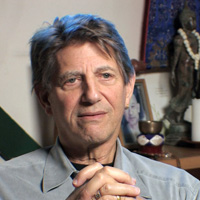
View Spark Web extra of Peter Coyote, actor and a major player in the counterculture of the 1960s, talk about his experiences as a member of the San Francisco Mime Troupe, the power of comedy, and the legacy of the 1960s. (Running Time: 3:54)
Decidedly unsilent, the San Francisco Mime Troupe’s gadfly theater, played for free in city parks and spaces, has long defined a distinctly San Francisco brand of experimental theater. Spark talks with actors Ed Holmes, Michael Sullivan, and Velina Brown in Dolores Park as the San Francisco Mime Troupe gets ready for a 2009 performance of “Too Big to Fail” during their 50th anniversary season.
Founded in 1959 by actor Ronnie Davis, the Mime Troupe’s debut work, “Mime and Word,” took commedia dell’arte as its model. But as the turbulent, politically charged 1960s unfolded, the troupe evolved into a fast-moving, agitprop theater — or as alumnus Peter Berg described it, “guerrilla theater” — bringing caustic political and cultural satire to the city’s streets and parks.
The troupe’s freewheeling productions ran afoul of the law in 1965 when the San Francisco Recreation and Park Department denied the troupe a permit to perform and arrested Davis, citing “obscenity.” The Mime Troupe won the subsequent lawsuit, establishing the right of artists to perform uncensored in city parks.
In 1968, the troupe — which tours throughout the United States and internationally — won its first Obie Award “for uniting theater and revolution and grooving in the parks” with its contemporary version of “L’Amant Militaire.” The production protested the Vietnam War and the involvement of Dow Chemical Company — which then manufactured napalm — and featured a young Peter Coyote. Since 1970, the Mime Troupe has operated as a collective, and among the many who’ve participated are such notables as concert promoter Bill Graham (who organized his first show at the Fillmore as a bail benefit for the Mime Troupe), musician Bruce Barthol, poet Lawrence Ferlinghetti, and Teatro Campesino’s Luis Valdez.
The Mime Troupe has won two more Obies (in 1973 and 1990) and a special 1987 Tony Award for excellence in regional theater. They’ve performed in Communist Cuba and in Sandinista Nicaragua; taken a modern Israeli-Palestinian farce to both West and East Jerusalem, garnering their third Obie for that production; and continued to tackle topics from corporate imperialism to terrorism to religious fanaticism, fulfilling the troupe’s mission to identify the forces that shape our lives and dramatize the operation of these giant forces in small, close-up stories that help audiences feel the impact of political events on personal life.
View segment on Amalia Mesa-Bains. Produced by Spark for This Week in Northern California. Original air date: October 2009. (Running Time: 6:08)
The beginning of November marks the Mexican holiday Día de los Muertos, or Day of the Dead. It is an occasion for people to celebrate and remember friends and family members who have passed on. Spark explores the meanings and history of Día de los Muertos with internationally renowned Chicana artist Amalia Mesa-Bains as she teaches a class on the holiday’s traditions at Cal State University, Monterey Bay.
The roots of Día de los Muertos combine both pagan and Christian traditions. The celebration can be traced back to a variety of indigenous ancient festivals, including one dedicated to the Aztec queen of the underworld, Mictecacihuatl. It also coincides with the Catholic All Souls’ Day, celebrated on November 2, when family members pray for the souls of the dead that have not yet been granted entrance to heaven.
Central to Day of the Dead is the act of remembrance in which loved ones reenact their most cherished memories of the dead. The holiday is joyful and celebratory, but also offers an occasion for participants to connect with their ancestors and the past.
One of the key practices of the holiday is the construction of altars, or ofrendas, dedicated to friends and family members who are being remembered. Altars normally include an assortment of offerings to the dead, such as bread, salt, incense, water, candles, and flowers — traditionally, Mexican marigolds — alongside photographs of the deceased. Other offerings include cherished items of clothing and other objects reminiscent of those who have passed and brightly decorated skulls made of sugar.
In teaching these traditions, Mesa-Bains helps her students get in touch with their own histories. Although more than half of Monterey County is of Mexican origin, the tradition of making ofrendas for Day of the Dead has been in great part abandoned as families came to the United States. For some, the tradition is even at odds with the practices of the Catholic Church. But by learning the traditions of Día de los Muertos, many of Mesa-Bains’s students are able to reconnect with cultural practices and their own past.
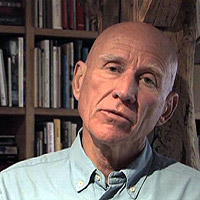
View segment on Sebastião Salgado. Produced by Spark for This Week in Northern California. Original air date: October 2009. (Running Time: 5:37)
View Spark Web extra of Ken Light, the director of UCB’s Center for Photography, talking in detail about three of Sebastião Salgados photographs from the Then and Now exhibition at the David Brower Center. (Running Time: 8:06)
In an age of lightning-fast and celebrity-obsessed media, a time when a single subject can be photographed and transmitted around the world in mere moments, Brazilian photographer Sebastião Salgado stands out. Not only does the celebrated documentary photographer eschew commercial subjects for socially charged images of humans and landscapes shaped by socioeconomic and environmental injustice, but also he routinely devotes years to his projects, which often comprise hundreds of black-and-white images.
Selected for the inaugural exhibit at the new David Brower Center — a nonprofit center in Berkeley, Calif., designed to foster collaborations between organizations and individuals dedicated to environmental and social action — an exhibition of Salgado’s works, entitled Then and Now, unearths a wealth of imagery. It spans the nearly four decades since his wife, Lélia, who is the show’s curator, presented him with a camera as a gift in 1970. Then and Now includes selections from Salgado’s current project, Genesis, which was begun in 2004 and is scheduled for completion in 2011 and which emphasizes dramatic landscapes in locations ranging from the mountains of Ethiopia to the Galapagos Islands. “We needed ways to engage people in activism, and in my opinion, the arts are the best way to inspire people to think about the world in a different way,” says Brower Center executive director Amy Tobin.
Salgado has won widespread acclaim for his photographs — and not just from the art world. Championed by social change groups and nongovernmental organizations for his work reflecting struggling populations in developing regions of the world, Salgado is perhaps best known for photographing such subjects as manual laborers, refugees displaced by war or drought, and populations weighed down by famine in Africa and other nations. Organizations such as Doctors Without Borders, the World Health Organization, Amnesty International, and UNICEF regularly use his images in their work.
Not surprisingly, given the nature of his images, Salgado’s interests stretch beyond the art world and into activism. Since 1991, Sebastião and Lélia have been involved in restoration efforts in Brazil’s Atlantic Forest, threatened by logging and cattle grazing. In 1998, the Salgados founded the Instituto Terra to promote reforestation and environmental education in the forest, which has since been designated the first private nature reserve in Brazil.
Salgado was a trained economist who worked for the London-based International Coffee Organization before becoming a full-time photographer in 1973. In addition to being exhibited in more than 100 galleries and art centers around the world, many of his collections have been published as books, including The Other Americas (1986), Sahel: Man in Distress (1986), Workers: An Archaeology of the Industrial Age (1993), Migrations (2000), Sahel: The End of the Road (2004), and Africa (2007). Salgado is the recipient of numerous awards and honors, among them the World Press Photo Award, the Oscar Barnack Award, the Hasselblad Foundation Award, and the New York International Centre of Photography Award. He has also served as a UNICEF Goodwill Ambassador.
Produced by Spark for This Week in Northern California.