Category Archives: Digital Arts

Arts and the Economy Report from The NewsHour (2009)

When the economy takes a turn for the worse, arts institutions and programs often suffer from cutbacks because of the perception that the arts are a dispensable luxury. But even as the Obama administration puts together an economic stimulus package that includes $50 million for the National Endowment for the Arts (NEA), economists such as Amity Schlaes debate what the federal government’s role should be in sustaining a vibrant arts community in America.

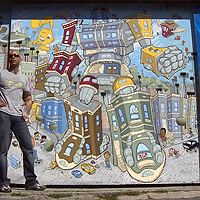
Spark, in a joint report with The NewsHour, looks at the impact of the economic recession on artists such as muralist Sirron Norris and writer Carla Blank and discusses whether a public arts program similar to the Federal Art Project (FAP) of the 1930s is a viable way to help artists who are feeling the financial pinch.

During the Great Depression, amidst programs that would eventually employ some 3.3 million people, Franklin Delano Roosevelt’s Works Progress Administration actively sought to bring relief to working artists by sponsoring a wide range of public-art projects as part of the New Deal. These projects helped, among others, Jackson Pollock, Mark Rothko, Philip Evergood and Lee Krasner.

Under director Holger Cahill, the FAP — following in the footsteps of Roosevelt’s earlier Public Works of Art Project, whose purpose was “to give work to artists by arranging to have competent representatives of the profession embellish public buildings” — created more than 5,000 jobs for artists and left a legacy of 225,000 works of art for the American public in the eight years of its existence. With offices in 48 states, the FAP commissioned works of art for numerous public buildings, managed community centers and arts programs, and sponsored exhibitions across the country. By the time the program came to a close with the advent of World War II, the thousands of artworks produced under its auspices, many of them still enjoyed today, had not only decorated American institutions and given struggling artists temporary employment, but also helped document American life.

But even beyond the aesthetic gratification that art provides is the idea that the arts can actually help drive economic prosperity — that bolstering the creative sector significantly helps the larger economy. A 2008 study, Artists in the Workforce, released by the NEA estimates that there are 2 million artists working in the United States, equivalent to 1.4 percent of the American workforce. Even more non-artists are employed by arts organizations in administrative and production roles. The research organization Americans for the Arts notes that “nonprofit arts organizations and their audiences generate $166.2 billion in economic activity every year, support 5.7 million jobs and return nearly $30 billion in government revenue every year. Every $1 billion in spending by nonprofit arts and culture organizations and their audiences results in almost 70,000 full-time jobs.”

As Carla Blank states in a 2009 op-ed in the San Francisco Chronicle, “The 21st-century version of New Deal arts programs could feature creative partnerships between artists and scientists, engineers, businesses, educators, skilled labor, city planners and community leaders throughout our nation’s cities and rural communities. When such collaborations are successful, they are called a renaissance.”

  • Array
  • Array
  • Array
  • Array

Mark Fiore


View Spark segment on Mark Fiore. Original air date: February 2008. (Running Time: 8:15)


View the segment on Mark Fiore. A co-production of Spark and PBS NewsHour for This Week in Northern California. Original air date: May 2010. (Running Time: 6:59)

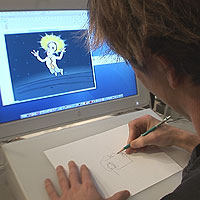
In an era where audiences prefer more comedic news sources like the Jon Stewart Show and the Colbert Report, political cartoonist Mark Fiore believes that animation gives him a bigger arsenal to both captivate and inform. His hectic production process for a two-minute cartoon consists of researching, storyboarding, creating a soundtrack, drawing caricatures, and animating — crammed into three days so that he can stay current with the latest headlines.

When selecting his subject matter, he explains, “I just go after something that makes me mad. If I can’t believe what I’m reading, those are always the best starting points for a cartoon.” Spark visits with Fiore as he creates a cartoon riffing on Hillary Clinton’s emotional moment before the 2008 New Hampshire primary, and the media frenzy that followed.

Mark Fiore began his career as a print cartoonist at the San Jose Mercury News. He left in 2001 to turn his attention to the animated realm. His cartoons appear on a variety of online news sites including SF Gate, CBS News, and Slate. He has been awarded a Robert F. Kennedy Journalism Award and has also received an Online Journalism Award from the Online News Association and the Columbia Graduate School of Journalism.

  • Array
  • Array
  • Array
  • Array
  • Array

Scott Kildall

Scott Kildall

Living in an age of information overload, Scott Kildall sees a cultural shift moving towards a media information economy. He also perceives the artist as a gatherer, so to create an original media object, Kildall often repurposes materials to give them a whole new meaning. Spark accompanies Kildall as he works on his ongoing video project called “Something to Remind Me.”

Being a multi-media artist, Kidall’s talents include welding, editing video, programming microcontrollers, building electronics and developing controlled pyrotechnic systems. He earned a B.A. in political philosophy from Brown University and an M.F.A. in art and technology studies at The School of the Art Institute of Chicago. His work has been exhibited around the world.

  • Array
  • Array

Julio Cesar Morales

Cultures collide in the work of Julio Cesar Morales, an artist offering hisinterpretation of a post-apocalyptic city based on his experiences growingup on the border of California and Mexico. Morales’s exhibit “There’s Gonna Be Sorrow” was also influenced by the first album he ever purchased, David Bowie’s “Diamond Dogs.” Bowie’s album, which was influenced by George Orwell’s dystopian novel, “1984.” Spark catches up with Morales to chat about his installation at GalerĂ­a de la Raza.

San Francisco-based Morales is a conceptual and installation artist who expresses his thoughts on labor issues and personal identity through sculpture, photography, video and other medias. In “There’s Gonna Be Sorrow” Morales employs idiosyncratic symbols to express his bi-cultural identity, fusing elements of traditional Mexican culture with contemporary, technology-infused aspects.

Born in Tijuana, Mexico, Julio Cesar Morales studied new genres at the San Francisco Art institute. An artist, educator and curator, Morales founded San Francisco gallery Queen’s Nails Annex and has exhibited throughout the world. He has received awards from The Rockefeller Foundation, The Arts Council, The Fleishhacker Foundation, and The Creative Work Fund.

  • Array
  • Array

Seyed Alavi

For Seyed Alavi, creating objects and asking questions are equally important in his art-making process. For nearly two decades, the Bay Area artist has been working with public institutions to create conceptual works of art to be experienced by passersby. Spark follows Alavi as he offers a guided tour of his art and working process.

Though Alavi produces tangible objects, he thinks of himself as a conceptual artist, that is, the ideas behind his works are centralized over the finished object. Whereas many artists choose to master a specific medium and explore multiple subjects through it, Alavi works in several media. He develops a concept, plans the work for a specific location, then outsources the actual fabrication of the piece.

Alavi has created some of his most penetrating works with the help of high school students. His first such project was a series of text pieces painted under the overpasses of Interstate 580 in Oakland. Collaborating with a group of students from the region, he helped them to develop wordplays that would cause those who viewed them to think about the topics raised. Stenciled in capitalized serif fonts, the murals provocatively announce “INVISIBLE COLORS,” “INFORM(N)ATION,” and “D FFERENCE,” the last suggesting that one needs to include his or her “I” to make the “difference.”

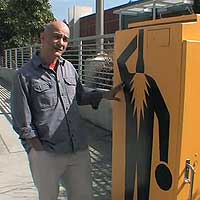
Another project done in collaboration with students is a series of variations on the ubiquitous schematized human figures found on street signs. Together with a team of students, Alavi came up with 17 surreal alterations of the figures. They then painted their versions onto utility boxes scattered throughout the town of Emeryville, Calif., in order to raise questions about the nature of human identity, interaction and existence.

Spark also trails Alavi to San Francisco’s Exploratorium, where he and four other artists have been invited to create installations in the museum’s space based on the notion of “liminality,” the condition of being between states. Alavi’s concept provides the physical challenge of closing off the skylights in the Exploratorium’s massive space so that he can program the illumination of lights clustered in a ball high above visitors. As museumgoers move in and around the space, their relationship to the moving lights continually changes, thereby making them aware of their constant state of liminal perception.

Seyed Alavi earned a B.S. from San Jose State University and an M.F.A. from the San Francisco Art Institute. He has created site-specific installations for locations in New York, Long Beach and the Bay Area. He has taught classes and workshops at the San Francisco Art Institute, the California College of the Arts, San Francisco State University and the University of California at Davis.

Array

  • Array
  • Array
  • Array

M dot Strange

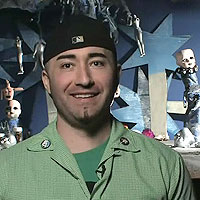
Despite his sudden rise to international fame, Michael Belmont, aka M dot Strange, advocates that life is simply better with ice cream. His feature-length film “We Are the Strange” is about two outcasts who risk going to the evil city to get ice cream. Among many things, they encounter monster ambushes, giant robot attacks, and explosions.

What started as a project in Belmont’s bedroom, “We Are the Strange” premiered at the Sundance Film Festival in January 2007 after the movie trailer’s overwhelming popularity on YouTube. To show his gratitude, Belmont has been offering a series of tutorials on YouTube to create his particular style of animation, which he’s dubbed “Str8nime” — a fusion of 8-bit videogame culture, Japanese anime, and of course, a healthy dose of strangeness. Spark visits the San Jose filmmaker and his cast of characters.

  • Array
  • Array
  • Array

Jesus Aguilar

Bay Area video artist Jesus Aguilar is exploring the intersection between language and technology. Drawing his inspiration simultaneously from video artist pioneers of the 1970s and the Internet, Aguilar is developing an artistic process that examines communication in the 21st century. Spark visits Aguilar at the Headlands Center for the Arts, where the young artist talks about some of his latest projects.

Much of Aguilar’s work explores how we interface with information via computers and the Internet. Several pieces in “No Entropy,” Aguilar’s solo show at the Stephen Wirtz Gallery in San Francisco, overlay multiple modes of communication to unveil the conditions of our experience of information in the digital age.

In “Dante’s Inferno in 8 Minutes 34 Seconds,” the entire text of the epic poem scrolls by in just over eight-and-a-half minutes, at a rate impossible to register not only by the viewer, but also by the camera that captures the transmission. The piece, along with the similarly crafted “The Odyssey of Homer in 8 Minutes 44 Seconds,” represents both the fleeting nature and the omnipresence of information in a world in which all accumulated human endeavor is subjected to the same process of coding.

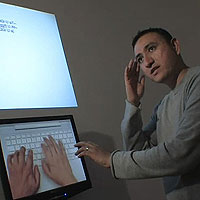
In “ABC, 123,” Aguilar overlays two registers of communication. The video shows Aguilar’s finger carefully impressing letters and numbers on a computer screen and the liquid crystal display’s momentary retention of a trace of the artist’s actions. The artist’s hand and the digital medium create an interaction that is all the more poignant for the tension it creates.

Even as these experiments with digital media and the transmission of information speak of the present digital age, for Aguilar they also hearken back to the 1960s and 1970s, when artists like Joan Jonas and Nam June Paik were wrestling with the technology of video, which held the promise of making everyone not only a consumer of televisual technology, but also a producer. As did the generation of artists that came before him, Aguilar uses his work to come to grips with a fundamental shift in the way we experience and interact with the ever-changing terms of the world around us.

Jesus Aguilar was born in San Lucas de O’Campo, Durango, Mexico, and currently lives in San Jose. In 1999, he graduated from San Jose State University with a B.F.A. and subsequently earned an M.F.A. in video, multimedia and photography from Mills College. In 2006, he received the M.F.A. Studio Residency Award from the Headlands Center for the Arts and the Herringer Prize for Excellence in Studio Art.

Array

  • Array
  • Array
  • Array

Taraneh Hemami

Iranian-born painter, installation and conceptual artist Taraneh Hemami has two homes — and she also has none. When Hemami came to the United States in 1978 to attend the University of Oregon at Eugene, she had little idea of what the future held. Within a year of her arrival in this country, the Iranian Revolution had changed her homeland forever and prevented her from visiting for more than a decade.

As an Iranian living in the United States, it’s not surprising that Hemami’s art would explore her complex relationship with the concept of home and her struggle to secure a sense of belonging from both her country of residence and the country and culture of her youth. In many ways, Hemami’s art is her home. “There is a sense of satisfaction in placing myself within the walls that I create,” says Hemami.

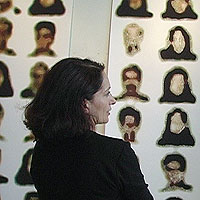
Among Hemami’s many projects is an installation she began in 2000 called “Hall of Reflections.” She collected hundreds of personal photographs, portraits and images from Iranian Americans and transposed them onto more than 400 glass and mirror tiles using silkscreen, prints and transparencies that fade and age over time. The resulting multidimensional installation, inspired by traditional Iranian mirrored gathering halls, explores the lives of the individuals fixed on her tiles and their experiences as immigrants, mothers, fathers, children and a community.

Spark follows Hemami as she gathers footage, photographs and stories from a Castro Valley Iranian woman named Nosrat, who is known as “Mommy” and whose life is the cornerstone of Hemami’s multimedia display exploring the layers of history and connected stories within a family home. The finished product is an exhibit she titled “Homes,” which was displayed at ZeroOne San Jose: A Global Festival of Art on the Edge and the Thirteenth International Symposium of Electronic Art in August 2006.

Taraneh Hemami’s work has been exhibited in the Yerba Buena Center for the Arts, the Artist’s Gallery of the San Francisco Museum of Modern Art, the San Francisco Arts Commission gallery, and numerous other locations around the country and the globe. Her themes revolve around the Iranian American experience, notions of memory and the ephemeral nature of concrete space.

  • Array
  • Array
  • Array
  • Array
  • Array

Ben Rubin

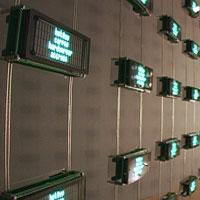
Spark checked out “Listening Post” on view at the San Jose Museum of Art from June 3 through November 26, 2006. Created by media artist Ben Rubin along with statistician Mark Hansen, “Listening Post” takes chat and messages from bulletin boards — thousands and thousands of messages in real time — and displays them on a suspended arc of 231 small text screens. In addition, voices from a text to speech synthesizer can be heard in the speakers that surround the exhibit. “Listening Post” won the 2004 Golden Nica Prize from ARS Electronica.

Based in New York City, Ben Rubin earned a B.A. from Brown University in 1987 and an M.S. in visual studies from the MIT Media Lab in 1989. His work has been included in exhibitions at the Whitney Museum of American Art, the MIT List Visual Arts Center, and the Skirball Center. He has collaborated with many other artists including Laurie Anderson and Ann Hamilton. Mr. Rubin teaches at the Yale School of Art.

  • Array
  • Array
  • Array

Sandow Birk

https://youtu.be/aimLeC7mdDw
View a KQED Education video filmed in February 2012 at Catharine Clark Gallery.


View Spark segment on Sandow Birk. Original air date: June 2006. (Running Time: 8:28)

Catch up Sandow Birk as he describes several of his recent projects, including a hand-transcribed and illustrated project called American Qur’an, and a large-scale drawing about the American Constitution. This KQED Education production was filmed in Februrary, 2012 at the Catharine Clark Gallery in San Francisco, CA.

Over the last few years, Los Angeles-based painter Sandow Birk has been expanding his artistic scope — and his audience — by turning his sumptuous contemporary history paintings into motion pictures. Spark visits Birk and his crew as they finish production on Dante’s 14th-century epic “The Divine Comedy” — set in 21st-century San Francisco.

Birk is a keen student of art history and often recasts classic subjects and compositions with modern-day figures and narratives. Birk’s work is deeply influenced by history painting, a European tradition of depicting historical events in detailed and often dramatic images. Birk first encountered 19th-century history paintings on a trip through Europe — he was struck by the grand scale of the images and their theatrical tone. Upon returning to the United States, Birk moved into a storefront apartment in South Central Los Angeles and began creating his own versions of history painting, documenting the events that happened in his neighborhood — gang warfare, drug deals, looting and rioting — in that same dramatic style.

Birk’s first film project was “In Smog and Thunder,” a mockumentary inspired by Ken Burns’s marathon 11-hour film about the American Civil War. In Birk’s version, Los Angeles and San Francisco engage in all-out war for control of the entire state of California. Birk got the idea for the project during a month-long trip to San Francisco for his solo show at the Catharine Clark Gallery.

After multiple affronts to his hometown from a variety of Bay Area dwellers, Birk decided to exact his revenge by making a series of canvases in which San Francisco is finally invaded and conquered by Angelinos. After the success of the series, Birk decided he could reach more people by making a film, and he collaborated with filmmakers Sean Meredith and Paul Zaloom to produce the project.

Like “In Smog and Thunder,” Dante’s “Inferno” began as a series of paintings that Birk then decided to make into a film. Using live actors for the project would have been prohibitively expensive — upwards of a million dollars — so Birk decided to make the film using paper cut-out puppets. Set in contemporary San Francisco, the film follows the experiences of a blue jeans-wearing Dante and his guide, the Roman poet Virgil, as they tour the depths of Hell, finally meeting the Devil himself.

Sandow Birk was raised in Southern California. He lives and works in Los Angeles. Birk earned a B.F.A. from the Otis Parsons Art Institute in Los Angeles and studied painting and art history at both the American College in Paris and the Bath Academy of Art in England. Birk was the recipient of a Guggenheim Fellowship in 1995, a Fulbright scholarship in 1997 and a Getty Award for the Visual Arts in 1999. His work has been shown in galleries and museums throughout North America and Europe.

Array

  • Array
  • Array
  • Array

Andrew Kleindolph

In the proverbial battle between man and machine, you might say that Andrew Kleindolph is on the machines’ side. Many of the artist’s interactive electronic sculptures play games with their human counterparts, instead of the other way around. Spark follows Kleindolph from his workshop at the Headlands Center for the Arts to his show at San Francisco’s RX Gallery as he demonstrates his interactive artwork.

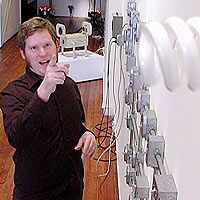
One recent Kleindolph creation resembles a video game like any other. The catch? The game never starts. Instead, Kleindolph’s machine sends its users through an endless series of pointless prompts and error screens. At a Kleindolph show, players’ increasing frustration with an obstinate video game, onlookers’ confusion over which switches illuminate which light bulbs and baffled stares at a contraption emitting manipulated audio tracks of wild animal calls are as much a part of the art as the machines themselves.

The tension between humans and machines is an overarching theme in both Kleindolph’s three-dimensional electronic pieces and his two-dimensional digital images. The latter looks like a cross between blueprints for the innards of fantastic machines and a busy intergalactic highway frequented by space-age cellular creatures. The images juxtapose electronic circuitry and organic forms in a way that’s both playfully cartoon-like and technically precise.

Machines have been a part of Kleindolph’s life since childhood. His family owned a vacuum cleaner and sewing machine sales and repair shop in his small hometown of Muscatine, Iowa. His grandfather started the business, and his parents, uncle and cousins worked there. Kleindolph also worked there for a time.

When he begins working on a new piece, Kleindolph doesn’t just do what he already knows how to do. Instead, each sculpture is a learning process in and of itself. An idea, like the one for an “anger meter” that lights up in the presence of body heat, will often send Kleindolph to his studio in the basement of the Headlands Center for the Arts, where he has had space for several years.

As he tinkers with new devices and works on projects sure to baffle and surprise visitors at his next show, Kleindolph is turning the senseless vagaries of life into art. “A lot of the stuff that I’ve been doing looks at everyday situations and how absurd they are. The sort of things that we do everyday can be [absurd]. Yet we just tolerate this and that and just go onward with our business.”

Andrew Kleindolph earned a B.F.A. in painting from the University of Iowa and an M.F.A. in electronic arts from Mills College. While attending Mills, he began teaching at City College of San Francisco. He still works at City College part time, but focuses on his electronics classes at Lick-Wilmerding High School in San Francisco.

  • Array
  • Array
  • Array

MoAD (Museum of the African Diaspora)

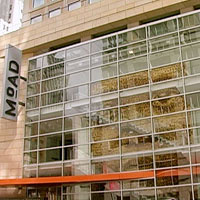
The Museum of the African Diaspora (MoAD) uses art, culture, history and technology to foster cross-cultural communication while it also provides an exhibit space and resource for African-American artists. MoAD is the newest addition to the collection of museums in the Yerba Buena arts district, surrounded by SFMOMA, the Cartoon Art Museum, the Museum of Craft and Folk Art, and the future sites of the Jewish and Mexican museums. MoAD receives international support from institutions such as the British Museum and the Museum of African Art, which have made it a truly global collaborative effort.

  • Array

Tracey Snelling

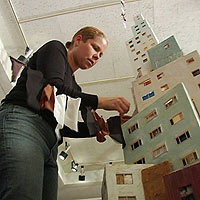
Tracey Snelling‘s miniatures are little tributes to ordinary American settings. Her small-scale renderings of run-down, neglected and overlooked buildings cast a nostalgic look back at a landscape of handmade signs, ad hoc architecture and highway development that is rapidly disappearing. In “New American Landscape,” Snelling takes Spark on a tour of her artistic process.

Snelling’s multimedia constructions boast a painstaking attention to detail, often combining electric light, still photography, moving images and sound. Drawing on imagery of small towns and desolate road stops, her landscapes eerily evoke the subtle moods of the places they represent. They resemble movie sets abandoned long after the film has been shot, inviting observers to project their own narratives onto them.

Spark follows Snelling as she installs her solo exhibition at the de Saisset Museum at the University of Santa Clara. The highlight of the show, which is entitled “Dark Detour,” is a meticulously crafted miniature tenement complex, complete with peeling paint, clotheslines, and a looping soundtrack of television sounds, plumbing and barking dogs, along with moving images in some of the windows. The piece re-creates for gallery visitors the voyeuristic experience of dense city living as they share in the sounds and sights that are central to apartment life.

Before experimenting with sculpture, Snelling worked primarily in photography, a medium that retains a central role in her process. Snelling’s miniatures often begin with a photograph that she has taken or found. Once she has re-created the photograph’s subject, Snelling photographs her miniatures in real-world settings, often creating surreal images depicting complex relationships between varying levels of representation.

Tracey Snelling earned a B.F.A. from the University of New Mexico, Albuquerque. In addition to her show at the de Saisset Museum, her work has been featured in solo exhibitions at the Mission 17 gallery in San Francisco, the Stephen Cohen Gallery in Los Angeles, and the Museum of Art and History in Santa Cruz as well as in group exhibitions at the Kala Art Institute in Berkeley, Intersection for the Arts in San Francisco and the Center on Contemporary Art in Seattle.

Array

  • Array
  • Array

Bill Owens

Bill Owens is rediscovering an artistic medium that he thought he had left behind more than 20 years ago. Owens made his mark on the art world in the 1970s with “Suburbia,” a collection of photographs that documented suburban life in Livermore, California. The book won him critical acclaim, including a prestigious Guggenheim Award. But by the time Owens was working on his fourth book, money ran out, and he decided to follow other paths in order to pay the bills.

More than 20 years later, the reissue of “Suburbia” in 1999 brought new interest in Owens’s achievements, providing the artist with fresh opportunities. Spark checks in on the Bay Area photographer as he mounts an exhibition of his photographs and short films at the Berkeley Art Museum.

After giving up photography in the 1980s, Owens turned to teaching as well as a variety of odd jobs and business enterprises to make ends meet. He even sold his cameras to raise some extra money. But the renewed acclaim for Owens’s work after the reissue of “Suburbia” enabled him to publish his unfinished Leisure collection. He also decided to return to photography, now made cheaper and more accessible by digital technology.

When he discovered that his new digital cameras could also be used to make short videos, Owens began exploring the possibilities of motion pictures. He now has a collection of short films that he directed, shot and edited entirely himself. Like his still images, his short videos are meditations on daily routines, capturing the commonplace realities of everyday life.

Recently, Owens has returned to a subject that was conspicuous in his earlier series in the 1970s – food. Spark follows the artist to the Berkeley Bowl market, where Owens collects images for a photo essay and new book dedicated to what and how we eat. As they did with his “Suburbia” series, Owens’s photos still endeavor to capture American habits directly, honestly and without judgment.

After graduating from California State University at Chico in 1963, Bill Owens began to pursue photography while serving in the Peace Corps. In 1968, he landed a job as a newspaper photographer for the “Independent News” in Livermore, where he was assigned the daily beat of the suburban activities of his friends and neighbors. He published his first book, “Suburbia,” in 1972, which was followed by “Our Kind of People” (1976), “Working” (1978) and “Leisure” (2004).

  • Array
  • Array
  • Array