Category Archives: Digital Arts

Richard Kamler

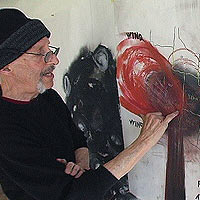
Artist, educator and curator Richard Kamler has gained a reputation for taking on tough subject matter. Since the mid-1970s, Kamler has produced work built on the premise that art can help to effect social change and cultural transformation. Spark visits the artist in the studio as he works on an installation that documents his own battle with cancer.

Kamler is an installation artist whose works are often designed for locations outside the traditional museum or gallery space. “Table of Voices,” which Kamler made in the mid-1990s, was one of several he created for prisons. Installed on Alcatraz Island, the piece brought together recordings of the voices of parents of murdered children with those of the perpetrators. Visitors to the installation could pick up a phone on one side of a long table and hear the voice of a victim’s family member and move to the other side of the table to hear the voice of a convicted murderer. The controversial piece generated a heated public debate that helped to initiate a reconciliation program for offenders and victims.

More recently, Kamler has approached another subject very close to his heart. In 2004, Kamler was diagnosed with thyroid cancer, an event that temporarily suspended his art-making activities. He had his thyroid gland removed before enduring a series of radiation treatments. Kamler was struck with the paradox that the treatment for his cancer was linked to what may have caused the illness in the first place. Having grown up in an area close to numerous government nuclear testing sites, Kamler has come to believe that these tests are responsible for his cancer and that this constitutes a criminal act on the part of the government.

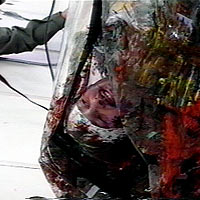
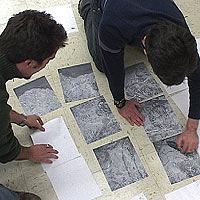
Dedicated to change through art, Kamler is transforming his rage over this negligence into a work of art chronicling his illness alongside the history of government nuclear testing in America. Spark visits Kamler at his studio in the Headlands Center for the Arts as he transforms his meticulous journals into a series of large charcoal drawings to be used in a broad and multilayered installation.

Richard Kamler received a B.A. in 1963 and an M.A. in 1974 from the University of California, Berkeley. He has received numerous awards, including a National Endowment for the Arts Visual Arts Fellowship in the New Genres category, an Alaskan State Arts Council/NEA grant, several California Arts Council Artist-in-Residence awards, and grants from the Gunk Foundation for Public Art, the Institute of Noetic Science and the Potrero Nuevo Fund. He is currently the chair of the visual arts department of the University of San Francisco, where he is also responsible for the art outreach program “Artist as Citizen in Contemporary Society,” which places artists into various communities.

  • Array
  • Array
  • Array

Workshop on Space Artists

Frank Pietronigro is using his art to go where no artist has gone before — outer space. The San Francisco artist is a pioneer in space art, a movement dedicated to building bridges between artists and space exploration organizations. Spark takes a look at this futuristic work at the Workshop on Space Artists’ Residencies and Collaborations, which brings together artists and scientists from around the world at the NASA Ames Research Center in Mountain View.

Space art is still a loosely defined field that encompasses a range of interdisciplinary practices, including painting, sculpture and performances that use space flight and/or the technologies of space exploration. Works may be produced within an antigravity environment, use materials specially designed for space travel, or be generated by information collected from celestial bodies and phenomena.

In an effort to bring attention to space art, Pietronigro co-founded the Zero Gravity Arts Consortium, an international organization dedicated to fostering greater access for artists to space technologies through the creation of partnerships between arts organizations, space agencies and research centers. The groundbreaking organization is a small step in a field that is sure to be a giant leap for space artists around the world.

  • Array
  • Array
  • Array

Kerry Laitala

Kerry Laitala is an experimental filmmaker who is interested in how films are made — one frame at a time. Laitala hand-builds her films, manipulating the surface of the celluloid and exposing each frame individually to create works that stand at the edge of both film and art. Spark follows Laitala’s painstaking work on her ongoing tribute to the film medium itself, “The Muse of Cinema.”

Film is a strip of celluloid. Until the 1950s, celluloid was produced with nitrates and was highly flammable. Today, film is usually manufactured on a cellulose acetate or ester base, which is not combustible. Although it comes in varying lengths and speeds, all film is comprised of identical individual frames. Film has light-sensitized silver halides coated in an emulsion that forms images when exposed to light. The images are invisible to the human eye until the film is processed and the images become visible.

For “The Muse of Cinema” series, Laitala produces direct films, exposing the film directly with a light source, not a movie camera. This method often physically alters the surface of film. The techniques Laitala uses include placing objects directly on unprocessed film stock, then exposing and developing it. Filmmakers using this method also paint, scratch or otherwise manipulate processed film. The resulting images, though photographic, retain a handmade, unrefined quality that characterizes the direct film aesthetic.

As a practice, direct manipulation of film is a slow, laborious process because of the number of frames required to make a film of any substantial length. Film that appears normal is shot and played at 24 frames per second (fps). Increasing or decreasing the fps can change the perception of motion, blur the images or cause the images to shake. Laitala’s cranking speed usually ranges between 8 fps and 24 fps, and she intends for “The Muse” to be feature-length (60 to 90 minutes), requiring her to produce more than 3,000 feet of film.

“The Muse of Cinema” is an ongoing project that began when Laitala found a box of early-20th-century magic lantern slides at a flea market. Slides such as these were used to entertain audiences during technical difficulties, giving the projectionist a chance to solve a problem with the projector. Laitala transferred these slides onto 35mm motion picture film, which became the first footage for her project. The rest of the film is being shot on orthochromatic film intended for use in an X-ray camera, a type of film that is not sensitive to red light.

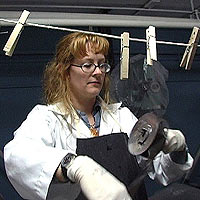
Working under red light in her apartment, Laitala places a variety of objects on the celluloid, then exposes the film with the help of a flashlight. She then processes the film using a hand-cranked processing tank. Laitala’s interest in the tactile, hand-manipulated qualities of film extends to the way in which her films are screened. For “The Muse of Cinema,” Laitala purchased and restored a vintage 1928 Acme film projector, which is hand cranked, requiring the projectionist to move at just the right speed in order for the motion to be perceived as the filmmaker intended.

Laitala studied film and photography at the Massachusetts College of Art and the San Francisco Art Institute. She has screened work internationally and has won various awards including the Princess Grace Award. She also held residencies at the Akademie Schloss Solitude in Germany.

Array

  • Array

Ben Wood

Video artist Ben Wood is using his skills as a digital image maker to uncover a piece of San Francisco’s artistic heritage hidden from view for more than 200 years. In “Through the Lens,” Spark watches as Wood, archaeologist Eric Blind and curator Andrew Galvan photograph Mission Dolores’s rare mural, which may very well be the only one of its kind in California.

Behind the Baroque altarpiece at San Francisco’s historic Mission Dolores stands a mural believed to have been a collaboration between local Ohlone Indians and Franciscan priests in 1791. The painting, executed in natural red, yellow, and black dyes on the untreated stone wall of the mission, is perhaps the best-preserved and earliest example of art from the period of Native Californians’ first contact with Europeans. The mural is dominated by two sacred hearts of Jesus penetrated by swords and daggers, which are surrounded by swirling decorative motifs believed to be Native in origin.

Working atop the redwood ceiling beams of the mission building, Wood and Blind suspend a digital camera on a network of pulleys into the narrow gap between the altarpiece and the mural. Working within only 18 inches of clearance from the mural and no ambient lighting, the team has been painstakingly photographing the entire 22-foot expanse of the mural a few inches at a time. Once the entire mural has been photographed, the two will begin the equally laborious process of organizing the images into a complete picture of the lost artwork. The final image will then be projected onto a wall of the adjacent Mission Dolores Museum.

  • Array
  • Array
  • Array

Scott Snibbe

For more than a decade, Scott Snibbe has been combining interactive computer technology with Eastern philosophy to create artworks that are at once technologically sophisticated and hauntingly lyrical. In the Spark episode “Shaken and Stirred,” get a glimpse of his recent work, including the large-scale interactive sculpture “Blow Up.”

All of Snibbe’s work depends upon the participation of its audience to work. Using a projector-camera-recorder loop and Snibbe’s own recognition software, several of his pieces produce a kind of video based on participants’ actions. “Cause and Effect” (at Rx Gallery in November 2004) allowed audience members to produce projected silhouettes that trace their own movements. In “Shy” (at the Exploratorium through February 2005), a projected geometrical form timidly withdrew from participants’ advances.

Much of Snibbe’s work finds its roots in ideas that come from Buddhism. Snibbe attends several classes a week at the Tse Chen Ling Center for Tibetan Buddhist Studies, in San Francisco. His concept of interactivity is closely related to the Buddhist belief that the central delusion of human existence is that each of us exists independently of everything else around us. Through their ceasing to exist without the input of participents, Snibbe’s interactive works demonstrate that all things are connected.

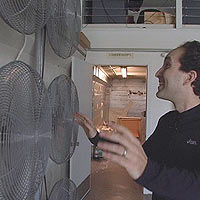
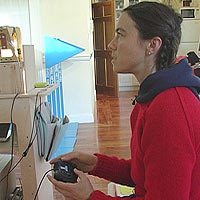
Designed for the Yerba Buena Center for the Arts, “Blow Up” is Snibbe’s first large-scale sculptural piece. It is conceptually continuous with the works that came before it. Participants can blow into a set of sensors, which then activates a corresponding grid of industrial fans. Through the movement of the fans, the participant’s breath is both represented and amplified. The piece links breath to wind, connecting the personal with the cosmic, the inside of the body with the space that surrounds it, and demonstrating the lack of difference between the two.

Scott Snibbe’s work has been shown internationally at venues that include the InterCommunications Center, Tokyo; Ars Electronica, Linz, Austria; Eyebeam, New York City; New Langton Arts, San Francisco; ICA, London; and The Kitchen, New York City. He holds B.A. degrees in computer science and fine art, and an M.A. in computer science from Brown University. Snibbe studied experimental animation at the Rhode Island School of Design and has taught media art and experimental film at Brown University, The RISD and UC Berkeley. He has held research positions at Adobe Systems and Interval Research.

Array

  • Array
  • Array
  • Array
  • Array
  • Array
  • Array

Kal Spelletich

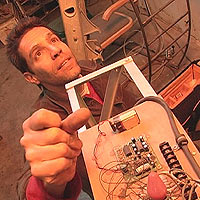
Machine artist Kal Spelletich uses his work to provoke a response in his audience: wonder, awe and even fear. Combining scrapped computer parts with welded metal, Spelletich’s machines interact directly with audience members, sometimes taking them right to the edge of bodily harm. In the episode “Shaken and Stirred,” Spark visits Spelletich in his warehouse-turned-studio as he works on some of his latest creations.

Since the late 1970s, San Francisco has been the epicenter of machine art, a creative practice that fuses kinetic technologies with artistic performance. Spelletich’s work is a unique combination of high and low technologies, combining outmoded computer hardware from Silicon Valley with the metal detritus from abandoned factories at the fringes of the city.

Spelletich’s fascination with machines developed at the age of 15, when he began working on cars in his industrial hometown of Davenport, Iowa. After years of odd jobs, Spelletich enrolled at the University of Iowa, where he studied photography and graduated with a B.F.A. in interdisciplinary art. In 1987, he founded SEEMEN, a machine art collective, before completing his M.F.A. at the University of Texas, Austin, in 1989.

Lately, Spelletich has been making works that involve pyrotechnics, incorporating moving gas flames that come within inches of audience participants. For Spelletich, it is at these moments, when his works provoke a reaction of fear or anxiety, that art becomes most transformative. Spelletich has also been experimenting with biofeedback medical technology, using information emitted from a participant’s body to make a piece function. In this way, an audience member may have a reaction to a work, but the work itself also reacts to the participant, reflecting the user’s emotional state.

  • Array
  • Array
  • Array

Amy Franceschini

Amy Franceschini is a pioneer in the burgeoning field of net art, an art form that is created, circulated and experienced through the Internet. She is the founder of Futurefarmers, an art and design collaborative dedicated to expressing environmental and community interests through digital media. In “Shaken and Stirred,” Spark checks out her piece, “Fingerprint Maze,” at Pond gallery.

While playing video games one day with a friend, Franceschini imagined getting inside her own fingerprint and finding her way around within its twisting grooves as one would within a labyrinth. Her latest piece provides just such an experience. A scanner takes an image of a participant’s print, which is then modeled into a virtual, three-dimensional maze and projected onto a wall. The participant can then enter into the labyrinth of his or her own fingerprint as though it were a topiary maze. Franceschini has plans to save these mazes and allow others to try them out via the Web.

In addition to founding Futurefarmers, Franceschini helped to start Atlas, an online magazine, in 1995. She has taught at art and design in schools across the Bay Area, including Stanford University. She has shown at Yerba Buena Center for the Arts, Cooper-Hewitt, the National Design Museum and Transmediale in Berlin, and was invited, along with Futurefarmers, to participate in the 2000 Whitney Biennial.

  • Array
  • Array
  • Array

Wowhaus

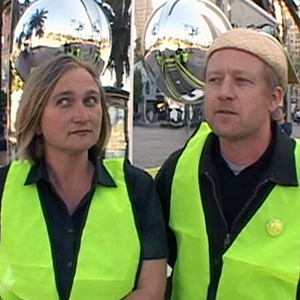
Wowhaus is an artist collaboration between Ene Osteraas-Constable and Scott Constable, whose work is focused on public site specific work. Spark hits the streets with them to check out a public art project funded by the San Francisco Arts Commission called the Art on Market Street Program.

  • Array
  • Array

BAYCAT

“Environment is the cornerstone of community,” says Bill Strickland, co-founder of San Francisco-based Bayview-Hunters Point Center for Arts and Technology (BAYCAT). “In my view, there can’t be any change unless the fundamentals of the environment are in place to encourage that growth and creativity.”

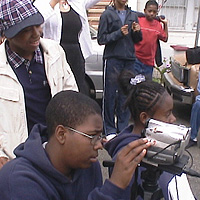
In the Spark episode “Making Room for Art,” follow Villy Wang, BAYCAT’s executive director and co-founding team member, as she helps a group of students create a film project entitled “Hunters Point Heroes,” which documents members of the local community who have made a difference in these children’s lives — figures such as Bayview filmmaker Kevin Epps, who, like the students, has used film to bring about awareness of the neighborhood in all its forms. See how the process of making art empowers these students, and ultimately their families and their community, to see themselves in a different light.

The environment, like art, is inherently intangible, simultaneously fragile and a powerful force for change. Luckily for the residents of Bayview-Hunters Point, some prominent figures in the arts are working with the BAYCAT team to increase the role of art in the neighborhood, not only for art’s sake, but also to bring about social and economic uplift. Strickland, a ceramic artist and social entrepreneur who has spearheaded social initiatives in the past, teamed up with jazz legend Herbie Hancock, one of BAYCAT’s board members, for this project. “We know that in the next millennium, the convergence of art and technology is going to be a big factor,” says Hancock.

BAYCAT focuses on youth and adult programming, training participants for jobs and business opportunities in fields that San Francisco is best known for: arts, graphic design and media, biotechnology and medical technology, the culinary arts, and the financial sector. With major funders such as the Skoll Foundation and the Pierre and Pamela Omidyar Fund, the BAYCAT team is realizing its mission, a school that conducts art and technology programs to inspire inner-city youth’s and adults to become not just artists, but business-savvy individuals who will be an asset to their communities. BAYCAT envisions an accessible education and training system that instills every individual with the self-confidence and self-respect needed to define and achieve his or her own life’s dream.

BAYCAT’s 5,000-square-foot site is currently being renovated. When completed, it will serve as a state-of-the-art multiuse, multidimensional learning and presentation environment. BAYCAT is a powerful example of bringing together training, education, art, music, culture and enterprise as a community focal point to enrich one of the most underserved districts in San Francisco, providing opportunity for a neighborhood greatly in need of it.

  • Array
  • Array
  • Array

Yerba Buena Center for the Arts

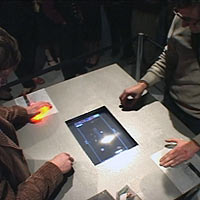
The “Bang the Machine” exhibit at the Yerba Buena Center for the Arts (YBCA) from January 17 through April 4, 2004, brings a whole new dimension to digital gaming. For example, those brave enough to play “Painstation” have their hands shocked, whipped, and burned for making mistakes in a game of Pong. As Spark tours the exhibit, artists discuss gender in the world of interactive technology and the connection between visual artistry in digital games.

Incorporated in 1986, YBCA was built by the San Francisco Redevelopment Agency to help transform a once dilapidated area of the city into an urban cultural center. The YBCA presents contemporary work by visual and performance artists from the Bay Area and around the world.

  • Array

Paul DeMarinis

In the Spark episode “Technophiles,” viewers encounter Paul DeMarinis‘s art which is filled with things both simple and magical. People experiencing his art might be standing outside, listening to the music created by a sound-modulated water jet against the fabric of an open umbrella, or they might be seeing a gas flame, flicking in lockstep to the breaths of dictators’ recorded radio addresses.

Ever since watching atomic tests light up the Nevada sky as a young boy, DeMarinis has been fascinated by the human relationship with technology. In 1971, he began working as a multimedia electronic artist, becoming one of the first to use a personal computer as an art-producing tool. He has since created numerous performance works, sound and computer installations, and interactive electronic inventions. His art has taken him around the world — DeMarinis has performed and displayed his art in galleries from New York to Tokyo, at the 1996 Olympics in Atlanta and at the 1998 World Expo in Lisbon.

DeMarinis works in the intersection of tradition and progress, striving to cover modern knowledge’s bases. He is a Renaissance man in the tradition of Benjamin Franklin, a person comfortable in both the arts and the sciences, whose kind is slowly disappearing as society becomes increasingly specialized. Aside from being an artist, he is a historian, an experimenter, a chemist, a physicist, an engineer, a programmer, an inventor, a computer scientist and an archaeologist. A multidisciplinary approach helps him distill technology’s many facets into art installations that aim to be at once comprehensible and profound.

The interplay between current and “orphaned” technologies is of particular interest to DeMarinis as he looks back in time and sees forward to our present state, achieving a perspective that unlocks secrets otherwise lost in the zeal for progress. As Peter Richards of the Exploratorium museum in San Francisco has written about DeMarinis, “His is the job of exploring the relationship between questions being asked in our culture and the tools being developed to find the answers.” Questions as large as these sometimes require a person like DeMarinis, who can take history and technology together in his arms and nurture it into art.

  • Array
  • Array
  • Array
  • Array

Ken Goldberg

Conceptual artist Ken Goldberg is considered a pioneer in the growing genre of Internet art. A professor of industrial engineering at the University of California at Berkeley, Goldberg combines his skill in robotics and his fascination with the social behavior of Internet communities. The result is a series of whimsical artistic experiments in which strangers use the Internet to jointly control and monitor real-life events and activities. In the Spark episode “Technophiles,” join Goldberg as he explains several of his pioneering works in the emerging field of Internet and tele robotic art.

On selected Fridays at noon, Goldberg and his students organize a game of Tele-Twister at the Alpha Lab at U.C. Berkeley. As in the original Twister game, Tele-Twister participants contort their bodies in order to place their hands and feet on colored dots — except in this version, remote players log in via the Internet and collectively decide how the participants move.

Goldberg began experimenting with using machines to make art while completing a Ph.D. in robotics at Carnegie Mellon University in the late 1980s. For the installation “Power and Water,” in 1992, Goldberg and his students at the University of Southern California built a robot programmed to paint on large paper during the exhibition. Because the piece combined robotics and painting — a medium usually associated with a unique style produced through an artist’s hand — “Power and Water” raised many questions about the uniqueness, authenticity and even authorship of art.

Though the exhibition had been well attended, Goldberg was frustrated with the limited audience reached through a gallery show. So in 1994, with the emergence and widespread popularization of the Internet, Goldberg assembled the first tele-robot in a work called “Mercury Project,” an interactive online scavenger hunt. The work reached an audience unimaginable in a gallery context, receiving more than 2.5 million hits in the seven months it remained online.

Goldberg’s next project, “Telegarden,” which is still online and offers participants use of a robot to tend and monitor a remote garden. There are no behavioral restrictions on the project; however, participants are never entirely sure whether others are watching them or not. In this way, “Telegarden” is concerned with the behavior of users who are aware that they may become objects of scrutiny.

In the vein of “Telegarden” and in time for the 40th anniversary of the Free Speech Movement in October (2004), Goldberg’s team launched another webcam project. In the “Demonstrate” project, the camera provides a 360-degree view of the activities at Sproul Plaza on the UC Berkeley campus, a location which has been traditionally used for political demonstrations and rallies. This installation is implemented by using advanced networked robotic camera, a visual database, and a mathematical model of socio-ocular behavior. The Web site can handle up to twenty simultaneous users and allows each user to zoom into the scene and to take still photographs.

Since 1995, Goldberg has been teaching computer science at U.C. Berkeley, where he also co-founded the Art, Technology and Culture Colloquium. His artwork has been shown internationally at Ars Electronica in Austria, ZKM in Germany, Pompidou Center in France, Tokyo ICC Biennale, Artists Space, the Kitchen, the Walker Art Center and the Whitney Biennial (2000).

Array

  • Array
  • Array
  • Array
  • Array

Southern Exposure

Editor’s note: Southern Exposure has moved since this video was released. Their new address is listed below.

Southern Exposure, a non-profit artists organization as part of Project Artaud, has been an integral part of the arts community for over thirty years. Their large and open space occupies 2,400 square feet and has two galleries. Artists contribute to the organization’s policies, planning along with their advisory board. Southern Exposure shows contemporary artwork that is conceptually diverse spanning across several mediums from painting and photography to cutting edge multi-media installations. In addition to their visual art exhibitions, they offer programs such as public lectures, residencies and a youth advisory board.

  • Array

James Buckhouse

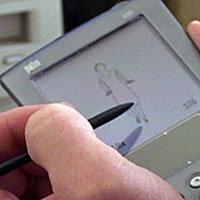
“Tap: A Share-Ware Art Project” was created by James Buckhouse in collaboration with Holly Brubach, dancer Christopher Wheeldon, and programmer Scott Snibbe. This free software can be beamed from one PDA (personal digital assistant like a Palm Pilot) to another, creating a person-to-person connection between the PDA holders like real dancers might experience when sharing choreography with one another. The user can then chose a male or female dancer, who must then practice to improve his or her dancing technique.

“Tap” was commissioned by Dia Center for the Arts and selected for the 2002 Whitney Biennial exhibit. Spark visits with Buckhouse to discuss how a simple line drawing of a dancer can create parallels between the arts and digital technology.

  • Array
  • Array
  • Array
  • Array