Category Archives: Digital Arts

Jim Campbell

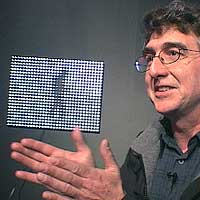
One of the most innovative artists in the country, Jim Campbell leads the way in the use of computer technology as an art form in his customized electronic sculptures and installations.

Now living in San Francisco, the Chicago-born Campbell holds degrees in mathematics and engineering from MIT. As an electrical engineer, he possesses more than a dozen patents in image processing and high-definition television; however, as an artist, he parlays his technical expertise into the aesthetic exploration of low-resolution video displays. In the mid-1980s, he transitioned from filmmaking to interactive video installations.

Campbell’s art consistently has probed into the questions of perception, time and memory. Much of his recent work harnesses the visual impact of LED (light emitting diode) displays, by transmitting digital video through LEDs, in order to create moving-image sculptures. But these works are not so much about an LED display as they are about the perception of a recognizable moving image through extremely low resolution and with very small amounts of information.

Spark follows the development of a series of works, in which Campbell explores the very essence of movement and information in a group of LED pieces called “Motion and Rest Studies,” which focuses on people with physical disabilities, a personal inspiration for Campbell, who grew up with parents who had physical disabilities. Sherry Petrini, one of six people featured in “Studies,” comments: “My overall feeling about it [is] that it’s a gentle rendering of a very profound human experience … a feeling of warmth and humanity.”

  • Array
  • Array
  • Array

Pamela and Richard Kramlich

With more than 200 pieces, Richard and Pamela Kramlich have one of the world’s largest private collections of video and new media arts. In the “Collectors and Their Collections” episode, Spark gets a rare insider’s look at what it takes to acquire, preserve, and display this challenging contemporary art form. Plus, tour the Kramlich home and comb the city for new works with their private curator, Christopher Eamon.

The Kramlichs have been collecting film and video-based art since the late 1980s. Their collection includes pieces by such historical figures as Vito Acconci, Dara Birnbaum, Marcel Broodthaers, Dan Graham and Bruce Nauman as well as works by leading contemporary artists including Matthew Barney, Stan Douglas, Steve McQueen, Mariko Mori, Keith Tyson and Jeff Wall.

In 1997, the Kramlichs established the New Art Trust to advance the media arts through the support of research and scholarship in the field. This foundation also collects and maintains new media art installations between San Francisco and New York Museums of Modern Art and the Tate Modern in London.

  • Array
  • Array
  • Array

Ned Kahn

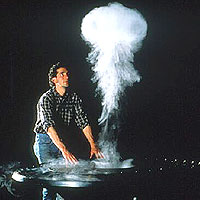
Giant whirlwinds, spiral galaxies and oceanic currents are just a few forces at work in Ned Kahn‘s art. This Sebastopol artist applies his background in science to the engineering of wondrous sculptures and public installations that transform natural phenomena into dynamic visual experiences, unveiling the mystery of the physical world surrounding us. Spark tracks Kahn in his studio and machine shop as he churns out the final details of his monumental project “Wind Portal.”

Internationally renowned for his installations, Kahn’s creative impetus began in the Bay Area. Soon after graduating from the University of Connecticut, he became an apprentice to the late Frank Oppenheimer, legendary founder of the San Francisco Exploratorium. Kahn continued working at the Exploratorium as an exhibit designer for 10 years, where numerous works of his are still on display. Other art installations by Kahn can be found around the Bay Area, including 14 exhibits at the Chabot Space and Science and “Wind Portal” at the San Francisco International Airport BART station.

Providing many with their first exposure to environmental art, “Wind Portal” encircles the top of the main escalators at the new BART station. A 55 foot-long shimmering lattice supporting 200,000 one-inch, stainless steel discs detect and reflect every subtle shift in the wind currents passing through the station. As pedestrians enter and exit the station, they can see invisible rhythms in the wind’s behavior.

Lauding the complex beauty of fire, water, fog and wind, Kahn’s art retains a fluid momentum that conveys perpetual play of order and chaos. Although his artworks allude to numerical science, Kahn’s ultimate fascination lies in the visual wonders of natural phenomena. In Kahn’s own words, “I am less interested in creating an alternative reality than I am in capturing, through my art, the mysteriousness of the world around us.”

  • Array
  • Array
  • Array

Natalie Jeremijenko

One of the hottest topics in modern science is genetic cloning. In this episode of “Art Meets Nature,” Spark trails along with artist and engineer Natalie Jeremijenko as she moves forward with her ambitious project, “OneTree(s),” a combination of art, science and nature.

A long-term project, “OneTree(s)” is a citywide enviro-social sculpture that encourages individual action and community dialogue around contemporary environmental issues. In partnership with Pond, 100 pairs of cloned trees will continue to be planted at locations throughout San Francisco. Over many decades, Jeremijenko expects these genetically identical trees to exhibit patterns of cultural and climactic differences between their locations, painting a vast portrait of the city.

In crossing the boundaries of science, engineering and art, Jeremijenko explores the material culture that surrounds our everyday lives. Using many ideas and methods drawn from science, she experiments with digital, electromechanical and interactive systems in her art installations. In paying attention to particular details in material objects, or what Jeremijenko likes to call “everydayness,” she hopes to inspire audiences to notice and understand the subtle, yet profound truths about life in a technological age.

  • Array
  • Array
  • Array