Asides

Helena Jack

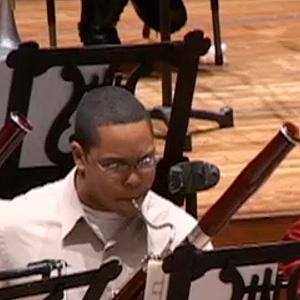
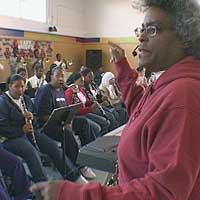
Helena Jack was a successful jazz musician, playing and traveling with distinguished jazz artists like Nancy Wilson and Eddie Fisher. She recalls that as a child, music was what kept her going — staying in school, being motivated and having fun — so she went back to school and got her credential to bring jazz music to students of Oakland. In the episode “Master Teachers,” Spark follows Jack and her school’s award-winning jazz band in preparation for an upcoming jazz festival, from fundraising to performance.

In 1995, Jack became the director of the music department at Elmhurst Middle School in the Oakland Unified School District, where she developed a program of instrumental and choral instruction. Jack found that once she had worked with the students in the junior high most went off to Castlemont High School where there wasn’t a music program. Not satisfied with that arrangement, she began splitting her time between the two schools, becoming the only instrumental music teacher for a total of 2600 students.

In a neighborhood plagued by poverty, Jack finds it important to provide the students with music programs, but also to take them to outside activities and events like jazz festivals and competitions. Since many of them have never gone much further than their own homes and schools, it gives the students exposure to other people and places as well as other music styles, genres and methodologies. They get to experience working with renowned jazz musicians, competing against other bands and performing for the public.

In 2002, she founded Standing Ovation Performing Arts (SOPA) with the mission to provide quality jazz music education within a nurturing environment to East Oakland youth. SOPA is dedicated to fostering aesthetic growth as an essential part of a child’s total education by providing scholarships, creating enrichment programs and funding a summer school music workshop. Performances and active exchanges with other schools are developed throughout the year, culminating in an annual trip to a music festival.

Teaching the students to play and having them play together is something that is important to Jack. Though the schedule and the budget can be a challenge, she would hate to see the programs die in the district. The students need to have a creative outlet, so Jack keeps going. “What keeps me going and coming back as tired as I am, is looking at the kids and seeing the success … It gives you energy!”

SOPA (Standing Ovation Performing Arts)
Where: 7933 Hillmont Dr., Oakland
Phone: (510) 685-3636

  • Array
  • Array
  • Array

San Francisco Symphony Youth Orchestra

The young people in the San Francisco Symphony Youth Orchestra come from every corner of the Bay Area, from private and public schools. Some got their start in school, some in private lessons, some just doodling on their own. Spark talks to Michael Tilson Thomas and members of the San Francisco Symphony Youth Orchestra about what makes a teacher great.

  • Array

Natalie Jeremijenko

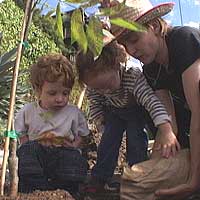
One of the hottest topics in modern science is genetic cloning. In this episode of “Art Meets Nature,” Spark trails along with artist and engineer Natalie Jeremijenko as she moves forward with her ambitious project, “OneTree(s),” a combination of art, science and nature.

A long-term project, “OneTree(s)” is a citywide enviro-social sculpture that encourages individual action and community dialogue around contemporary environmental issues. In partnership with Pond, 100 pairs of cloned trees will continue to be planted at locations throughout San Francisco. Over many decades, Jeremijenko expects these genetically identical trees to exhibit patterns of cultural and climactic differences between their locations, painting a vast portrait of the city.

In crossing the boundaries of science, engineering and art, Jeremijenko explores the material culture that surrounds our everyday lives. Using many ideas and methods drawn from science, she experiments with digital, electromechanical and interactive systems in her art installations. In paying attention to particular details in material objects, or what Jeremijenko likes to call “everydayness,” she hopes to inspire audiences to notice and understand the subtle, yet profound truths about life in a technological age.

  • Array
  • Array
  • Array

Ned Kahn

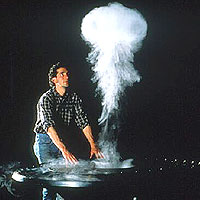
Giant whirlwinds, spiral galaxies and oceanic currents are just a few forces at work in Ned Kahn‘s art. This Sebastopol artist applies his background in science to the engineering of wondrous sculptures and public installations that transform natural phenomena into dynamic visual experiences, unveiling the mystery of the physical world surrounding us. Spark tracks Kahn in his studio and machine shop as he churns out the final details of his monumental project “Wind Portal.”

Internationally renowned for his installations, Kahn’s creative impetus began in the Bay Area. Soon after graduating from the University of Connecticut, he became an apprentice to the late Frank Oppenheimer, legendary founder of the San Francisco Exploratorium. Kahn continued working at the Exploratorium as an exhibit designer for 10 years, where numerous works of his are still on display. Other art installations by Kahn can be found around the Bay Area, including 14 exhibits at the Chabot Space and Science and “Wind Portal” at the San Francisco International Airport BART station.

Providing many with their first exposure to environmental art, “Wind Portal” encircles the top of the main escalators at the new BART station. A 55 foot-long shimmering lattice supporting 200,000 one-inch, stainless steel discs detect and reflect every subtle shift in the wind currents passing through the station. As pedestrians enter and exit the station, they can see invisible rhythms in the wind’s behavior.

Lauding the complex beauty of fire, water, fog and wind, Kahn’s art retains a fluid momentum that conveys perpetual play of order and chaos. Although his artworks allude to numerical science, Kahn’s ultimate fascination lies in the visual wonders of natural phenomena. In Kahn’s own words, “I am less interested in creating an alternative reality than I am in capturing, through my art, the mysteriousness of the world around us.”

  • Array
  • Array
  • Array

Bill Dan

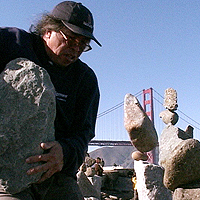
On any given day and in all types of weather conditions, nature artist Bill Dan can be seen balancing rocks at Fisherman’s Wharf, Crissy Field or on the waterfront of Sausalito. Since he began this practice in 1994, he has become a well-known local figure, often attracting large groups of spectators who gather around him while he creates vertical rock sculptures that seem to defy gravity.

Completely self-taught as a rock balancer, he plays upon the possibilities inherent to the interaction of rock, mass and gravity to create his nature art. There are several forces governing his approach: concentration and a positive attitude, along with an understanding of and respect for materials. His philosophy is that balancing rocks is play and work, beauty and craft. Sometimes building up to 10 sculptures in a day, he acknowledges that the act of physical labor, of hours spent stacking heavy rocks, depends upon his being in a good mood.

He keeps his work as simple as possible, to be an antidote to the complications of modern living. His source material is the “stone riprap” for their seemingly endless supply and varying shapes, sizes, colors and textures. The abstract sculptures he leaves behind do not conflict or compete with the beauty of their surroundings — they merely allow viewers to appreciate nature in new ways.

Spark catches up with Dan and witnesses that his work is both public and performance art. The crowds observing him get different things out of it. For some it is meditative and spiritual in its simplicity; for others, Dan’s ability to balance large stones perfectly on small rocks — without the use of any adhesive — is awe-inspiring. Unlike many public art pieces, his are not bound for permanence, and upon completion, the sculptures are left to endure the elements. It is part of his art to accept that his rock formations are temporary and ephemeral, even fleeting.

Bill Dan left his native Indonesia more than 20 years ago. He says that his friends and family back home can’t believe what he does. Still at it, he is out there every day doing what he loves: building sculptures and sharing his simple philosophy with others. Not limited to shores, he has been invited to perform at events and to teach schoolchildren the importance of using creativity and imagination over drugs.

  • Array

Chris Johanson

Visual artist Chris Johanson dodges the spotlight since being jettisoned to international art stardom when his site-specific installation was included in the 2002 Whitney Biennial. Also, in 2002, he was one of four recipients of the SECA award, for emerging artists from San Francisco Museum of Modern Art. In the episode “Fame,” Spark explores the impact this success has had on his gritty, street-based works, journeying with him from his studio in San Francisco to the Deitch Projects gallery in New York City.

With no formal art training, Johanson learned his craft in everyday jobs — painting skateboards and houses. In 1989, he found a home and a community of artists in San Francisco’s diverse Mission District. His early work consisted of deeply observational drawings of distinctive cartoon characters, using black Sharpies on restroom walls and lampposts. He continues to work in the “documentary” spirit but his work has evolved into more colorful, show-stealing, grandiose works. Ever modest, Johanson professes that “art is really about sharing information and ideas … that’s more important than the artist.”

Like the work of many artists who are identified with what is now dubbed the Mission School, Johanson’s works are a direct response to his suburban upbringing. The Mission School, known for filtering themes on urban realism through graffiti art and social commentaries on found or recycled materials, also includes internationally acclaimed artists Barry McGee (aka Twist), Alicia McCarthy and the late Margaret Kilgallen.

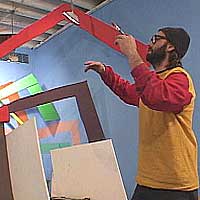
Spark follows Johanson and his neighborhood artist-friends as they install the Deitch show “Now is Now.” This solo exhibition of Johanson’s individual pieces constructs one continuous document about life. In the exhibition, paintings of crudely drawn figures lead to the centerpiece sculpture of a ship that is mechanically going around in circles, chasing a bag of money with a brightly painted backdrop of abstracted swastikas.

Array

  • Array
  • Array
  • Array
  • Array
  • Array

Rasta Thomas

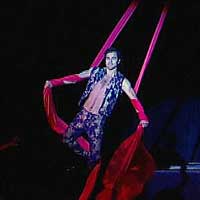
Gifted with movie star good looks, prodigious talent and a youthful ambition, dancer and actor Rasta Thomas could be thought of as the epitome of the dance world’s perfect star — a mercurial action hero as at home in the ballet classics as he is in Broadway musicals.

Born in San Francisco in 1981, Thomas displayed a phenomenal natural affinity for movement early on, studying martial arts, swimming and gymnastics from the age of three on. He won his first dance competitions at 9, and made a splash in the ballet world at Varna, Bulgaria in 1996 when he won the gold medal in the Junior Division, and then again in 1998 when he won the gold medal in the Senior Division at the International Ballet Competition in Jackson, MS — the first 16-year old to do so.

His remarkable talent has given Thomas the ability to forge a unique path to a career in the dance world. Instead of joining a single company to secure his future, Thomas has the luxury of an array of choices. It’s an advantage that has resulted in a diverse resume that includes every thing from ballet companies (Dance Theatre of Harlem and LINES Contemporary Ballet) to film (Patrick Swayze’s “One Last Dance”) to the musical stage, starring as Eddie in the tour of the Broadway hit “Movin’ Out.”

In “Fame,” Spark follows Thomas to Los Angeles, from ballet class with Adrian Dellas — one of his first dance teachers — to rehearsal with Debbie Allen on her show, “Pearl.” It’s a typically hectic day in the life for the mercurial Thomas, who sees himself as the artist of the future, a dancer for whom any kind of movement is both an open challenge and an opportunity.

  • Array
  • Array
  • Array

Joshua Bell

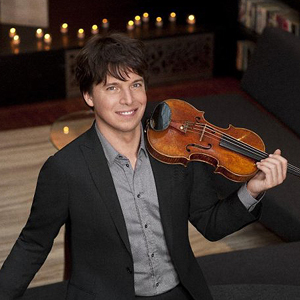
Violinist Joshua Bell is one of the world’s top classical soloists. He debuted with the Philadelphia Orchestra at the age of 14. Twenty years later, he’s still packing concert halls wherever he goes. Joshua is, by anyone’s definition, a superstar complete with fan club and recording contract.

Spark visits him at rehearsal at Davies Symphony Hall, San Francisco.

  • Array

Asian Art Museum


View Spark segment on the opening of the new Asian Art Museum building with Pop Zhao. Original air date: March 2003 as part of the episode “Opening Nights.” (Running Time: 8:15)


View Spark segment on the Shanghai exhibit at the Asian Art Museum. Original air date: February 2010 as part of a This Week in Northern California episode. (Running Time: 6:08)

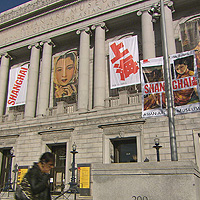
Shanghai at San Francisco’s Asian Art Museum is the first large-scale exhibition to feature the cultural productions of the city of Shanghai. Using a wide range of visual artifacts, the exhibition traces the impact that globalization has had on molding the city’s dynamic, international character. Spark gets a guided tour of this unprecedented exhibit.

Shanghai runs from February 12 through September 5, 2010, and is the cornerstone of the Bay Area-wide yearlong celebration of San Francisco’s illustrious sister city. The celebration features concerts, performances, films, lectures, special events, programs, and exhibitions presented by local arts organizations in honor of the 2010 World Expo in Shanghai, to be held May 1 through October 31. The theme of the World Expo is Better City — Better Life, heralding Shanghai’s 21st-century status as a major economic and cultural center. It is expected to generate the largest number of visitors in the history of World Expos.

More about the Asian Art Museum
Originally housed in a wing of the de Young Museum in Golden Gate Park, the Asian Art Museum has been in the works since 1959, when Asian art collector Avery Brundage donated 8,000 works of art to the city of San Francisco. Since then the museum has managed to raise enough money to move out of its temporary location in the de Young Museum to its new home, the renovated site of San Francisco’s old main public library. With architect Gae Aulenti overseeing the dramatic transformation of San Francisco’s former Main Library, the new structure features 40,000 square feet of gallery floor, enhanced with state-of-the-art interpretive displays and programs.

The Asian Art Museum is one of the largest museums in the Westernworld devoted exclusively to Asian art. Its holdings include nearly 15,000 treasures spanning 6,000 years of history and representing cultures throughout Asia. Nearly 2,500 objects are on display at any given time with many hundreds rotating throughout the year.

Array

  • Array
  • Array
  • Array
  • Array

Teatro Visi贸n

Pulling out all the stops, Teatro Visi贸n takes on its biggest challenge yet — an opening night on a shoestring. In the episode “Opening Nights,” Spark captures all the creative trials and tribulations as the staff of this small theater company tries to fill their new 500-seat theater for the 2003 world premiere of a potentially controversial new work, “Conjunto” by Oliver Mayer.

A co-production of Teatro Visi贸n and Contemporary Asian Theater Scene, “Conjunto” takes place during World War II and tells the story of California farm workers of Mexican, Filipino and Japanese descent. The play addresses issues surrounding the internment of Japanese Americans and the deportation of Mexican immigrants. Los Angeles playwright Mayer developed “Conjunto” at the Sundance Lab, San Jose Rep and the Mark Taper Forum New Work Festival.

Teatro Visi贸n produces bilingual (Spanish/English) plays and their new theater boasts being the largest on the West Coast for Chicano/Latino theater. Originally named Teatro Huipil, Teatro Visi贸n was founded in 1984 as a nonprofit arts organization. The company is committed to providing a forum for aspiring Latino/Latina actors, playwrights, directors and a host of other artists living Santa Clara County. It is also dedicated to promoting multicultural participation at all levels of the organization. In addition, the Academia de Teatro Program offers training workshops taught by its core ensemble members.

Teatro Visi贸n
teatrovision.org
Where: Mexican Heritage Plaza, 1700 Alum Rock Ave., San Jose
Phone: (408) 272-9926

Array

  • Array
  • Array
  • Array

San Francisco Ballet

View Spark segment on San Francisco Ballet’s Don Quixote. Original air date: March 2003. (Running Time: 4:41)

View the Spark episode on SF Ballet’s New Works Festival. Original air date: April 2008. (Running Time 29:05)

Spark visited the San Francisco Ballet twice; once in 2003 for for a taste of the ballet classic “Don Quixote” and again in 2008 for their New Works Festival.

In celebration of its 75th anniversary, San Francisco Ballet is mounting an ambitious festival of new works by ten renowned choreographers. The ballet’s artistic director Helgi Tomasson often refers to the company as a laboratory for new ballets and conceived the New Works Festival as opportunity to look forward to the future of this centuries old art form. Spark follows the creation of three distinctively different dances by Mark Morris, Margaret Jenkins and Christopher Wheeldon.

Known for his musicality and irreverence, Morris enlists Isaac Mizrahi to design the costumes and John Adams to compose the music. Bay Area choreographer Jenkins pushes the company’s dancers into unknown territory by asking them to collaborate on the making of the dance. And heralded as the next Balanchine, Wheeldon wants to bring ballet to a new generation by infusing classical dance with contemporary elements.

  • Array
  • Array
  • Array
  • Array