Asides

Kitka

Bay Area vocal group Kitka began their journey in 1979 as a gathering of amateur singers fascinated with the exploration of traditional Eastern European women’s vocal music. Under the direction of Bon Singer from 1981 to 1996 and now led by executive director Shira Cion and music director Janet Kutulas, Kitka has developed into a professional touring company dedicated to performing, recording and presenting collaborative and educational opportunities related to Balkan, Slavic and Caucasian music for audiences across the globe. Celebrating their 30th year in 2009, Kitka continues to grow artistically with challenging new projects, tours and collaborations.

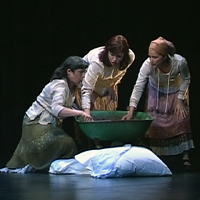
The process by which the company acquires new repertoire is rooted in careful study. The eight-member group works with renowned masters from all over Eastern Europe and travels to various countries to conduct fieldwork and make critical personal connections with women in small villages, many of whom are the last to sing the songs of their ancestors. Over the years, members of Kitka were inspired by the legends of the Rusalki, siren-like mythical creatures thought to be the spirits of women who suffered tragic or untimely deaths. Working with Ukrainian singer and composer Mariana Sadovska, they returned to Ukraine to learn songs and rituals surrounding the Rusalki directly from the women in rural communities, and they created a vocal-theater piece based on their research. The Rusalka Cycle opened to resounding success in 2005 and again in 2008, and it is being remounted to tour Eastern Europe in 2009.

Each year brings new projects and a new concert season, and to celebrate their 30th anniversary, Kitka released their recording Lullabies and Songs of Childhood. This collection of reinterpreted traditional lullabies has been passed on in the oral tradition by generations of Balkan, Slavic, Georgian and Armenian women. For their project Singing Through the Darkness: A Dramatic Song-Cycle Performance, they gathered songs and stories that express the multifaceted experience of wartime, with a special effort to invite contributions from the survivors of the Balkan conflict living in the Bay Area.

As part of their ongoing commitment to preserving endangered vocal traditions and collaborations with traditional artists, Kitka developed a program called Song Routes in a New Land: Folk Song Master Residencies, in which they work with several master folk singers and teachers dedicated to transmitting their vocal heritage both at home and within immigrant communities in the United States. Artists for 2009 include Birol Topaloglu (Laz vocalist from Turkey), Tzvetanka Varimezova (Bulgaria), Ensemble Kedry (Siberia) and Hasmik Harutyunyan (Armenia).

Array

  • Array

Victoria May

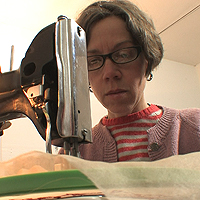
For most of us, clothing is cover-up, a practical shield against the elements, a fabric tool used variously to hide or enhance the specifics of the body underneath. But in the hands of Santa Cruz multimedia artist Victoria May, clothing has a way of trading its traditional role to become a form-fitting canvas created to showcase the psychological.

“There is a strong relationship to our daily lives with textiles because we wear them, we use them at home, we sleep in them. And so, to see artwork that incorporates something that is so personal to you, I think there is something very evocative about that,” May tells Spark.

A self-trained seamstress who began threading needles as a preteen and honed her skills creating couture wedding gowns, May uses hand-sewing techniques culled from vintage instructional manuals and works with unexpected found and reclaimed materials — such as shards of auto glass, bone, sand and locks of human hair — to communicate elements of the imagined wearer’s psyche in her Blouse and Headgear series. Her installations feature objects and forms built from textiles distressed with dirt, rust and scrap paper and from such mundane objects as ironing boards and crutches, sourced through the artist’s frequent foraging adventures at yard sales and thrift stores.

Using and recycling objects that have their own history adds further depth to each finished work for May, who has been experimenting with new ways to alter the fabrics and materials she will later transform once again with needle, thread and traditional finishing techniques rooted in craft. A visit to her studio might reveal, for example, a swathe of mud-stained fabric fresh from a temporary burial in the earth or the skins of yams treated with gel mediums to increase their durability. The resulting work is steeped in a process that’s curiously reminiscent of the complex human mentalities that May’s work seeks to address.

May earned her M.F.A. from San Jose State University. Her work has appeared in solo and group shows at a lengthy list of venues, including the Santa Cruz Museum of Art and History, the University of California at Santa Cruz, the Center for Book Arts in New York, and the Don Soker Contemporary Art gallery in San Francisco.

  • Array
  • Array

Arts and the Economy Report from The NewsHour (2009)

When the economy takes a turn for the worse, arts institutions and programs often suffer from cutbacks because of the perception that the arts are a dispensable luxury. But even as the Obama administration puts together an economic stimulus package that includes $50 million for the National Endowment for the Arts (NEA), economists such as Amity Schlaes debate what the federal government’s role should be in sustaining a vibrant arts community in America.

Spark, in a joint report with The NewsHour, looks at the impact of the economic recession on artists such as muralist Sirron Norris and writer Carla Blank and discusses whether a public arts program similar to the Federal Art Project (FAP) of the 1930s is a viable way to help artists who are feeling the financial pinch.

During the Great Depression, amidst programs that would eventually employ some 3.3 million people, Franklin Delano Roosevelt’s Works Progress Administration actively sought to bring relief to working artists by sponsoring a wide range of public-art projects as part of the New Deal. These projects helped, among others, Jackson Pollock, Mark Rothko, Philip Evergood and Lee Krasner.

Under director Holger Cahill, the FAP — following in the footsteps of Roosevelt’s earlier Public Works of Art Project, whose purpose was “to give work to artists by arranging to have competent representatives of the profession embellish public buildings” — created more than 5,000 jobs for artists and left a legacy of 225,000 works of art for the American public in the eight years of its existence. With offices in 48 states, the FAP commissioned works of art for numerous public buildings, managed community centers and arts programs, and sponsored exhibitions across the country. By the time the program came to a close with the advent of World War II, the thousands of artworks produced under its auspices, many of them still enjoyed today, had not only decorated American institutions and given struggling artists temporary employment, but also helped document American life.

But even beyond the aesthetic gratification that art provides is the idea that the arts can actually help drive economic prosperity — that bolstering the creative sector significantly helps the larger economy. A 2008 study, Artists in the Workforce, released by the NEA estimates that there are 2 million artists working in the United States, equivalent to 1.4 percent of the American workforce. Even more non-artists are employed by arts organizations in administrative and production roles. The research organization Americans for the Arts notes that “nonprofit arts organizations and their audiences generate $166.2 billion in economic activity every year, support 5.7 million jobs and return nearly $30 billion in government revenue every year. Every $1 billion in spending by nonprofit arts and culture organizations and their audiences results in almost 70,000 full-time jobs.”

As Carla Blank states in a 2009 op-ed in the San Francisco Chronicle, “The 21st-century version of New Deal arts programs could feature creative partnerships between artists and scientists, engineers, businesses, educators, skilled labor, city planners and community leaders throughout our nation’s cities and rural communities. When such collaborations are successful, they are called a renaissance.”

  • Array
  • Array
  • Array
  • Array

Firebird Youth Chinese Orchestra

For hundreds of the South Bay’s young Chinese Americans, reconnecting to their cultural heritage happens through the Firebird Youth Chinese Orchestra (FYCO). Founded in 2000 by Gordon Lee, the FYCO originally attracted only 13 young musicians. Today it boasts more than 100 youngsters, ranging in age from 9 to 17 years old, who come together once a week to practice on instruments whose origins date back thousands of years.

Lee and his core of musicians formed the orchestra after the successful premiere performance in Cupertino of one of Lee’s compositions, a work based on the Disney movie Mulan. Spark takes viewers behind the scenes with the Firebird Youth Chinese Orchestra as they prepare the classic folk piece “The General’s Command” for a concert at the San Jose Center for the Performing Arts in 2009.

Although the instruments they play — the lute-like pipa, the ancient moon-shaped ruan, the two-stringed fiddle called an erhu, the seven-string zither called a guqin and the hammered yanqin, among many others — date as far back as 200 B.C., the concept of a large orchestra of Chinese instruments is relatively modern. China’s first modern orchestra was founded in 1935 in Nanjing by Jilue Chen, one of Lee’s own teachers. In 2004, by invitation of the People’s Republic of China, the FYCO traveled to Beijing, Chengdu and Shanghai to perform at three of the country’s most prestigious music conservatories, becoming the first Chinese orchestra from the West to perform in China.

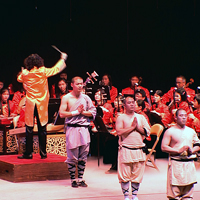
The Beijing-born Lee, whose love for traditional Chinese music was not dimmed by “reeducation” during the Cultural Revolution, began learning to play the pipa at age 13 and studied under Chen at the Sichuan National Conservatory. After emigrating to the United States in 1989, Lee earned an M.A. from San Jose State University in 1995, and since 2002, he has been on the faculty of San Jose City College, where the FYCO also offers music lessons for Chinese instruments. The composer and conductor, who creates his own arrangements of traditional Chinese works for the FYCO, has also fostered collaborations for the orchestra with other performing groups, including the Shaolin monks, who appeared with the orchestra in March 2009.

  • Array
  • Array

Daniel McCormick

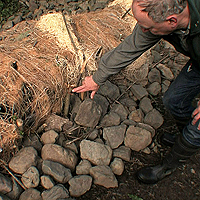
Although Marin landscape artist Daniel McCormick often exhibits his works of earth art in galleries, the natural place for his organic sculptures is in the wild, where the graceful forms find a home clinging to the edges of creek banks and gullies, gradually subsuming themselves into the existing environment. Spark follows McCormick as he works on an installation in the John West Fork of Olema Creek, in Marin — a prime spawning ground for endangered coho salmon and steelhead trout.

Born in 1950 in Oakland, McCormick graduated from San Leandro High School, then UC Berkeley, where he studied environmental design. Deeply influenced by James Turrell, whose large-scale works — such as Roden Crater in Flagstaff, Arizona — play with ideas of light and space, McCormick incorporates ideas of interplay and intervention with the natural environment into his artwork.

The Sausalito-based Headlands Center for the Arts awarded McCormick a grant to create his site-specific installations for riparian environments, areas where land and stream converge. When streams run near farms and towns, silt, gravel and sediment often flow into the water, clogging areas once populated by spawning salmon and trout. McCormick’s works — woven shields made of local biodegradable materials such as willow branches, alder and straw — are designed not only as public art, but also as strategically placed silt traps that he hopes will help restore watersheds critically damaged by erosion and agricultural runoffs.

“I want my sculptures to have a part in influencing the ecological balance of compromised environments,” McCormick states in an article in Land Views. “They are intended to give advantage to the natural system, and after a period of time, as the restoration process is established, the artist’s presence shall no longer be felt.”

For McCormick, seeing his sculptures become a part of the environment is an integral part of the process, as is the element of community education and participation. As his works have become larger in scale, McCormick often employs the assistance of students from Dominican University in San Rafael and West Marin Elementary School in the installation process.

  • Array
  • Array
  • Array
  • Array
  • Array

Kerry James Marshall

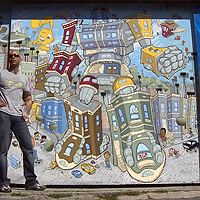
Chicago-based artist Kerry James Marshall’s large-scale artworks participate in the tradition of history painting — larger-than-life depictions of historical events. But whereas traditionally, history paintings have often relayed official accounts of nationhood, Marshall uses his work to bring untold history and counter-histories to light. Spark visits with Marshall as he works with San Francisco’s Precita Eyes muralists in creating Visible Means of Support, two specially commissioned murals for SFMOMA’s Haas Atrium.

Marshall’s sense of social responsibility guides his depictions of African American figures often absent in art institutions. His museum pieces place African Americans front and center in an array of situations that range from idyllic romantic scenarios to scenes of leaders from key historical events, like the Civil Rights Movement. The idea is to present African Americans in the full range of human experience.

Often emphatically depicted in deep shades of black, Marshall’s figures stand in stark contrast to their surroundings. These renderings have been controversial for some, but for Marshall, the decision to portray his figures in this manner is both aesthetic and political. Their absolute blackness lends a pictorial power that demands the viewer pay attention to them.

In this sense, the two murals at SFMOMA are a departure from Marshall’s usual style. The two enormous panels, each measuring 27 by 32 feet, represent what on the surface appear to be standard depictions of American history: Mount Vernon and Monticello, the estates of George Washington and Thomas Jefferson, respectively. Marshall’s usual strategy of dramatically announcing his African American figures is missing from these murals. At first glance, the large anamorphic renderings of Washington and Jefferson are the only figures one sees.

Upon closer examination, it becomes clear that Marshall has employed visual trickery to embed a series of figures in the scene — images of the African American slaves that supported these plantations. They aren’t apparent immediately, but as one looks more closely, they emerge everywhere: in the trees, the sky, the flowers, the fields, the water, and even subtler, more hidden places: In one section, Marshall has included connect-the-dot images that form African American figures, and even the dots themselves are small icons of African American heads.

To accomplish this optical trickery, Marshall has borrowed a visual language from preschool activity books — at once universally recognized and entirely unusual for history painting. The flat, un-modulated colors and heavy outlines suggest children’s coloring books, as do the connect-the-dot figures and hidden imagery that populate the murals. It’s an invitation with a simple message: Engage with this history — it’s open, it’s not difficult, it can even be fun.

Kerry James Marshall was educated at the Otis Art Institute in Los Angeles, where he earned a B.F.A. In 1999, the institute awarded him an honorary doctorate. Marshall has shown his work at several international venues, including the 2007 and 1997 editions of Documenta, the 2003 Venice Biennale, the 1999/2000 Carnegie International and the 1997 Whitney Biennial. Among the many honors he has received are a MacArthur Fellowship, a National Endowment for the Arts Visual Arts Fellowship, a Wexner Center Residency Award and a Skowhegan Medal for Painting. Marshall’s work is represented in major private and museum collections throughout the world, including the Koplin del Rio Gallery, Culver City; the Jack Shainman Gallery, New York City; the Los Angeles County Museum of Art; the Museum of Modern Art, New York City; the Walker Art Center, Minneapolis; and the Whitney Museum of American Art, New York.

Array

  • Array
  • Array
  • Array

Dan Hoyle

Editor’s note: Right? was renamed The Real Americans after the original broadcast of this story.

San Francisco writer, performer and playwright Dan Hoyle set off in a Ford E-150 conversion van on a three-month-long summer journey into America’s heartland to discover just what — and who — lies between the liberal-leaning cultures of the East and West coasts. Hoyle, a Fulbright scholar and son of well-known Bay Area circus performer Geoff Hoyle, shares with Spark what he found during his rambling adventure across some 20 states. Hoyle’s travels through countless small towns and the people he met along the way inspired the solo show Right?, a humorous and thought-provoking window into American lives lived far outside the big city.

Using his talent for capturing the language and mannerisms of real people and translating their personas into vignettes for the stage, Hoyle’s latest effort features a host of characters drawn from personalities encountered along his journey, first transmitted to the reading public through Beyond the Bubble, a series of articles for the San Francisco Chronicle and Salon.com. Among these characters are an enthusiastic Arizona gun show vendor and a Nebraska businessman with allegiances to the Aryan Brotherhood.

Instead of shying away from stereotypes and painting a picture of a cohesive America, Hoyle’s show raises questions for audiences living within the liberal bubble covering much of the nation’s outermost flanks.

“I’m throwing myself open to accusations that I’m poking fun at people, I’m judging people. … I think what I’m trying to do with this show is, first of all, to just show people some of what it’s like and to do it in a detailed and nuanced way. The other thing is, I’m trying to ask, ‘So what does it mean for us to all be a part of this country?'” says Hoyle.

Right?, which premiered at the February 2009 GAP Festival at Aurora Theatre Company, is not Hoyle’s first solo performance. His one-person show about Nigerian culture and politics, Tings Dey Happen, won the 2007 Will Glickman Award for Best New Play and was nominated for a Lucille Lortel Award for Outstanding Solo Show. His other shows include Circumnavigator and Florida 2004: The Big Bummer. Hoyle is the recipient of a Fulbright scholarship to explore politics and oil in Nigeria, and he is a teacher at the San Francisco School of the Arts through the artist-in-residence program.

  • Array
  • Array

Benjamin Levy

With a body of work noted for its pulsing athleticism and intelligent composition, Benjamin Levy has become one of the Bay Area’s most sought-after choreographers, creating a style marked by personal inspiration distilled into pure movement.

In his 2007 work tentatively called “Bone Lines,” Levy translates into dance the story of his own family, Persian Jewish immigrants who fled Iran during the religious revolution of the 1970s. Levy brings Spark inside the process of creating this piece premiering at the Jewish Community Center in San Francisco. For this production, he collaborates with his five-member troupe along with designers Colleen Quen and Rick Lee and composer Keeril Makan, whose original score will be recorded by the Kronos Quartet.

Born and raised in California, Levy studied dance as a teen, appearing with Janet Roston’s Advanced Dance Theater Group at Beverly Hills High School. His love of dance solidified when he encountered the work of Martha Graham as a student in the dance department at the University of California at Berkeley, where he earned his bachelor’s degree.

As a dancer, Levy has trained with such noted Bay Area choreographers and teachers as Janice Garrett, Ellie Klopp and Robert Moses. He has also performed with Marni Woods’s Bay Area Dance Repertory Company and the Lula Washington Dance Theater, and he spent two seasons as a company member of the Joe Goode Performance Group.

His creative and choreographic spirit, however, led him to form his own company, LEVYdance, in 2002, while he was still at UC Berkeley. The following year, the young company made a splash with its residency and performances during ODC Theater’s “House Special” series, for which he created LEVYdance’s acclaimed “Holding Pattern.” The very next year, Levy was named among the “25 to Watch” artists by “Dance Magazine.”

Within only five years, Levy’s company garnered national attention, appearing not only throughout the Bay Area, but also at the Joyce SoHo in New York, at the Dance Place in Washington, D.C., and with the Los Angeles Philharmonic in the Minimalist Jukebox Festival. Described by “Dance Magazine” contributor Heather Wisner as “a balance of brain and brawn,” Levy’s work buzzes with life and intensity.

  • Array
  • Array
  • Array
  • Array

Dhol Di Awaz

The driving, high-energy Indian folk dance known as “bhangra” has a long history that takes it from the fields of northern India and Pakistan to modern-day dance halls. It has become the connection to the Punjabi culture for a generation of Indian Americans who have grown up far from home. Spark goes inside the Dhol Di Awaz competition held at Cupertino’s Flint Center and meets one of the Bay Area’s top bhangra teams.

Founded in 1999 by the Berkeley Sikh Student Association, Dhol Di Awaz — which translates as “the sound of the dhol [an Indian drum]” — is the oldest bhangra competition on the West Coast. With participating teams that hail from as far away as Canada, it has also become one of the largest events of its kind.

Vigorous and dynamic, bhangra arose out of dances that Punjabi farmers once performed while working in the fields during the spring harvest. From there, it gradually evolved into a popular folk dance for festive occasions, such as weddings and parties. Although originally it was danced primarily by men, in modern competition it’s not unusual to see co-ed groups dressed in colorful outfits — the men usually in long tunics called “kurtas” and the women in bright baggy pants, or “salwar kameez.” Bhangra dancers traditionally bound and bob to the relentless beat of the dhol, a two-sided Indian bass drum, accompanied by such other instruments as the stringed sarangi, the jingling chimta and the sups, which resemble a long section of a wooden folding gate.

As young people of Southeast Asian descent rediscover their roots, they’ve found that bhangra’s heavy backbeat and coordination of nonstop foot and hand motions has made it a natural match to other styles of dance and music, and its distinctive rhythms have filtered into dance clubs and fused with reggae, raggamuffin, house music and hip hop, all of them breathing contemporary life into an ancient style. No longer confined to just the Punjabi area, bhangra fusion can be heard in Apache Indian’s ragga hit “Chok There,” on Missy Elliot’s 2001 Get Ur Freak On in “Beware,” in Jay-Z’s remix of the bhangra song “Mundian to Bach Ke” and even in Britney Spears’s “Me Against the Music.”

Array

  • Array
  • Array

Contemporary Jewish Museum

In any given year, spring would be an appropriate season for an art institution to explore Passover themes. But the Contemporary Jewish Museum exhibit New Works/Old Story: 80 Artists at the Passover Table comes during an especially fitting year. As the San Francisco museum’s invitational exhibition showcases artists’ interpretations of the seder plate used during Passover, a holiday with history and retelling at its core, the museum itself is both looking to its future and reflecting on its past.

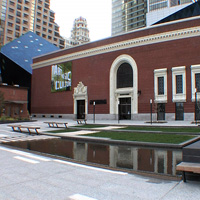
In June 2008, after nearly a decade of planning and construction, the Contemporary Jewish Museum settled into its new home, a Daniel Libeskind-designed adaptation of the landmark Jessie Street Power Substation. Noted for its striking blue steel façade, the redesigned historic building, on Jessie Square in San Francisco’s SoMa neighborhood, provides more than 10,000 square feet for the museum’s exhibition space, education center, store and café.

The institution celebrates its 25th anniversary in 2009. With its quarter-century history and long-awaited new home both squarely in the spotlight, the museum devotes its 2009 Dorothy Saxe Invitational to the central object in one of Judaism’s most widely celebrated holidays. Key to the ceremony, but without religious guidelines regulating its form, the seder plate, which is used to hold the traditional foods served on the first night of the eight-night holiday commemorating the Israelites’ exodus from Egypt, lends itself to a particularly wide variety of artistic interpretations.

Not surprisingly, the seder plates created for the exhibition range from traditional versions to conceptual objects, from the irreverent to straightforward displays of craftsmanship. A hand-carved limestone and brass serving plate by Amy Klein Reichert looks like it could be part of a real seder meal; a plate constructed of pencils and office supplies by Grace Hawthorne and Phoebe Streblow of Readymade magazine plays with the idea of everyday objects in a ceremonial space. Artist Gay Outlaw’s stackable paper plates reference the simplicity and haste associated with the first Passover meal, and Harriete Estel Berman’s ornate metal plate abounds with symbolic imagery from Jewish history.

Spark gets a closer look at this show. Taken together, the many objects on display during this juried exhibition combine to educate onlookers about Judaism’s past while raising questions about its present and future — not unlike the holiday itself.

  • Array
  • Array
  • Array
  • Array

Katherine Westerhout

Instead of glamorous hotspots, famous faces and iconic structures, Oakland-based photographer Katherine Westerhout prefers just the opposite. Rather than the latest and greatest venues du jour and the throngs that flock to them, Westerhout has built a career on creating large-scale images which capture the empty places long since forgotten by the general public — including abandoned hospitals, churches, and theaters.

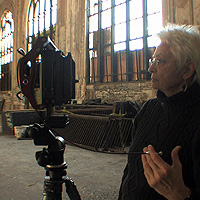
“I’ve been photographing in abandoned buildings for about 12 years now, and what I am so drawn to is the way the light enters these buildings and the way it carries color, from the outside, depending on the time of day,” Westerhout explains to Spark during a photo shoot at the train depot at 16th and Wood streets in West Oakland.

Using only available light, Westerhout prefers to work from October to April, when the sun is closest to the horizon. She is attracted to subjects like the deteriorating station, which is a 1912 Beaux Arts gem and historical landmark, for the sense of mystery that accompanies the absence of human sound and movement. At the same time, Westerhout uses her photography to preserve a part of history that would otherwise be erased as new buildings and developments arrive to replace the old.

“The train station itself has a special feeling because of its history, because of its inherent beauty. But I also grew up in Oakland. And so the opportunity to photograph here, it feels like I’m giving a little back to my city and helping to preserve it,” she says.

Westerhout earned a B.A. in art from San Francisco State University and has been exhibiting her photographs since the late 1990s. Her work has appeared in shows in the United States and internationally, at such venues as New York’s Sepia International Gallery, the San Francisco Museum of Modern Art Artists Gallery, the Oakland Museum of California, the San Jose Museum of Contemporary Art, the Berkeley Art Center, the Michael Hoppen Gallery (London, England) and the Biblioteca Nacional (Havana, Cuba).

More about the 16th Street Station:
West Oakland’s 16th Street Train Station is an important historic and cultural landmark. Built in 1912 at the terminus of the Transcontinental Railroad, for decades the station served as a beacon of hope for European immigrants and American migrants seeking a better life in California. Designed by Chicago architect Jarvis Hunt in the Beaux Arts style, the station boasted an intermodal transportation system ahead of its time — cross-country travelers could arrive on Southern Pacific trains and transfer to streetcars that would take them to destinations throughout the Bay Area.

The train station was abandoned after damage from 1989 Loma Prieta earthquake rendered it unsafe. Since then it’s fallen victim to vandals, the elements, and general neglect. Originally purchased in 2000 by Holliday Development, plans for restoration and redevelopment of the station (now known as Central Station) are currently being spearheaded by Oakland developer Phil Tagami. Once plans and funding sources have been finalized, Central Station will operate as a nonprofit community center, alongside parks, shops and new homes in the 29-acre area.

  • Array
  • Array

W. Kamau Bell

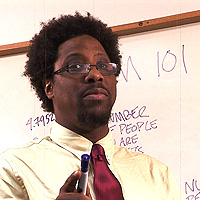
Sorting out the complexities of racism in 60 minutes might seem an impossible proposition, but that’s exactly the challenge San Francisco comedian W. Kamau Bell undertakes in his one-man show, The W. Kamau Bell Curve: Ending Racism in About an Hour. Spark visits Bell to discuss race and check out his show.

After years of performing standup in comedy clubs, the Chicago transplant to the Bay Area has been delivering his solo show before local audiences since 2007. Trading the comedy club circuit to pursue his solo show has given him new freedom to explore race and its impact on American culture in a public setting. Like his earlier work, the show is rooted in comedy. But Bell’s underlying agenda is much more serious.

“I want people to actually walk out talking about racism in different ways. We don’t ever really have open discussions about race …. Normally it’s quiet, it’s only our group. And that’s what this show’s about,” Bell explains.

During the show, Bell riffs on everything from race and politics to interracial friendships and the sort of subtle racism that is likely to emerge, as Bell puts it, “around the water cooler, at the Xerox machine, often while holding a latte.”

“An audience shows up to my solo show knowing I’m going to talk about race. It leaves me open to talk about race in ways I could never really get away with in a comedy club,” he says.

Bell was named the 2008 Bay Area Comedian of the Year by San Francisco Weekly. He can be heard on radio station Live 105 and online at Roof Top Comedy as half of the rant-and-rave team Siskel and Negro. Along with television appearances on Comedy Central and Comics Unleashed, he has performed at numerous festivals and comedy events, including the New Faces show, the Just for Laughs Festival in Montreal and the Best of the Uptown Comics show.

  • Array

Wil Blades

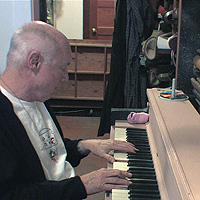
Wil Blades is at the top of the local music scene as a Hammond B3 organ player. The B3 is that big warm sultry, funky tone that provided the groove to many of the 1960s and 1970s R&B recordings. The B3 is experiencing a revival today, particularly among jazz saxophonists who find it a nice complement to a trio.

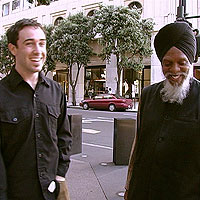
Blades is only in his 20s but plays like a veteran, and his knowledge of the instrument is encyclopedic. He has accompanied the greats, including good friend and B3 legend Dr. Lonnie Smith. Their relationship is based in part on their love of music, but also Smith has been a mentor to Blades.

There aren’t a lot of places besides the Boom Boom Room that have a B3, so Blades owns three of his own organs. For many of his performances, Blades lugs his organ around the Bay Area in his van — as Spark witnesses. As he says, “It’s like a piece of furniture.” Imagine taking a 400-pound desk around with you, and you begin to get the idea.

Originally from Chicago, Blades began playing and studying drums at the age of 8, guitar at 13 and organ at 18. He studied at New College of California. He teaches at Berkeley Jazz School and plays in a number of different groups, including the Wil Blades Trio, O.G.D., Steppin’ and BluesBeat. Blades can be seen performing regularly as the house organist at John Lee Hooker’s Boom Boom Room.

Array

  • Array
  • Array

Ron Nagle

Master ceramicist and singer-songwriter Ron Nagle claims to have little patience. But to anyone familiar with the painstakingly rendered, diminutive forms he has become best known for over the last three decades, impatience seems an unlikely quality to ascribe the San Francisco artist.

“Yes, it does take an amazing amount of patience, which, if you ask anybody — particularly my wife — I have none of. Except when I’m in here,” Nagle says as he works in his studio.

Nagle apprenticed with the late ceramic artist and UC Berkeley professor Peter Voulkos and was further influenced by the work of renowned ceramicist Ken Price and the Italian painter Giorgio Morandi. Nagle often applies bold colors, which are inspired by the 1950s hot rods of his youth, to his ceramic vessels and abstract forms. Achieving the deep, rich hues and painterly mingling of colors that characterize his work can require each piece to undergo firing 10 times — and often many more.

When he’s not consumed with clay, Nagle’s talents play out in an entirely different kind of studio. Since the late 1960s, Nagle has achieved steady — if under-the-radar — acclaim for his music. He has been in two different bands, the Durocs and the Mystery Trend, and has put out a solo album, Bad Rice. He also has written songs recorded by the likes of Barbra Streisand, Jefferson Airplane and the Tubes. As Spark catches up with him, Nagle is hard at work on his first new album in 30 years, with songwriting partner Scott Mathews.

And although the mediums with which Nagle works and the worlds within which he works may be separate, his goal for both is the same. “I just want to perpetuate the things that I’ve been moved by and that I love, and, in turn, I want to do something and hope that something I make will blow somebody’s mind,” he says.

A teacher at Mills College since 1978, Ron Nagle is currently the Joan Danforth Faculty Chair and head of the school’s studio art department. He is the recipient of two Mellon Grants and multiple fellowships from the National Endowment for the Arts, among other awards. His work can be found in the private collections of the San Francisco Museum of Modern Art, the Los Angeles County Museum, the Metropolitan Museum of Art in New York and the Shigaraki Museum of Contemporary Ceramic Art in Japan.

  • Array
  • Array