Water Bond Shelved Until 2012

(Photo: Amanda Dyer)

From KQED’s  The California Report:

The $11 billion water bond was the product of a tough political compromise last year. Lately, it’s been the focus of a lot of criticism — detractors say it is too filled with pet projects, and it contains too much borrowing for a state in fiscal chaos.

Last night, the Legislature pushed the bond onto the ballot two years from now, a plan to pay for new dams, water conservation, and some changes in the fragile Delta ecosystem. Supporters say the delay isn’t likely to hurt the state’s water needs. But no one can say whether a two-year postponement will allow the proposal to be fine-tuned or killed by its many opponents.

Today’s San Francisco Chronicle has more on the fate of the bond measure, which had been scheduled to appear on this November’s state ballot.

For more on California’s water issues, including an interactive map of where the $11 billion in this bond measure was proposed to go, visit California’s Water.

From Russia: More Heat, Less Wheat

This post also appears at Climate Central, a content partner of Climate Watch.

By David Lobell

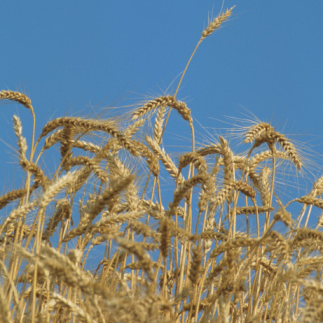
The heat wave in Russia has captured international media attention, breaking temperature records left and right (see figure below). It has also captured the attention of commodity traders. In a typical year Russia produces about as much wheat as the United States, and is among the top exporters of wheat flour in the world. But this year, wheat has been decimated in the areas around Moscow, with yield expected to be 30 percent or so below normal. This week Russia announced they are banning all exports of wheat from August 15 through the end of the year. Since late June, wheat prices on the Chicago Board of Trade have risen by 50 percent, to more than $7 a bushel. Continue reading From Russia: More Heat, Less Wheat

Whitman Commits on Prop 23 — Sort of

The mystery of whether Republican gubernatorial candidate Meg Whitman does or does not support Proposition 23 would appear to be solved. After weeks of steadfastly refusing to take a stand one way or the other on the ballot measure to freeze the state’s climate law known as AB 32, Whitman conceded on a radio broadcast that “In all likelihood I will vote ‘No’ on Prop 23.” Continue reading Whitman Commits on Prop 23 — Sort of

Wind Picks Up Nationally, California Lags

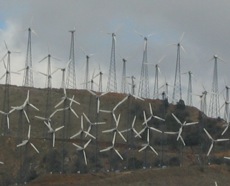
A cluster of wind turbines in Tehachapi Pass marks California's early commitment to wind energy. (Photo: Craig Miller)

Wind power generators added nearly 40% to their total capacity in the US last year, as several states blew past California, according to a new report from the Department of Energy’s Lawrence Berkeley National Lab. According to the tally, four states now generate more than 10% of their total electricity (excluding exports) from wind.

Texas is the undisputed leader in the wind race, installing nearly 2,300 megawatts of capacity last year alone. Other Midwestern states such as Indiana, Iowa, the Dakotas and Minnesota have also been aggressive installers of wind farms. Continue reading Wind Picks Up Nationally, California Lags

Energy Storage: The Holy Grail

New solar panel technology being tested at Stanford University. (Courtesy of Nick Melosh)

Energy storage is something we’ve come to take for granted in everyday life. Our cell phones, iPods, cars and computers all depend on batteries. But storing large amounts of energy for the electric grid is another matter entirely. It’s a technical challenge that has yet to be met–but will need to be for the coming age of renewable energy.

California’s grid is designed to deliver electricity on a real-time basis. Every four seconds, the grid operators at the California Independent System Operator (ISO) have to ensure that the energy supply meets the demand in the state, something that’s known as “balancing” the grid (you can see today’s electricity forecast on the ISO site). As a result, they coordinate the one piece of the system that they have control over: the power plants. Continue reading Energy Storage: The Holy Grail

Creating Power from Both Light and Heat

A key component of new solar panel technology being tested at Stanford. (Photo: Nick Melosh)

In a kind of cruel paradox, heat has always been the enemy of solar panels.  At higher temperatures, photovoltaic cells become less efficient, which is problematic in an industry where efficiency is the name of the game. That heat also represents wasted energy.

Today, researchers at Stanford University announced that they may have helped solve that problem. Nick Melosh of Stanford’s Materials Science & Engineering department set out to make use of the wasted heat. He and his colleagues created a solar cell technology that uses both light and heat to generate electricity. It’s called “photon-enhanced thermionic emission” (or PETE for short). “This is the first time that a process has been reported that can use the heat and the photons together harmoniously,” says Melosh. Continue reading Creating Power from Both Light and Heat

Coal, Soot and A Mighty Wind

This week in climate news: coal dollars in California, soot in the air, and wind in the desert.

1. Big Coal Donates to Fiorina Campaign

Republican Senate candidate Carly Fiorina received $63,000 in donations  from out-of-state coal mining interests. About a third of that money is from Murray Energy Corporation in Ohio, the largest privately owned coal producer in the U.S. Continue reading Coal, Soot and A Mighty Wind

Poll Shows Support for Climate Law

An expansive new poll on environmental attitudes suggests that despite the recession, Californians are holding fast to their environmental priorities.

Among the findings in the report released this week by the non-partisan Public Policy Institute of California is that support for the state’s climate change strategy remains strong, even in the face of a well-financed campaign against the law known as AB 32. Two-thirds (67%) of the respondents support the 2006 Global Warming Solutions Act, aimed at reducing greenhouse gas emissions in California–about the same level as when PPIC polled the question last year. Continue reading Poll Shows Support for Climate Law

Annual Climate Report Shows a Warming World

This post also appears at Climate Central, a content partner of Climate Watch.

By Alyson Kenward

Global temperatures continued to increase in 2009, and atmospheric greenhouse gas levels also rose, according to a new “State of the Climate Report” from the US National Oceanic and Atmospheric Administration (NOAA). The report, released today as a supplement to the Bulletin of the American Meteorological Society, offers a detailed look at last year’s major weather and climate events, and reviews long-term global climate trends. Overall, it paints a picture of a world that continues its long-term warming trend, albeit with considerable variability from year-to-year.

The report finds that the earth warmed more last year than in the preceding two years, and reiterates the conclusion that the first decade of the 21st century, 2000-2009, was the warmest decade on record, both at the earth’s surface and in the lower atmosphere.

The State of the Climate report attributes many of the significant weather and climate events of 2009 to natural variability. For example, the return of El Niño, a periodic cycle of ocean warming in the tropical Pacific which influences global weather patterns, helped increase global temperatures. It states that El Niño may account for much of last year’s global increase in temperature compared to 2008 — about 0.1 degrees Celsius warmer in 2009.

“Global surface temperatures in 2009 saw a return to near-record levels as the cooling in the tropical Pacific associated with the 2007/08 La Niña event gave way to strengthening El Niño conditions in 2009,” the report states. The average global land and sea surface temperatures for 2009 was about 0.5 degrees Celsius warmer than the average between 1961-1990.
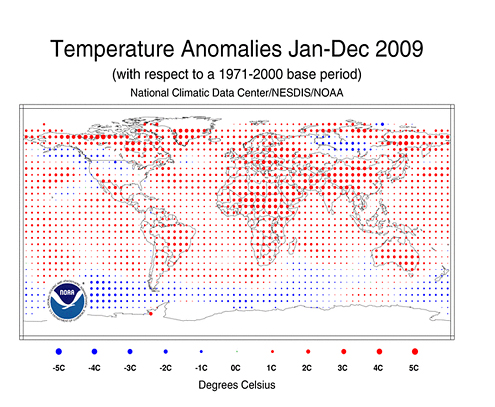

Surface temperature anomalies, Jan.-Dec. 2009. Click on the image to
see a larger version. (Source: NOAA/NCDC)

The abundance of warmer-than-normal water in the Pacific also contributed to the most active storm season there since 1997, while the Atlantic saw a relatively quiet season in 2009.

While NOAA publishes its State of the Climate reports annually, the 2009 version differs from previous years with its focus on a specific series of climate change indicators, such as global average air and ocean temperatures and ocean heat content. Tracking this group of metrics illustrates the long-term trends that are the hallmarks of climate change.

“For the first time, and in a single compelling comparison, the analysis brings together multiple observational records for the range of carefully selected indicators we would expect to change with surface temperatures,” said Dr. Peter Thorne, a co-author of the report and climate scientist at North Carolina State University, in a press release.

Examples of climate indicators investigated by NOAA:

  • Air temperature over land
  • Air temperature over sea
  • Troposphere temperature
  • Sea surface temperature
  • Ocean heat content
  • Sea level
  • Snow coverage
  • Sea ice extent

These indicators are bound to fluctuate from year to year, however. For example, the last decade may have been the warmest on record, but 2009 was not the hottest year ever recorded (though it managed to tie 2006 for the fifth spot since instrumental measurements began in the 1850s). Furthermore, 2009 saw a slight recovery in the extent of Arctic sea ice.

But when each year is lined up next to all the preceding years, NOAA said, these short-term variations are small compared to the clear and significant long-term warming trend.

“Despite the variability caused by short-term changes, the analysis conducted for this report illustrates why we are so confident the world is warming, ” said Dr. Peter Stott, a co-author of the new report in a press release. Stott is the team leader of the Climate Monitoring and Attribution group of the United Kingdom’s Met Office Hadley Centre, which contributed to the NOAA report.

The report itself was authored by more than 300 scientists from every continent and from 160 research groups around the world.

So far, the data for 2010 shows no let-up in sight for warmer than average global temperatures. As this summer drags on, the planet has already recorded its warmest year-to-date, with several record-breaking heat waves in the US, Asia and the Middle East. Along with April and May, June was the hottest such month on record worldwide.

With this year already off to a hot start and on a pace to surpass 2009 in terms of global temperature averages, Stott says the long-term trend sends a clear message: “When we follow decade-to-decade trends using multiple data sets and independent analyses from around the world, we see clear and unmistakable signs of a warming world.”

In addition, the report responds to questions during the past year from critics of climate science who have questioned the veracity of the surface temperature record. “Globally averaged surface temperature anomalies are shown to be robust given the close agreement between independently-derived datasets and strong corroborative evidence across a wide range of other climate variables,” it states, adding that the conclusion that the world is warming does not rest solely upon surface air temperature records. Evidence that the oceans are storing greater amounts of heat, sea levels are rising, atmospheric humidity is increasing, and land and sea ice is melting all point to a warming climate as well.

“If the land surface records were systematically flawed and the globe had not really warmed, then it would be almost impossible to explain the concurrent changes in this wide range of indicators produced by many independent groups,” the report states.