Remote deserts would seem to be the ideal place for Big Solar — were it only that simple
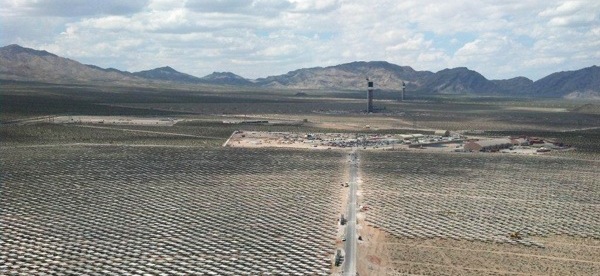
Can threatened tortoises and utility-scale solar plants coexist in the California desert? Since the solar rush began a few years ago, results have been discouraging. But an ambitious new plan aims to strike a long-lasting compromise. Northern Californians get a chance to weigh in on the process at a public meeting in Sacramento on Wednesday, September 5.
The sprawling Ivanpah Solar Electric Generating System is scheduled to go online next year.
Federal incentives can hasten development–or slow it down
By Nate Seltenrich
Last year brought a fresh breeze for wind energy, and projections indicate that 2012 will be even better. But over the next two years, a variety of forces could conspire to hamper wind energy development across the United States, despite a significant decline in the cost. These are the main findings of a new report by the US Department of Energy and the Lawrence Berkeley National Laboratory.
It’s that classic good news-bad news scenario: should proponents focus on the fact that in 2011 wind energy became cheaper, more efficient, and more widely distributed than ever? Or should they dwell on the looming challenges, including steep competition from cheap natural gas, inadequate high-voltage transmission in many parts of the country, and the possible expiration of federal incentives at the end of the year? Continue reading Fast Lane for California Wind Energy — But for How Long?→
Wind is one of the few energy sources that requires virtually no water.
The Gordian knot of interdependence between water & power (not the political kind — that’s another story) has been getting a lot of attention lately as the “water-energy nexus.” A new report from Oakland’s Pacific Institute warns that as population grows and a changing climate further wrings water out of the West, “These trends will intensify water resource conflicts throughout the region.”
California’s three big utilities have another two years to reach their mandated target of having 20% of their electricity generated from renewable sources, and today PG&E announced two new deals that could inch the company closer to that goal:
Wind: An agreement with NextEra Energy Resources, for 25 years of wind power from the company’s 163 megawatt North Sky River project in Tehachapi, CA. PG&E says the energy from this project could meet the needs of about 90,000 typical homes.
Solar: A 25-year contract with Sempra Generation for 150 megawatts of solar power from an expansion of the Copper Mountain Solar complex near Boulder City, NV. Just under 2/3 of that power is expected online in 2013, with the remainder available by 2015. Ultimately, the company says, this project could power 45,000 homes.
Nearly 3,000 tons of spent nuclear fuel have accumulated at nuclear power plants in California…with nowhere to take it.
"Dry casks" waiting to be loaded with spent fuel at Diablo Canyon. (Photo: Craig Miller)
It could be worse. This could be Illinois, the undisputed spent fuel champ, with more than 8,000 tons piled up at plants. As it is, California ranks eighth in the nation.
“This country has an obligation to those states and those communities to take those materials and put them into deep geologic disposal, where they can be safely isolated for a very long period of time,” says Per Peterson, who chairs the nuclear engineering department at UC Berkeley.
Trouble is, the country seems farther now from meeting that obligation than it was in 1998, the original legislative deadline for opening a permanent repository for spent nuclear fuel. Continue reading California’s Nuclear Burden→
Business group says delays are costing thousands of jobs, billions in lost economic benefits
The US Chamber of Commerce says it’s taking too long to green-light energy projects — not just in California but across the US — and that it’s putting a drag on economic recovery.
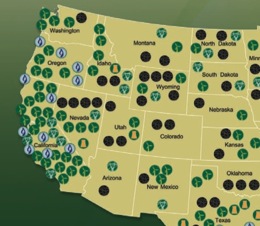
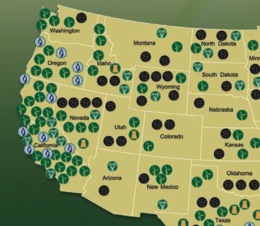
Map shows energy projects that are facing permitting or court challenges, 31 in California. (Image: US Chamber of Commerce)
The pro-business group issued a report that attempts to quantify the opportunity cost of projects that were in permitting or litigation limbo during March of 2010. That “snapshot” includes 31 projects in California. Continue reading Report: “Stalled” Energy Projects Costing Us→
Bill to require one-third renewable energy sails through state senate
(Photo: Craig Miller)
That next gust of wind you hear may be a collective sigh of relief from the renewable energy industry. By a margin of more than two-to-one, state senators have approved a bill to cement California’s requirement that utilities draw at least a third of their power from renewable sources by 2020.
The wind energy industry faces multiple challenges in California.
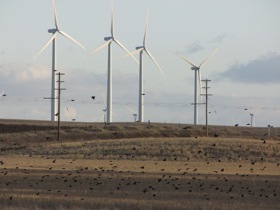
Flocks of birds near wind turbines in Solano County. (Photo: Craig Miller)
It’s hard to find people who are just flat out against wind energy. As with real estate, attitudes seem to come down to location, location, location. That’s why three of the thorniest issues with wind are project siting, transmission (lines for the power produced), and the industry’s turbulent history with birds and bats.
Last fall, even the National Audubon Society, one of the nation’s most stalwart protectors of winged creatures, published a position statement generally favorable toward wind power, calling it a “good news, bad news” proposition. The statement calls California’s Altamont Pass “notorious for killing many raptors, including golden eagles.” A 2003 study by the National Renewable Energy Lab calculated that on average, each turbine in the pass was claiming a bird about once every five years (0.19 birds/turbine/year) — but there are thousands of turbines in the pass, many older models that are more of a danger to birds.
Developers are in the process of “repowering” the pass with newer, larger turbines, less lethal to birds. That may seem counterintuitive but the older, smaller models caused more problems. Since they had lower output, more of them were required. The blades were positioned lower, spun faster, and supported by lattice towers that provided inviting nesting spots, unlike the smooth tubular towers of new turbines.
Altamont is the oldest of California’s four biggest wind energy zones, highlighted on this interactive map.
The Audubon statement concedes that newer turbine designs are becoming more bird-friendly, and finds climate change a bigger threat to avian critters in the long run. The Society went on to call for an extension of the federal Production Tax Credit for wind development, fearing its expiration next year encourages wind developers to rush projects along and “cut corners” on siting.
How much wind energy do we need to make California’s goal of 33% clean electricity by 2020? Whenever I put this question to one of the experts, the answer is always: “It depends.” But under almost any scenario, thousands more windmills will dot the California landscape in years to come.
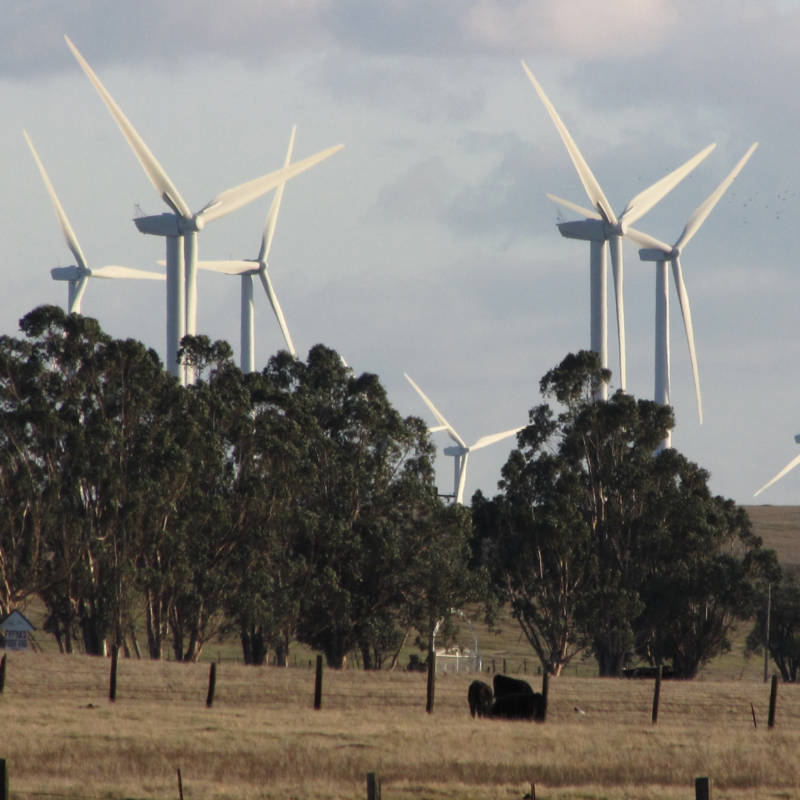
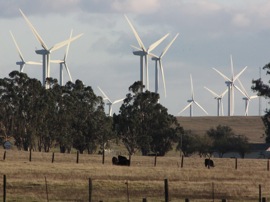
Cattle and wind turbines dot the Solano County landscape. (Photo: Craig Miller)
Those who don’t see them on a daily basis might be surprised to learn that there is already something on the order of 13,000 commercial wind turbines operating in California. Ryan Wiser, who tracks wind energy trends at Lawrence Berkeley National Lab, does a rough calculation that meeting that state-imposed threshold of 33% renewable energy could take 5,000 more, in order for wind to do its share. That’s based on an estimated 10,000 megawatts of new wind power, using the current standard two-megawatt turbine. While most of these will be concentrated in a few major “wind resource areas” (there are currently four big ones in the state), numbers like that almost ensure that wind turbines will become a more familiar feature of the California landscape. Continue reading Wind Farm Forecast: More & Bigger→
Hear the companion radio feature about opposition to the Sunrise Powerlink at The California Report, starting Friday morning.
By Ruxandra Guidi
The road that takes you from the sleepy town of Boulevard into the path of the Sunrise Powerlink is a dusty, unmarked path that’s a couple of miles long. It ends at a gate without a sign, where a guard stands in the hot midday sun. He knows to keep any unauthorized visitors away; there’s a party going on inside, while the protesters make noise for hours outside.
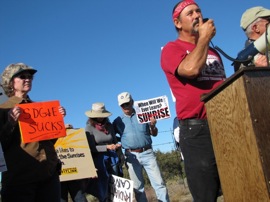
David Elliott speaks to protesters outside the Sunrise Powerlink headquarters in the town of Boulevard. (Photo: Ruxandra Guidi)
No one yet knows what the Sunrise Powerlink will end up looking like, and at what cost — and that’s just two of the main issues people have with it. Opponents of the giant network of powerlines, towers, and substations, say it will run for 120 miles, through delicate ecosystems and fire-prone areas. Its impact on local residents and wildlife will be irreparable.
On the other hand, SDG&E says its “superhighway” for transporting electrons from remote solar and wind farms to coastal population centers, will respect state and federal lands and go around delicate areas of the desert; that it will generate much-needed jobs while meeting state goals for green energy development. In the process, the California Imperial Valley is being touted as a so-called “mega-region;” a showcase for clean energy production. Continue reading Environment and Electrons Create Sparks in SoCal→