Tag Archives: 33×20

Some “Low-Hanging Fruit” Still Hanging

(Photo: Craig Miller)

California’s commercial buildings suck up more than a third of all the electricity used in the state–and that’s too much.

That’s among the conclusions of a new report from the San Francisco-based think tank Next 10. The 12-page report points out that on average, such buildings could cut energy use by 30% just by upgrading insulation, and another 18-to-20% with more efficient lighting.

Though California leads the nation in its stingy use of electricity overall, the report notes that efficiency standards for new construction are “well below what is possible” and what standards are in place are not met by 40% of new buildings. Study co-author Tracey Grose says that’s partly because even if state-of-the-art equipment is installed, it isn’t always used as intended. There are no energy efficiency standards at all for existing buildings. In general, the study finds that energy use in most buildings could be cut by 80% with some basic upgrades.

The report, compiled by the consulting firm Collaborative Economics in Mountain View, and largely a compilation of existing work, also implies that there’s a built-in way to pay for some of these improvements. The authors cite studies showing that commercial tenants are willing to pay higher rents for “greener” space. The report also cites figures from the Building Owners & Managers Association, that some basic improvements in energy efficiency offer a three-to-one return on investment.

Power consumption varies widely within the commercial sector. Next 10 notes that restaurants are the biggest kilowatt hogs per square foot, followed by supermarkets and hospitals (when’s the last time you had to wear a sweater while grocery shopping because the frozen food section was chilling the whole store?).

According to the report, while raw consumption has continued to rise, efficiency in these buildings has leveled off in recent years. Overall, the nearly 6.8 million square feet of commercial space accounts for 37% of California’s electricity use, compared with 40% for commercial buildings nationwide. The latter accounts for more than a quarter of the nation’s carbon dioxide emissions, according to the report.

Next 10, which describes itself as an “independent, non-partisan organization” has been a vocal promoter of the economic benefits from greening the state’s economy.
Passionate About Panoche

The “33 x 20” series continues today on Quest Radio, with the second of two parts on the proposed Solargen project in San Benito County. The report will be repeated on The California Report weekly magazine on Friday.

Catch up by listening to the first part and reading the accompanying blog post from last week.

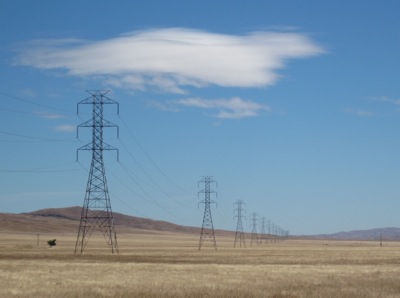
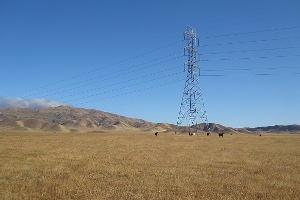
PG and E already has transmission lines running along the Panoche valley floor.

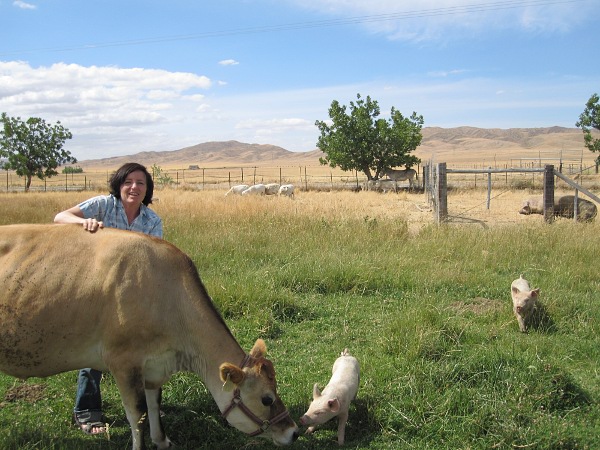
One thing becomes clear when you visit the Panoche Valley and the people that live and work there, everyone is charmed by it. The local ranchers, the environmental advocates, even the biologists hired by the Silicon Valley company that is looking at developing part of the valley for a commercial solar farm.

Thousands of acres of vast cattle land ringed by golden, scrub covered hills make up the Panoche Valley. The area has a vast, open beauty that seems very Californian. But in the springtime locals say it looks like Ireland. The land has also caught the eye of the CEO of Solargen Energy.

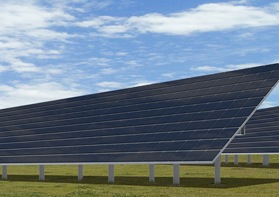
The company would like to build a 420 megawatt solar farm that would power about 120 thousand homes. To do so, Solargen would cover much of 4,700 acres of the valley with photo voltaic solar panels. Locals like chicken rancher Kim Williams worry it would change the character of the valley and harm wildlife. A group of local environmental advocates and ranchers have formed a group called Save Panoche Valley.

Kim Williams runs Your Family Farm in the Panoche valley and is opposed to the Solargen project.

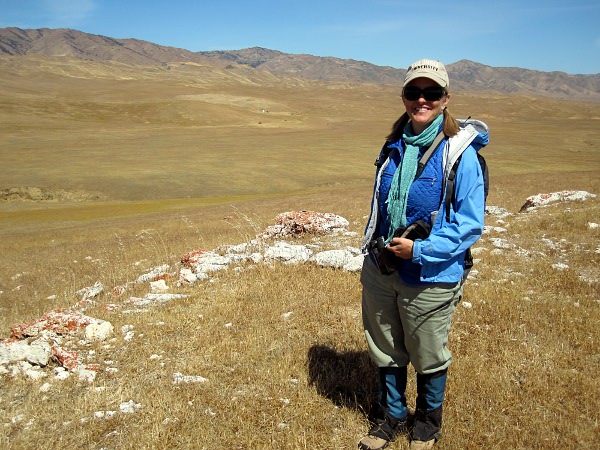
Solargen, as required by law, has hired a team of wildlife biologists to do environmental surveys of the area which, it turns out, is home to several endangered species. Michelle Korpos, the leader of the team, has also developed a fondness for Panoche Valley where she has been working for the past year. Everyday she and group of biologists march out to the project site, and surrounding hills, searching out fox dens, canvassing creek beds and geo-tagging lizard scat.

Michelle Korpos, along with other biologists, has been hired by Solargen to run wildlife surveys for an Environmental Impact Report.

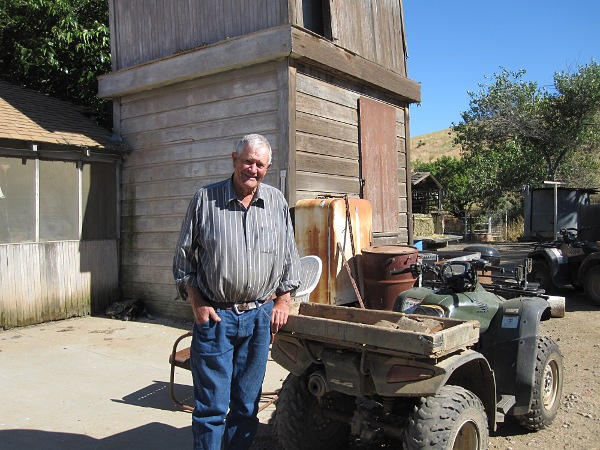
Charlie McCullough has owned his cattle ranch, one of the biggest in the area, since the early fifties and was born in San Benito County. He is one of five ranchers who has agreed to sell some of his land to Solargen. But McCullough is feeling remorseful that his decision could lead to such a change in the valley he loves.

Charlie McCullough has agreed to sell some of his land to Solargen for their big solar project.

The only commercial business in town is the Panoche Valley Inn which is not really an inn at all but a bar that serves as a stop for tired ranchers at the end of the day and birders and bikers on sunny weekends. The owner hopes the project’s contstruction jobs mean more business over the six year build out. But even the number of jobs Solargen promises to create has become contentious.

Larry Lopez, owner of the Panoche Inn, hopes construction of a big solar array would bring in more business.

One thing is for sure, the valley gets lots of sun, 90-percent of the solar intensity of the Mojave desert. But the Mojave, with its protected federal lands and desert tortoises, has turned out to be a nightmare for big solar entrepreneurs. Listen to our stories on the Panoche Valley which now finds itself in the middle of the debate over big solar. It’s all part of our series, “33 by 20,” a look at the obstacles in the way of California’s plan for utilities to generate one third of their electricity from clean energy by 2020. Here’s a map of solar intensity throughout the U.S.

Clock Ticking for Solar Developers

The “33 x 20” series continues Monday on Quest Radio, with the first of two parts on the proposed Solargen project in San Benito County. The reports will be repeated on The California Report weekly magazine.

Well hidden among the coast ranges of San Benito County, there’s a valley where, as one ecologist put it, “the hammer is hitting the anvil.” Mike Westphal of the Bureau of Land Management’s Hollister field office was describing the current tension playing out in Panoche Valley between two environmental goals: the mandate to combat global warming with a transition to renewable energy, and the desire to conserve the habitat of endangered animals, as well as California’s remaining ag land.

Solargen argues that Panoche Valley is a rare combination of great sun, proximity to population centers, and existing transmission lines to get the power there. (Photo: Craig Miller)

As part of our collaborative series: “33 x 20: California’s Clean Power Countdown,” Quest Senior Editor Andrea Kissack and I have been exploring the effort by Solargen Energy to develop Panoche Valley as a utility-scale solar power array (the state defines “utility-scale” as any facility that produces 200 megawatts of electricity or more).

Like many developers, Solargen CEO Mike Peterson is racing to break ground by the end of this year, in order to cash in on up-front stimulus money from the federal government. He says Panoche Valley presents a rare alignment of attributes for solar power: high solar potential (he says 90% of the Mojave), relative proximity to population centers, and existing transmission lines to get the power there. Peterson told me that the lines already in place have enough available capacity to handle his 420 megawatts of solar power, though a spokeswoman for PG&E says that question is still under study.

Meanwhile, some farmers and wildlife advocates have opposed the plan, saying big solar “farms” are better placed on “degraded” land. Ron Garthwaite, who runs Claravale organic dairy, says “This is just not the place to put it. There’s other places which have no ag value and which have less of a natural value where they could put it.”

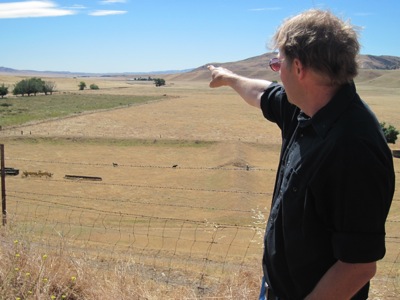
Standing at the valley's north end, BLM ecologist Mike Westphal points to where 2,000 acres might be covered in PV solar panels. (Photo: Craig Miller)

Westphal, whose agency is not directly involved in assessing the project, sees the valley as a rare microcosm for the once unspoiled habitat of the San Joaquin Valley, just over the hill. “What we really need to think hard about is do we want to risk ecosystems to get energy,” he told me, scanning the valley from Shotgun Pass at the north end.  “That’s what’s going on here in Panoche Valley is we’re making this equation: how much do we want to risk the continued endangerment or extinction of this ecosystem in order to get more energy? That’s the crux of this conflict here.”

In this video clip, BLM ecologist Michael Westphal gives Craig Miller an overview of the valley, looking south from Shotgun Pass.

Solargen is shelling out for a $1.3 million-dollar environmental impact report, which Peterson says does not include measures such as the two dozen biologists and a detachment of scat-sniffing dogs, trained to track down the droppings of other critters for DNA analysis. The results help determine what species are there. Peterson says the total tab in “preparing and preparing for the EIR” now tops $7 million.

In Part 2 of our Panoche Valley “case study,” Andrea Kissack will have a closer look at the wildlife issues. That report runs next Monday, June 28, on Quest Radio.

As for the Governor’s ambitious goal to have renewable energy sources account for one third of the state’s electrical generation by 2020, Peterson describes the process as “surprisingly harder than you would expect.” He says he ponders how to “get this done in a way that is able to meet the mandates, but also be a good steward to the environment, and try to make people happy. And we won’t be able to please everybody.”

He’s right about that. Dairyman Garthwaite says of the state’s quest for renewables: “Just because somebody in Sacramento says something, doesn’t mean that it can happen–or should happen. I mean there’s all kinds of political things involved in that, there’s lobbyists involved in that. People want to make money.”

Climate Watch intern Chris Penalosa mapped some of California’s larger solar projects in development, below.


View Utility Scale Solar Projects in California in a larger map

California’s Future Energy Mix

The Quest/Climate Watch series “33×20: California’s Clean Power Countdown” continues on Monday, with the first of two parts on one company’s attempt to build one of the nation’s largest PV solar arrays in San Benito County.

(Image: Solargen Energy)

With its ambitious 33%-by-2020 renewable energy goal, California will be looking for renewable megawatts from all corners of the state. While the state may hit 18-19% by the end of this year, reaching 33% will require approximately a doubling of renewable power, since the state’s energy appetite will continue to grow in the meantime.

So, where will the energy come from? According to the California Public Utilities Commission, wind and solar will have to carry much of the “load.” Check out the CPUC projections in the charts below.

Series Explores 33×20 Renewable Energy Goal

California has set some ambitious targets for ramping up renewable energy sources. Some say too ambitious. Utilities won’t make the first milepost of 20% renewable power by this year, and many are skeptical that the longer-term goal of 33% by 2020 is doable, either, the executive order signed by Governor Schwarzenegger in 2008 notwithstanding.

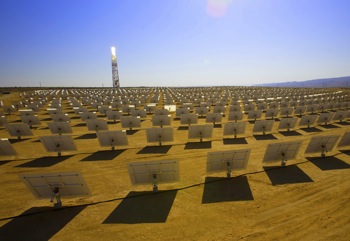
A thermal-solar array of the type planned for southern California. Photo: Brightsource Energy
A thermal solar array of the type planned for southern California. Photo: BrightSource Energy

A major hurdle is the permitting process for large “utility-scale” solar and wind installations, described by the Governor’s own senior advisor as “tortuous.” In the months ahead, we’ll take you through some of the obstacle course in a multimedia series called “33 x 20: California’s Clean Power Countdown.” A collaboration of Climate Watch and Quest, KQED’s science and environmental initiative, the series of radio reports and web features explores the promise and pitfalls of the state’s 33 x 20 plan.

The series begins Monday with Lauren Sommer’s review of California’s clean power legacy and an assessment of the present push. Future reports will look at a solar siting case study in central California, as well as prospects for major development of wind and geothermal sources. California currently leads the nation in solar generation but trails Texas and Iowa in the race for wind power. See Lauren’s interactive map for an overview of how California stacks up against other states in its ambitions toward renewable energy.

Future reports will examine the potential impact of large-scale power generation on deserts and tribal lands and the progress toward what some consider the “holy grail” of energy technology; large-scale storage of electricity. In June, Quest Senior Editor Andrea Kissack and I will team up for a kind of case study in one company’s ambitions; the 4,700-acre photovoltaic array planned by Solargen Energy for Panoche Valley in San Benito County.

Northern California listeners can hear the radio series as part of KQED’s Quest radio service (airs Mondays during NPR’s Morning Edition on KQED and KQEI in Sacramento) or statewide on The California Report. You can follow the entire series and see the related web features as they appear on our “33 x 20” series page.

AB 32 Stopper Headed for Ballot

It looks like there will be a measure on November’s statewide ballot to block full implementation of California’s greenhouse gas regulations.

Groups supporting the measure they call the “California Jobs Initiative” claim they gathered more than 800,000 signatures, nearly twice what they needed to qualify the proposal as a statewide referendum.

The existing climate law, known widely as AB 32, allows for the Governor to declare an emergency suspension of up to one year. But John Kabateck, who heads the California branch of the National Federation of Independent Businesses, says small businesses in particular can’t wait to see what the next governor might do; that the measure is needed to “stop the madness.” Kabateck said it’s time to “just push the pause button and please stop loading small businesses with new costs, new mandates and new regulations at a time when we need to crawl out of the hole.”

Studies have reached varying conclusions about what effect the state’s current regulatory path for carbon emissions would have on the California economy. Opponents of the measure have already formed their own campaign, trying to keep momentum behind the three-year-old climate law known as AB-32.

Steve Maviglio, who works for the the pro-AB 32 Californians for Clean Energy and Jobs, formed to oppose the ballot initiative, says he doesn’t think all those signatures necessarily signify broad support. “I think what that represents is the travesty of the initiative system and how out-of-state oil companies can buy their way onto the ballot,” he told me, in a telephone interview. The push to get the measure on the ballot has been financed largely by Texas-based oil companies and a somewhat obscure organization called the Adam Smith Foundation, based in Missouri.

“It took them $2 million to round up these signatures” said Maviglio. “And if you look at every single poll, you can see that Californians know we can have both clean air and a strong economy, and that we’re not going to be fooled by Texas oil companies,” he added.

The proposed ballot measure would freeze AB-32 until the state’s unemployment level dropped to five-and-a-half percent—or lower–for one full year. That’s something that’s happened only three times since the mid-1970’s: once in the late 1980s (for about ten quarters), a similar stretch in the late ‘90s, and once in 2005-06. After the deep recession of the early ‘80s, it took the state’s unemployment rate about four-and-a-half years to move from its 11% peak back to the 5.5 percent threshold.

Governor Arnold Schwarzenegger today called the effort to halt AB-32 “the work of greedy oil companies.”

East Coast Leads Offshore Wind Derby

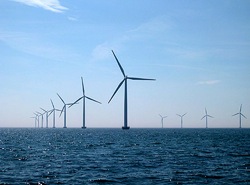
The Nysted wind farm off Denmark. Image: Cape Wind Assoc.

The nation’s first offshore utility-scale wind farm has won federal approval but it was no slam dunk. The Dept. of Interior has approved the 130-turbine Cape Wind project, off Nantucket.

The plan launched such an epic debate that at least one book has been written about it. Today’s nod comes just weeks after a federal advisory panel recommended against approval and doesn’t necessarily mean the project will go forward. Opposition groups have already vowed to go to court.

Cape Wind is just one of numerous offshore wind projects under consideration for the East Coast and Great Lakes region.

Permitting for most wind projects in California comes under local jurisdiction but a spokeswoman at the California Energy Commission told me that to her knowledge, no offshore wind projects are currently under review for California. An obstacle often cited is the extreme ocean depths off California, which make construction difficult. Various wave power projects have been proposed for the coastline.

New Solar Manufacturing Plant for Silicon Valley

SunPower CEO Tom Werner and Gov. Arnold Schwarzeneggar announcing the creation of a new solar manufacturing plant in Milpitas, CA (photo: Gretchen Weber)
SunPower CEO Tom Werner and Gov. Arnold Schwarzenegger. Photo: Gretchen Weber

Silicon Valley-based solar cell manufacturer SunPower Corp. announced today that it’s decided to site its newest manufacturing plant in California, a move that CEO Tom Werner says will create hundreds of jobs and may prompt an “economic cluster” that will attract similar projects.

SunPower has partnered with contract manufacturer Flextronics, and plans for the Milipitas-based operation to be up and running by the end of the year, producing high-efficiency solar cells.

Werner and Flextronics CEO E.C. Sykes were joined at the announcement in Milipitas by Gov. Arnold Schwarzenegger, who sported a green tie and chastised the assembled crowd for not celebrating Earth Day with similar fashion choices.

“I am so excited about this,” said Schwarzenegger about the new project. “This proves that protecting the economy and protecting the environment can be done simultaneously.”

Werner said locating the manufacturing operation in California makes sense both for economic reasons and because California is home to a large solar market, thanks to  the state’s Renewable Portfolio Standard, requiring 33% renewable energy by 2020, and the Million Solar Roofs Initiative.  Werner added that a record 50 megawatts of rooftop solar power were installed last month in California.

“You want to be close to your customer for logistical reasons, and also because you learn from your customer and you build it back into your product,” Werner told me following the staged media event.  “And by being local you can learn faster than you can if you’re distant.”

Other California selling points were a green manufacturing equipment sales tax exemption, which enabled SunPower to buy equipment for the facility tax-free, and low-interest loans from Recovery Act funds granted through the City of Milpitas, said Werner.

Governor Schwarzenegger used the occasion to warn Californians against taking the state’s environmental laws for granted.

“Right now there are greedy Texas oil companies that want to come in here and spend millions of dollars to roll back AB 32 (the state’s 2006 carbon legislation) and our other environmental laws,” he said. “Why? Because they don’t like that there’s alternative energy being created.  They don’t like what you are doing here.”

Hope, Skepticism at Renewables Conference

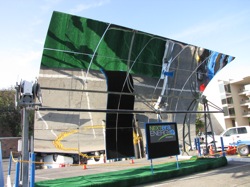
One section of a solar-thermal array on display at UC Riverside. Thousands of these mirrors gather solar radiation to heat a synthetic oil, which drives electrical generation at huge desert facilities. Photo: Craig Miller

Perhaps the most telling moment at the Governor’s Renewable Energy Policy Conference this week, was when the Governor’s own senior advisor on renewables, Michael Picker, asked for a show of hands. How many present, he wondered, actually thought that California would attain its goal of 33% renewable power by 2020. Amid the 370 or so gathered on the campus of UC Riverside, about a dozen hands went up. How many, he asked, thought we’d make it to 33% by 2050? Another dozen or so hands.

Bear in mind that this was a room containing some of the most knowledgeable people on the topic, from government, industry and environmental organizations. These were people invested in getting there, yet most seemed to doubt that we would.

Their pessimism was not entirely shared by the questioner. Picker told me afterward that he expected about 8,000 megawatts of new power to be approved by year-end. That’s approved, not necessarily financed. Solar arrays that generate 250 MW or more are considered large-scale operations.

Meanwhile, developers are pushing to get major projects approved before the year is out. To qualify for federal stimulus dollars, projects have to break ground this year and spend a certain percentage of project costs.

“It’s a hard state to develop in,” said Matt Handel, a vice president with NextEra Energy Resources. The Florida-based company is already a major player in both solar and wind generation in California, and Handel says the stimulus money is essential for two major new projects that NextEra has in mind for the southern California deserts.

“There is hope,” Handel told me. “It is difficult. There are a lot of constituencies out there pulling in different directions.”

Virtually all of those stakeholder groups were present in Riverside, in some form. Local (especially desert) communities, environmentalists, Indian tribes and representatives from federal agencies such as the Bureau of Land Management and National Park Service were there.

Identifying the most appropriate sites for large-scale wind and solar plants has been complicated by more than bureaucracy, said Kim Delfino, California Program Director for Defenders of Wildlife. “The landscape we’re working in is already changing due to the effects of climate change, which presents a challenge as to which areas to protect,” said Delfino in a panel discussion.

Picker says he’s “not so sure” that the state is doing the best possible job of moving projects efficiently through the pipeline (to borrow a metaphor from the fossil fuels era), and he conceded that some developers will be left standing in line as the year-end deadline expires. But he calculated that if, over the next five years, 20% of the biggest projects on the drawing board can get approved, the state should make its 2020 goal.

AB 32 and the Economic Road Ahead

By 2020, California will see two million new jobs whether the state implements its climate law AB 32 or not, according to a revised analysis from the California Air Resources Board.

The report, released Wednesday, predicts modest growth in the state economy over the next 10 years, including growth of 2.4% in both personal income and gross state product with or without the law.

During a Wednesday conference call,  CARB chairman Mary Nichols told reporters that sectors where California is strong, such as renewable energy and informational technology, will benefit from AB 32.

“California is uniquely positioned to benefit because this is the direction in which our economy is going anyway,” she said.

Nichols added that industries heavily dependent on petroleum will also benefit, but that they will have to go through a transition.

“We will see economic benefits overall by 2020,” said Nichols, “but it will be easier for some than for others.”

The report was reviewed by the 16-member Economic and Allocation Advisory Committee (EAAC), an independent panel of policy, business and economic experts appointed by Nichols and California Environmental Protection Agency Secretary Linda Adams.

The report finds that AB 32 provides, “neither a huge boost nor a major negative impact on California,” said Larry Goulder, chair of the EAAC and of Stanford’s Economics Department on a call Wednesday with reporters.  “These findings are not that different from other studies that have been done.”

The Air Board’s original analysis was questioned earlier this month in a report from the non-partisan Legislative Analyst’s Office, which projected a mixed bag of pluses and minuses, with a short-term negative impact on jobs.

CARB’s first economic projections were criticized by others, including UCLA economics professor Matthew Kahn.   Kahn said he is much happier with this new report because of adjustments made to the baseline scenario and because of the independent review made by EAAC panel, which he called a “dream team” of economists.  However, the report still falls short, Kahn says, because its macroeconomic approach doesn’t identify how specific industries and businesses will fare under AB32.

“The report released today is about averages. And where I think we need more research is in how individual firms will be affected,” said Kahn. “When I was in graduate school, I had a professor who used to say ‘if your feet are in the fridge and your head is in the oven, on average, you’re ok’ and I always thought that was a funny joke, but I think it’s apropos about California today.”

Also on Wednesday, Kahn published an opinion piece in the LA Times with co-author James L. Sweeney, director of Stanford’s Precourt Energy Efficiency Center, arguing that a study frequently cited by opponents of AB 32 is seriously flawed.  The study, known as the Varshney/Tootelian analysis, estimates that the law will cost small businesses $50,000 a year and each household $3,857 a year once the new rules kick in.

Opponents of AB 32 are advocating for a ballot initiative that would suspend the law’s regulations until the state economy improves and the state unemployment rate drops to 5.5%. It’s currently pegged at 12.5%, officially.