Just a couple of weeks back, some stalwarts still held out hope for a federal climate bill this summer. But with the capitulation by congressional leaders on Thursday, this week the legislative landscape looks undeniably bleak. And with flagging expectations for multinational climate talks, the heat is now turned up once again on the so-called “sub-national” actors, like states and provinces. It also lends more gravitas to efforts like Governor Schwarzenegger’s announced third climate summit for sub-national leaders, scheduled for November at UC Davis. Continue reading Climate Action May Be Up to the States→
It’s just outside Phoenix. No, it’s in the Mojave. Wait, no, it’s in San Benito County.
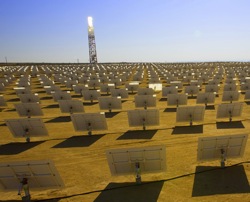
A solar-thermal array uses mirrors to concentrate sunlight. (Image: BrightSource Energy)
On a media call this week in which executives and investors from the solar industry stumped for extensions to key federal incentives, I heard Fred Morse of Abengoa Solar say that the company’s Solana project in Gila Bend, Arizona, will be, as described on the project website, “the world’s largest solar plant.” Later that same day, an email came in from Oakland-based BrightSource Energy, (not in response) touting its Ivanpah project as “the largest solar project in the world.” Similar terms have been used to describe Solargen’s proposed 4,700-acre photovoltaic array in San Benito County. Continue reading The Biggest Solar Project in the World→
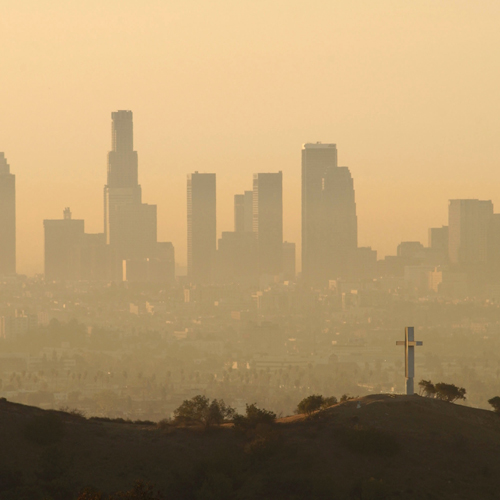
Los Angeles cloaked in smog shortly after sunrise. (Photo: David McNew/Getty Images)
Air pollution, already a problem for much of central and southern California, will get worse as temperatures warm, according to a new report from scientists at UC Davis and UC Berkeley.
By mid-century, trouble spots like the Central Valley and Los Angeles could experience between six and 30 more days per year when ozone concentrations exceed federal clean-air standards, depending on how much temperatures rise, and assuming that pollutant emissions in the state remain at current levels, the scientists project. Continue reading Another Climate Change Impact: Smog→
The ultimate model for clean fuels? (Photo: KQED QUEST)
Amidst all the fretting over the development of solar and wind technology, it hasn’t been lost on some scientists that there are organisms on the planet that have already cracked the renewable energy code: plants.
Photosynthesis is a highly efficient way of converting sunlight to fuel. So why not try to copy them?
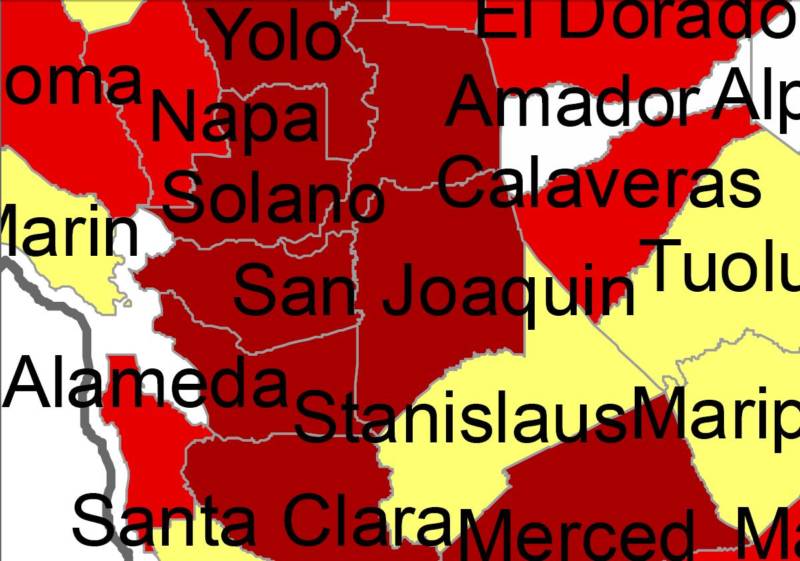
More than eight out of ten California counties will face frequent water shortages within 40 years. That’s the conclusion of a report released this week by Tetra Tech for the Natural Resources Defense Council.
See complete map of California, below. (Image: NRDC)
“This report is a real eye opener,” says Theo Spencer, senior advocate for the NRDC’s Climate Center. “It shows the toll climate change will take on the water resources in the U.S.”
Tetra Tech projects that climate change will exacerbate water problems in more than a third of counties across the US. In California, the outlook is worse. Forty-eight counties (83%) will be at risk by 2050, and 19 counties are on the critical list, those the report describes as under “extreme risk.” Only ten counties, mostly at the northern end of the state, were assigned to the low-risk category.
Officials at the US Department of Energy are checking their roofs for some of that “low hanging fruit” available to increase energy efficiency in buildings. A study released this week by Lawrence Berkeley National Laboratory suggests that “cool roofs” have the potential to offset up to two years worth of worldwide CO2 emissions and reduce the effects of urban “heat islands.” If that’s the case, increasing the albedo, or reflectivity, of roofs and pavements might be the solution to hotter days in the city.
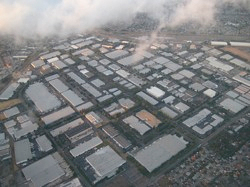
Flying over most California cities reveals relatively few white roofs (Photo: Craig Miller)
There’s been much hand-wringing of late over the disconnect between science and “Main Street.” When it comes to communicating complex concepts to the general public, even many scientists admit that they haven’t been making the light bulb come on.
Steve Schneider was a fearless advocate of climate action (Photo: Stanford University)
Schneider reportedly suffered a heart attack on a flight from Stockholm to London. Schneider founded a scientific journal on the subject of climate change and was a vocal advocate of the need for policy action, to respond to the threat posed by global warming.
A release issued by Stanford today reads, in part:
“Steve, more than anything, whether you agreed with him or not, forced us to confront this real possibility of climate change,” said his colleague at Stanford’s Woods Institute for the Environment, Jeff Koseff.
Schneider was influential in the public debate over climate change and wrote a book, Science as a Contact Sport: Inside the Battle to Save Earth’s Climate, about his experiences. He also wrote a book about his battle with leukemia, Patient from Hell.
He had been a White House consultant in the Nixon, Carter, Reagan, George H.W. Bush, Clinton, George W. Bush and Obama administrations.”
Schneider last appeared on KQED’s air just after the UN climate talks ended in last December, with what many considered a whimper. His disappointment was palpable as he spoke with Forum host Dave Iverson over a tenuous cell phone connection from Copenhagen (Schneider joins the program about 30 minutes in). He also made Forum appearances in programs in 2007 and 2004.
On his widely read Dot Earth blog for the New York Times, Andrew Revkin offers a personal perspective on Schneider, his work, and his bigger-than-life personality.
Despite frequent pronouncements by the outgoing governor of the Golden State, the chair of the giant solar industry expo that winds up in San Francisco today says “California and the US are losing badly in the global race” for solar energy deployment.
Weber said that California will represent a tiny fraction of the world’s growth in photovoltaics this year; just 200 of the 10,000 megawatts that he projects will be installed globally. California remains ahead of all other states in the deployment of solar panels. Weber’s forecast for California still represents two thirds of his projected total for the US. That’s “far below what could be expected from a country that’s as rich and sunshine-filled as the United States,” added Weber.
Chinese suppliers had a high profile at this week's solar expo in San Francisco (Photo: Craig Miller)
The global face of solar was impossible to miss at the Intersolar conference at San Francisco’s Moscone Center. Three levels of exhibition space were crammed with industry exhibits. To get there, attendees had to jostle for space on the escalators. Though this was billed as the “North American” conference (following an even bigger one in Europe), the halls included major product exhibits from China, Germany, Spain, South Korea, and other nations. Organizers told the trade publication Solar Industry that they booked 30% more exhibitors than last year for the expo.
While speakers at the conference were calling for more government support for solar and other renewable energy sources, state officials in California were going to the mat to save what’s already in place here. On Wednesday attorney general/gubernatorial candidate Jerry Brown said he is suing key players in the mortgage markets, in an effort to save the vaunted PACE program, which finances residential solar projects through property tax assessments. The announcement came even as the California Public Utilities Commission said it was suspending some solar incentive programs for schools and community organizations, after being overwhelmed with applications.
During the Forum discussion, Weber was sometimes at loggerheads with a former colleague from UC Berkeley, where Weber taught for more than 20 years. Weber predicted that rooftop solar could be cost-competitive with fossil fuels within seven years. But Severin Borenstein, who co-directs the Energy Institute at Berkeley, said he considered that forecast to be “at the very optimistic end of the range.”
Borenstein said he was not surprised that the PACE program is in trouble. He said that from the outset, mortgage lenders had been queasy about the program because when properties end up in foreclosure, the banks could find themselves second or third in line for their money, behind counties that finance the PACE energy upgrades.