Bill to require one-third renewable energy sails through state senate
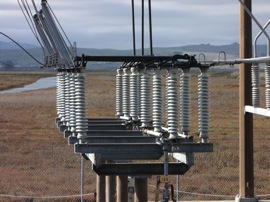
(Photo: Craig Miller)
That next gust of wind you hear may be a collective sigh of relief from the renewable energy industry. By a margin of more than two-to-one, state senators have approved a bill to cement California’s requirement that utilities draw at least a third of their power from renewable sources by 2020.
Report: Big changes needed to avert “widespread environmental and economic losses” in California
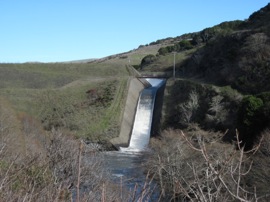
Grand illusion? Water rushes over the spillway at Nicasio Reservoir in Marin County. (Photo: Craig Miller)
A high-profile team of experts is calling for a major overhaul of the way California manages its water. In a 500-page report from the non-partisan Public Policy Institute of California, the authors say decades of well-intended water policies simply haven’t worked, leaving the state vulnerable to major crises, including water shortages, catastrophic floods, decline & extinction of native species, deteriorating water quality, and further decline of the Sacramento-San Joaquin Delta.
“Our system has been dying a death by a thousand cuts,” says co-author Ellen Hanak, an economist and policy analyst at the PPIC. Hanak says that the state’s water management efforts have been “incremental” and “piecemeal,” with little success to show for it. Continue reading What Will Your Water Cost?→
Rooftop solar can make a sizable dent in the West’s renewable energy needs
This week representatives from the federal Department of Energy and Bureau of Land Management wrap up their California barnstorming swing, to gauge public opinion on the topic of siting solar projects. Throughout this often contentious debate, many have claimed that a potentially huge piece of the power solution is being overlooked; rooftop solar.
Acres of flat-roofed commercial buildings in California's Inland Empire. (Photo: Craig Miller)
Fly into Ontario airport in Southern California’s Inland Empire — or just zoom in on Google Earth — and you’ll see hundreds of block-long warehouses. There are acres — probably square miles — of flat, gray roofs sizzling in the San Bernardino County sun. Soon, though, instead of merely soaking up the rays, hundreds of industrial rooftops in Southland cities will harness them to feed the local electrical grid.
Solar panels ready for installation on Ontario warehouse. (Photo: Ilsa Setziol)
Southern California Edison and independent power producers holding contracts with the utility are building 500 MW of solar panels on warehouses and, to a lesser extent, on the ground at other Southern California locations.
Together these projects are expected to produce enough energy to rival a traditional power plant, enough to serve about 325,000 homes. Continue reading Yes in Our Backyard→
As if drought and wildfires weren’t enough, California’s coniferous forests face another climate-related threat
(Photo: Reed Galin/Lone Tree Productions)
In the last decade, tiny forest-dwelling beetles have wiped out pine trees on millions of acres in the Canadian and American West, including Southern California. The rest of the state has been largely spared, but forest ecologists say that’s likely to change.
Pacific storm makes for some high tides and scary waves on the Bay
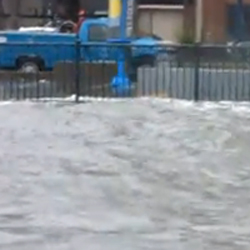
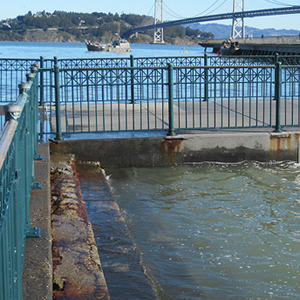
Waves slosh on to San Francisco's Embarcadero during Thursday's "king tide" (Photo: Gretchen Weber)
Take naturally-occurring extremely high tides, and add to them high winds and torrential rain, and you get some pretty big seas.
At least, that’s what I got out on the San Francisco Bay today. How big exactly, is hard to say (our uneducated guessed ran the gamut), but they were big enough to wash over the bow of our 26-foot boat on more than one occasion and to keep most of us aboard holding on for dear life for much of the three-hour voyage. What I can say for sure is that as I type this blog post, four hours later, my body still feels like I’m rolling up and down and back and forth on some stormy seas.
We braved the weather today to check out the latest round of “king tides” and see how they affect low-lying shorelines in places like Crissy Field, Treasure Island, and SFO. The seas were so rough that we didn’t make it all the way to the airport, but we did see waves crashing over the sea wall along the Embarcadero just south of the Ferry Building (see video below). At Crissy Field, the beach was nearly submerged and a small footbridge near the mouth of the estuary was almost awash. Continue reading Storm Surges and King Tides→
This post was originated by our content partners atCalifornia Watch.
Report says driving needs to be more costly to get us out of our cars
By Marie C. Baca
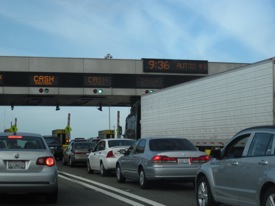
Drivers now pay $6 to cross the San Francisco Bay Bridge during peak traffic hours. "Peak pricing" is one strategy to push commuters to alternative transit. (Photo: Craig Miller)
California faces significant obstacles in complying with a 2008 state law aimed at reducing passenger vehicle usage, according to a report by the nonpartisan Public Policy Institute of California.
The report points to unrealized rail transit investments and resistance to pricing tools like fuel taxes as factors that have slowed reduction in car usage.
The two-year-old SB 375 mandates that California’s major metropolitan areas reduce per capita emissions from driving by 7 percent by 2020 and by 15 percent in 2035. While the primary focus of the bill is a reduction in the greenhouse gases that contribute to global warming, the legislation places a special emphasis on addressing traffic and public health concerns by reducing the number of miles residents drive. Continue reading State Struggling to Reduce Vehicle Emissions→
High tide at Pier 14 in San Francisco on January 19, 2011 (Photo: Jack Gregg)
This week another round of extremely high tides will hit the California coast, providing a glimpse of what the state can expect as sea levels continue to rise. These “king tides” will roll in from February 16th through the 18th, with the highest swells expected on the morning of the 17th, between 7:30 and 9 a.m.
The head of a major NASA research facility in California is downplaying efforts by a handful of House Republican members to strip the agency’s budget of its climate science funding.
An image from a joint NASA-NOAA satellite project. (Image: NASA-NOAA GOES Project)
iNaturalist Update: A biologist’s take on the potential for citizen science in a changing climate
(Photo: Richard Morgenstein)
Last month I went out to Jasper Ridge Biological Preserve near Stanford, where Scott Loarie and Ken-ichi Ueda showed me and about a dozen docents how to use the new iNaturalist iPhone app, which Ueda created. The aim of the app is to make recording and sharing of accurate field observations incredibly simple. It’s still in testing mode and not yet available to the public. “Citizen scientists” can already upload their digital photos and share them with an online community of naturalists around the world, at the iNaturalist website.
Studies reveal huge water withdrawals from aquifers under California’s Central Valley
The New York Times this weekend published a story and useful graphic describing new findings on the intensity of groundwater pumping in California’s San Joaquin Valley.
One eye-opening note from Felicity Barringer’s article:
“…the total loss of groundwater from the Sacramento and San Joaquin River basins in California’s Central Valley from 2003 to 2010 was just under 16.5 million acre-feet — approximately the volume of the Lower Colorado River reservoir, Lake Mead, when it is full.”
Lake Mead is the nation’s largest man-made reservoir (and has not been full for some time).