Of Birds, Bats and Blades

The wind energy industry faces multiple challenges in California.
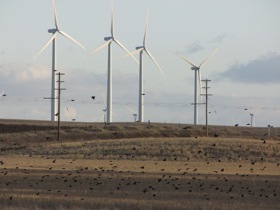
Flocks of birds near wind turbines in Solano County. (Photo: Craig Miller)

It’s hard to find people who are just flat out against wind energy. As with real estate, attitudes seem to come down to location, location, location. That’s why three of the thorniest issues with wind are project siting, transmission (lines for the power produced), and the industry’s turbulent history with birds and bats.

Last fall, even the National Audubon Society, one of the nation’s most stalwart protectors of winged creatures, published a position statement generally favorable toward wind power, calling it a “good news, bad news” proposition. The statement calls California’s Altamont Pass “notorious for killing many raptors, including golden eagles.” A 2003 study by the National Renewable Energy Lab calculated that on average, each turbine in the pass was claiming a bird about once every five years (0.19 birds/turbine/year) — but there are thousands of turbines in the pass, many older models that are more of a danger to birds.

Developers are in the process of “repowering” the pass with newer, larger turbines, less lethal to birds. That may seem counterintuitive but the older, smaller models caused more problems. Since they had lower output, more of them were required. The blades were positioned lower, spun faster, and supported by lattice towers that provided inviting nesting spots, unlike the smooth tubular towers of new turbines.

Altamont is the oldest of California’s four biggest wind energy zones, highlighted on this interactive map.


View Major Wind Energy Pockets in California in a larger map

The Audubon statement concedes that newer turbine designs are becoming more bird-friendly, and finds climate change a bigger threat to avian critters in the long run. The Society went on to call for an extension of the federal Production Tax Credit for wind development, fearing its expiration next year encourages wind developers to rush projects along and “cut corners” on siting.

Meanwhile industry and wildlife groups have joined forces to address the bat mortality issue.

Hear my two-part radio series on challenges facing wind energy development in California on The California Report. Those and all other stories in our series, “33 x 20: California’s Clean Power Countdown,” are archived at our special series page.
Wind Farm Forecast: More & Bigger

How much wind energy do we need to make California’s goal of 33% clean electricity by 2020? Whenever I put this question to one of the experts, the answer is always: “It depends.” But under almost any scenario, thousands more windmills will dot the California landscape in years to come.

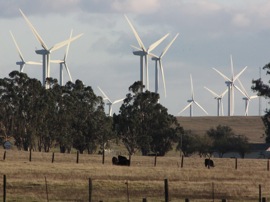
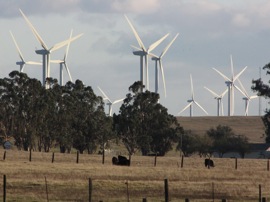
Cattle and wind turbines dot the Solano County landscape. (Photo: Craig Miller)

Those who don’t see them on a daily basis might be surprised to learn that there is already something on the order of 13,000 commercial wind turbines operating in California. Ryan Wiser, who tracks wind energy trends at Lawrence Berkeley National Lab, does a rough calculation that meeting that state-imposed threshold of 33% renewable energy could take 5,000 more, in order for wind to do its share. That’s based on an estimated 10,000 megawatts of new wind power, using the current standard two-megawatt turbine. While most of these will be concentrated in a few major “wind resource areas” (there are currently four big ones in the state), numbers like that almost ensure that wind turbines will become a more familiar feature of the California landscape. Continue reading Wind Farm Forecast: More & Bigger

Air Board Defends EPA on Capitol Hill

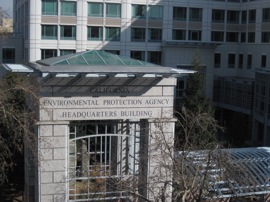
A high-ranking California official appeared on Capitol Hill today to defend the right of the federal Environmental Protection Agency to regulate greenhouse gas emissions.

James Goldstene, executive director of the state’s Air Resources Board, told members of a House subcommittee that the EPA’s recently released regulations will not create a “regulatory train wreck.”

Goldstene  held up a planned power plant in Northern California to advance his case, saying that the Russell City Energy Plant will stand as an example of how power companies can use the “best available technology” for reducing emissions, as required under a recently issued EPA rule. The plant, to be built on the Hayward shore of San Francisco Bay, is a 600-megawatt plant to be fired by natural gas.

Goldstene’s appearance before the Subcommittee on Energy and Power (part of the Energy & Commerce Committee) was to counter Republican efforts to pull EPA’s authority to regulate greenhouse gas emissions, contained in a bill known as the Energy Tax Prevention Act. Goldstene said passage of the bill into law would “send a stark message…that the U-S isn’t serious about being a leader in the future economy.” It would also upstage a ruling by the US Supreme Court affirming the EPA’s authority to regulate carbon emissions under the Clean Air Act.

Goldstene’s full testimony is available as a PDF download.

Greenpeace Urges Facebook to “Unfriend Coal”

Greenpeace gives Facebook a deadline to clean up its act…on Facebook.

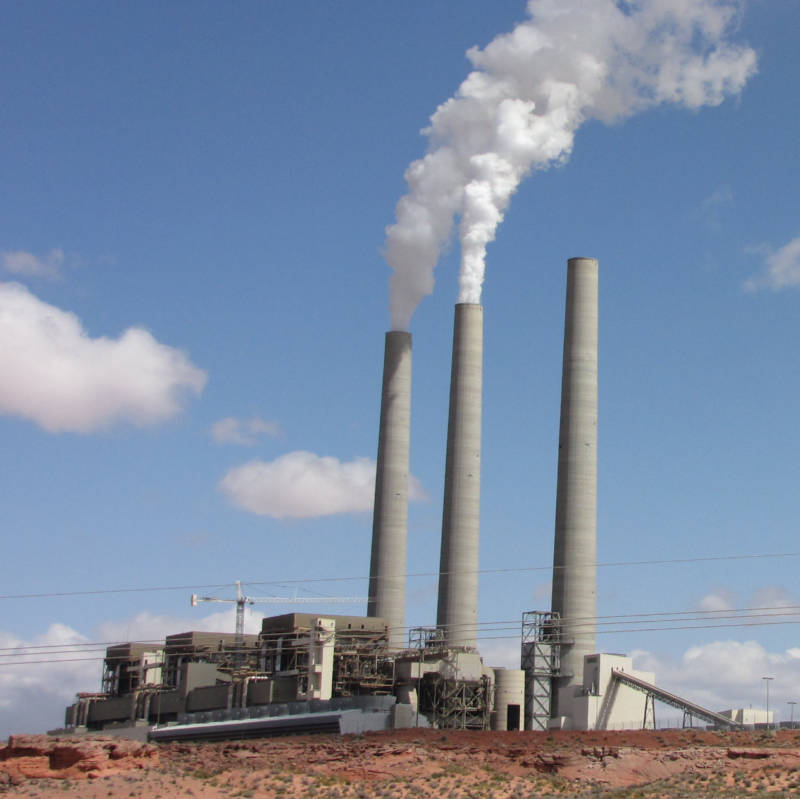
Navajo Generating Station, a coal plant, located near Lake Powell in AZ (Photo: Gretchen Weber)

With its stepped-up “Facebook: Unfriend Coal” campaign, Greenpeace is calling on the Palo Alto-based company to become coal-free by 2021, to be transparent about its carbon footprint, and to advocate for clean energy sources at all levels of government. And it wants a public commitment by April, 22: Earth Day.

“We’re saying, ‘Look, you’re being looked at as a leader in the technology space, and the corporate space, and to be using 19th century technology to power your 21st century company doesn’t make sense,” said Casey Harrell of Greenpeace.

Facebook drew some criticism last January when it announced plans to construct a data center in Oregon.  Despite high efficiency standards and plans for facility-wide LEED Gold certification, environmental groups protested the data center’s energy source; a utility that is powered largely by burning coal. Continue reading Greenpeace Urges Facebook to “Unfriend Coal”

Why EJ Groups are Leery of Cap & Trade

Environmental Justice groups say they support California’s climate law. So why did they sue?

Environmentalists may seem the most unlikely of sources stalling the state’s landmark climate change law. But the case brought by a group of environmental justice advocates is bringing up issues that have been largely overlooked in the zeal of carrying forward AB 32.

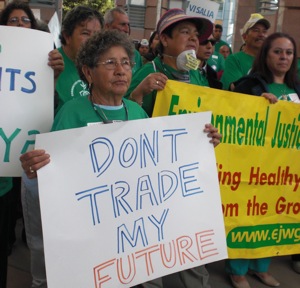
(Photo: Center on Race, Poverty & the Environment)

This means that a California power plant can increase CO2 emissions if it buys allowances from another industry that’s reducing emissions, or offsets from, say, a tree farm in Canada.

“The evidence out there is that cap-and-trade is going to fail these communities and will continue to allow polluters to dump on them, and that’s unacceptable and it’s also illegal,” said Alegria De La Cruz, legal director at the Center on Race, Poverty & the Environment in San Francisco. The Center is a plaintiff in a lawsuit filed by several organizations over the implementation plan for AB 32. Parties in that case are awaiting finalization of a state court ruling that could hold up the scheduled launch of California’s cap & trade plan. Continue reading Why EJ Groups are Leery of Cap & Trade

CA Air Official Rebukes Auto Trade Group

I-80 near the Oakland interchange known as "the Maze." (Photo: Craig Miller)

In a strongly-worded letter [PDF] to the CEOs of seven major auto manufacturers, California Air Resources Board chair Mary Nichols defended California’s efforts to curb greenhouse gas emissions from cars and trucks and accused the trade group, the Alliance of Automobile Manufacturers, of misrepresenting California’s cooperation with federal agencies in letters to Congress.

At issue, wrote Nichols, are letters the Alliance sent to Congressmen Darryl Issa (R-Vista) and Fred Upton (R-MI) in January, calling “our commitment to a national program into question.”

“For the Alliance to suggest we are no longer committed to a cooperative effort is disingenuous at best, and incorrect,” wrote the Air Board chairman.

Nichols called on the executives to “distance” their companies “from future efforts by the Alliance to undermine the achievement of our mutual goals to set standards that will provide American consumers with cleaner and more efficient vehicles.”

The letter comes just as California and federal agencies announced a shared deadline for their collaboration to set national fuel economy and greenhouse gas standards for model year 2017-2025 cars and trucks.

Margot Roosevelt of the Los Angeles Times has more, including a response from an Alliance vice president who reportedly would not address the Nichols letter directly, but did express support for the shared fuel standards deadline.

NASA’s Closer Look at the Bay Area


Taking global climate models and “downscaling” them for use at the local level is an ongoing challenge for scientists and for planners.  But thanks to new climate projections from NASA, the Bay Area now has a sharper view of what may be in store.


BCDC map showing 16 inches of sea level rise in the SF Bay, which the agency projects will occur by mid-century.


NASA says two-thirds of its facilities are at risk from sea-level rise, including Ames Research Center, which sits at the southern edge of San Francisco Bay.  So, it’s not exactly altruism that motivated the agency to deploy its own scientists to take a closer look at what climate change will really mean on the ground in places where it’s heavily invested. Continue reading NASA’s Closer Look at the Bay Area

EJ Groups Say Suit is Not To Undo AB 32

Plaintiffs who won a tentative ruling in a suit over the state’s climate law say they’re not out to torpedo AB 32

Six environmental justice groups sued state regulators over implementation of AB 32. (Photo: Craig Miller)

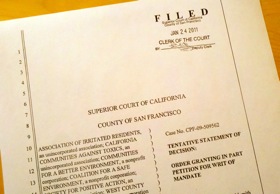
The half-dozen environmental justice advocacy groups sued over state regulators’ implementation plan and won a tentative ruling in their favor, from a state court in San Francisco. A lawyer for the Oakland-based Communities for a Better Environment called the ruling “very important and exciting,” but the groups insist that they’re looking to tweak the regulations under California’s Global Warming Solutions Act, not blow it up. Continue reading EJ Groups Say Suit is Not To Undo AB 32

Is AB 32 Headed for the Rocks?

After all this, California’s global warming law may have hit a legal wall

Lawyers at the gates. (Photo: Craig Miller)

Oil companies couldn’t bring it down with a well-funded statewide ballot initiative. But the state’s landmark 2006 law to combat climate change by regulating carbon emissions might be undone by another of California’s major environmental laws.

Cara Horowitz reports for Legal Planet that a San Francisco superior court could set aside implementation of AB 32, finding that the “scoping plan,” the implementation strategy developed by the state’s Air Resources Board, does not comply with the California Environmental Quality Act, known as CEQA. Continue reading Is AB 32 Headed for the Rocks?

Citizen Science: The iPhone App

A new iPhone app aims to make recording and sharing observations of the natural world fast, easy, and could eventually help bring climate models into better focus.

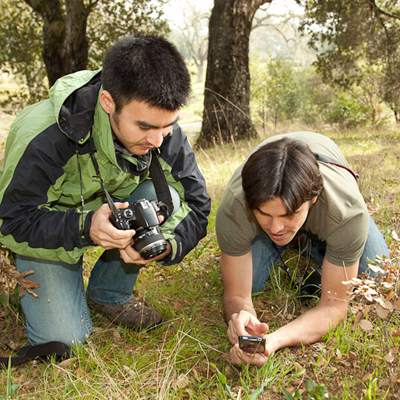
Ken-ichi Ueda and Scott Loarie demonstrating the new iNaturalist iPhone app at Stanford’s Jasper Ridge Biological Preserve (Photo: Richard Morgenstein)

At Jasper Ridge, a biological preserve and study area on the Stanford campus, a dozen of the preserve’s docents gathered this week to learn about a new iPhone application that could ultimately help scientists study how ecosystems are adapting to climate change.

The new app, called iNaturalist, is the mobile version of a citizen-science website by the same name.  The iPhone app is still in testing and not yet available, but the website, iNaturalist.org, is already an active online community of citizen-scientists around the world who use the site to record and share their sightings. Continue reading Citizen Science: The iPhone App