A Different Kind of Tsunami: Climate Refugees


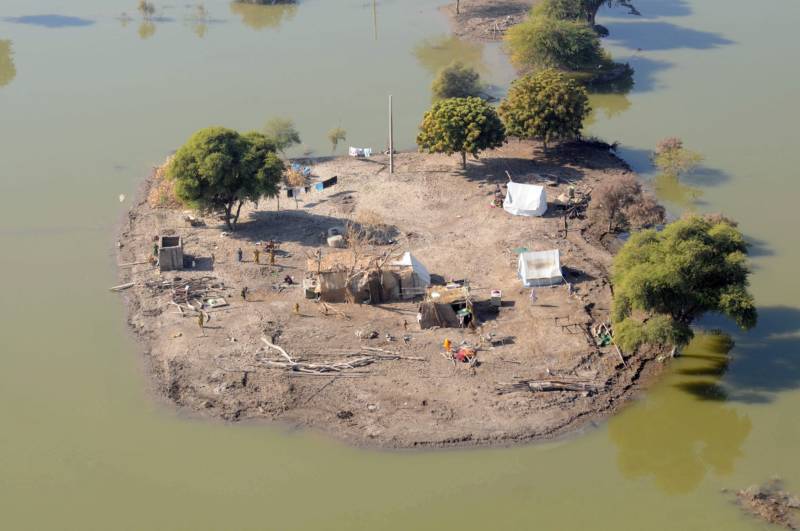
Remains of a flooded village in Pakistan in December 2010 (Photo: RIZWAN TABASSUM/AFP/Getty Images)

It’s not so much the planet we need to worry about, it’s each other.  And ourselves.

That’s the message of the documentary Climate Refugees, which aims to portray “the human face of climate change.” The film takes viewers to flooded disaster zones in Bangladesh and China, to tiny island nations like Tuvalu under threat from sea level rise, and to the desert wastelands of Sudan, where, according to the UN,  the devastating war in Darfur has been driven partly by climate change.

Extreme weather events are expected to become more common as the climate continues to change, raising the odds for disastrous floods like the ones Pakistan last year, which displaced more than 20 million people, and major droughts which will likely increase desertification in vulnerable areas of Africa and Asia, threatening food and water supplies for millions of people.

And all of those people will need someplace to go.
Continue reading A Different Kind of Tsunami: Climate Refugees
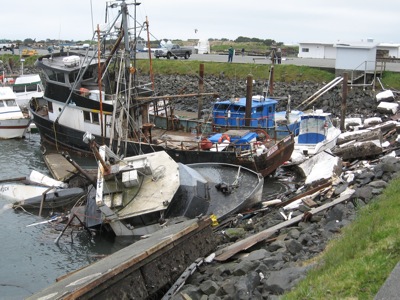
Crescent City: “It’s a mess, all right.”

Astoundingly, the mess left by Friday’s tsunami was confined to the harbor…for now. No, it wasn’t 1964, when a tsunami triggered by a quake off Alaska took out the harbor and half the town, killing 11 people. But hanging out there on the northwestern tip of California, Crescent City is “Tsunami Central” for this part of the continent.

Through a quirk of geography, the opening to the city’s horseshoe-shaped inner harbor seems to be lined up perfectly for seismically induced waves sweeping across the Pacific. The most impressive video clips I’ve seen were shot by Bryant Anderson. Both are posted on the website of the Crescent City Daily Triplicate. Anderson captured one clip while the tsunami sirens were still sounding:

Crescent City Tsunami from Bryant Anderson III on Vimeo.

Crescent City Tsunami from Bryant Anderson III on Vimeo.

Friday’s surge, which peaked with an 8-foot wave, had its way with what local officials say had been the most productive seafood landing harbor on the California coast. The next challenge is environmental, as salvage crews wait out the weekend’s extreme weather to tackle the potential threat of nearly 60 damaged and sunken boats, many full of diesel fuel, industrial lubricants and other contaminants. “Every one of the vessels has fuel on board,” said Alexia Retallack, who is helping coordinate recovery efforts for the state Department of Fish & Game’s Office of Spill Prevention & Response. “So every vessel that’s either sunken or currently in the harbor and compromised is a source of petroleum product,” she said. Continue reading Crescent City: “It’s a mess, all right.”

Report: “Stalled” Energy Projects Costing Us

Business group says delays are costing thousands of jobs, billions in lost economic benefits

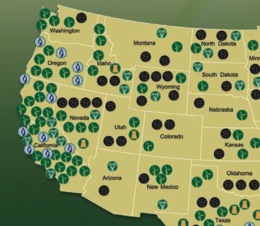
The US Chamber of Commerce says it’s taking too long to green-light energy projects — not just in California but across the US — and that it’s putting a drag on economic recovery.

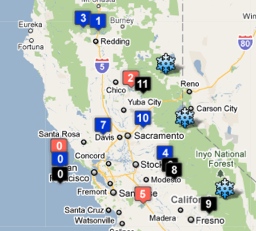
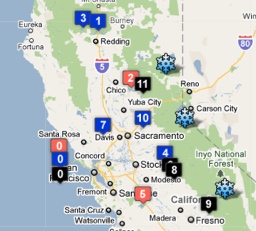
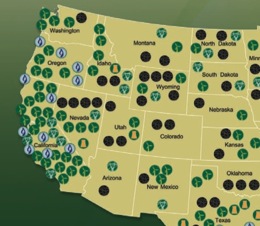
Map shows energy projects that are facing permitting or court challenges, 31 in California. (Image: US Chamber of Commerce)

The pro-business group issued a report that attempts to quantify the opportunity cost of projects that were in permitting or litigation limbo during March of 2010. That “snapshot” includes 31 projects in California. Continue reading Report: “Stalled” Energy Projects Costing Us

Melting Ice Sheets Spur Sea Level Rise

By Michael D. Lemonick

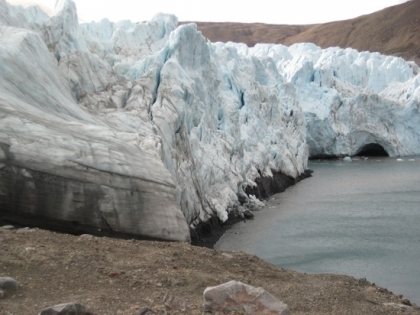
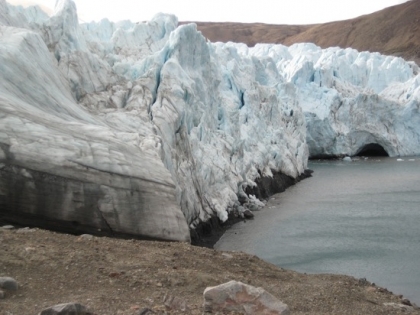
A new study says melting ice sheets will likely be “the dominant contributor to sea level rise in the 21st century.”

A tidewater glacier in Greenland, pictured in 2008. (Photo: Michael Lemonick)

About 110,000 years ago, global sea level began to drop as the planet cooled, and evaporating seawater was transformed into massive ice sheets that covered large parts of the Northern Hemisphere. About 10,000 years ago, the Earth warmed up again. The ice retreated dramatically, and sea level rose. Since then, the planet’s ice, and the level of the ocean have been more or less stable.
Continue reading Melting Ice Sheets Spur Sea Level Rise

Arnold’s Advice to Jerry

Give incentives, don’t inflict guilt, repackage the climate message

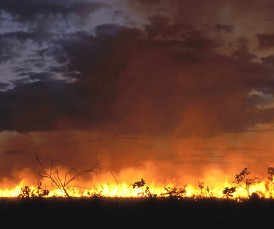
A forest ablaze in Brazil. (Photo: Haroldo Castro/Conservation Int'l)

Arnold Schwarzenegger has some advice for his successor as governor of California, Jerry Brown: “The important thing is for California to stay in there and continue the things that we started.” The former governor was talking to actor Harrison Ford at a recent fundraiser for the non-profit Conservation International (CI), about advancing the environmental and climate agenda.

“Concentrate on giving incentives to companies because in the end it’s technology that will save us all,” Schwarzenegger told the group of several hundred CI donors at San Francisco’s Four Seasons Hotel last week.

Ford, who was moderating the on-stage dialog, expressed frustration that apathy toward climate change is “a daunting obstacle to overcome.” Continue reading Arnold’s Advice to Jerry

Connecting Citizens and Science… with Smart Phones

Harnessing the power of “citizen science” can be a challenge, but many think technology can provide the missing link.

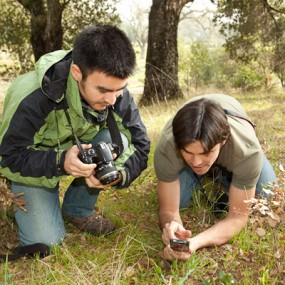
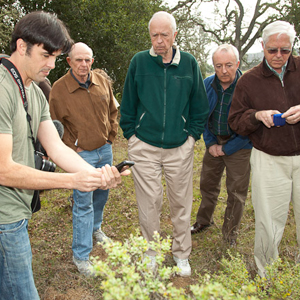
Scott Loarie demonstrates the iNaturalist iPhone app to docents at Jasper Ridge. (Photo: Richard Morgenstein)

The new iPhone app for the online community iNaturalist is officially out and available for free download from Apple’s App Store.  Its creator, Ken-ichi Ueda, hopes that the new app will make sharing and uploading field observations so easy, that more people will want to document what they find next time they’re out on a hike.

“My primary motivation is to get people outside, thinking about the plants and animals they are seeing and actually recording them,” he said.  “The act of recording really locks it in your mind.” Continue reading Connecting Citizens and Science… with Smart Phones

Federal Budget Pressure on Rivers, Wetlands

Witnesses tell an Assembly committee that looming federal cuts would leave state programs adrift

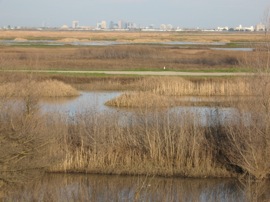
The Yolo Bypass, with Sacramento in the background. (Photo: Craig Miller)

An array of state programs to protect and restore rivers and wetlands is endangered by current plans to cut funding on Capitol Hill. That’s what a string of witnesses told the Assembly Water, Parks & Wildlife Committee in Sacramento this week.

At risk are programs that have leveraged federal money to restore hundreds of thousands of acres of wetlands and wildlife habitat in California, according to speakers for environmental and outdoor groups.

For a nearby example of how federal funds have been used, waterfowl advocate Bill Gaines pointed to the Yolo Bypass, almost within sight of the state Capitol. Gaines, president of the California Outdoor Heritage Alliance, said that over ten years, $5 million in federal money has fueled restoration of 4,300 acres of wildlife habitat. Continue reading Federal Budget Pressure on Rivers, Wetlands

Burgeoning Snowpack Sweetens Water Outlook

A wet and wild February provided a huge boost to California’s water outlook

An unusually dry January started some folks thinking that maybe the tap had been shut off for this season. But last month winter came roaring back as Pacific storms brought epic snowfalls to the Sierra. The result: Today’s monthly survey shows the water content of the mountain snowpack at 124% of normal for this date–and even above its normal level for April first.

Check current reservoir levels with our interactive map, below.

Major reservoirs are also above their normal levels for early March. But it still doesn’t mean that contractors on the State Water Project will get all the water they ask for. Officials say they still expect deliveries to come in at about 60% of the volume requested. That’s a number that typically gets adjusted throughout the winter. Continue reading Burgeoning Snowpack Sweetens Water Outlook

Green Fire Spreading

A new documentary broadens awareness of a timeless thinker

“Civilization has so cluttered this elemental man-earth relationship with gadgets and middlemen that awareness of it is growing dim. We fancy that industry supports us, forgetting what supports industry.”
— Aldo Leopold,
A Sand County Almanac

Everybody in California seems to have at least a vague notion of who John Muir was. Now, with the help of a new documentary film, Aldo Leopold may get more of the props he earned during his fascinating life as a forester and conservationist.

Leopold’s following has been growing since his work in the first half of the 20th century. When Steve Dunsky set about with his co-producers creating Green Fire, they heard plenty of superlatives from the biographers, historians and naturalists they interviewed. One called Leopold the third pillar of conservation’s “Holy Trinity,” with Muir and Henry David Thoreau. Continue reading Green Fire Spreading

California’s Giant Carbon Sponge

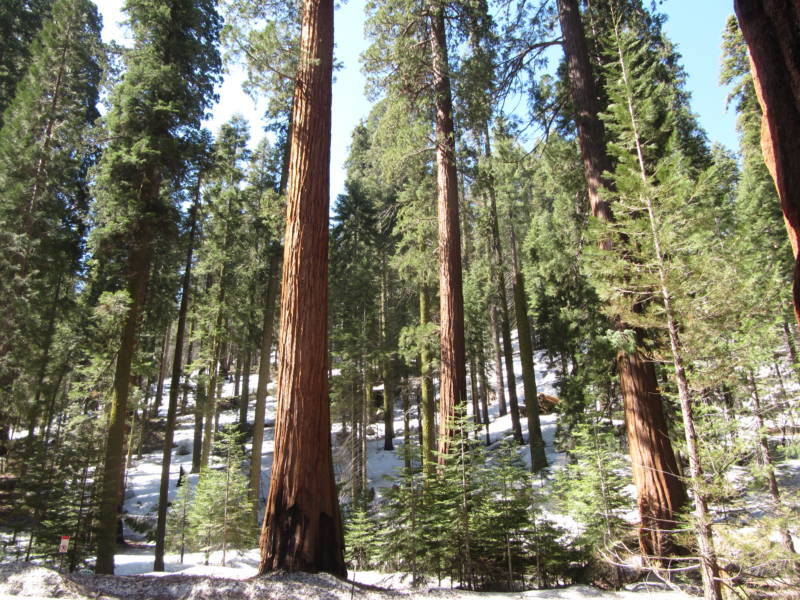
The forests in the state provide water, habitat for animals, lumber and tourism dollars, and they sequester carbon. (Photo: Molly Samuel)

For decades the federal government has touted the nearly 200 million acres of national forests and grasslands under its control as a “land of many uses.” But one “use” that’s seldom discussed is as a huge repository for carbon.

But clearly it’s on the minds of officials and scientists as the Forest Service seeks comments on its proposed new planning rule. National Forests and Grasslands are managed individually, but the planning rule guides how those management plans are developed. This new one is replacing a Planning Rule from 1982. Continue reading California’s Giant Carbon Sponge