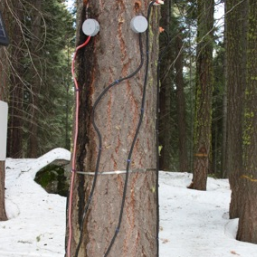
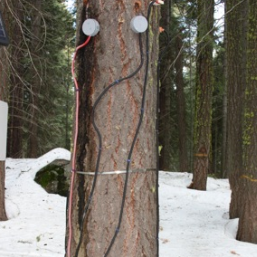
A white fir outfitted with snow sensors in the Southern Sierra Critical Zone Observatory. (Photo: Sasha Khokha)
Trying to interview guys who wear backcountry skis to work can be tough…especially when trudging behind on snowshoes with a pack full of recording equipment. But my visit to the Southern Sierra Critical Zone Observatory was worth the slog.
It’s a patch of forest at about 6,000 feet near Shaver Lake in the Southern Sierra, in what’s known as the rain-snow transition zone. The snowpack at this elevation is likely to be the first to reflect climate change as temperatures warm and snow turns to rain. Scientists at UC Merced’s Sierra Nevada Research Institute, in conjunction with UC Berkeley, have developed new, high tech sensors to intensively monitor snow melt and runoff here. Continue reading Snow Surveys of the Future→
Governor lifts drought declarations from 2008, 2009
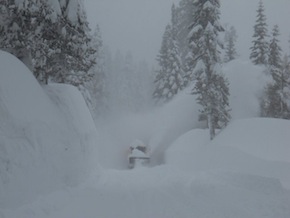
Snow removal near Mt. Lassen. (Photo: KNVN Chico-Redding).
Frank Gehrke summed it up: “Well, it has been a really crazy winter,” said the state’s chief surveyor of the Sierra Nevada snowpack.
Statewide averages from the season’s fourth survey Wednesday, shows water content at 165% of normal for April 1.
The latest survey shows statewide, water content of the Sierra snowpack is 165% of normal. Gehrke says it’s been about 15 years since there’s been this much snow on the ground at this point in the season. Earlier this month, some locations were reporting total seasonal accumulations equivalent to the height of a six-story building. Continue reading CA Drought Lifted, Snowpack at 15-Year High→
After two failed attempts, California is moving ahead with the most aggressive renewable energy goal in the country. Today the State Assembly passed SB 2x, a bill that requires utilities to get 33% of their electricity from renewable sources like solar and wind, by 2020.
By all accounts, utilities will need to add an unprecedented amount of renewable energy to meet the goal. Peter Miller of the Natural Resources Defense Council says that will spur new technology and green job opportunities. “There’s worldwide competition to lead this industry, which is the growth industry of the 21st century,” said Miller. “And this moves us, I believe, to the front of the pack.”
If the 33% renewable portfolio standard (RPS) doesn’t sound new, that’s because it isn’t. The goal was originally set by former Governor Arnold Schwarzenegger in a 2008 executive order. Supporters knew that an executive order could be overturned by a future governor, but two previous bills aiming at cementing the goal failed to make it into law. Continue reading CA Moves Forward with Renewable Goals→
To paraphrase Yogi Berra, you can observe a lot by listening
It was interesting to hear a report from NPR’s Richard Harris on a “new” branch of science called “soundscape ecology.” Harris interviewed Purdue landscape ecologist Bryan Pijanowski, who is part of a group of scientists advancing a “research agenda” to fully integrate the discipline into the study of ecosystems.
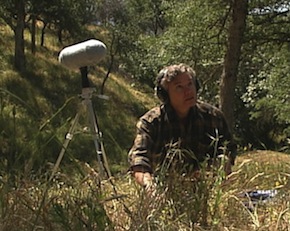
Bernie Krause, recording a soundscape in the Sycamore Creek area of Sequoia-Kings Canyon National Park.
“We’re trying to understand how sounds can be used as measures of ecosystem health,” Pijanowski told Harris. Pijanowski is hardly the first to make this connection. An article co-authored by him and seven colleagues for the the March issue of the journal BioSciencecites references back to 1969 (and gives a nod to Rachel Carson’s Silent Spring, which appeared in 1962). Continue reading Ecosystems by Ear: It’s About Time→
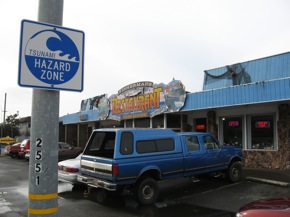
A sign along Highway 101 in Crescent City marks the tsunami hazard zone. Officials say they can evacuate the hazard zone in about two hours. (Photo: Craig Miller)
Of course, after facing down 34 tsunami events in the past 100 years, I suppose they should have it down. When I was there to cover the aftermath of the March 11 event that pretty much took out the working harbor, it was clear that the possibility of a seismically-triggered surge is never far from the public consciousness in Del Norte County.
“It’s here with us from the names of buildings to the names of the businesses,” Cindy Henderson told me. “Tsunami is our world. So yeah, it is a very big threat,” said Henderson, who heads emergency services for the county. “We do have others we have to prepare for but in the backs of our minds, we are always thinking about tsunamis — every time there’s a big earthquake.” Continue reading How “Tsunami-Ready” Are You?→
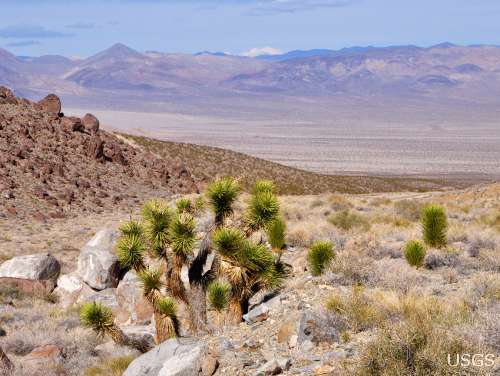
Joshua trees, the spiky desert-dwellers that are so iconic to Southern California’s dry country that they got a national park named after them, will likely disappear from 90% of their current range by the end of the century, according to a new study by scientists at the US Geological Survey.
Ecologist Ken Cole, the study’s lead author, said that means no more Joshua Trees in Joshua Tree National Park, which is currently in the southernmost part of the species’ range. It also means elimination of the trees across wide swathes of other parts of Southern California as well as Nevada and Arizona.
Cole and his team used climate models, field work, and the fossil record to project the future distribution of Joshua trees. They compared the projected increase in temperatures for the Southwest (four degrees Celsius, according to a “middle of the road” IPCC scenario) to a similar rapid increase in temperatures nearly 12,000 years ago, at the end of the ice age.
Using fossil sloth dung and packrat midden, the scientists reconstructed how Joshua trees responded to that warming. (Sloths, which are now extinct in the region, and packrats, ate the Joshua tree fruit, spreading the seeds and leaving them behind for the scientists to track.) Continue reading Joshua Trees Losing Ground, Fast→
“Climate Watch Conversations” is a series of television interviews with experts from California’s climate change community. Below are the interviews we’ve done to date. All originally aired on KQED’s weekly public affairs program This Week in Northern California.
May 4, 2012
Threats posed by rising sea levels and extreme weather patterns are changing the way California’s coastal communities plan for the future. Senior Climate Watch editor Craig Miller talks with National Oceanic Atmospheric Administration’s Margaret Davidson about the impact of climate change on Bay Area shoreline, most visibly along San Francisco’s Ocean Beach.
February 17, 2012
Climate Watch Senior Editor Craig Miller hears Jared Blumenfeld’s take on the top climate change challenges for the Environmental Protection Agency in Northern California. Blumenfeld also discusses his recent visit to San Francisco’s Mission Motors, an electric motorcycle company seen as a poster child for the Obama administration’s focus on renewable energy and “green” jobs it creates.
December 16, 2011
Heavy precipitation, brutal storms, and devastating drought will continue to afflict the planet in the coming decades. That’s according to the latest report from the U.N.’s Intergovernmental Panel on Climate Change (IPCC). But where’s all this climate science leading us if governments aren’t acting upon it? Climate Watch Senior Editor Craig Miller discusses the impact of the report with Chris Field, a leading scientist with the IPCC.
June 24, 2011
Climate Watch Senior Editor Craig Miller discovers why Jon Jarvis, Director of the National Park Service calls climate change “the greatest threat” to our national park system. With rising temperatures, extended fire seasons and foreign plant species threatening some of California’s most treasured parks, Jarvis discusses actions underway to respond to the crisis.
May 13, 2011
Climate Watch Senior Editor Craig Miller talks with Mindy Lubber, president of the Boston based nonprofit Ceres. The organization works to address sustainability challenges such as global climate change and water scarcity. This week, it held a conference in Oakland at which environmentalists, executives and investors from around the world gathered to consider ways for business to adopt environmentally sustainable practices.
April 8, 2011
European Union Commissioner for Climate Action Connie Hedegaard speaks with Senior Editor Craig Miller about working with California leaders on climate policy. The Commissioner met with Gov. Brown and business executives at a conference on climate related issues and policy.
March 18, 2011
Climate Watch Senior Editor Craig Miller talks with Mary Nichols, Chair of the California Air Resources Board about implementing AB 32, the state’s renewable energy goals and promoting alternative transit.
Air board will appeal ruling on implementation of AB 32
Environmental justice advocates will tell you they never intended to shut down the state’s whole climate law, when they filed suit against it. But a broadly-worded court decision could put some or all implementation of AB 32 on hold.
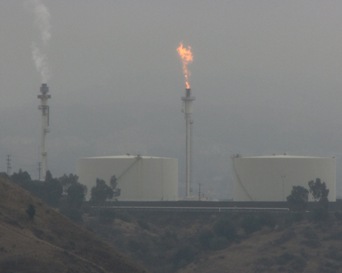
Waste gases are burned off at the ConocoPhillips refinery in Rodeo. (Photo: Craig Miller)
The ruling, which was rendered last Friday by a state superior court in San Francisco and made public yesterday, finds that in putting together its implementation (scoping) plan, the California Air Resources Board failed to give adequate weight to potential alternatives to cap & trade.
Judge Ernest Goldsmith issued the ruling:
“…enjoining any further implementation of the measures contained in the scoping plan until after (the Air Board) has come into complete compliance with its obligations under its certified regulatory programs and CEQA (the California Environmental Quality Act).
Environmental groups are criticizing the Obama Administration’s new proposed rules for managing the country’s nearly 200 million acres of national forest, arguing that they weaken current standards for protecting wildlife and watersheds.
More than 100 organizations, including the Natural Resources Defense Council and Defenders of Wildlife, signed on to a letter sent to Secretary of Agriculture Tom Vilsack on Monday, arguing that the proposal “fails to provide critical, concrete protections for the most precious resources of our forests — water and wildlife,” and that it “weakens the strong standards for safeguarding water quality and wildlife viability first issued in 1982 by the Reagan Administration and currently still in place.” Continue reading New Rules May Put National Forests at Risk→
My experiment in audience participation falls short
I had the chance to sit down for a few minutes with California’s top air regulator today. Mary Nichols, who chairs the state’s Air Resources Board joined us by satellite from Sacramento. The seven-minute interview will air on KQED’s This Week in Northern California, Friday evening.
Nichols after a day-long public hearing in December of last year. (Photo: Craig Miller)
On Wednesday, blogger Jon Brooks posted a call for questions on “News Fix,” the KQED News blog. It was a worthwhile experiment but the results speak to the extent to which Nichols has become a lightning rod for opponents of environmental regulation in general and cap & trade in particular — and to some degree the state of public policy discourse in America today. The comments, some emailed and some posted on the comments thread at News Fix were largely a stream of invective directed at Nichols and the Air Board. Some questions were a bit technical for a seven-minute TV interview. Others were valid but off-topic. As the latest installment in our series of “Climate Watch Conversations,” I tried to keep to the climate-related business of the Board (with one exception: I felt I needed to have her address events unfolding in Japan and concerns here about radioactive drift).

 Environmental groups are criticizing the Obama Administration’s