This post has been modified based on clarifications by the study’s lead author, which are outlined in her comment, below.
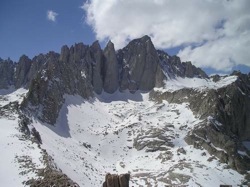
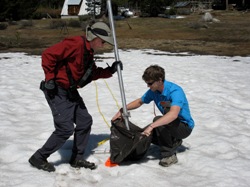
A recent study seems to confirm what many have already surmised: The spring melt from the Sierra snowpack is happening sooner.
To get a handle on the timing of mountain runoff, a team led by Iris Stewart of Santa Clara University pulled together data from 52 stream gauges up and down California. For her study, Stewart says she chose only water courses unaffected by dams and diversions, with at least 20 years of continuous data.
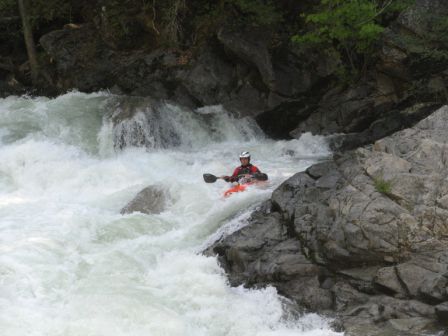
Stewart’s data shows that over the 60 years spanning 1948-2008; 80% of the gauges show the “stream pulse” that accompanies peak runoff, coming consistently sooner in the season–an average of about 10 days sooner, though at least one location had shifted up by more than a month. In fact, combining all of the metrics in the study, Stewart says only one gauge showed a later trend.
The trend seems remarkably consistent. Stewart says that despite a warming trend over the past ten years, she has not seen any acceleration of the trend within that period.
Stewart cautions that there’s more work to do on this and was reluctant to draw broad inferences from the study. Runoff in a particular stream is affected by many factors, including the elevation, slope, aspect (which direction it’s facing), vegetation cover and soil composition. Stewart says further study of these variables will better help identify the most vulnerable streams. But the latest results seem consistent with an earlier study in which Stewart found “earlier runoff on a continental scale.”
Scientists are concerned that as average temperatures rise, California’s mountains will see more rain, less snow–and what snow there is will melt off sooner. Reservoirs can only retain so much runoff at once, so if more of the “frozen reservoir” dissipates earlier in the season, farms and cities stand to be caught short of water before the rains return.
Stewart, an assistant professor at SCU’s Environmental Studies Institute, presented her findings this morning to researchers at the Pacific Climate Workshop (known as PACLIM, the conference does not have a website), a semi-annual gathering of climate scientists doing front-line research around North America. The conference in Pacific Grove is organized by the USGS office in Menlo Park.
Over the course of four days, about 60 researchers will hear findings on the climatic implications for fire, fog, glaciers, the ocean and wildlife, among other topics.