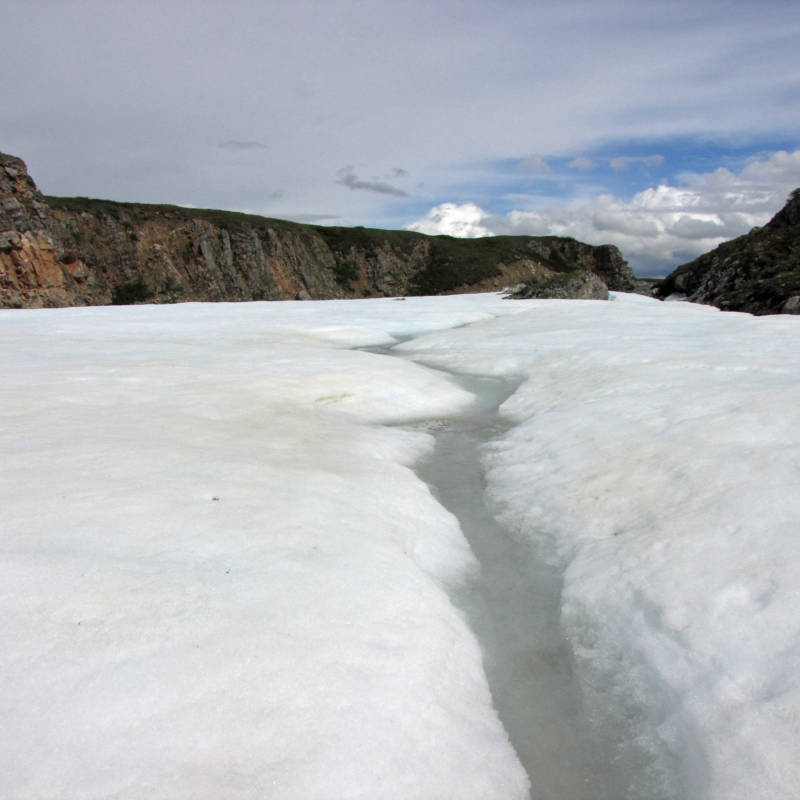
This week, NPR launches a six-part series on, “the changing Arctic,” taking a look at, “what may be the world’s next geopolitical battleground.” Part of that look includes considering the impact of rising temperatures and melting ice, such as freshly-opened strategic waterways and the rush to claim newly-accessible natural resources, like oil and gas deposits.
Loot from the recent invasion of email servers at the Climatic Research Unit (CRU) in Britain has raised questions about whether scientists who dissent from the prevailing views of climate research are being muzzled by their colleagues.
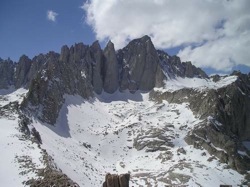
Snow on Mt. Whitney. Photo: USFS
An interesting example of this arose this week in a report by Richard Harris for NPR’s All Things Considered. It’s worth a listen, if only for the back-and-forth between two climate scientists over snowfall in the southern Sierra Nevada mountains. John Christy of the University of Alabama, Huntsville, tells Harris about trouble he’s had publishing research that appears to counter the mainstream view that the Sierra snowpack is endangered. For a response, Harris goes to Philip Mote at Oregon State University, one of the scientists who reviewed Christy’s research.
The head of the UN’s climate panel finally issued his own statement on the email flap, which was part condemnation of the hackers, part defense of the science and peer review process.
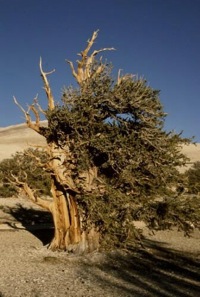
Bristlecone pine in the Inyo National Forest. Photo: US Forest Service
There’s a lot of history packed into a tree with more than 4,000 annual growth rings. Scientists who count them (dendrochronologists) have been able to learn a lot about the drought history of California and the West.
The Great Basin bristlecone pines that grow along the spine of the Sierra are the oldest living things on Earth–older, even, than the giant sequoias. Studying the uppermost trees, around 12,000 ft., researchers stumbled on a strange trend. The trees, legendary for their slow rate of growth, have been growing faster over the last 50 years or so, than at any time in the last three millennia.
If you missed it this week, Malcolm Hughes, one of the study’s lead researchers and a professor of dendrochronology at the University of Arizona’s Laboratory for Tree-Ring Research, spoke to NPR’s All Things Considered about the possible cause.
You can see these astonishing trees for yourself in the Ancient Bristlecone Pine Forest of Inyo National Forest–but you might want to wait until spring. The visitor center is not staffed between November and May and winter access is iffy at 10,000 feet. Worse yet, the original vistor center burned down in the fall of last year. The Forest Service is using a temporary (trailer) facility until a permanent one is rebuilt. According to the Forest Service website:
“…the visitor center is being designed to be a model of energy efficiency, utilizing the latest in “green” building practices. According to Bristlecone Pine Forest Manager John Louth, some of the improvements that visitors will see will be a state-of-the art solar power system, updated exhibits addressing the impacts of global warming on the ancient trees, a small research library, a slightly larger theatre room and a fire/intrusion detection & suppression system.”
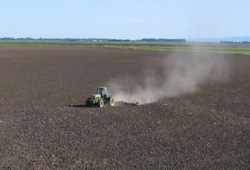
NPR’s Morning Edition launched an “occasional series” on California’s water woes this morning. Veteran correspondent John McChesney begins with the impact on agriculture in the Central Valley’s Westlands Water District, the nation’s “biggest irrigated region.”
KQED’s Central Valley Bureau Chief and Climate Watch contributor Sasha Khokha will have three stories in the series, two of which will debut on The California Report in the weeks ahead:
WATER METERS: Many California cities are preparing for or implementing mandatory water rationing this summer. But there are still cities and towns, particularly in California’s Central Valley, where water can’t be rationed because residents don’t even have water meters. Residents are charged a flat rate for any amount of water they use. Khokha looks at the city of Fresno, where water meters will be phased in, but not until 2013.
MENDOTA PROFILE: The town of Mendota in California’s Central Valley is at the heart of the economic crisis spawned by drought and the loss of farm jobs. Sam Rubio grew up here, the son of a Mexican farmworker. He went off to college, and was planning to become a doctor, but instead has returned to this town to teach biology, mentor local kids, and run a café that’s become a haven for the farmworker youth.
AG ADAPTING TO DROUGHT: California farmers are facing an increasingly uncertain water supply, brought about by drought, environmental restrictions on pumping, and climate change. How will farmers adapt? Some of them are yanking out water-intensive crops and replacing them with more drought-tolerant ones. But others are trying to keep growing the same crops with improved technology. We’ll follow a new tech start-up that’s helping farmers use water more efficiently by tracking how much moisture reaches each plant in their fields–and sending a satellite message to their cell phones. We’ll also talk with a researcher who says there are ways California can grow some key crops, like oranges and nuts, using less water.