Planners Seek Public Input on Bay Area Growth

How do you want the Bay Area to look in 2040?

Tonight the Metropolitan Transportation Commission (MTC) kicks off the first of nine “Plan Bay Area” workshops, aimed at gathering public input on plans for sustainable growth in the region. The planning agency is seeking comment on the Initial Vision Scenario, which was released by MTC and the Association of Bay Area Governments (ABAG) last month.  This scenario is the first draft of the Bay Area’s Sustainable Communities Strategy, a planning document required under the state law, SB 375, which was passed in 2008 and requires planning regions throughout California to cut greenhouse gas emissions from cars by integrating land-use and transportation planning.

The Bay Area, Sacramento, and San Diego
have some of the most aggressive reductions targets: seven percent per capita by 2020 and 13-16% by 2035 (compared to 2005 levels).  The South Coast (by far the biggest region, including Los Angeles, San Bernadino, Ventura, and other counties) is shooting for an eight percent reduction by 2020, and 13% by 2035.
Continue reading Planners Seek Public Input on Bay Area Growth

To Shrink Carbon Footprints, One Size Doesn’t Fit All

While turning down your thermostat, taking public transportation, and buying locally grown food could all reduce your household’s carbon emissions, just how effective each of those individual strategies is depends on who you are and where you live, according to researchers at UC Berkeley.


The study, authored by Christopher M. Jones and Danial Kammen of Berkeley’s Renewable and Appropriate Energy Laboratory (RAEL), analyzed thousands of different “types” of typical carbon footprints by looking at households in all 50 states, including six different household sizes and 12 different income brackets.  They used data from the US Labor Department’s Consumer Expenditure Survey.

The results of the analysis are summarized in a new “carbon calculator” that can help people estimate their carbon footprints and identify the areas where lifestyle changes would have the largest impact.  Users can also compare their footprints to similar households in their own area.
Continue reading To Shrink Carbon Footprints, One Size Doesn’t Fit All

Time for “Creosote Bush” National Park?

It’s not time to rename Joshua Tree just yet, says the author of a new study.

Climate change is threatening the Joshua trees in Joshua Tree National Park all right, according to a new report. But unlike the findings of recently-published study,  this report finds the park’s iconic, spiky namesake is unlikely to completely vacate the premises over the next century.

The new report was funded in part by Joshua Tree National Park, and its author Cameron Barrows, a researcher at UC Riverside’s Center for Conservation Biology, says that he conducted it partly in response to the recent study by Ken Cole of the USGS, which found that the trees would likely be gone from the park within the next 90 years.

“I facetiously say if that was to happen, we’d have to rename the park ‘Creosote Bush National Park’ or something like that,” said Barrows.  “It would be really sad if that’s the case.”
Continue reading Time for “Creosote Bush” National Park?

Emissions Trading May Not Worsen Local Pollution

Study could weaken underpinnings of suit holding up AB 32

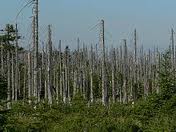
Trees killed by acid rain. (Photo: bdk)

In response to a court order, California regulators say they are working up a “very robust analysis” of alternatives to cap & trade, a critical part of the state’s AB 32 climate law.

Right now, the entire implementation plan is on hold, after environmental justice groups sued the Air Resources Board.

A lower court ruling has forced state officials to reexamine the carbon trading program, on the grounds that alternative ways of controlling emissions were not adequately considered.

The activists’ concern is that a market-based system of emission reductions will create “hot spots” in low-income communities of color as industrial polluters buy the rights (called allowances, or carbon credits) to emit more greenhouse gases, and potentially bring other more toxic forms of pollution into nearby communities.

But will that happen? Since carbon trading won’t start until at least next year, the argument is hypothetical. But another example of emissions trading has been well tested.
Continue reading Emissions Trading May Not Worsen Local Pollution

Brown, Chu Tout New Renewables Law

California’s utilities now have their marching orders: to provide one third of the state’s electricity from renewable sources by 2020.

Now that the “33-by-20” target is a mandate backed by state law, supporters say it will lure more renewable energy investments to California. There’s evidence that it already is.

Calling it a “breakthrough,” Governor Brown signed the bill into law at the dedication of a new SunPower Corp. manufacturing plant in Milpitas, near San Jose. And he laid down a challenge:

“Last year six thousand megawatts of solar installations were produced by China and one thousand by the United States. Now, are we up for changing that? I think we are.” Continue reading Brown, Chu Tout New Renewables Law

Goldman Prize Winners Reflect Energy, Water Concerns

The 2011 Goldman Environmental Prize winners were honored in San Francisco last night. In a ceremony at the Opera House, they were each awarded $150,000 for their grassroots work addressing pressing environmental issues around the world.

Environmental degradation from energy production is a common theme in the work of at least half the winners: Dmitry Lisitsyn, who’s worked to protect the ecosystems of Sakhalin Island from rapid destruction caused by companies exploiting the region’s petroleum reserves; Hilton Kelley, for environmental justice work on the Texas Gulf Coast, a region plagued with air-quality-related health problems due to emissions from the major refineries and petrochemical plants in the area; and Ursula Sladek, who created Germany’s first cooperatively-owned renewable power company. Continue reading Goldman Prize Winners Reflect Energy, Water Concerns

Report: Cities Fiddle While World Warms

Compared to most of the world, California would appear to have a head start in planning for a changing climate.

Cities across the world are not doing enough to protect citizens from the likely impacts. That’s the finding of a new analysis from the National Center for Atmospheric Research (NCAR) in Boulder, CO. The report says cities are unprepared for rising seas, intensified heat waves, while failing to curb their own greenhouse gas emissions. Continue reading Report: Cities Fiddle While World Warms

EU Lesson for CA: Don’t Give Away the Store

Advice from Europe for California’s cap-and-trade captains

As California lurches toward what would be the nation’s most comprehensive carbon trading program, I got an interesting perspective from the world’s largest, the European Union. “California is one of the states that is actually moving forward in the US,” EU Commissioner Connie Hedegaard told me in a one-on-one interview this week. “And we know in Europe that sometimes when California starts to do something, that it’s the start of something that will end up being the American way of doing things.”

Connie Hedegaard directs climate action for the EU. (Photo: European Union)

Hedegaard, who is the EU’s Commissioner for Climate Action, cited California’s leadership in regulating tailpipe emissions, among others, though when it comes to cap-and-trade for carbon, it’s unclear who will be following. Certainly Congress is in no mood, and the regional trading scheme known as the Western Climate Initiative has been severely stunted.

Citing recent estimates that five years of carbon trading in Europe has lowered total greenhouse gas emissions by less than one percent, I asked her if she considers that a success. “Yes, I do,” replied Hedegaard. She countered with her own figures that while US emissions had continued to rise between 1990 and 2009, those in Europe had fallen 16%. “So we’re doing something right,” she said (again, EU carbon trading only began in 2005). “Of course when you’re building a complex system like that, those who do it first, in the first couple of years, have a lot of lessons learned.” Continue reading EU Lesson for CA: Don’t Give Away the Store

On the Capitol Hill Climate Hotseat

And the Smoking Gun that Never Fired

This week’s hearing on climate science before the House Committee on Science, Space & Technology had some observers on the edge of their seats.

Berkeley Physicist Richard Muller testifies on Capitol Hill, Thursday (Image: House Committee on Science, Space & Technology)

Much of the pre-game analysis focused on Richard Muller, UC Berkeley physicist and author of Physics for Future Presidents.

Muller started taking hostile fire weeks ago when bloggers noted that the famously anti-climate-regulation Koch Brothers were providing funding for his audit of the global temperature data used in UN climate reports. When he was slated to testify, speculation arose that Muller was hand-picked by House Republicans to savage the prevailing science.

But if there was any agenda behind Muller’s remarks, it wasn’t in evidence at this hearing, as Andrew Revkin notes in his Dot Earth blog. After Muller’s opening statement, which was deadpan and laden with technical detail, committee members seemed to shy away from him and pursue soundbites from more colorful panelists, who included: Continue reading On the Capitol Hill Climate Hotseat

AB 32 Negotiations Stalled: Climate Plan in Limbo

Litigants can’t come to terms on letting part of the law proceed

Environmental justice groups say California's carbon trading program would make pollution worse for communities near major polluters. (Photo: Alison Hawkes)

Prospects for full implementation of California’s 2006 climate change law turned a darker shade of gray this week. Environmental justice groups walked away from negotiations with state officials. The talks were intended to allow certain portions of the plan to move forward even as the carbon trading program remained tied up in litigation.

That means implementation of AB 32 is effectively at a standstill.

“At this point my clients consider negotiations over,” said Brent Newell, a lead attorney in the case representing a dozen environmental justice groups and individuals. Continue reading AB 32 Negotiations Stalled: Climate Plan in Limbo