Category Archives: Water

Potentially the biggest climate impact on life in California

Burgeoning Snowpack Sweetens Water Outlook

A wet and wild February provided a huge boost to California’s water outlook

An unusually dry January started some folks thinking that maybe the tap had been shut off for this season. But last month winter came roaring back as Pacific storms brought epic snowfalls to the Sierra. The result: Today’s monthly survey shows the water content of the mountain snowpack at 124% of normal for this date–and even above its normal level for April first.

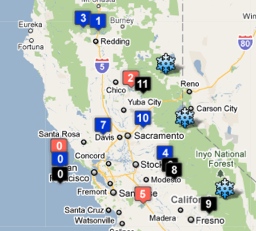
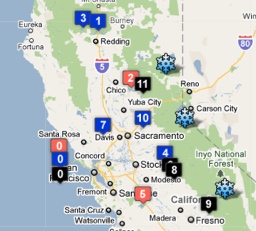
Check current reservoir levels with our interactive map, below.

Major reservoirs are also above their normal levels for early March. But it still doesn’t mean that contractors on the State Water Project will get all the water they ask for. Officials say they still expect deliveries to come in at about 60% of the volume requested. That’s a number that typically gets adjusted throughout the winter. Continue reading Burgeoning Snowpack Sweetens Water Outlook

What Will Your Water Cost?

Report: Big changes needed to avert “widespread environmental and economic losses” in California

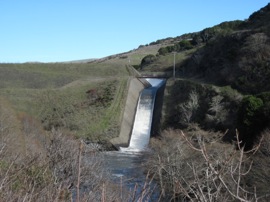
Grand illusion? Water rushes over the spillway at Nicasio Reservoir in Marin County. (Photo: Craig Miller)

A high-profile team of experts is calling for a major overhaul of the way California manages its water. In a 500-page report from the non-partisan Public Policy Institute of California, the authors say decades of well-intended water policies simply haven’t worked, leaving the state vulnerable to major crises, including water shortages, catastrophic floods, decline & extinction of native species, deteriorating water quality, and further decline of the Sacramento-San Joaquin Delta.

“Our system has been dying a death by a thousand cuts,” says co-author Ellen Hanak, an economist and policy analyst at the PPIC. Hanak says that the state’s water management efforts have been “incremental” and “piecemeal,” with little success to show for it. Continue reading What Will Your Water Cost?

Beetlemania Creeping Into California

As if drought and wildfires weren’t enough, California’s coniferous forests face another climate-related threat

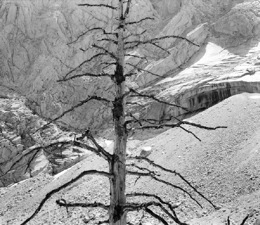
(Photo: Reed Galin/Lone Tree Productions)

In the last decade, tiny forest-dwelling beetles have wiped out pine trees on millions of acres in the Canadian and American West, including Southern California. The rest of the state has been largely spared, but forest ecologists say that’s likely to change.

Reporter Ilsa Setziol recently spent some time tracking these bugs with an entomologist from the US Forest Service. They found beetles at work in Jeffrey pines and coulter pines in the San Bernardino National Forest, east of Los Angeles. Continue reading Beetlemania Creeping Into California

The Central Valley’s Giant Sucking Sound

Studies reveal huge water withdrawals from aquifers under California’s Central Valley

The New York Times this weekend published a story and useful graphic describing new findings on the intensity of groundwater pumping in California’s San Joaquin Valley.

One eye-opening note from Felicity Barringer’s article:

“…the total loss of groundwater from the Sacramento and San Joaquin River basins in California’s Central Valley from 2003 to 2010 was just under 16.5 million acre-feet — approximately the volume of the Lower Colorado River reservoir, Lake Mead, when it is full.”

Lake Mead is the nation’s largest man-made reservoir (and has not been full for some time).

The research, by scientists at a Massachusetts arm of the Stockholm Environment Institute, includes projections for water supply and demand in California and the Southwest. The article points out that about a third of Californians’ total water use is groundwater.

Soggy Mountain High: Big Start for Sierra Snowpack


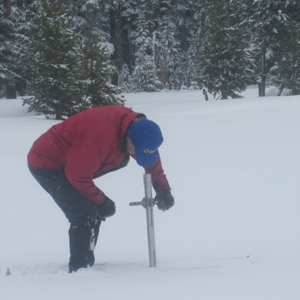
Frank Gehrke conducting last year’s first snow survey of the season. (Photo: Gretchen Weber)

All the wet weather that’s been drenching much of the state has left the Sierra Nevada with an extra-thick blanket of snow, which has water officials optimistic about the state’s water supply for 2011.

Using a combination of manual and electronic measurements, the state’s Department of Water Resources conducted its first snow survey of the season on Tuesday, and found the water content of the state’s snowpack at 198% of normal for this time of year.   Last year at this time, the statewide average was just 85% of normal.
Continue reading Soggy Mountain High: Big Start for Sierra Snowpack

So Much for La Niña

Pacific ocean conditions that often portend a dry winter sure haven’t so far.

Scientists like to joke that “climate is what you expect, weather is what you get.” The relatively soggy winter so far is a classic example of that.

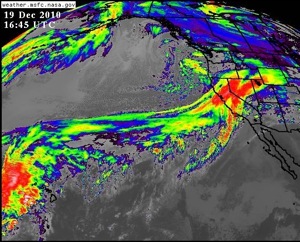
Satellite image from last weekend, showing storm systems marching across the Pacific toward California. (Image: NASA)

A closely-watched oscillation in the Pacific is in the La Niña phase this winter, creating colder-than-normal surface temperatures and distorting weather patterns. Usually a La Niña means drier-than-normal conditions for Southern California in particular and often for northern parts of the state as well. Not this year–at least not so far. The rain set multiple records over the weekend. Los Angeles has had a third of its average annual rainfall in a week. So what’s going on? Continue reading So Much for La Niña

…And It’s Not Even Winter Yet

Photo: Gretchen Weber

Good news for cities, towns and farms across the state that rely on the State Water Project: Today California’s Department of Water Resources doubled its projected 2011 deliveries of water from its initial 25% estimate to 50% of amounts requested.

Fifty percent doesn’t sound like much but compared to last year, when the initial projection for 2010 was a record-breaking low of five percent, this year is off to a pretty soggy start.  These allocations tend to climb throughout the season, so the 25 million Californians who rely on this water could actually see much higher numbers as the winter progresses.  2010 ended up with a 50% allocation despite its conservative early estimates.

Statewide, remote sensing indicates the mountain snowpack is 122% of normal for this date. As of Wednesday, the northern Sierra had already received nearly half its “normal” precipitation for the entire water year, which runs from October 1 to September 30, according to DWR.

And it looks like more of the same for the near future.  Meteorologists are predicting up to 15 feet of new snow for parts of the Northern Sierra by the middle of next week.

Californians Who Rely on Delta at “Severe Risk”

Here’s a shocker: Yes, action is necessary on the San Francisco Bay Delta

(Photo: US Fish & Wildlife)

State and federal authorities provided an update Wednesday on the Bay Delta Conservation Plan (BDCP), which is tasked with restoring the damaged ecosystems of the Sacramento-San Joaquin Delta and safeguarding California’s water supply.

“The 25 million Californians who rely on the Delta for clean drinking water are at severe risk,” said Secretary of the Interior Ken Salazar, on a call with reporters. Continue reading Californians Who Rely on Delta at “Severe Risk”

Imperial Valley Confronts its Water Future

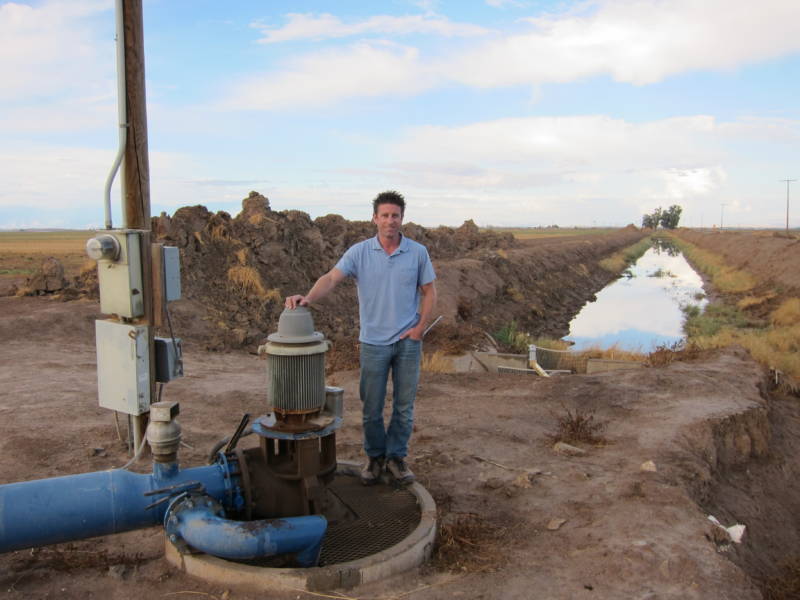
Peter Osterkamp is one of the next generation of farmers in the Imperial Valley. He hopes not to be the last.

Clichés about water in California can seem more abundant than the water itself these days.  But that doesn’t make the clichés any less true.

There’s that Mark Twain saw about how “whiskey is for drinkin’ and water is for fightin’,” and the line about how water flows uphill toward money.  And then there’s the time Twain fell into a California river and “came out all dusty.”

All those quips seemed fairly dead-on when I was down in the desert of southeastern California recently.  I was reporting for two radio stories on how Imperial Valley farmers are facing the double wallop of an eleven-year drought (and counting) in the Colorado River basin, and the expected effects of climate change.  Recent models suggest that Lake Mead — the giant reservoir that stores Colorado River water for Imperial farmers and much of the Southwest — has a 50% chance of drying up in the next 50 years.  Talk about dusty.  And because the Colorado is so over-allocated already, no water is left by the time the river reaches — make that attempts to reach — the Colorado delta in Mexico.  More dust. Continue reading Imperial Valley Confronts its Water Future

State Water Picture Improves

If you’re counting on water from the State Water Project, this year is at least starting off better than the last couple.

For the farms and towns that depend on deliveries from the SWP, the outlook for the coming year is better than in recent years, which is not to say ideal.

State water managers today made their preliminary estimate that customers would get one quarter of the water requested from the system. That beats last year’s initial estimate of five percent–the lowest on record. Mark Cowin, who heads the state Department of Water Resources, says these early estimates are intentionally stingy:

“Over the past few dry years, CA has made good progress in improving our ability to conserve water,” Cowin told reporters in a conference call today, but cautioned that “We must continue to promote an ethic of using water efficiently—regardless of  the day-to-day outlook for water supplies.”

But Cowin says that between the wet spring and early start to the rainy season this fall, chances are good that the initial 25% projection will rise.

A key reservoir on the system, Lake Oroville, stands at more than three-quarters of its average for this time of year, whereas last year at this time, it was only about half full. By the time the water year was winding up, DWR officials had raised the allocation to 50%. They added that with average precipitation the rest of the way, customers could end up with about 60% of their hoped-for deliveries in 2011. So far this season, precipitation is running ahead of the long-term average.

You can check on how the state’s major reservoirs are doing throughout the year, with our interactive map.
View KQED: California Reservoir Watch in a larger map


View KQED: California Reservoir Watch in a larger map

Water in the State Water Project, like the federally run Central Valley Project, comes in large part from the mountain snowpack of the Sierra and lower Casdade ranges. Growers typically make up for shortfalls by pumping more groundwater.