The decrease in snowpack would be driven by two processes, according to study author Geoffrey Schladow. With warmer temperatures, more precipitation will fall as rain during the winter, instead of snow. And as any skier knows, when rain falls on snow, it melts the snowpack in what scientists call “rain-on-snow” events.
These findings are a concern since the Sierra Nevada snowpack is often called California’s “frozen reservoir.” That reservoir is critical to the state’s water supply — and it’s free. “What the snowpack affords us is a way to very economically store water,” said Schladow. “If the water is falling as rain, rather than snow, then we have to build more dams and reservoirs to catch it, which is expensive.” Continue reading Tahoe Forecast: Shrinking Snow, Longer Walk to the Water→
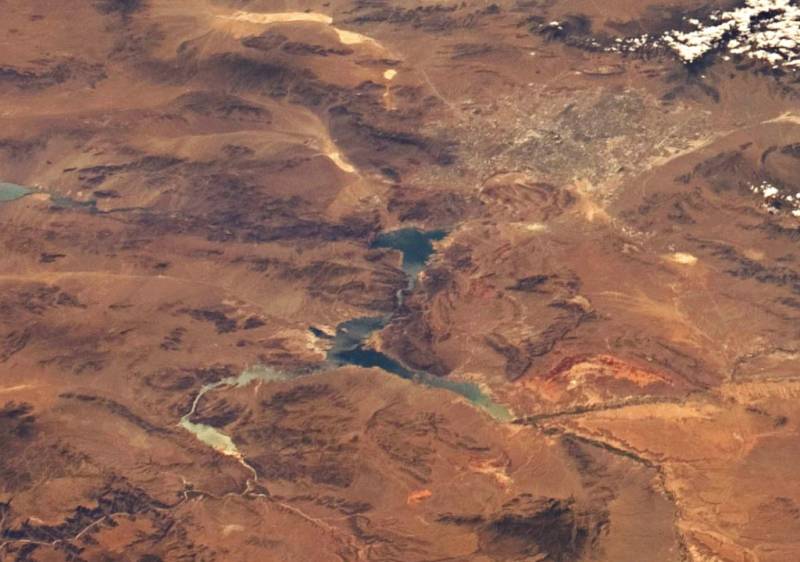
View of Lake Mead on 9/9/10 (Image courtesy of the Image Science & Analysis Laboratory, NASA Johnson Space Center)
Lake Mead is the largest reservoir in the country. It’s located on the Colorado River, which provides water for about 27 million people in seven states, including millions of Californians. In fact, California gets more than a trillion gallons of water from the Colorado River each year, directly from Lake Mead via the Colorado River Aqueduct which snakes across the desert. Eighteen million people in Southern California are dependent on the Colorado for 40% of their water. And for some agricultural operations, that percentage is more like 100. Needless to say, it’s a critical source of water.
The thing is, after 11 years of dry conditions in the region, Lake Mead dropped to its lowest level ever in October. And so far, it’s stayed there. Since Hoover Dam was completed in the 1937 the water level has never been so low. As of today, it’s at 38% of capacity. And it’s not just Lake Mead that’s low. The whole Colorado River storage system is at just 55% of capacity, so forget just filling it up with water from upstream. Of course, winter’s on it’s way, and with that, precipitation, so the lake shouldn’t stay quite so low for long. And, thanks to a wet year, Northern California’s reservoirs are doing well. Continue reading Running Dry? California Water Supply at Risk→
Two recent events provide a timely backdrop for this conversation, the water level in Lake Mead, the huge reservoir on the Colorado River, reached a record low — and the National Center for Atmospheric Research released a new report on projected drought impacts, worldwide, described as “possibly reaching a scale in some regions by the end of the century that has rarely, if ever, been observed in modern times.” — Ed.
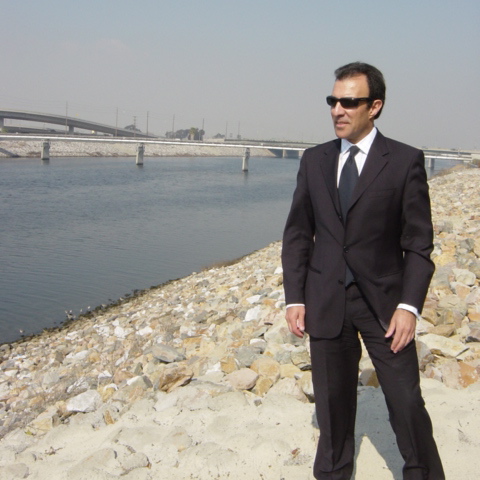
David Nahai on at the Los Angeles River in 2006
David Nahai was CEO and General Manager of the Los Angeles Department of Water and Power (LADWP) from 2007 to 2009. On Nahai’s watch, the utility amped up renewable energy projects and launched new outdoor water restrictions that resulted in Angelenos cutting their consumption by more than 20%. I first met Nahai a decade ago when he and other members of the Los Angeles Regional Water Quality Control Board were grappling with what was arguably the nation’s worst urban runoff problem. Currently he’s a green-tech consultant and advisor to the Clinton Climate Initiative (CCI). I sat down with him in his little corner of a Century City high rise. He started by reminding me that opinions expressed in our discussion were his alone, not those of CCI: Continue reading Water and Power→
A new study out of the Pacific Institute in Oakland finds that California can save more than a million acre-feet of water each year — or 890 million gallons a day — through conservation and improved water efficiency. That’s close to 12 times the annual water usage of the city of San Francisco, and it’s roughly equal to the water required to grow all the grain produced in California.
To find out what tree rings are telling us about droughts in the Colorado Basin, and to get some current perspective on the current eleven-year drought in the region, listen to my radio story for The California Report and view the slide show of my journey to the region. — Gretchen Weber
With cores from trees like this one, TIngstad was able to reconstruct more than 1,000 years of climate history in this region.
Abbie Tingstad is a paleoclimatologist whose doctoral work at UCLA involved reconstructing climate in the Upper Colorado River Basin, using tree rings and lake sediments.
By Abbie Tingstad
Unlike biology, chemistry, or most mainstream sciences, it’s hard to envision what someone who studies paleoclimatology actually does. I run into a lot of blank stares at dinner parties. So I’ve started describing the field as “climate forensics.”
Paleoclimatology and forensics of the Law & Order or Bones variety share the basic goal of reconstructing something that has happened in the past. In the latter, of course, the sequence of events that led to a crime is put together. In the former, researchers identify past variations in climate. These sciences also have quite a lot in common when it comes to the basic methodology: Continue reading The Science of Reconstructing Past Climate→
As climate models zoom in to the regional level, they may provide a sharper lens for viewing climate impacts–and even coping with them. Two interactive web tools — WECalc from the Pacific Institute and CalAdapt from the California Energy Commission — attempt to show how climate change hits home. Continue reading Climate Widgets on Your Home Computer→
The $11 billion water bond was the product of a tough political compromise last year. Lately, it’s been the focus of a lot of criticism — detractors say it is too filled with pet projects, and it contains too much borrowing for a state in fiscal chaos.
Last night, the Legislature pushed the bond onto the ballot two years from now, a plan to pay for new dams, water conservation, and some changes in the fragile Delta ecosystem. Supporters say the delay isn’t likely to hurt the state’s water needs. But no one can say whether a two-year postponement will allow the proposal to be fine-tuned or killed by its many opponents.
Today’s San Francisco Chroniclehas more on the fate of the bond measure, which had been scheduled to appear on this November’s state ballot.
For more on California’s water issues, including an interactive map of where the $11 billion in this bond measure was proposed to go, visit California’s Water.
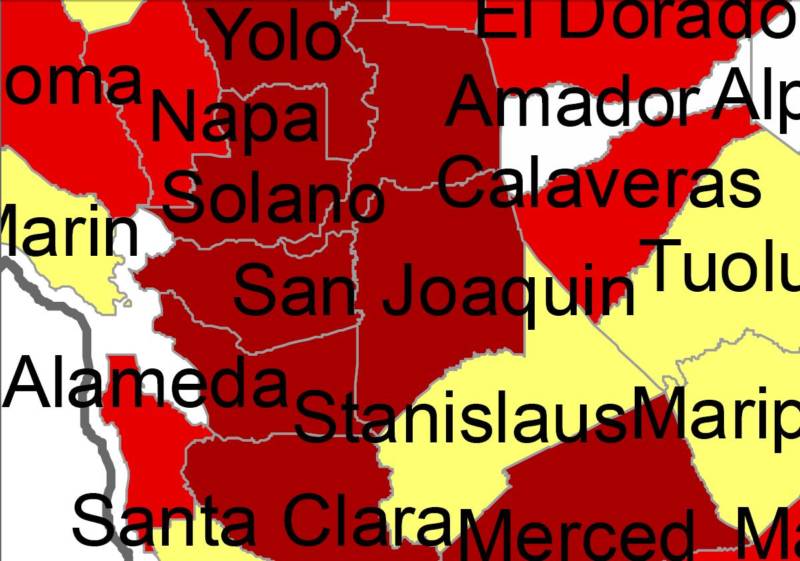
More than eight out of ten California counties will face frequent water shortages within 40 years. That’s the conclusion of a report released this week by Tetra Tech for the Natural Resources Defense Council.
See complete map of California, below. (Image: NRDC)
“This report is a real eye opener,” says Theo Spencer, senior advocate for the NRDC’s Climate Center. “It shows the toll climate change will take on the water resources in the U.S.”
Tetra Tech projects that climate change will exacerbate water problems in more than a third of counties across the US. In California, the outlook is worse. Forty-eight counties (83%) will be at risk by 2050, and 19 counties are on the critical list, those the report describes as under “extreme risk.” Only ten counties, mostly at the northern end of the state, were assigned to the low-risk category.
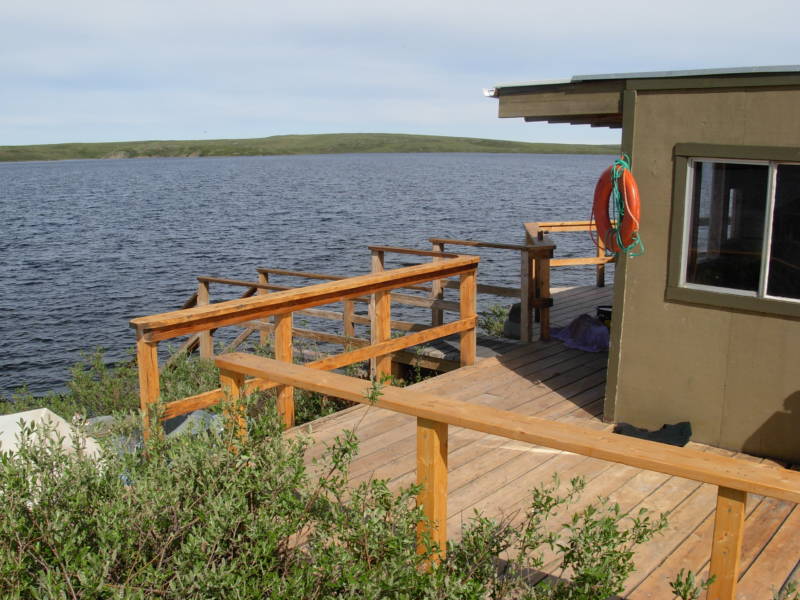
Last night I celebrated my first summer solstice in the Arctic by participating in one of the most beloved activities here at Toolik Field Station. I took a sauna. Then I jumped in the lake, which still had ice on it one week ago, according to the Toolik Naturalist’s Journal. The sauna at Toolik is spoken about in almost reverential tones, and with good reason. It’s a small wooden cabin a few dozen yards from the main camp, perched at the water’s edge, and there’s a window that lets you soak up the stunning expanse of lake, tundra, and mountains, while you warm your bones after a plunge in the frigid waters. “Sauna Nirvana” was how one of the scientists described the experience.
But people don’t just love the sauna for the view and the warmth. They also love it because here at Toolik, it’s the main way to get clean. The process entails warming up in the sauna, running outside and dumping lake water over yourself, soaping up with some biodegradeable cleanser, dumping more lake water over yourself, and then running back into the sauna so you don’t freeze to death. Or, if you are hard-core, you can skip the water-dumping part and just jump in the lake.
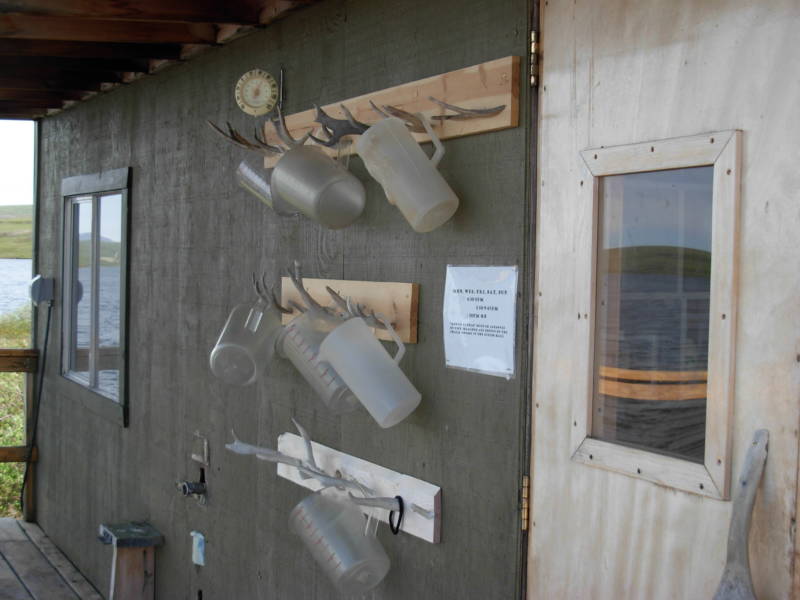
Pitchers for bathing, on hooks outside the sauna (photo: Gretchen Weber)
The station didn’t have any showers at all until 2001 (researchers have been coming here since 1975), and even now, residents are limited to two two-minute showers per week. Water conservation here is taken very seriously, not because there isn’t enough supply, but because all of the waste water from the showers, kitchen, and outhouses, has to be trucked 140 miles north to Prudhoe Bay for disposal at a cost of $1.24 per gallon. Because this is such an active research site, scientists aren’t too keen on the idea of a leach field right next to the spots where they are sampling nitrogen and phosphorus. So, in the name of science, we sauna.
Last summer, 85,680 gallons of waste water were trucked out of Toolik, which translates to 9.77 gallons of water per day, per person, according to Michael Abels, the Toolik Operations Supervisor. Compare that with the 99 gallons per day that San Franciscans use, per capita, or the 287 gallons in Sacramento. True, the conditions here are pretty extreme, but it’s an interesting experiment to see what it’s like to get along on 10 gallons of water each day. Of course, no one here is watering any lawns or trying to keep a swimming pool full. And since we’re only allowed one load of laundry every two weeks, maybe everyone smells a little differently than they do in the rest of the US–but I think most people here would agree that living on 10 gallons of water a day isn’t half bad.
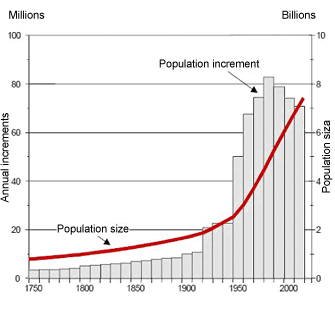
Recently I saw a startling graph, plotting world population from the Middle Ages to projections for 2050. The red line remains relatively flat for several centuries, starts ramping up around the time of the 19th century Industrial Revolution, and then takes off like a Roman candle right about the time of my own birth, in the mid-1950s. Granted, the steep rise was enhanced by the drawn-out time scale of that particular graph. As you shorten the time frame you’re looking at, the slope flattens out. But the numbers paint a sobering picture on their own.
World population from 1750 to 2020. Extending the curve leads to 9 billion people by 2050. Source: United Nations
I decided to plot some of my own family history against that curve. When my father entered the world on the eve of the Great Depression, there were barely two billion people populating the globe. By the time I came along, the number had nudged above three billion. This was America’s legendary Baby Boom and the beginning of the Roman candle phase (an exponential growth trajectory which continues today). Should I be so fortunate (or unfortunate) to make it to my own century mark, demographers project that by then (2055), the Earth will be asked to support more than nine billion people. That’s a tripling of the world’s population just in my (theoretical) lifetime.
Population growth seldom takes center stage in discussions of climate change, though the connection is undeniable (heck, nine billion people just breathing is a lot of CO2).
Biologist William Ryerson, President of the Washington-based Population Institute, says that population growth is “not an inconsequential impact on the climate crisis.” But breathing is not the problem; it’s consumption. Appearing on KQED’s Forum program with Michael Krasny, Ryerson said that were that prediction of nine billion people by 2050 to be realized, it would be “the climate equivalent of adding two United States to the planet.”
Ryerson, who also heads the Population Media Center in Vermont, says we’ll be lucky to make it to nine billion. Ryerson said that in his view, “the resources just aren’t there,” for a doubling of the current population. He cites research by Stanford biologist Peter Vitousek, indicating that humans are already appropriating half of the total global “products of photosynthesis, i.e. all green plants.”
It seems that after decades of being dismissed by mainstream economists, 18th-century philosopher Thomas Malthus is getting a fresh hearing. Malthus made his reputation as a doomsayer in 1798, when he wrote that “the power of population is indefinitely greater than the power in the earth to produce subsistence for man.”
As procreation and climate change accelerate in tandem, the two forces may place a double bind on basic resources like water (see also Gretchen Weber’s post on “peak water“). Ryerson, who recently visited Pakistan, says that nation currently has 20% of the water that they had 50 years ago, on a per-capita basis, and “they’re on a 30-year doubling time,” meaning 368 million people by 2040.

 A
A 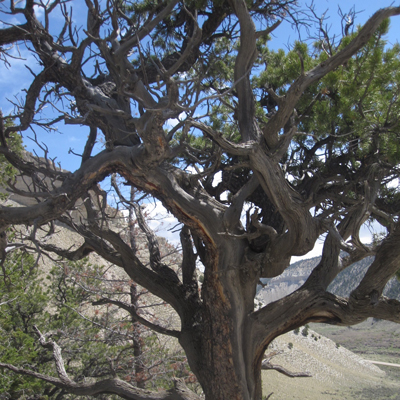

 Biologist William Ryerson, President of the Washington-based