Category Archives: Water

Potentially the biggest climate impact on life in California

Has the Southwest Passed “Peak Water”?

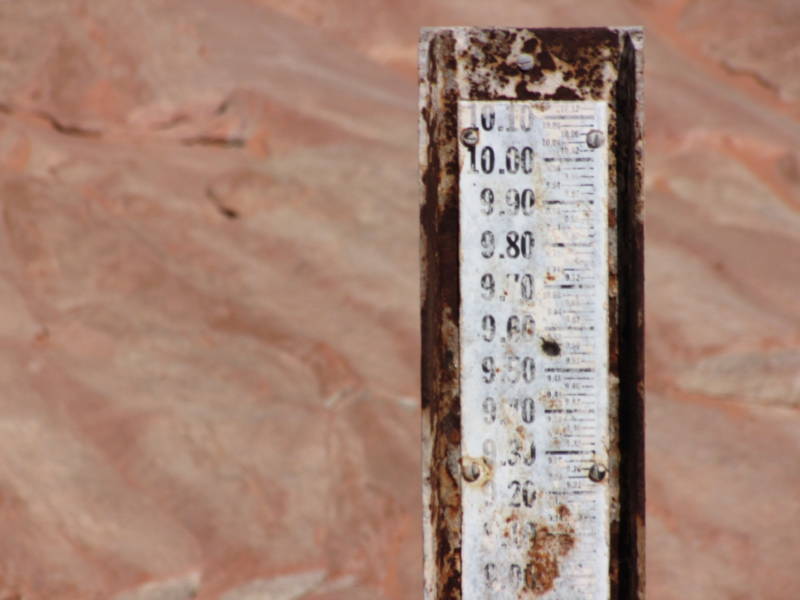
Historic water marker on the shores of Lake Powell, April 2010 (Photo: Gretchen Weber)

People have been talking about “peak oil” for decades now, debating when oil production will peak and then start to decline as remaining resources become scarcer and harder to access.   Less attention has been given to the idea of “peak water,” which is the subject of a new analysis by the Oakland-based Pacific Institute.  The concepts of peak oil and peak water aren’t entirely analogous for a number of reasons, not the least of which is the fact that, overall, water is a renewable resource.  But there are limits to what water is renewable, and how fast supplies recharge.  While the world is not going to run out of water, the report authors argue, in parts of the world including the southwestern US, we’re likely long past the point of peak water.  That matters a lot, said study co-author Meena Palaniappan, because unlike oil, which is shipped across the world, water is still a local and regional issue.

“We’re not going to run out of water,” said Palaniappan, “but we’re going to see a change.  We’re at the end of cheap, easy access to water.  We’re going to have to go further, pay more, and expect less in terms of fresh water.”

The report divides peak water into three types: peak renewable water, the total annual supply of water from sources such as rainfall, rivers, and groundwater sources that are refilled relatively quickly; peak non-renewable water, which includes groundwater aquifers that either do not refill or do so extremely slowly; and peak ecological water, past which, the value of ecological services provided by water is greater than the value it provides in direct human services.  Or simply, it’s the point where taking water causes more ecological damage than it’s worth.

“The goal is to find the sweet spot, where we can maximize the human value water provides as well as the ecological value,” said Palaniappan.

In the western US, we are definitely past peak ecological water, said Palaniappan.  As evidence of this, she cited the Central Valley aquifer, which is being pumped down far faster than it can recharge and the Colorado River, which supplies Southern California with much of its water, and no longer reaches the ocean most years because every drop of it is appropriated for human use.

Last week, I was in Salt Lake City to talk with Terry Fulp, the Bureau of Reclamation‘s Deputy Regional Director of the Lower Colorado Region.  He said that after 10 years of drought on the Colorado, each of the seven states that draw from it are still getting their allotted water supply, and the reservoirs are about half full.  The Colorado River system, which supplies water to more than 30 million people, has a huge storage capacity, equal to four times the river’s annual flow, Fulp said. But increasing demand due to the drought and to population growth have the Bureau looking ahead at the challenges the system may be facing in the not-too-distant future.

“The supply and demand curves basically have crossed,” said Fulp.  “If you look over the last 100 years, the water supply has been above the demand, but demand has been growing, and essentially, today they have met.  We’re operating on a tight margin, a very tight margin, so the question is about projecting what we think the future will look like twenty years out.”

Like Palaniappan, Fulp says that conservation is critical and may become increasingly so in the near future. But even so, he said he doubts the demand for Colorado River water is going to decrease. The supply may, however.  Long droughts are common in the paleorecord, and water managers are planning for an additional 10-15% reduction in flow due to the effects of climate change.   This matters a great deal in a system where just about every drop is spoken for.  Fulp says that developing methods for accessing new water supplies, such as groundwater and desalinization plants, needs to be central to a long-term water management strategy for the region.
The Rain in May Falls Mainly Near the Mean

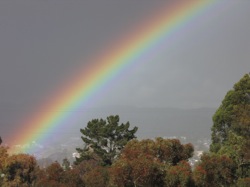
Rainbow following late spring rains in Vallejo. Photo: Craig Miller

Just a passing admonishment from meteorologist Jan Null, who keeps meticulous, often eye-opening records of weather patterns in northern California: We can stop talking about the “unusual weather” we’ve been having.

In California’s Mediterranean climate, precipitation tapers off to virtually nothing between June and October. So any rain this close to the end of “the rainy season” tends to create some buzz.

But Null, a former forecaster with the National Weather Service and founder of his own weather consulting firm, pointed out in an email this week that “the amount and number of days (with rain) so far in May are right near the 30-year normals for San Francisco and San Jose.” Null confirmed for me this morning that:

“So far in May, San Francisco has had three days of rain for a total of 0.44 inches.  The May normal is 3.3 days of rain for a total of 0.54 inches.  Last year, there were 5 days of rain for a total of 0.80 inches.  Even if there is a little more rain (this week), it will be pretty close to a normal May.

Similarly in San Jose the normal is 0.44 inches in 3.0 days. So far in May 2010 there have been three days of rain totaling 0.19 inches.  Last year San Jose had 0.09 inches over three days.”

By George, I think we’ve got it.

The Bay Area’s weather has been unusually cool, however. Null says the April-May period could end with “dramatic cool averages.” He says average daily highs for the two months could be “on the order of three to five degrees below normal.”

Null regularly updates local weather statistics on his website.

Playing the State Water Lottery

Craig Miller
Photo: Craig Miller

I don’t know Mark Cowin, the director of the state’s Department of Water Resources. I haven’t even met the man, in person. But after listening to and reading his pronouncements about the state’s water supply, I’d guess he’s a guy who would barely crack a smile if he found himself holding a winning lottery ticket. I hazard that opinion because even after today’s great news about the Sierra snowpack–which is a little like finding out the state has won its annual water lottery–what Cowin emphasizes is that California isn’t out of the woods after the dry spell of 2007-2009. But more about that to follow. First, the details on the DWR’s final Sierra snow survey.

DWR announced on Friday that statewide, the water content stored in the Sierra snow is at 143% of normal for the date; 188% in the northern Sierra, 121% in the central mountains, and 139% in the southern reaches of the range. Up and down the Sierra, those figures are more than double the levels of the past two years, and are up to seven times as much as surveyors found in the bone-dry spring of 2007.

Last week, the Department announced it would increase allocations from the State Water Project to 30% of the amount requested from 29 urban and agricultural customers. Today’s snowpack news prompted the department to say that it’s likely to increase deliveries. How much? “Only marginally,” Cowin said in a phone interview this afternoon. “We’ll have to run the numbers, and we’ll probably make that determination in the next week or two.”

How much water will State Water Project customers get, eventually? Let’s run some numbers of our own.

The main reason the department cites for the very tight supply in the midst of a year of “normal” precipitation is the continuing below-average levels at California’s biggest state-owned reservoir, Lake Oroville. As of Friday afternoon, the lake is at 72% of normal for the date and about 60% full. But the stats that Cowin’s water geeks are crunching aren’t about the level today, but where they guess it will be as runoff begins to pour from the snow-blanketed mountains through the Feather River watershed into Lake Oroville. DWR officials have insisted that it believes runoff will be held down because of dry conditions caused by the last three drought years. You wonder if they’ll still believe that after assessing the impact of an unusually wet April and its impact on the snowpack.

While pondering that, here are some other numbers to consider if you want to play what I’ll call the State Water Project Allocation Game:

  • After running far below its 2008-2009 levels all season, the water storage in Lake Oroville caught up and passed year-ago levels this week. The lake’s storage has increased six percent—more than 150,000 acre-feet—since last Friday.
  • As noted above, this year’s snowpack is better than double last year’s.
  • Last year, the state delivered 40 percent of requested water shipments to its SWP customers. The average allocation for the past 10 years is 68 percent.

Considering all of the above—last year’s deliveries, the snowpack, the sudden late-season surge in Lake Oroville’s levels—it’s a no-brainer that water deliveries will at least match last year’s 40 percent. The question is whether the allocation will go higher. All Cowin would say on that subject today is that he thinks that 45%, the amount DWR described two months ago as the upper limit for shipments this season, is still accurate.

But Cowin did say, as he has more and more frequently of late, that a preoccupation with the this year’s water level misses the point about California’s water reality.

“That’s why we’re so concerned when we get the black and white question, ‘Is the drought over,'” he said. “We are in a period of long scarcity in California. We have no idea what next year’s water supply picture will look like. It’s possible we could have two or three more dry years in a row. So we’re trying to get a message out that we need to have a new attitude about how we use water in California, and it shouldn’t depend on this week’s outlook. We need to conserve water just as a way of life.”

If you want to explore the state’s water supply picture for yourself, check out our California Reservoir Watch map, below:

View KQED: California Reservoir Watch in a larger map

What’s an Albedo? (And Why You Should Care)

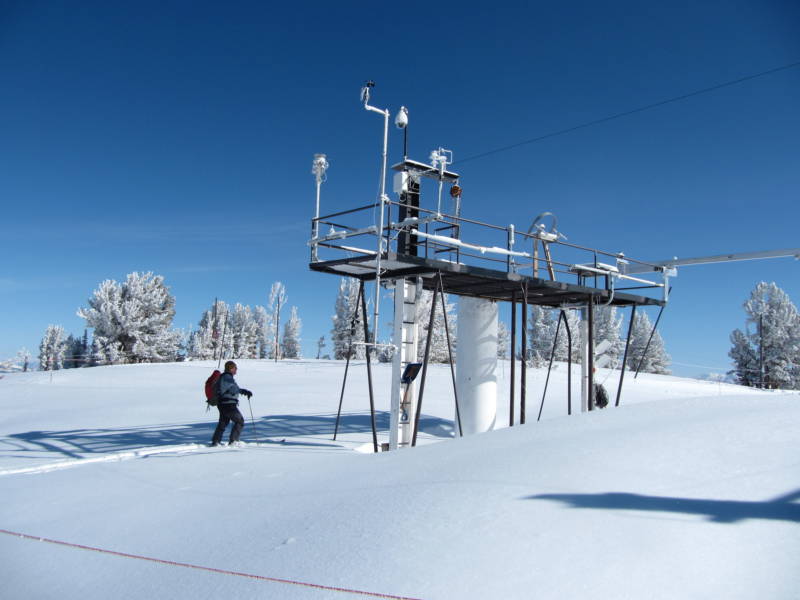
Jeff Dozier approaches the instrument tower on Mammoth Mountain.

When Jeff Dozier, a hydrologist at UC Santa Barbara, goes to work, he gets to enjoy quite a view. His snow lab is perched halfway up Mammoth Mountain in the central Sierra. We took a gondola to get up there; the other passengers were skiers and snowboarders itching to get out on the freshly fallen snow.

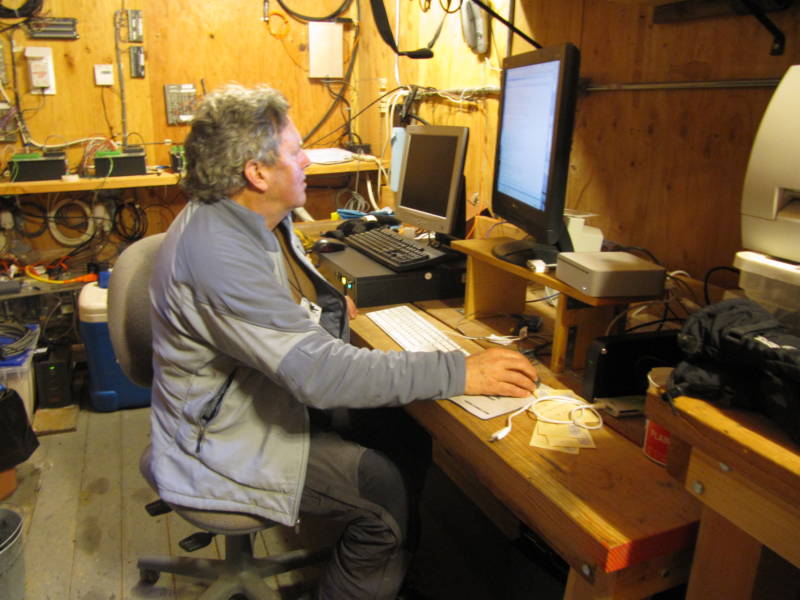
But the instrument platform from which we enjoyed views of the White Mountains is really only half the story. Dozier’s computer lab has much less of a view. In fact, it has no view. It’s buried under the snow, accessible only through what he calls a “Santa Claus entrance” (in the picture above, you can see the entrance–it’s the white tubular “chimney” extending down into the snow from the center of the platform).

The snow lab, operated by both UCSB and the U.S. Army Cold Regions Research and Engineering Laboratory (CRREL), uploads information about the snowpack to a website every fifteen minutes. You can see nearly real-time readings on, among other things, snow depth, temperature, humidity, and radiation.

Dozier in the computer lab. Photo: Molly Samuel

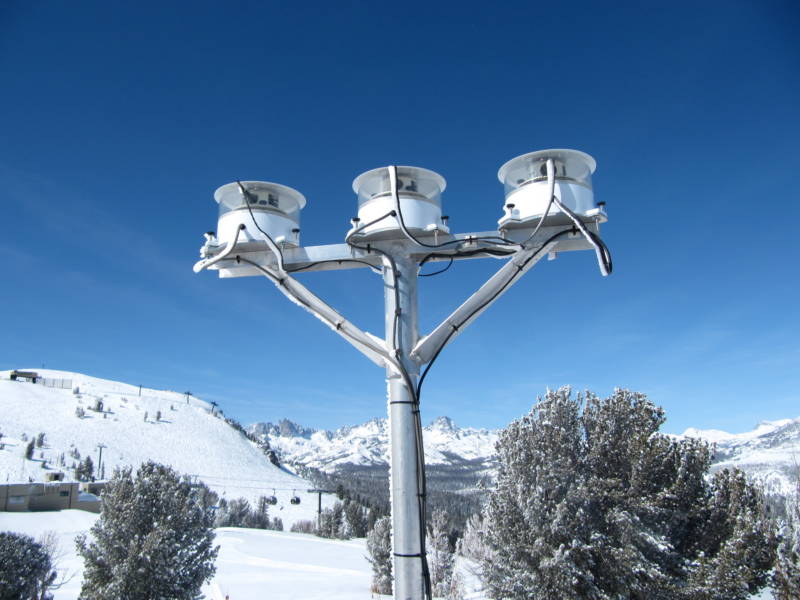
Radiation is an important one. Instruments called radiometers are mounted on the tower. Some point up, measuring the radiation coming from the sun; others point down, measuring how much is reflected back to the sky by the snow.

Albedo” is the measurement of how reflective the snow is. Something completely white that reflects all of the sun’s energy has an albedo of one; something black, that absorbs all the energy, is zero. Bright, freshly fallen snow has a high albedo, typically above 0.8.

Even if the term is new to you, albedo is probably a familiar concept. As I reported for KQED’s The California Report this morning, Hans Moosmuller of the University of Nevada’s Desert Research Institute explains it in terms of outfits: on a sunny day, if you wear a black sweater you’ll be warmer than if wear a white one. You may notice it with roofs, too. I grew up in Atlanta, in a house with a black roof. Before my parents got an air conditioner, the upstairs bedrooms were unbearable in the summer. If we’d had a white

These radiometers measure radiation coming from the sun. Photo: Molly Samuel

roof, it would have been a little more bearable (though I can’t say it would have helped with Atlanta’s other charming summer attributes, humidity and mosquitoes).

The color sweater you wear has no bearing on the earth’s climate. Roof color could have an effect on a large enough scale. What really matters are the huge swaths of dark and light that cover the globe: ocean and snow.

When warming causes sea ice near the poles to melt faster, areas that had a high albedo (ice is very reflective) become  areas with a very low albedo (the blue ocean absorbs more radiation than forests or plain dirt). Moosmuller says it creates a feedback loop. The more dark spots there are, the more radiation is absorbed. So melting speeds up, and warming increases, exposing even more dark areas, and so on.

Pollution plays an important role that’s coming under increasing scrutiny. Deposits of soot or dust make the snow darker, so it melts faster, exposes more dark ground, and there’s that feedback loop again. In the Himalayas soot, also known as black carbon, from stoves, tailpipes, factories, and fires is having a measurable impact.

In the Rockies, there’s a similar problem caused by dust kicked up from ranches. Tom Painter of the University of Utah says the snow in the Colorado River Basin melts a full month earlier than normal. The difference the dust makes is so drastic, Painter says, that “We’re in an entirely new regime for snow melt…it would be like if we started measuring climate impacts fifty years from now.”

No one has yet done a long-term study on the effects of dust and soot on the Sierra Nevada snow pack. Moosmuller says he’s beginning to look into it now. In the summer, black carbon drifts into the mountains from California’s cities, ports, highways and farms in the Central Valley. Tony Van Curen, in a research project at UC Davis, has found that soot blows over from Asia, too.

There is good news in all of this: Black carbon, unlike most greenhouse gases, lingers in the atmosphere only for a couple of weeks. So reducing emissions could have a relatively quick impact.

Tracking the Changing Glaciers of the West

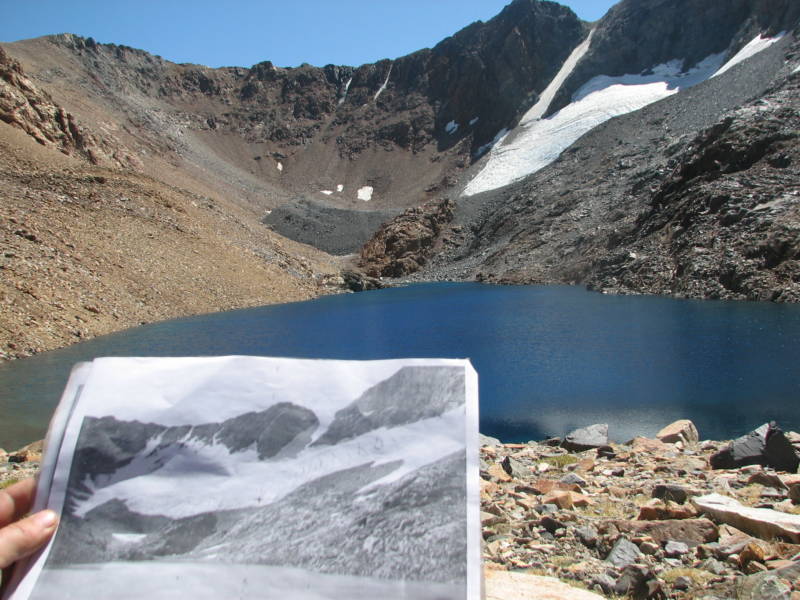
Yosemite’s Dana Glacier, in 2008 and 1883 (photo: Gretchen Weber)

Years of exhaustive (and exhausting) field work out of Portland State University has produced some stunning visual images online.

Not quite two years ago, reporter Sasha Khokha and I joined geologist Hassan Basagic on a long trek to photograph the Dana Glacier, located just inside the eastern edge of Yosemite National Park.  Since 2003, Basagic has been documenting the changes in the glaciers of the Sierra using historic photographs, and we joined him in September of 2008 to see the shrinking glacier for ourselves. We documented the trip with a radio report, an audio slide show, and web videos.

That field work was part of a project called “Glacier Rephotography of the American West” which tracks the retreat of glaciers across the western United States over the last century.

Tom Knudson of the Sacramento Bee, who has closely followed the project, tells us that it has produced a new online resource. It includes a series of interactive time lines that showcase historic photos as well as more recent ones (including Basagic’s) that, when viewed side by side, offer some startling views of how glaciers in various regions have changed.

For more remarkable images of moving glaciers, explore the “Extreme Ice” episode of the PBS series Nova.

NASA Looking More Earthward

Rachel Cohen is a Bay Area freelance writer, presently serving an internship with Climate Watch.

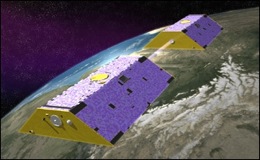
NASA's GRACE satellite is equipped to gather ice and water data on the Earth's surface. Image: NASA

To boldly go–where we already live

By Rachel Cohen

NASA will likely be focusing more attention on the “pale blue dot” in coming years, with a reinvigorated Earth Science Program. California’s freshwater supply and sea level change are among the features that will be studied by replacing an aging satellite.

The proposed White House budget for the National Aeronautics and Space Administration includes billions of dollars for satellites and other tech tools to help scientists investigate Earth-bound problems, especially climate change. Part of the program will be steered from Pasadena’s Jet Propulsion Laboratory, which will manage two key missions connected with the program. JPL spokesman Alan Buis says the White House support may provide stability for gathering the kind of long-term data sets needed to study gradual changes in earth systems.

As Jon Hamilton reports in his  story for NPR’s Morning Edition, the centerpiece of the program will be the GRACE satellite which will collect data critical for a variety of models and applications, including:

· The changing mass of polar ice caps
· Changes in water resources on land
· Shallow and deep ocean current transport mechanisms
· Sea level change resulting from ocean temperature and water mass changes
· Exchanges between the oceans and atmosphere
· Forces that generate Earth’s geomagnetic field, and
· Internal Earth forces that move tectonic plates and result in earthquakes and volcanic eruptions

GRACE has been in orbit since 2002 and is due to be replaced. NASA suffered a severe setback when its Orbiting Carbon Observatory (OCO) satellite crashed after its launch early last year. The White House budget includes funding to rebuild the vehicle and relaunch in February of 2013. The OCO2 satellite is designed to measure carbon dioxide in the atmosphere, specifically comparing sources of CO2 to “sinks,” where it is stored.

Average Sierra Snowpack, More Water Allocated

Photo: Gretchen Weber

Despite what might feel like an incessant onslaught of storms these past few months, the word from the Department of Water Resources’s fourth snow survey of the season is… average. Manual and electronic survey readings indicate that statewide, the Sierra snowpack water content is 106% of normal for this date. In the northern Sierra it’s higher, at 126% of normal, while the central and southern Sierra are at 92% and 105%, respectively.

The news was good enough for the DWR to increase its State Water Project allocation from 15% to 20%, but agency director Mark Cowin told reporters on a call Thursday that three years of drought and regulatory restrictions on Delta pumping to protect fish species will keep the allocations far below normal.  He said the final allocation, which is announced in May, will likely be between 30% and 40%, depending on April’s precipitation.  (Last year’s final allotment was 40%.)

“We’ve had a hit and miss nature to storms this winter, and that has left the State Water Project in not as good a position as we would like to be and perhaps worse than you would expect based upon those fairly good numbers regarding snowpack and precipitation,” said Cowin. “Remember that we started this winter with very poor carry over storage in most of our key reservoirs.”

While many reservoirs across the state, such as Lake Shasta, are at above average capacity for this time of year, others still have a ways to go.  The State Water Project’s principal reservoir, Lake Oroville, is currently at 47 percent capacity, which is just 60 percent of normal.   Cowin said that the difference between the two lies with where the snow fell this year.

“Clearly we’re going to have water shortages this year,” said Cowin.  “We’re all going to have to conserve water.  Even if we get to 30 or 40% allocation, those are still low numbers. The ethic of using water efficiently in California has got to be the normal course of business and not dependent on the weather forecast.”

Last month, the U.S. Bureau of Reclamation issued an updated allocation for its Central Valley Project customers that ranged from 25% to 75%.

Check recent levels of California’s major reservoirs on the map, below:

View KQED: California Reservoir Watch in a larger map

California Water Update: A Mostly Adequate Year

87760251Almost everywhere you look this week, California is dry. By which we mean the state is experiencing the first truly warm, rainless week since a series of Pacific storms blew through the state in mid-January.
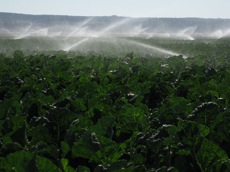
Hydrologists for the state Department of Water Resources and the federal California-Nevada River Forecast Center expect the warm temperatures to trigger the first significant surge of snowmelt for the season. With slightly above-average snowpacks in the Sierra Nevada, that should help continue to raise reservoir levels. Our 2009-2010 rainy season is likely to go down in water history as adequate–short of hopes for a wet year but an improvement on the past three winters, which were much drier than average.

Admittedly, that’s the view from the city, where we get our water out of taps and garden hoses. The picture for agricultural users is not nearly as bright, as we were reminded earlier this week.

On Tuesday, the U.S. Bureau of Reclamation issued an updated allocation for its customers in the Central Valley. The bureau offered a good news-bad news scenario. For CVP customers north of the Sacramento-San Joaquin Delta, the news was mostly good. Agricultural contractors there will get at least 50% of promised deliveries this year; municipal and industrial customers will get 75%. South of the Delta, the news is not so good. Municipal and industrial users will get 75%, but farm customers are guaranteed just a quarter of the water they want.

That 25% zone south of the Delta includes the Westlands Water District and other areas on the west side of the San Joaquin Delta that have suffered severe water shortages, due mostly to the state’s prolonged dry spell and, less directly, to restrictions imposed on Delta pumping to protect Delta smelt and Chinook salmon.

That’s the same area for which Sen. Dianne Feinstein tried to secure extra water this year–even if it meant overriding provisions of the Endangered Species Act. Feinstein’s effort to attach a water amendment to a federal jobs bill failed, but the move apparently prodded the Department of the Interior–the parent agency of the Bureau of Reclamation–to try to find more water for Westlands and its neighbors. This week’s allocation announcement included assurances that the department is still working to secure additional water for west side farmers.

The state Department of Water Resources, which also ships water from the Delta to customers in the San Joaquin Valley and beyond via the California Aqueduct, also issued an updated allocation announcement this week. The department said that for now it’s sticking with its guarantee of 15 percent of requested deliveries this year.

Why such a low figure? The department says it’s because of continuing “poor hydrological conditions” in the Feather River drainage that feeds the State Water Project’s principal reservoir, Lake Oroville. The main symptom of those conditions is the lake’s storage level, now just 57% of average for mid-March. For contrast, look at California’s main federal reservoir, Lake Shasta, less than 100 miles away from Oroville as the crow flies. It’s got 104% of average storage for the date (not to be confused with percent of capacity).

Here’s my amateur, off-the-cuff runoff-watcher’s observation of what’s behind the difference: The Shasta drainage, which captures the upper reaches of the Sacramento, McCloud and Pit rivers as well as lesser streams, has benefited from several storms since mid-January that dumped heavy rains throughout the watershed. Those same storms have dropped lighter amounts of rain further south and east, including over the Feather watershed. The same effect can be seen in the American River basin, which flows into Folsom Lake. A month or so of intense precipitation last year eventually filled the lake; lighter rains this year have led to lower-than-average storage levels in Folsom (84 percent as of this week).

The final word on the water season, of course, will come from the Sierra snowpack and runoff. Stay tuned for the snow melt.

Check recent levels of California’s major reservoirs on the map, below:

View KQED: California Reservoir Watch in a larger map

Latest Snow Survey Offers Hope

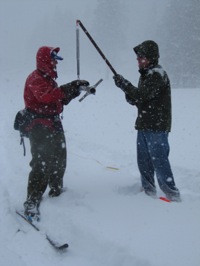
Frank Gehrke, left, weighs snow near Echo Summit, to measure water content. Photo: Molly Samuel

His clipboard doesn’t have quite same gravitas as a pair of stone tablets. Nonetheless, Frank Gehrke is sort of the Moses of California water. Once a month he comes down from the mountaintop with a pronouncement on the state of the snowpack in the Sierra Nevada. Today’s message: Whew.

The Department of Water Resources announced today that on average, the water content of California’s Sierra snowpack stands at 107% of “normal” for this date. The figure is derived from a combination of electronic sensors and manual surveys, including Gehrke’s, taken at various points along Highway 50. It’s the first time this season that the statewide average has clocked in above normal.

In the monthly DWR news release, Director Mark Cowin expressed some relief, while warning that the state is still struggling to overcome three abnormally dry winters prior to this one. DWR reports that Lake Oroville, the primary reservoir for the State Water Project, still stands at just 55% of it’s long-term average level for this date. Shasta Lake, however, the biggest reservoir on the federal Central Valley Project, is now above its normal level.

Cowin says the latest readings offer hope that water managers will be able to increase projected allocations to state water customers, currently set at 15% of requested amounts. DWR estimates that final allocations will be “in the range of 35-45%.” Over the past ten years, customers have averaged about two thirds of requested water. Farms often make up for shortfalls by pumping costlier groundwater.

Our interactive map shows the current status of California’s key reservoirs. We also have a short video that takes you into the field with Frank Gehrke, to see how he does his manual surveys.

More Water Likely for Farms and Cities–With a Catch

Craig Miller
What is now looking like a "normal" wet winter may mean bigger water allocations for crops. Photo: Craig Miller

We’d like to think that weather and water supply is a straightforward proposition. If rain falls in the lowlands and snow blankets the Sierra Nevada the way we expect it to, then we ought to have enough water to get us through the dry months ahead. But of course, California water is never that simple. The latest example: today’s state and federal announcements of projected  deliveries from two massive Central Valley water systems.

From the state: The Department of Water Resources said it’s increasing promised State Water Project deliveries from five percent–the amount projected last December 1–to 15%.

In a conference call with reporters, newly-appointed DWR Director Mark Cowin called the 15% figure “very conservative.” He said that if the wet season continues on its current “average” path, the department could deliver between 35-and-45% of the contracted amount.  Cowin said where final allocations would land in that range depends on pumping restrictions currently in place to protect endangered salmon and smelt.  “That spread between 35 and 45 percent is based on how the fisheries agencies ultimately apply the existing rules to protect fish–and how much resulting flexibility we have to pump water from the Delta,” Cowin said.

The bottom line from the DWR announcement: Three years of drought have taken a toll on water supplies that will take more than one good year of rain and snow to reverse. Cowin says runoff from the healthy Sierra snowpack will be lower than normal, as more water is absorbed by relatively dry soil.

At the same time, the State Water Project’s biggest reservoir, Lake Oroville, stands at 54% of its normal level for this time of year. The other linchpin for SWP supply, San Luis Reservoir, is at 80 percent of normal overall. But most of that water is already spoken for and is unavailable for meeting this year’s state water contract commitments.

As the state was adjusting its projections, officials also weighed in on 2010 deliveries from the federal Central Valley Project.

Secretary of the Interior Ken Salazar announced that the initial allocation from the CVP to San Joaquin Valley farmers and other users is 5%. That’s better than nothing–which was the early allocation last year. But it was only part of the news.

Salazar disclosed that negotiations involving Senator Dianne Feinstein, other members of the California congressional delegation, water contractors, and environmental groups have hammered out a plan that could deliver nearly 40% of contracted supplies to CVP customers. But there’s a big “if” in the picture: Those expanded deliveries only happen if the wet season continues to be wet.

Weeks of controversy preceded Salazar’s announcement. Areas of the San Joaquin Valley that have gone thirsty during the three-year drought–notably the Westlands Water District–have been agitating for more federal water even if it means overriding Endangered Species Act protections for fish.

Feinstein went to bat for Westlands and other federal water customers, proposing an amendment to a jobs bill that would set aside Delta pumping limits in order to guarantee deliveries to Valley water users. That sparked outrage from those working to save the Delta fisheries and a sharply critical letter from a dozen House members. But it also apparently prompted the talks that led to Salazar’s announcement. In a statement, Feinstein said she was pleased with the projected allocations announced today and praised the “creative thinking” that went into it. But she added that she’s watching how water shipments play out. Although she has shelved her water amendment for now, she said, “I reserve the right to bring it back should it become necessary.”

Here’s our updated KQED California Reservoir Watch, which gives a pretty good picture of the state’s water storage:

<
View KQED: California Reservoir Watch in a larger map