Tag Archives: KQED American Graduate

Contra Costa Times: Education Report: 13 Oakland schools to lose a teacher because of bad enrollment projections

October 10, 2012
By Katy Murphy

This year, 14 teachers are being moved to other schools, a process known as “consolidation,” because fewer students enrolled in a particular school than the district expected, the Oakland school district has reported.

Enrollment projections are complicated, especially when school closures and new charter schools are in the picture, as was the case here. Another problem, which affects even the most popular schools? When families admitted to a school don’t bother to tell anyone they’re sending their child elsewhere — essentially, holding their spots until the last minute.

According to a report I requested from OUSD, 14 teachers from 13 schools are being reassigned in what’s become an annual process to balance the budget. They’re from Bella Vista, Cleveland, Hoover, Kaiser, Claremont, Melrose Leadership Academy, Bret Harte, Roosevelt, Frick (two teachers), Piedmont Avenue, Allendale, La Escuelita and Rise. The report also included three vacant positions that are being consolidated at Burckhalter, Markham and Grass Valley elementary schools.

To read more.

SFGate: Oakland Measure J to upgrade school kitchens

October 11, 2012
By Katharine Mieszkowski
Public schools in Oakland are looking for major kitchen remodeling with a measure on the Nov. 6 ballot.

If approved, Measure J would authorize the Oakland Unified School District to issue as much as $475 million in bonds to improve school facilities.

Along with seismic upgrades and lead-paint removal, the bonds could help underwrite a planned overhaul of school kitchens in the district, including building a new central kitchen in West Oakland. It’s part of an effort to improve the food the district serves to students, 70 percent of whom are eligible for free or reduced-price meals.

Oakland has made strides toward serving healthier and fresher food in recent years. For instance, the district now buys more fresh fruits and vegetables from within 250 miles of Oakland. There are salad bars at 67 schools.

‘Kitchen dinosaurs’

But it’s infrastructure, not ingredients, that has become the biggest barrier to making lunches healthier and tastier. Many schools have antiquated kitchens – if they have a kitchen at all.

“It’s a very attractive museum of kitchen dinosaurs,” said Zenobia Barlow, executive director of the Center for Ecoliteracy, a nonprofit advocacy group.

The facilities limit what food can be served.

“A lot of what is served is processed and prepackaged and frozen,” said Ruth Woodruff, who has a first-grader and a fourth-grader attending Chabot Elementary School. “It gets unwrapped and put on trays and heated.”

Some schools, like Piedmont Avenue Elementary, don’t even have a kitchen. Meals there are reheated in the corner of a multipurpose room.

The Education Report: Oakland, Alameda teachers named Alameda County Teacher of the Year

October 5, 2012
By Katy Murphy

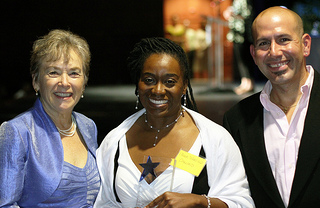
Congratulations to the two Alameda County teachers of the year: I’Asha Warfield, from Oakland’s Frick Middle School, and Chris Hansen, from Alameda’s Lincoln Middle School.

They learned of the distinction last night, at an awards night organized by the Alameda County Office of Education. Now, they go on to compete for California Teacher of the Year.

In this video of Warfield, she talks about the conversations and debates that take place in her classroom. “I really, really believe in my students,” she said. “Their intellectual capacity is so great.”

Stephen Davis, a kindergarten teacher at Global Family Elementary School, was Oakland Unified’s other nominee for 2012-13. At a school board meeting last week, he said he had three rules for his students: 1) Be kind. 2) Be kind. 3) Be kind.

To read more.

I-SEEED Guest Youth Blogger: Prevailing by Pelesani Sua

October 6, 2012
By Pelesani Sua, youth representative of the Institute for Sustainable Economic, Educational and Environmental Design (I-SEEED)

It only took one person to stop me from believing that I could go to college.

When your teacher passes you up for a school funded college tour because she says she knows you’re not going to make it to college, let alone graduate high school it falls right into the category of oppression. Although this would be a great learning opportunity you won’t even have the chance to experience it because your teacher has already decided your future. Or when your teacher doesn’t believe that you could’ve gotten everything correct on a test and accuses you of cheating, because of your race.   I’ve been in situations like this one many times.

I now know that some people don’t believe in encouraging others that don’t belong in the same racial background as them. So from that day on I told myself that I wasn’t going to diminish someone else’s education just because I wasn’t good enough myself. I would just pick myself up and keep trying to prove that I could be the best. It didn’t matter to me whether or not that teacher believed in me because the years afterwards I met better teachers who believed in and encouraged me to become the intelligent young lady I am today.  In a way I would like to thank that one teacher, because the racism and institutionalized oppression she showed to me in middle school actually gave a me an extra push to do better as I got older.  But not every student responds the way that I did, and they shouldn’t have to.

It’s a dream of mine to see a world of equality not only in education but in government and the communities around me. People need to not just know how to unite with their own, but with all people. I would love to wake up to a world where people know their neighbors, school officials, and people in office. When a person knows when the next election is, not the next football game. Where people don’t settle for satisfactory, but they push the limit.  When people get together not only to support themselves, but also the elderly and disabled. It would be wonderful to be able to walk around my neighborhood and know I’m safe and think “which park will I go to?” and not “which fast food restaurant is the closest?”. These are the issues close to my heart and I hope I will be one of the many people to unite to fight against these detrimental issues at hand.

I would like to end by saying that it starts here with me. I will someday lead an army of people who believe in the same issues as me and want to unite against it all to protect our future generations from falling to the hands that the government has given us.

KQED News: Oakland School District and Feds Agree on Changes to School Discipline

October 1, 2012
By Barbara Grady

The Oakland Unified School District board agreed Thursday night to take  specific steps to eradicate racial bias in school discipline, voting unanimously to enter a voluntary resolution with the U.S. Department of Education’s Office of Civil Rights.

The resolution focuses on replacing suspensions – which historically OUSD meted out to African American boys with much greater frequency than to other students – with restorative justice and positive behavior intervention practices and requiring training for all OUSD staff in these practices as well as in classroom management. The resolution includes about a dozen other specific actions the school district must take, many of which it has already begun.

At a packed school board meeting Thursday night, OUSD Superintendent Tony Smith called the agreement “an exciting opportunity to continue work,” along a path that OUSD started with its strategic plan of creating Full Service Community Schools in the district and launching the African American Male Achievement Initiative. But he and others acknowledged the resolution means accelerating those efforts.

“We will further work that is already underway” Smith said. What have been pilot projects in restorative justice will need to be expanded and brought to every school, starting with 38 the DOE cited for disproportionate use of suspensions as discipline of African American boys.

To read more.

Oakland Tribune: School closures an issue in Oakland school board race

October 4, 2012
By Katy Murphy

Until now, Thearse Pecot’s decades-long involvement in Oakland’s public education system has focused mainly on the schools her children and grandchildren have attended. But the latest round of school closures — which included Santa Fe, her grandchildren’s school — prompted her to challenge Jody London for the District 1 seat on the Oakland school board.

“We’ve got to stop tearing down our communities by closing neighborhood schools,” Pecot said.

Pecot sued the district in April to block the closures, alleging that it was discriminating against poor and minority families. While the case has yet to make it to court, she said it demands the reopening of Santa Fe Elementary. Pecot said that if she succeeds in unseating London, she will fight to prevent additional school closures. None are being considered at the moment, though if statewide tax measures fail and education funding “trigger cuts” proceed, schools throughout California will face some painful choices.

The other priorities Pecot listed — from improving safety on school campuses to lowering the dropout and truancy rates — were broad and ambitious, though she offered few specifics of how her approaches would compare to the district’s current policies and initiatives. She said she would advocate giving children more enriching activities to keep them interested in school.

To read more.

KQED News: Future Looks Bright for Lacrosse at Oakland Public Schools

September 26, 2012
By Juan Antonio Martinez

Despite having a reputation of being a rich white sport, this fall, hundreds of students at Oakland public schools will be introduced to the game of lacrosse.

The Oakland Lacrosse Club – which is a newly created, but not yet completed 501(c)3 nonprofit corporation – intends to work with several Oakland schools to introduce lacrosse to students that the sport has not traditionally served.

“I want every kid in Oakland to have access to play lacrosse,” Kevin Kelley, the boys game director for the Oakland Lacrosse Club, said. “My goal is to expose the sport to 500 middle schoolers and then in the spring create two under 13 teams; one boys and one girls.”

To read more.

Lendri Purcell: Program Director of the At-Risk Youth & Families Program of the Barbara & Donald Jonas Family Fund

October 3, 2012
By Lisa Hewitt

Coming to Oakland in 2000, Lendri Purcell has spent over a decade teaching, advocating for under-resourced educational systems, community organizing and working to implement programs that aid at-risk students. As the Program Director of the At-Risk Youth & Families Program of the Barbara & Donald Jonas Family Fund, Lendri has a deep commitment to under-served communities. She began her career with Oakland youth as part of Teach For America.  Becoming a teacher just out of college, Lendri taught Special Education at Lowell Middle School. She explains,“It’s a big responsibility but there was a lot of support. At the same time the needs were daunting. It was kind of shocking; there were things at the school that blew me away. We have televisions in the classroom, but we don’t have books. I got to see a lot of great things and a lot of sad things.” Lendri’s time in Oakland and teaching experience made her realize there are many positive things about the community, but a lot of work to be done.

It is estimated that only 40 percent of existing students will graduate high school in Oakland and it’s essential that teachers, parents, and community members work to curb this trend. The Jonas Center is one organization doing just that.  For the last five years they have made grants to school programs, after school programs and summer programs that serve middle and high school age students all in an effort to keep students in the educational system and on a strong career path.

In order to gain funding from the Jonas Center, the programs must incorporate education into their mission, while also integrating one of the following components: mentorship, mental health treatment and/or a school to career focus.  Lendri explains, “Education is kind of tied into all these programs, just in different ways, whether it’s life skills for transitioning foster youth, or trying to bring entrepreneurs to the classroom”.  Students play a large and important role in the grant making process. From serving on the board of the Jonas Center’s At-Risk Youth & Families Program to reviewing grant proposals from local organizations, they offer a unique and valuable perspective. Lendri says, “When I was living in Oakland and I had a lot of contact with young people, they would just straight out tell me, ‘This program is really helping me.’ Or ‘This program’s great, but we don’t have a counselor.’”  From the inception of the Jonas Center’s initiative, youths’ voices have a played an essential role; they offer relevant and first hand experience to aid in the grant making process.

Whether through a stipend, a paycheck or a chance to build their resume, young people need to know what they’re doing has meaning, “They often say, ‘I want a job. I need money, I need money for clothes. I don’t have money for school lunches.’ So I think another thing that is really important is access to a job, an internship, a mentorship. Something where there’s a stipend, so the young person gets, if possible, some sort of monetary gain. Or training or something they can put on their resume. And that’s a great way to have that link between school and career.” Lendri stresses it’s important for the organization or business to make the work they’re doing relevant to the student.

Lendri recognizes that the students can’t do it alone; having a strong adult in their life is vital. Mentors often can show the connection between education and a profession; encouraging young people to stay in school longer. “It’s important to have some kind of mentor in your life. I know even for me, growing up in a very well resourced community, that connection wasn’t made very clear. That what you do in school will dramatically impact what kind of salary you have later. How easy or hard your life might be, your choices. It’s important to make what’s happening in school very relevant to the world of work outside of school.” She stresses it’s essential that each student has an adult in the community who cares, is accessible and who has time to spend with them, in order to keep young people interested in school, their job, or an internship.

If you’re interested in getting involved with a business partner that works with young people, please visit: www.oyfba.org, which provides a youth friendly business directory.

Lendri Purcell and her grandparents, Barbara and Donald Jonas.

Los Angeles Times: Oakland schools to let feds monitor discipline of black students

By Stephen Ceasar
October 1, 2012

The Oakland Unified School District and the U.S. Department of Education reached an agreement last week that would allow federal officials to monitor the district’s efforts to curb the number of out-of-school suspensions of its African American students.

The resolution, which the Oakland school board passed unanimously, closes an investigation by the Department of Education’s Office for Civil Rights into whether African American students were disciplined more frequently and harshly than their white classmates. The agreement was reached Thursday.

Last school year, African American students made up about 39% of the district’s total enrollment but accounted for 63% of students with at least one suspension and 61% of those who were expelled, said Russlynn Ali, the department’s assistant secretary for civil rights.

To read more.

Oakland Tribune: Alameda County teen leaders to tackle problems facing high school girls at summit

September 25, 2012
By Angela Woodall

The most pressing social issues encountered by teenage girls in their schools — relationships, social networks and families — will be the topic Saturday at the inaugural Junior Commission on the Status of Women.
The summit of high school girls is sponsored by the Alameda County Commission on the Status of Women.
During the event, peer counselors and licensed professionals will facilitate workshops on stress and mental health; career and college preparation; and teen dating abuse.
The Junior Commission on the Status of Women is comprised of Alameda County high school girls in grades 9-12. Junior commissioners, who are appointed by the Alameda County supervisor to their district, work on in civic projects and educational dialogue that advance issues relevant to all girls.
The summit is free and includes lunch and door prizes. It will be held from 10 a.m. to 3 p.m. at Youth Uprising, 8711 MacArthur Blvd., Oakland.