Tag Archives: KQED American Graduate

Mercury News: Oakland schools bond, Measure J, is winning

November 7, 2012
By Katy Murphy

A $475 million Oakland school facilities bond measure received overwhelming voter support on Tuesday. Returns posted early Wednesday morning showed Measure J far above the 55 percent threshold.

For homeowners, this will mean a property tax increase of up to $60 per $100,000 in assessed property value. The rate in the initial years is estimated to be lower, roughly $40 per $100,000.

Oakland Unified has said it will spend the money on improving the seismic safety of its buildings, new and upgraded kitchens, science labs, technology, energy efficiency and other infrastructure. The district has also identified about 10 schools to receive major improvements, including Fremont High School in East Oakland, which would replace its portable classrooms with a new structure.

Some of the other schools on the list include Glenview, Greenleaf, Sankofa and Sobrante Park elementary schools, Roosevelt and Madison middle schools and McClymonds High School.

Those who have pushed for more healthful school food have rallied around the measure, which would fund the construction of a central commissary and allow more schools to serve food made from scratch. In addition to those families, more than 40 students have spent a recent Saturday — or, in some cases, five — going door to door, trying to convince likely voters to say ‘yes’ to Measure J.

To read more.

KQED: In the Studio with Rashidi Omari

November 7, 2012
Kristen Farr

Rashidi Omari is a performance artist, writer and educator at Destiny Arts Center, a violence prevention and arts education organization in Oakland. Growing up, hip-hop was an outlet that helped Rashidi deal with life’s challenges, and he works to provide today’s Bay Area youth with the same creative opportunities. We stopped by his dance studio to learn more about this dynamic Oakland artist, and find what hip-hop means to him and his students.

Watch Videos.

Oakland Local: OakTown Gardens: Reducing waste to ‘green’ Lincoln Elementary

October 30, 2012
By Irene Florez

This year, Lincoln Elementary did something few schools would have dreamt of 10 years ago: It formalized a green connection with Waste Management to exchange food scraps for compost.

Lincoln and roughly 50 other Oakland schools are now taking part in “Green Gloves,” a collaborative effort to reduce and sort the waste leaving OUSD during meal times.

The aim, says Nancy Deming, OUSD’s Sustainability Program Initiatives Manager, is “to have a program that the school and its students are directly involved in that provides a much more meaningful environmental impact.”

According to Deming, the main impetus at Lincoln Elementary was Lana Cheung, Lincoln’s head custodian.

With more than 600 students and two meals served every day, Lincoln used to send 12 cubic yards of trash to the landfill every week. These days they have reduced that by 33 percent. Most of this reduction was through incorporating compostable trays and sorting trash after meals.

Cindy Seh, Lincoln’s head night custodian stands in for Cheung during sick days and vacations. She says though the green change requires more work for custodians, it’s a change for the better.

“It’s good to teach kids to save the earth,” she says. “Stressing the importance of keeping clean and recycling is good for raising responsible children.”

Seh’s children attended Lincoln. Both are now at American Indian Public Charter School.

Annie Liu, a 7-year-old in Chou’s class, says that the process is easy.

“You just separate and stack,” Annie says, while munching on the pretzels that accompanied her chicken soft tacos and trading her classmates milk for carrots.

All told, Lincoln Elementary’s 20 minute per child lunch period results in three and a half hours of lunch related work for custodians. In the end, 8-cubic yards ends at the trash every week and the school receives compost once a year. In total, WMEarthcare is committed to providing OUSD Green Gloves schools at least 100-cubic yards of compost per year.

So far the compost is used in the school’s playground kale garden and in Cheung’s flower garden located at the front of the school.

“Unfortunately our school isn’t located in a green open space,” says Lincoln’s principal. “So, with composting and gardening we can each do a little to bring attention to our environmental connection.”

To learn more.

Mercury News: Election 2012: Oakland schools get out the youth vote

November 1, 2012
By Katy Murphy

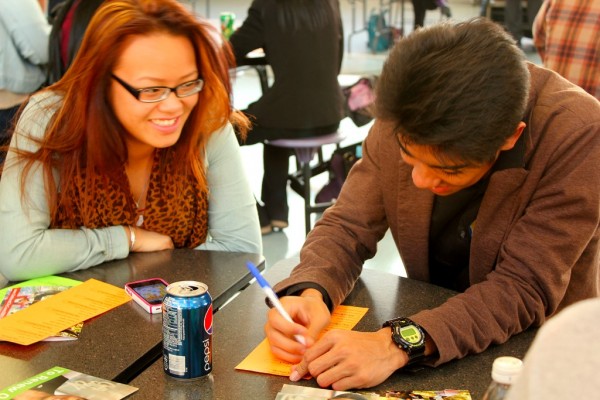
This week, a group of boisterous teenagers marched down to a ballot box a few blocks from their school. The first-time voter contingent and their sign-holding supporters whooped and chanted all the way to the Alameda County Courthouse, eliciting friendly toots from passing cars.

“I feel like I’m always complaining about what’s wrong with the world,” said Di’Jahnay Stewart, a Dewey Academy student who turned 18 on May 23 and registered to vote shortly thereafter. “I feel like if I vote, at least it’ll mean something.”

Many young Americans aren’t as quick to exercise their new electoral power. Although they voted in larger numbers in 2004 and 2008 than they had in decades, their turnout was still the lowest of any age group. For all the buzz surrounding the 2008 presidential race, for all the YouTube videos and the plugs on MTV, just 41 percent of 18- to 20-year-olds and 47 percent of 21- to 24-year-olds reported voting in that election. By contrast, 58 percent of all age groups and 68 percent of those 65 and older went to the polls that year, according to a survey of noninstitutionalized adults by the U.S. Census Bureau.

“I’m finding a shocking number of young people who just won’t vote,” said Deanita Lewis, a parent leader who has long been involved in Oakland’s public schools. The reasons she most often hears? “‘My vote doesn’t count. It doesn’t matter. Nothing’s going to change.'”

To read more.

I-SEEED Guest Youth Blogger: Not An Impossible Crisis by Nazshonnii Brown

By Nazshonnii Brown, youth representative of the Institute for Sustainable Economic, Educational and Environmental Design (I-SEEED)

Since the age of two, growing up in Oakland has given me a unique perspective into the experiences of my fellow students that have gone through the ups and downs of the OUSD public school system.

My experience in the OUSD system was minimal due to my families living circumstances. We traveled often and returned to Oakland numerous times, and as a result, homeschooling has taken up the majority of my pre-university education. I could say that my first experience in a school setting was the Saturday and weekday evening classes at Temple Emanu-El in Reno, Nevada. My education at that time consisted of Hebrew vocabulary, alphabet, reading the Torah, and of course, watching the prince of Egypt. My official public school debut was in Stockton, California at Oakwood elementary, and it was both a threatening and new experience. There, the principal made me face the wall until class started because I was not supposed to be in my classroom too early. I also got in trouble after school for running after a boy I wanted to punch in the face. Of course, I was the one physically held back by the staff. If they were actually doing their jobs correctly, they would have seen that the boy threw me down beforehand. The inexperienced girl hired by the staff, irritated me because she was paying more attention to her phone than who actually was harming who. This was my first experience of tolerable school lunches, single file lines, recess, PE, and more importantly being in an academic classroom setting. I can still say I am grateful because of my teacher, Mr. Hoffman, who helped me when I needed material that was more challenging. I was also happy that the school was in proximity to the house I was staying at. Rolling out of bed an hour before class, stuffing a bag with lunch, and then walking 10 minutes all occurred with ease. Without the lessons learned from this experience I would not have made it through secondary school with half as much success as I have now.

Back to being religious; when homeless in San Jose, my family and I stayed at a church where I spent my time completing Jesus coloring books and reading the bible. Sometime after arriving back in Oakland, my sister enrolled me in a school that employed her in their after school program. In my prior visits before officially beginning school, I got the feel of the Oakland Public Charter School system, my prospective classmates, and the realization that the California Preparatory Academy, my new school, would be moved to Berkeley. From what I witnessed during lunch and after school times the majority of students were African American/Black and Chicano or Latino. My first impression was that they were the most loud and loquacious kids I’ve ever known. After two years, I loved the people there, grades 8th to 11th and all the staff, I could say that the environment was homely. However, my sister and I made the decision to leave because I wasn’t happy with the disciplinary system, my way of transportation, and my uniform that never fit. Cal Prep is not as bad as it seems but it just was not for me. Socially, I loved my Cal Prep family, academically, I needed a change.

My 10th grade year began at Maybeck High School, the private independent school that offered me a full scholarship. Also, my first experience with a locker, off-campus lunch, free periods, and managing my own classes! This school year I will be a senior. I look forward to taking a paleontology class, and setting a healthy example for the underclassmen.

In Oakland, the main issue I see is that the dropout crisis is not taken as seriously as it should be. Educators tend to prioritize good behavior and test scores, instead of preparing students for life after high school. My sister, who is tremendously ambitious, would always say her high school’s inability to prepare her for college began and ended with the teachers expectations of students and the overshadowing goal to just pass the CAHSEE. From what I know, people drop out because of rash decisions or events; ranging from outbursts in the classroom, suspension and/or expulsion, death of a loved one, bullying, lack of confidence, not having knowledge of their rights, and an overall lack of an environment that is neither safe nor trustworthy. The options for life after school should not come down to prison or death. Post-secondary educations and careers are places where youth should see themselves.

Among many socioeconomic disadvantages, I feel the main cause of disconnection between youth and high school graduation is purely psychological, and is strongly affected by the concepts of institutionalized and internalized oppression. If your environment implies or tells you that you cannot graduate, eventually one will internalize this and believe it. This idea is self-defeating, and the environment around a student should not have any implication of this sort. Just as so called ‘undeveloped’ countries see themselves as rich because they are thriving, those who are underprivileged in the schooling systems should see themselves as rigorous scholars because they hold a positive mentality among many other gifts.

The ratio of positive staff, supportive attention, and reliable resources to students is another reason for the dropout crisis. The difference between graduating and dropping out can simply depend on whether or not a school has enough guidance counselors, teachers with available office hours, and supplies to take notes and write papers with. Often times, a big factor of accumulating detentions can move a student closer to expulsion. This happens because some schools have a discipline hierarchy, that sets people up to fail.

Students and school staff need to show more concern, via positive actions, for the post-secondary life of all students. Often times schooling systems choose favorites based on who complies easily and has the lesser tendency to challenge authority within the school. This idea of labeling students as problem children needs to be expunged. Students often have problems with schools’ disciplinary systems because often times a feeling of embarrassment, shame or being unwanted comes about. A fair question is why would anyone want to be in a place where they are shamed or unwanted? Personally, I’ve once felt this, when a teacher looked at me and said aloud to the class “You should know this!” Immediately, I was embarrassed because I thought I was stupid, how could I not know this? However, my sister told me that “a student fails because their teacher has failed them”.  Though, it is not always true for every teacher, I feel it is a common classroom problem. Culturally aware, emotionally stable, and knowing where their students stand are qualities every educator needs. Students don’t want people who at the very least wouldn’t try to relate to them. All parties should come into the classroom with the expectation to learn something, particularly educators. And if a teacher should come into a classroom with a list of things to change; the students should be the ones to tell him/her what needs amending and the conversation should be mutual.

Often times during the summer I get lazy and procrastinate, which is why I think a solution to the dropout crisis is to keep youth active all year round. Weather through internships, summer classes, sports clubs, book clubs, dancing or visiting new places, all are valid avenues to learn from. I went to a summer program, Aim High, in Oakland as a student for two summers. This program helped me break my shell, stay active, and prepare for public school. In 2010 I came back as a volunteer, and then a volunteer coordinator, having the same amount of stimulation and fun as I did before becoming an alumna. From behind my desk to working the front desk, I learned more every year. In short, leadership opportunities are necessary, after starting with the right basics students should be able to guide themselves.

No matter the situation, everyone has a right to education; which is why I believe there should always be options when it comes to a student dropping out. Students should be tenacious enough to hop right back into a learning center, and be supported all the way around to do so. If a school kicks out a student, they should be willing to provide resources for jobs, rehabilitation, credit recovery, and other schooling options. Every student can take hold of their education, giving up should never be an option, nor should the school system be allowed to give up on them.

For example, a way that I have received an education outside of the classroom is through my community work with I-SEEED and HOPE Collaborative. As a participant in the Youth Action Board I have had numerous opportunities to gain leadership. Involvement with the Institute for Sustainable Economic, Educational and Environmental Design (I-SEEED), has lead to my enrollment in an early college model program. In this program I completed a university level course titled Race in The City. By analyzing materials from Beverly Daniel Tatum, Paulo Freire, Antwi A. Akom and Marc Bamuthi Joseph, I had the chance to learn and breakdown many concepts. In the class we studied the different forms of racism, oppression, eco-apartheid and resistance.

My academic journey and communal learning experiences have prepared me to be graduation ready. I have taken advantage and gained an awareness of so much that I can’t help but do everything in my power to bring as many fellow youth in Oakland along with me. My impetus for graduating is positioning myself around people that share the same goals, support me, and offer some wisdom based on similar experiences. I make the most out of resources and appreciate from everyone because wisdom is found everywhere. In my effort as a peer advocate and community activist, and through the initiatives of many Oakland organizations that combat injustices and provide resources to solve the dropout crisis, I foresee a decrease and an eventual removal of the dropout crisis from Oakland’s education slate all together.–


The Education Report: Weinberg: Rules requiring struggling schools to replace half their teachers are misguided

October 29, 2012
By Steven Weinberg

One of the most divisive elements of the “turnaround model” being used to improve test score results in many low scoring schools throughout the country, is the requirement that half the teaching staff be replaced.

State and federal projects that funnel increased funding to those schools often require such staff changes, arguing that they are necessary for school improvement, while teacher unions and parents oppose them because of the disruption they create.

Now a study, reported in Education Week, says that provision doesn’t seem to make any difference at all.

The requirement that half the teaching staff of a school be replaced assumed that less effective teachers would be removed and more effective teachers would stay. It does not work that way, according to Michael Hansen of the American Institutes for Research, which has conducted the most complete research on such programs to date. The study looked at 111 chronically low-performing elementary and middle schools in Florida and North Carolina between 2002 and 2008.

According to the Education Week article, Hansen found that “teachers who left schools during improvement were not always the worst performers; in fact, they ran the gamut of effectiveness.”

To read more.

SF Gate: Oakland Blog: High school students cast ballots at Oakland Youth Vote Forum

In the Castlemont High School library, Da’Janique White, 17, stood with a mic in hand, demanding more energy from her fellow students. “Okay, listen. I don’t like dead crowds. I don’t like people not being participation-ish,” said the Fremont High School senior. “Seriously. So, y’all gotta boost it up for me a little bit, okay?”

As president of the All City Council (ACC), the Oakland student government body, White was charged with getting the young crowd that was gathered there pumped up to vote.

The Oakland Youth Vote Forum 2012 drew nearly 90 high schoolers to East Oakland on Tuesday after school. Hosted by the ACC and other Oakland youth organizations, the event featured Oakland city council and school board candidates in a forum with pre-selected questions asked by students. At the end, students submitted their orange ballots, checking off the names of the people they wanted in office. Though most of the attendees are too young to vote in the general election on November 6, they were excited to see the candidates in person and hear a forum-style argument about issues specific to students.

To learn more.

SF Gate, Oakland Blog: Oakland’s Black Organizing Project to host school board candidates forum (Community Voices)

October 18, 2012

In an effort to give interested parents, teachers, students and community members an opportunity to meet the Oakland Unified School District Board of Education candidates, the Black Organizing Project is hosting a forum from noon to 3 p.m. Saturday, Oct. 20, at Castlemont High School, 8601 MacArthur Blvd. in East Oakland.

The candidate’s forum will be moderated and include the nine candidates for Districts 1, 3, 5 and 7. At the forefront of the discussion will be African-American male achievement gaps including the staggering drop-out rate of young people of color; budget cuts to school programs; recent school closures; and more. The event will give parents and local residents a chance to hear the candidates’ vision for the future of Oakland schools and help local voters make informed decisions at the polls on Nov. 6.

Read more of this story on http://oaklandlocal.com/

Mercury News: Oakland Tech's 'Metamorphoses' full of energy, enthusiasm

October 18, 2012
By Sally Hogarty

Drama teacher Jessa Berkner loves a challenge. When she first came to Oakland Tech High School, the spacious auditorium was being used for storage and the performing arts had all but disappeared. In her seven years at the school, things have certainly changed.

Now the school boasts a busy art, dance and music program, and Berkner has formed the Oakland Theater Arts Initiative to encourage art programs at other area institutions. In 2010, Oakland Tech’s theater program won an American High School Theatre Festival award and was listed as one of the top 50 high school drama departments in the United States. That same year, Berkner and her students traveled to Edinburgh, Scotland, to perform their production of “Hamlet, Blood in the Brain” at the prestigious Fringe Festival. The adaptation of Shakespeare’s “Hamlet” by local playwright Naomi Lizuka relocates the classic tragedy to the drug-ravaged world of 1989 Oakland.

Currently, the professional actress and teacher finds herself consumed with another challenging project — rehearsing Mary Zimmerman’s modern adaptation of “Metamorphoses.” Zimmerman uses Ovid’s epic poem as the basis for her stage adaptation, which adds a contemporary feel to the classical myths and legends with their unifying theme of transformation.

“I just love Mary Zimmerman’s work,” Berkner said. “I was looking for a show that speaks to where students are today, all the issues they have to deal with, and all the changes and growth they go through.

“This is also an ensemble piece, so I can give a voice to many actors,” Berkner said. She encourages her actors to “have each other’s back” in order to create a safe environment in which to take risks.

Berkner and choreographer Ena Dallas have used their own creative initiative to adapt Zimmerman’s script for their unique group of performers.

“We haven’t changed any of the language, but we’ve used the student’s individual skill sets to bring life to the characters,” Berkner said. To that end, the god Hades is a rock star showcasing guitarist Sasha Petterson’s musical abilities and several students perform acrobatic moves during the show.

“Since its based on mythology, the script is very lyrical,” Dallas said. “Postures and gestures say as much as the narration, so we’ve added very stylized movement for the gods and also utilized the talents of the students in my acrobatics class.”

Dallas, formerly a professional trapeze artist, taught Chinese acrobatics and aerial arts at San Francisco’s School of Circus Arts for 15 years.

To read more.