Asides

Headlands Center for the Arts

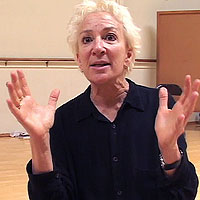
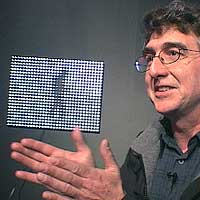
Nestled in the coastal wilderness of the Marin Headlands are historic military buildings that house Headlands Center for the Arts, a nationally-acclaimed residency program that provides artists from around the world with the scarce resources of time and space to pursue further development of their work. Resident artists Felipe Dulzaides and Nathan Lynch introduce Spark to the rhythm of life at the center and explain why the program represents a rare opportunity for experimentation and interaction among the lucky few chosen to participate.

Founded in 1986, Headlands Center for the Arts offers the Headlands’ Artists-in-Residence Program and a full array of public programs, including lectures, artist talks, performances and panels on topical issues in the arts, in order to cultivate understanding of and appreciation for the arts in the greater Bay Area.

The Headlands’ Artists-in-Residence Program has an international reputation for uniting pioneering artists in the visual, performing and literary arts, film/video, and interdisciplinary fields from the US and abroad. The program offers fully funded, live-in and live-out residencies to about 30 artists each year. Headlands assumes travel costs and provides each artist-in-residence with a studio, housing, a stipend and five meals a week. Residencies range from four weeks to 11 months, with an average stay of three months. Applications are due in June for residencies the following year. Historically, the center has collaborated with public and private agencies to fund artists from other parts of the US and the world.

More about Felipe Dulzaides
Video and performance artist Felipe Dulzaides’s work is action-based. He states, “I use a situation or a context as a frame and a container.” He participated in “Bay Area Now 3” at Yerba Buena Center for the Arts and at Art Basel in Miami. Dulzaides has exhibited at numerous venues in the Bay Area, including The Lab, Refusalon Gallery, the Exploratorium and the San Francisco Arts Commission Gallery. He also has shown at multiple venues in Havana, Cuba, where he graduated with a BFA in theater from Instituto Superior de Arte de la Havana. He holds an MFA in new genres from the San Francisco Art Institute.

More about Nathan Lynch
Nathan Lynch’s ongoing performance “Where is Your Wheel” has toured the United States from New York and Washington DC to San Francisco and Los Angeles. He also has presented projects at the Windhover Center for Performing Arts in Gloucester, MA and the Olive Hyde Art Gallery in Fremont, CA. Nathan received a BFA from the University of Southern California, and a MFA from Mills College. Lynch has taught at the University of Southern California and Mills College and is currently teaching at California College of Arts.

  • Array
  • Array
  • Array
  • Array

Artship

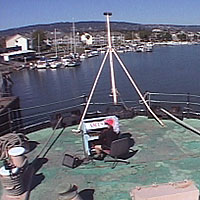
The Artship was one of the more unusual Bay Area arts venues. A cargo-passenger ship built in 1939, the vessel was used as a gallery, studio, classroom and performance space by visual and performing artists from 1999 to 2004. Unfortunately, the public gathering space and house for the arts lost its East Bay dock space due to commercial development.

Spark takes you inside the Artship as it was. Today, the Artship organization continues to support and produce exhibitions and performances through their dance/theater and urban/visual arts programs. The program particularly encourages artistic endeavors that build community by working to reclaim public space or increase audience/performer exchange.

  • Array

Andrea Higgins

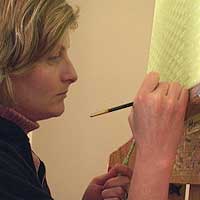
Threading the past into the present, fabric has permeated through every civilization as a vehicle of creative expression. Stroke by stroke, painter Andrea Higgins applies her brushmarks to emulate the stitch-by-stitch patterns of fabric swatches, creating dynamic abstractions in her compositions. The Spark episode “Threads” zooms into Higgins’s current series of oil paintings, “The Presidents’ Wives,” which explore the relationship between women, fashion and power through visual abstractions based on the wardrobes of America’s first ladies.

Formally trained as a painter, Higgins gravitated towards textiles in childhood when her grandmother took her shopping at Britex Fabrics in San Francisco. Fascination transformed into dedication when Higgins visited Indonesia in 1995 and observed how Hindu women weaved extravagantly intricate sarongs under rudimentary environments. This inspired Higgins to approach a refined technique in her own artworks: finely-woven, geometric-intricate patterns painting on canvas requiring countless studio hours exacting repetitive brushstrokes.

Beyond their crafted abilities, Higgins was struck by the amount of time that these Hindu women spent aestheticizing their clothes prior to temple ceremonies, in hopes of luring gods’ attention. Upon returning to the United States, Higgins correlated this type of “power dressing” to that of American first ladies in personifying a certain public image.

According to Higgins, the clothes and the colors a first lady wears represent the social, economical, and political climate of the incumbent administration. For instance, her painting “Laura” references Laura Bush’s purple tweed suit reflecting a growing nostalgia for a simpler America under the Bush’s administration. In contrast, Hillary Clinton’s signature black pantsuits point to a country getting “down to business.” In another era, Higgins’s painting “Nancy” highlights Nancy Reagan’s flamboyant red epitomizes the extravagance under the ebullient trickle-down economics of the 1980s.

Higgins holds a BA from Dartmouth College and an MFA from the San Francisco Art Institute. She is one of four recipients of the 2002 SECA Art Award for emerging artists from the San Francisco Museum of Modern Art (SFMOMA). Her work has been exhibited at SFMOMA and venues throughout the United States and Asia.

  • Array
  • Array
  • Array
  • Array

Consuelo Jiménez Underwood

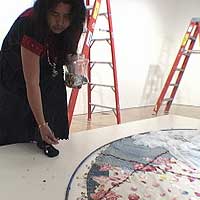
In the Spark episode “Threads,” we follow Consuelo JimĂ©nez Underwood as she installs new works at the San Jose Museum of Art for the “Un/Familiar Territory” exhibition, which includes 10 artists addressing the relationships between place and culture and personal identity. Discussing her roles as both artist and teacher at San Jose State University, Underwood raises two important issues that have surfaced in textiles recently — the contemporary interest in textiles as an expressive art form and the legacy of textiles as a craft traditionally practiced by women.

Underwood does not create textiles in the traditional sense, but uses textiles to express personal ideas the same way that a painter or sculptor might, by combining traditional textile materials with those not commonly used (barbed wire, plastic coated wire and safety pins). Because textiles have served utilitarian functions in history, the art world has generally thought of weaving as a craft. This assignation has served to relegate fiber arts outside what is considered to be the fine arts. Contemporary artists such as Underwood further push the boundaries of traditional craft materials by using them in new and different ways.

In her piece “Frontera Rebozo’s Noche/DĂ­:a,” Underwood uses safety pins to hold together hundreds of swatches of fabric. Each of the small square swatches of fabric in this work are screen-printed with the same image of a family running. This image is found on the highways along the border between the United States and Mexico, serving as a warning to motorists that people and families might be running across the road. As a cultural symbol, this image represents the border between North America and Mexico — describing a line that divides cultures. Underwood uses this symbol to represent her own history as a migrant agricultural worker, signifying her hybrid culture as well as the arbitrary lines that divide her homes.

Array

  • Array
  • Array
  • Array
  • Array

Philharmonia Baroque Orchestra

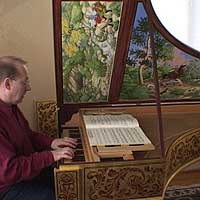
The genre of baroque music refers to a style of composition that flourished in Europe from about 1600 to 1750, characterized by exuberance and elaborate ornamentation through the use of major and minor tonality (rather than modes). Since 1981, the Philharmonia Baroque Orchestra has been dedicated to reproducing historically informed performances on original instruments, recreating the period’s authentic sound. Spark takes you into the rehearsal hall of Philharmonia, the home of conductor Nicholas McGegan to view his extraordinary collection of period and reproduction instruments, and the shop of harpsichord maker John Phillips.

Under the musical direction of Cambridge- and Oxford-educated McGegan since 1985, Philharmonia has repeatedly appeared in the Great Performers Series at New York’s Lincoln Center and has collaborated with the likes of San Francisco Opera Center, Long Beach Opera and Mark Morris Dance Group. Over the years, Philharmonia has released more than 20 CDs and received a Grammy nomination for its live recording of Handel’s oratorio “Susana” in 1990.

The ensemble is made up of roughly 40 musicians who play the works of a variety of Baroque composers, from Handel and Bach to Telemann and Vivaldi. Recognized as “America’s period-instrument orchestra,” Philharmonia has become the foremost early-music ensemble not only in the Bay Area but also in the country. Appearing locally in San Francisco, Berkeley, Palo Alto, San Rafael and Walnut Creek, the ensemble also is in demand around the world, frequently embarking on national and international tours.

  • Array
  • Array
  • Array
  • Array

Fine Arts Museums of San Francisco

The Fine Arts Museums of San Francisco (FAMSF) is the city’s largest public arts institution. Composed of the M.H. de Young Memorial Museum and the California Palace of the Legion of Honor, the FAMSF is one of the largest art museums in the United States. The FAMSF conservation staff includes specialized professionals in the areas of painting, objects, textiles and works on paper. Together with the curators, the conservation staff carefully monitors all of the works in the FAMSF’s collections, removing from storage or exhibition those that require treatment.

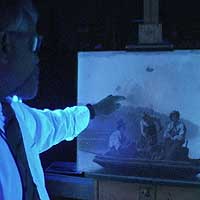
There are two critical aspects to taking care of works of artistic and historical value — conservation and preservation. Conservation concerns the correction of problems affecting a work of value, such as previous repairs and damage. Preservation is a proactive practice, seeking to minimize –and if possible, prevent — the effects of environment and other factors on a work. The Spark “Preservation” episode features two conservation staff members, Tony Rockwell and Carl Grimm, as they use a combination of art and science to restore George Bingham’s “Boatmen of the Missouri River” and a portrait that may have been painted by El Greco.

In another episode, called “Threads,” Spark learns about traditional Borneo textile weavings and the gender and social power significance of such traditional art forms. While traditional gender roles in Borneo directed women to weave the textiles and men to headhunt, the two practices were considered socially equal. Diane Mott, textile curator at FAMSF, explains the ways in which the weaving as well as their female creators were integral to the cultural practice of headhunting.

More about the de Young Museum
thinker.org/deyoung

Where: 50 Hagiwara Tea Garden Dr., San Francisco
Phone: (415) 863-3330
Located in Golden Gate Park, the de Young is San Francisco’s oldest museum. Its collections include American paintings, decorative arts and crafts, and arts from Africa, Oceania and the Americas as well as Western and non-Western textiles. The de Young is particularly recognized for its many educational arts programs for children and adults. The de Young museum reopened in 2005 in a magnificent new building designed by Pritzker Prize-winning architects Herzog & de Meuron.

More about the Legion of Honor
thinker.org/legion

Where: 100 34th Ave., San Francisco
Phone: (415) 863-3330
Built to commemorate California soldiers who died in World War I, the Legion of Honor is a beautiful Beaux-arts building located in San Francisco’s Lincoln Park overlooking the Pacific Ocean, Golden Gate Bridge and all of San Francisco. The Legion of Honor displays a collection comprising 4,000 years of ancient and European art. The collection includes Rodin’s “Thinker,” which sits in the museum’s Court of Honor, European decorative arts and paintings, ancient art, and one of the largest collections of prints and drawings in the country.

Array

  • Array
  • Array
  • Array
  • Array

Legacy Oral History Program

Editor’s note: In 2008, the San Francisco Performing Arts Library and Museum became the Museum of Performance & Design

Jeff Friedman became concerned about the vulnerability of the dance community to loss of documented work as many of his colleagues in the arts began contracting AIDS in the 1980s. In order to preserve not only the work of younger dancers at risk for AIDS but also the elders in his community, Friedman began the Legacy Oral History Program.

Friedman’s dance heritage program joined with the San Francisco Performing Arts Library and Museum to preserve not only dance but also theater, music, and other performing arts. The collection includes audio and video taped life history interviews, transcripts, photographs and other illustrations, as well as additional ephemera — all of which are available to the public. Spark talks to Friedman about how this project began.

  • Array

3 For All

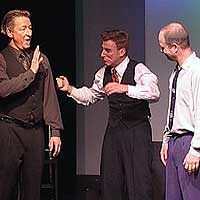
Driven by the artistic principle of “on a stage with no rules,” improv group 3 For All hits the floor with no script, no format, no preconceptions and no safety net — making their audiences roll with laughter. They are Bay Area improv comedians Rafe Chase, Stephen Kearin and Tim Orr.

Having met in the late ’80s through the improv company, Bay Area Theatresports (BATS), the trio formed an ensemble in the summer of 1996 to pursue their distinctive brand of high-stakes improvisation, releasing a self-titled CD in February 2003. Chase, a founding member of Improv Theater, as well as other local groups, teaches improv for BATS and A.C.T., and in private classes. Kearin, a visiting instructor at Stanford University, has recently appeared on HBO’s “Curb Your Enthusiasm” and a pilot of “The Phil Fuller Show.” Orr, like Chase, coaches improv at BATS and A.C.T. in addition to being cast in Bay Area plays and Brien Burrough’s improvised films “Suckerfish” and “Security.”

Spark follows 3 For All, taking you into the art of spur-of-the-moment improvisation. The three actors, along with the musical and lighting improvisers, work together to twist audience suggestions into narratives that last anywhere from a few minutes to over an hour. Whereas most actors spend countless hours getting into character, 3 For All live in the “adrenaline shots” of spontaneity. Nothing is rehearsed, nothing is discussed before or during shows, nothing is held over or reworked in future shows — nothing but pure improvisation.

Array

  • Array
  • Array
  • Array
  • Array

Rova Saxophone Quartet

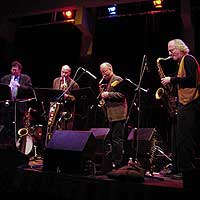
In the Spark episode “The Art of Improvisation,” we meet the members of Rova Saxophone Quartet as they prepare for a unique 25th anniversary concert at Yerba Buena Center for the Arts in San Francisco. Beginning with an introduction to improvised music, witness the behind-the-scenes rehearsal process of Rova and their international musical guests as they work on a series of musical pieces inspired by soprano saxophone legend Steve Lacy.

The Rova Saxophone Quartet was founded in the San Francisco Bay Area in October 1977 by Jon Raskin, Larry Ochs, Andrew Voigt and Bruce Ackley. The ensemble performed its first concert at the third annual Free Music Festival at Mills College in Oakland in 1978. The group is inspired by a broad range of musicians, including Charles Ives, Edgard Varese, Olivier Messiaen and John Cage to John Coltrane, Anthony Braxton, Steve Lacy and Ornette Coleman. Rova began writing new material, touring, recording and collaborating with like-minded colleagues such as guitarist Henry Kaiser and Italian percussionist Andrea Centazzo.

Early in its history, Rova performed both at the Vancouver New Music Society (1978) and the Moers International Festival of New Jazz in Germany (1979). Over the next few years Rova performed widely throughout North America and Europe, and in 1983 it became the first new music group from the US to tour the Soviet Union. “Saxophone Diplomacy,” a documentary video of the Rova USSR tour aired on PBS. Rova returned to the USSR again in November 1989 and released a CD titled “This Time We Are Both.” In 1986, in between visits to the USSR, Rova hosted the Ganelin Trio, the first Soviet jazz group to appear in the US. The trio performed with the Rova Saxophone Quartet at its first Pre-Echoes series of collaborative events, which would later include concerts with Anthony Braxton, John Zorn, Terry Riley and others.

Founding member Andrew Voigt left Rova in August 1988 and was replaced by Steve Adams, formerly with the Boston-based Your Neighborhood Saxophone Quartet. In addition, members of the quartet have been commissioned to write music for Rova by both Meet the Composer/Commissioning Music USA and Chamber Music America, which has commissioned 20 works from Rova over the years.

In 1999, Rova began presenting two annual events in the San Francisco Bay Area: New Music on the Mountain and Rovate. New Music on the Mountain presents several acts outdoors at Mount Tamalpais every September. Rovate presents special collaborations between Rova and such guest artists as Sam Rivers, Wadada Leo Smith, Gerry Hemingway, Satoko Fujii and Nels Cline as well as commissioning up-and-coming local composers to write new music for Rova.

Array

  • Array
  • Array
  • Array

Ruth Zaporah

Ruth Zaporah‘s technique may have seemed radical when she began performing it in the 1970s, but today her style is well established and internationally practiced. Zaporah’s improvisational acting technique is known as “Action Theater,” and it encourages freedom of movement, language and mind in improvisation. Spark drops in on one of her classes to see Zaporah and her students at work.

Zaporah’s students range from those who are entering the professional performance world as actors or dancers to those who simply have hopes of theatrical stardom. She takes the adage of “stage presence” to a new level by demanding that her students stay present in the moment by abandoning past, future, and current thoughts and give themselves up to improvisation.

  • Array

Jim Campbell

One of the most innovative artists in the country, Jim Campbell leads the way in the use of computer technology as an art form in his customized electronic sculptures and installations.

Now living in San Francisco, the Chicago-born Campbell holds degrees in mathematics and engineering from MIT. As an electrical engineer, he possesses more than a dozen patents in image processing and high-definition television; however, as an artist, he parlays his technical expertise into the aesthetic exploration of low-resolution video displays. In the mid-1980s, he transitioned from filmmaking to interactive video installations.

Campbell’s art consistently has probed into the questions of perception, time and memory. Much of his recent work harnesses the visual impact of LED (light emitting diode) displays, by transmitting digital video through LEDs, in order to create moving-image sculptures. But these works are not so much about an LED display as they are about the perception of a recognizable moving image through extremely low resolution and with very small amounts of information.

Spark follows the development of a series of works, in which Campbell explores the very essence of movement and information in a group of LED pieces called “Motion and Rest Studies,” which focuses on people with physical disabilities, a personal inspiration for Campbell, who grew up with parents who had physical disabilities. Sherry Petrini, one of six people featured in “Studies,” comments: “My overall feeling about it [is] that it’s a gentle rendering of a very profound human experience … a feeling of warmth and humanity.”

  • Array
  • Array
  • Array

Pamela Z

Pamela Z is a composer, performer, sound artist and vocalist who creates works primarily with and about the voice, using her voice, sampling technology and electronic processing to produce performance events and recordings of layered aural compositions. She creates solo works combining operatic bel canto, experimental extended vocal techniques, spoken word and sampled sounds triggered with a MIDI (music instrument digital interface) controller called The BodySynth which allows her to manipulate sound with physical gestures. Her performances range in scale from small concerts in galleries to large-scale multimedia orchestrations in proscenium halls and flexible black-box venues.

Pamela Z has toured extensively throughout the United States, Europe, and Japan, performing in numerous festivals. She has composed, recorded and performed original scores for choreographers and for film and video artists and has done vocal work for other composers. Her multimedia performance works have been included in exhibitions in San Francisco, New York and Germany.

In the Spark “Technology Enabled Art” episode, we see Pamela Z creating and performing a layered, multi-media performance called “Voci” (“Voices”). “Voci” explores the sonic, cultural, physical and artistic worlds of the voice, celebrates the broad range of colors in the singing and speaking voices, and examines the scientific and cultural phenomena surrounding the voice and its many metaphors. In addition to Pamela Z’s performance and live electronic processing, “Voci” features vivid, tall video projections designed by filmmakers Jeanne Finley and John Muse and a stunning lighting design by Elaine Buckholtz.

Array

  • Array
  • Array
  • Array

James Buckhouse

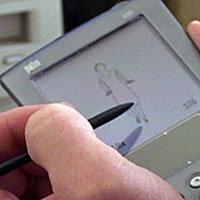
“Tap: A Share-Ware Art Project” was created by James Buckhouse in collaboration with Holly Brubach, dancer Christopher Wheeldon, and programmer Scott Snibbe. This free software can be beamed from one PDA (personal digital assistant like a Palm Pilot) to another, creating a person-to-person connection between the PDA holders like real dancers might experience when sharing choreography with one another. The user can then chose a male or female dancer, who must then practice to improve his or her dancing technique.

“Tap” was commissioned by Dia Center for the Arts and selected for the 2002 Whitney Biennial exhibit. Spark visits with Buckhouse to discuss how a simple line drawing of a dancer can create parallels between the arts and digital technology.

  • Array
  • Array
  • Array
  • Array

Derique

Derique

In his high-energy show of “Hambone, Hamtech Bring on the Groove,” performing artist Derique retells the story of how African-American slaves were deprived of drums and contributed to dance through other means, namely Hambone, a traditional form of body percussion. In the Spark “Solo Acts” episode, Derique’s passion for passing down this history becomes a celebration of music, dance, circus and high-tech Hambone.

Derique has introduced his unique blend of physical comedy and Hambone body music on stages and television shows around the world, with tours in Asia, Europe, the Americas and South Africa. He has performed with countless entertainers, including Bobby McFerrin, Lou Rawls and the late Sammy Davis Jr. Derique also shares his passion for performance with children, and has been featured on the Disney Channel and has hosted the Emmy Award-winning children’s television show “Short Stories and Tall Tales” for KQED.

The multitalented Derique began his career at age 15 — clowning, juggling, unicycling, dancing, doing gymnastics and performing Hambone body percussion. While working as a main attraction with Circus A La Mode in 1981, Derique “ran away” to join the Pickle Family Circus and Make*A*Circus in San Francisco. Currently, Derique is the Circus Arts program director at Oakland’s Children’s Fairyland and teaches circus arts at Bay Area schools.

Array

  • Array
  • Array
  • Array