View a Gallery Crawl segment on 111 Minna Gallery from May 2006.
View Spark segment on the Surf Style exhibit at 111 Minna Gallery. Original air date: August 2003. (Running Time: 3:88)
The place to see and be seen is also a contemporary art gallery showcasing some of the art worlds most promising up-and-comers and established figures. From painting to installation, the 111 Minna Gallery has been a consistent presence in the city’s vibrant art scene. Always attracting large crowds who come for the bar, the music as well as the visual art, they have rotating exhibitions of edgy work.
Theater productions often have no more involvement with the author than their name on the script. San Francisco’s theater company Campo Santo prefers to collaborate with authors, like Denis Johnson, to create works beyond any one person. In Spark‘s episode “Collaborations,” witness the relationship between writer, actors and director working together on the development of shows from first reading of the new work “Psychos Never Dream” to final rehearsals and the performance of “Soul of a Whore.”
Campo Santo, founded in 1996, is the resident theater company at Intersection for the Arts. Along with executive director Deborah Cullinan, the core members of Campo Santo are Margo Hall, Luis Saguar, Sean San José and Michael Torres, who came together in an effort to create socially relevant theater that is accessible to a diverse inner-city population. Campo Santo has produced over twenty highly successful productions of new works by contemporary writers continuing to experiment and take risks. They have received numerous grants and awards including Bay Area Theater Critics Circle Award for Best New Play for “Hellhound on My Trail” by Johnson.
Offering a unique theater experience, they let the words do much of the talking, presenting the plays simply in an intimate setting. Currently all of the plays are developed collaboratively over a period of months with not only the final product, but the process opened up to the community by early readings through the Open Process Series. Campo Santo works with playwrights as well as authors more accustomed to forms such as fiction, like Johnson, who is one of Campo Santo’s longest-running collaborators.
Having begun in 1999 with short stories from Johnson’s cult classic, “Jesus’ Son,” they have continued with a new production annually ever since. Johnson may be most well known for “Jesus’ Son,” which was made into a movie in 1999, but he has published over a dozen books including novels, collections of poetry and a collection of his international journalism. Johnson, still a relative newcomer to the world of theater, is able to continue experimenting as he finds his way. His production of “Soul of a Whore” is created entirely in verse. Johnson says, “It’s almost like a practice play. I’m just trying it out. It’s all very experimental for me.”
The collaboration benefits both Campo Santo and Johnson. “Soul of a Whore” director Nancy Benjamin says, “If a playwright’s dead or out of town, you can’t ask the questions we’re able to ask.” Through this process they are able to speak directly with Johnson, though they admittedly do not always agree with him, his words can often provide the clarity they are looking for. For Johnson, sharing with Campo Santo has been a way to move away from working alone as he does with fiction.
For Johnson maintaining this level of involvement isn’t just about finessing the dialogue or putting his stamp on the production — it’s an opportunity to connect with the actors in ways that continue to inspire him. He is able to spend time with people who now know his work as well as, if not better than he does. Johnson says, “I really feel as if I’m being intensely read and deeply appreciated. Maybe it’s not by the whole world, but even just a handful. It’s great. It’s just wonderful. It’s a writer’s dream.”
They live together, work together, make art together — meet Charlie Castaneda and Brody Reiman, known in the art world as the single entity castaneda/reiman. Neither lovers nor twins separated at birth, Castaneda and Reiman were both born in 1970, received BFAs from Carnegie Mellon University in 1992, and MFAs from the University of California at Davis in 1994. Since completing school, the two have lived together as roommates and worked together on a series of jobs, including construction and a dog-walking business they started together called Two Girls Walk Dogs.
In the episode “Collaborations,” Spark enters the creatives life of this seamless duo as they prepare their site-specific installation of conceptual sculptures titled “Floor Plan Landscape” for DCKT Contemporary Gallery in New York City. The collaborators’ experience of working together informs the content of much of their current artwork, which is made of cement, plywood, drywall, insulation and other “male-identified” construction materials. Provoking the sentiments associated with domestic settings, the works minimally reference the illusions of security and comfort associated with the physical spaces of a home.
castaneda/reiman has exhibited in the Bay Area and throughout the United States, gaining critical regard for their works. They have won a number of awards in the United States and abroad. Recently, the San Francisco Museum of Modern Art acquired one of their pieces. Their years of collective existence and artistic creation break the stereotypes of gender roles and the self-possessed artist working alone in a studio. Through differences and shared vision, castaneda/reiman truly embodies the concept of collaboration — in art, work and life.
Painter Mary Lovelace O’Neal and composer Olly Wilson create an audio-visual chamber music experience called “Call and Response” with the San Francisco Contemporary Music Players. Spark eavesdrops they create a series of musical pieces.
Maverick choreographer Joe Goode is internationally recognized as an innovator in the development of contemporary dance-theater. Since 1986, his Joe Goode Performance Group (JGPG) has been synthesizing a genre that combines text, gestures and humor with Goode’s own deeply physical, high-velocity dancing. In the episode “Trailblazers,” Spark trails along with Goode and his loyal company as they develop “Folk,” a brand new performance piece about rural life, with less than two months from the initial concept in Goode’s mind to the opening-night curtain.
Born in 1951, Goode earned a BFA in drama from Virginia Commonwealth University, then studied dance in New York City. In 1979, he began his signature genre of dance-theater synthesis. The essence of Goode’s concern as an artist is to explore a “deeply felt, profoundly human experience” in theater. His work has been recognized with numerous awards and prizes, including a New York Bessie; two Bay Area Izzies; a National Endowment for the Arts fellowship; and a Heritage Award from the California Dance Educators Association. Goode has recently joined the full-time faculty of the University of California at Berkeley in the department of theater, dance and performance studies.
To produce a new piece, rather than starting off with a story and filling it with material, Goode starts off with smaller elements and creates a story out of them. This process from creating original choreography and writing their own words and music to premiering the finished work usually takes the JGPG three to four months.
Over the past 13 years, Goode and his troupe have toured extensively throughout the United States, Canada, Europe, South America, the Middle East and Africa. JGPG is committed to reaching out to population groups who have little access to the performing arts, including gay/lesbian/transgendered/bisexual teens and young adults, low-income and at-risk youth, juvenile offenders, senior citizens, and battered women, as well as pre-professional dance artists.
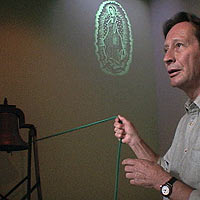
As Bay Area pioneer of conceptual art, Paul Kos helped define a West Coast approach to the form that emphasizes the elegant use of materials to explore issues of perception, social relations and life activities. In the Spark episode “Trailblazers,” audiences get a firsthand introduction to the artist, his fertile imagination and his 30-year body of humorous and provocative conceptual artwork. We examine individual works with the artist at his studio and the Berkeley Museum of Art, which has mounted the first major retrospective exhibition of Kos’s work, “Everything Matters.”
Kos relocated to San Francisco in 1967, arriving in the middle of a dynamic period in the history of the Bay Area characterized by cultural openness and curiosity and marked political activism. Already an important hub for artistic innovation, Kos and his peers experimented with new mediums through which to communicate contemporary ideas about the culture in which they lived. With the use of these new materials (most of them technologies designed for other purposes) as creative and expressive vehicles, over traditional artistic media such as drawing, painting, and sculpture, came the placement of concept as the driving force in artistic expression.
As a genre, conceptual art is art that aims to find its own definition by investigating the language of art and the system within which it exists. Conceptual artists question how we communicate by experimenting with different forms, thereby using the forms of visual phenomena to comment directly about how we engage with, apprehend and derive meaning from visual phenomena.
In his work, Kos has used a wide variety of media to explore a distinctive range of ideas, from the concept of time to the structure of the Catholic Church to the international divisions of global politics and cultural assumptions. Of primary concern to the artist is the employment of a unique language of art — finding the right combination of message and media that can transcend the limits of language and verbal communication.
Kos received both his BFA and MFA from the San Francisco Art Institute, where he has been a faculty member for the past 25 years. He has exhibited widely on the West and East coasts, has received numerous prestigious arts awards, including five National Endowment for the Arts fellowships, and a Rockefeller Foundation fellowship. His work is also in the collections of the Institute of Contemporary Art in Philadelphia, the San Francisco Museum of Modern Art, the Museum of Modern Art in New York, and the Stedelijk Museum in Amsterdam, Holland.
More Paul Kos sound bites from the Spark interview:
“My feeling is, if an artist develops fairly rigorous formalism in their education … after that, one should be able to move from craft to craft.”
“All art should have good craft — that’s just an assumption. But good craft is not art. Art is that magic that happens somewhere between the viewer, the object and the artist. The artist initiating it, but the viewer being that receiver of that triangle.”
“In new genres, the craft is thinking on one’s feet. And being able to use a material based on a site, maybe the site determines what the material is. It tells you everything.”
“Often I think a conceptual artist, unlike the painter or sculptor begins with a concept. And then finds the material that best suits that concept, that somehow the concept has some indigenous qualities to it that tell the artist what to use.”
“I respect painting probably the most because they are to the arts like philosophy is to the humanities.”
“When I was young I really loved magic tricks. I loved the idea of doing … a piece could have an element in it which is a surprise.”
“When everything matters, essentially, every detail counts.”
“Work should not necessarily be read like language is — left to right top to bottom. Instead, the work has its own language system.”
“I’m trying to pare down and pare down — use less adjectives and less adverbs, trust the verb and some nouns.”
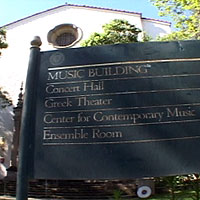
Originally founded in 1961 as the San Francisco Tape Music Center, the Center for Contemporary Music (CCM) moved to Mills College in 1966. Since then a tradition of experiment music has taken root at Mills through the program’s of composers such as Henry Cowell, John Cage, and Lou Harrison. Spark visits students at CCM as they explore the relationship between audience and performer.
In addition to traditional instruments, CCM maintains a variety of electronic equipment. They also offer studios, instruction and technical assistance as well as access to archives of audio recordings. The center serves as a resource to the community by holding public concerts and lectures, and is open to independent composers and musicians.
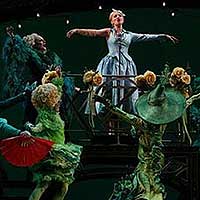
“Wicked: The Untold Story of the Witches of Oz” premiered on Broadway in October 2003. But before it hit theaters in New York, the multimillion dollar production impressed San Francisco audiences with a test run by the Best of Broadway company. In the Spark episode “The Engineering of Art,” we watch as the production crew tries to mount sets on a scale rarely seen at the Curran Theatre. From coordinating a fire-breathing dragon and flying monkeys to a spinning bed and enormous moving gears, the production team puts on a special effects show worthy of the great Wizard of Oz himself.
Based on the 1995 novel by Gregory Maguire, “Wicked” includes music and lyrics by Stephen Schwartz (“Godspell” and “Pippin”). The musical tells the story of two girls in the Land of Oz, one of whom become the Wicked Witch of the West and the other the Good Witch, Glinda. The stars of the original production were Tony Award winner Kristin Chenoweth, Tony nominee Idina Menzel (the original Maureen in “Rent”) and legendary two-time Tony winner Robert Morse.
The process of bringing “Wicked” to stage was no easy engineering feat. Costing $14 million, the play’s production involved over 150 people and took almost two years to become a reality. Built in Calgary, Ontario the show’s complex set took over a year and a half to design and had to travel over 1,500 miles to the Curran Theatre in San Francsico. Although the labor intensive set includes flying houses, a mechanized fire-breathing dragon, and individually hand-dyed corn fields, the hardest part of design proved to be staying away from the visual images of the original film version of “The Wizard of Oz.”
Under the direction of Carole Shorenstein Hays and Scott E. Nederlander, Best of Broadway is committed to bringing high-quality musicals and award-winning plays to the Bay Area. Over the years, local subscribers to the Best of Broadway have enjoyed a host of works, from the Tony Award-winning play “Fences” to the spectacular United States premiere of Baz Luhrmann’s production of Puccini’s “La Boheme.” Best of Broadway venues in the San Francisco-Bay Area include the Curran Theatre, the Golden Gate Theatre, and the Orpheum Theatre.
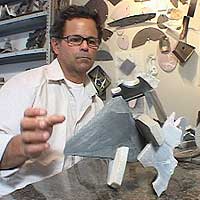
Working with materials that can weigh up to several tons, sculptor Richard Deutsch applies artistry and technology as he pushes the physical limits of his materials and creates gravity-defying art works in the process. In the episode, “Engineering of Art,” Spark visits Deutsch in his studio and at the worksites of his latest projects as he creates works that will outlast us all.
Born in 1953, Deutsch holds a BFA in fine arts from the University of California at Santa Cruz. Working with granite, bronze, fiberglass, and repurposed materials such as industrial objects, Deutsch uses solid media to explore the fluid themes of form, movement, space, and human interaction. As he designs and creates abstract sculptures for both public and private commissions, Deutsch’s finished works range from small studio pieces to monumental outdoor installations.
Spark tags along as Deutsch works on two of these monumental installations, one a fiberglass piece commissioned by Pineapple Sails, and the other, a larger-than-life granite stone sculpture for a private residence in Napa Valley. At Pineapple Sails, Deutsch utilizes the same ultra-light material the sailing company uses to create the hulls of its racing boats to create two 15 foot by 15 foot fiberglass pieces, which, with the help of a crane, are mounted in an outdoor display. At his project site in Napa, Deutsch, inspired by Italian ruins, creates a sculpture of rough-hewn granite slabs from Yosemite, entitled “Seven Stones.” Deutsch wants “Seven Stones” to evoke mystery like a contemporary Stonehenge, with the hopes that in several years viewers will ask, “How did this get here?”
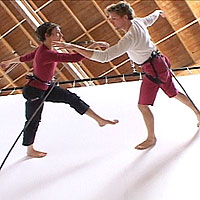
In an innovative combination of rappelling and dance, Project Bandaloop suspends dancer/athletes in mid-air and allows them to explore both vertical and horizontal movement. They have performed in all kinds of places: suspended beneath the Space Needle in Seattle and off of El Capitan in Yosemite.
Spark watches the dance group as they introduce a new “floor” into their routine — a vertical, trampoline-like surface that enables an even more interesting relationship between dance and gravity. The addition of this trampoline allows them to show projections as well as travel to venues around the world tp introduce new audiences to their unique perspective on dance.
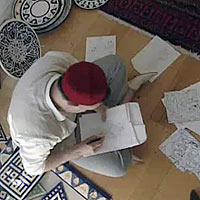
Berkeley-based artist Khalil Bendib is practicing a craft that goes back over a millennium, almost to the beginnings of the Muslim religion. Bendib paints on ceramic in a style initiated during the Moorish occupation of Spain in the Middle Ages, usually referred to as the Andalucian or Al-Andalus style. Spark visits Bendib in the studio as he works in this centuries old tradition.
Bendib comes from a long line of Andalus-style painters, stretching back through generations of his family. He first learned to paint from his uncle, Mustapha Maiza, a well-known ceramic artist in Algeria. Eager to continue his studies, Bendib went on to attend the Beaux Arts school of Algiers, working under the acclaimed painter Mohammed Temmam.
Though his work looks back to traditional designs and themes, Bendib often tries to interweave his own personal interests into his subject matter. Paintings often begin with a dream or recollection that will trigger an idea for a design. After working out a sketch on paper, Bendib then transfers the image onto a piece of ceramic in the form of a line painting. Finally, Bendib fills in his design with color, bringing the image to life.
Khalil Bendib grew up in Morocco and Algieria. After finishing his bachelor’s degree in Algiers, Bendib came to the United States, completing a MA at the University of Southern California in 1982. In addition to being a professional sculptor, Bendib produces political cartoons that have been published around the United States.
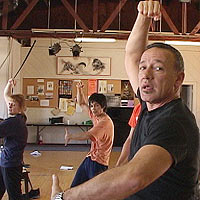
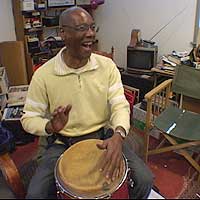
In the Spark “Transplanting a Tradition” episode, master percussionist, dancer and bandleader Roberto Borrell brings his passion for Cuban music and dance to students and audiences, reiterating the need to preserve the roots of Cuban music so that it will continue to grow and so that future generations can experience it. Viewers get to sit in on a dance class, see a segment of a performance by Borrell’s 12-piece Orquesta La Moderna Tradición and get a glimpse of the life of a traditional artist living outside his native country.
Borrell grew up in the 1950s and 1960s in Havana, Cuba, during the heyday of popular dance hall music, when danzón orchestras and big bands played all night performing a variety of genres, such as danzón-cha, cha-cha-chá, son-montuno, mambo and boleros. He enjoyed a successful career, first with the Conjunto Nacional de Cuba and later directing his own dance company. With the advent of the Cuban Revolution in 1959, however, many aspects of the culture in Cuba changed, and it became an increasingly difficult environment for artists, especially those who refused to join the Communist Party. Like many other thousands of Cubans, Borrell fled to the United States in 1980. Upon relocating to the Bay Area, Borrell met violinist, composer and arranger Tregar Otton, and together in 1996 they founded Orquesta La Moderna Tradición, perhaps the only ensemble in the United States that is dedicated to presenting traditional Cuban dance music, especially the lilting grooves of danzón.
Danzón, one of Cuba’s first unique dance/music genres has a long history that represents a fusion of African and European elements, and it represents the roots for many popular dance styles today. One of the most unique and compelling characteristics of danzón is the intricate connection between the music and the dance and between the musicians and the dancers. Following the musical structure and specific musical cues, dancers of classic danzón change their steps accordingly and move with musical phrases, at times allowing for some improvisation within the structure. This requires them to listen very closely to the music in order to hear an important cue, such as when to pause, when to make a big turn or when the music is about to end.
Landscape painter Li Huayi talks to Spark about his life as an artist and the different forms of art that have shaped his work over the course of his life — traditional Chinese landscape painting, modern American abstraction and Chinese propaganda posters from the Cultural Revolution — in terms of composition, content and style. In his contemporary works, Li Huayi is able to unite aspects of traditional and modern styles and genres to create innovative paintings that are highly regarded throughout the world.
Li Huayi was born in 1948 in Shanghai, a major international port city in the People’s Republic of China. Schooled as a painter from the age of 6, Li Huayi was educated in the techniques and traditions of landscape and flower painting by some of China’s most accomplished artists. As a teenager, he studied Western drawing and painting with a Chinese artist educated at the Royal Academy in Belgium. When he was in his 20s, the Cultural Revolution of the Communist Party was fully under way under the chairmanship of Mao Tse Tung, and Li Huayi was forced into a job as a “worker artist” creating propaganda images for the Socialist Party. Li Huayi finally left China in 1982 at the age of 34, relocating to San Francisco. Once here, Li Huayi was drawn to the powerful Northern California landscape, an inspiration that eventually drew him back to landscape painting after completing his studies at the Academy of Art in San Francisco.
Although Li Huayi’s paintings appear to be classical paintings, they are actually contemporary artworks that are made in the style and tradition of Chinese landscape paintings using traditional materials, subjects and compositions. He has brought his experiences in graphic arts as a creator of propaganda as well as his recent studies of American abstraction and modern art into the tradition of Chinese painting.
Spark visits Li Huayi at work in his studio and at the San Francisco Museum of Modern Art, where he discusses the similarities between Chinese painting and abstract expressionism, particularly the energy and spontaneity of the brushstrokes. This energy or “ch’i” (dynamic force), forms the basic compositional direction of Li Huayi’s paintings, defining the direction of verticals and horizontals as well as large areas of light and dark.
Editor’s note: Judith Scott passed away on March 14, 2005.
Since 1973, Oakland’s Creative Growth Art Center has been a nurturing ground for adults with mental, emotional and physical disabilities, providing them with creative art programs, educational and independent living training, counseling, and vocational opportunities. As the first independent visual art center and art gallery, this nonprofit organization also serves as an advocate for the disabled and provides services to teachers, caregivers, families, therapists and other persons who work in the fields of arts and disabilities.
Creative Growth is a productive playground for more than 130 hardworking artists in a variety of media, including painting, woodworking, ceramics and textiles. The artists exhibit their work at the Center’s Gallery as well as galleries and museums around the world. Spark investigates the creative impulses behind this miraculous place and the people who work and create there.
Just one of the amazing artists from this art center was Judith Scott, who was born with Down’s syndrome and could neither hear nor speak. Institutionalized for 35 years before her twin sister brought her to Creative Growth at the age of 44, Scott spent most of her life isolated from social contact with very little concept of language and no grasp of art. Yet when artist Sylvia Seventy of Creative Growth introduced her to fiber art in 1987, Scott was able to communicate through the mysteriously abstract beauty of her sculptures. Scott’s elaborate labyrinths of yarn, which surround a myriad of found objects, gained her the attention of art collectors and art critics around the world.