Category Archives: Visual Arts

Joe Mangrum

Since the mid-1990s, Joe Mangrum has been making temporary installations from found objects. Often exhibiting his designs in public spaces, Mangrum hopes to catch his viewers off guard, inserting something unexpected into their everyday routines. Spark visits Mangrum as he works on a large-scale piece for Red Ink Studios on San Francisco’s bustling Market Street.

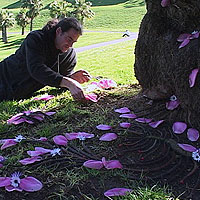
Mangrum began his career as a painter, but after 15 years, he began to feel frustrated with his reliance on the gallery system. Thinking that he would be able to reach a larger audience by making and showing his work outside of the gallery setting, Mangrum began assembling installations in public spaces like sidewalks and parks. He also he sought other media in which to work and decided on objects that he could find easily and in abundance, such as flower petals and beans. Mangrum breaks the vegetation into its core components, then reassembles the parts into elaborate patterns.

His installations often reiterate metaphysical polarities — such as man/nature and life/death — and speak to current world affairs. In 1995, Mangrum had his first gallery exhibition of this type of work at San Francisco State University. The exhibit consisted of five mandalas laid out on the gallery floor: one composed of natural materials, one composed of currency, two composed of computer parts and other industrial symbols, and a fifth, amorphous piece composed of a combination of natural and industrial elements. Mangrum intended this last mandala to suggest that nature and industry could co-exist without monetary exchange.

Spark caught up with Mangrum hard at work on “Birth and Death,” a similar design for San Francisco’s Red Ink Studios. The gallery is located in a storefront on Market Street, so Mangrum’s attenuated process of planning and installing the piece is exposed to passersby. The large installation is divided into two sections: “Birth,” which is composed of natural materials, such as seeds, beans, lentils and sprouts; and “Death,” which is composed of computer parts, bullets and bullet casings, cross-sections of engine tailpipes, and bricks covered in gold leaf. As in earlier works, Mangrum places these two sets of objects in opposition, in hopes of starting a dialogue about the use and abuse of industry and wealth. He also aims to encourage viewers to think more deeply about their surrounding environments.

Joe Mangrum earned a B.F.A. in 1991 from the School of the Art Institute of Chicago. In 2003, he was selected for the Florence Biennale, where he received the Lorenzo de Medici award for his piece addressing war called “Fragile”. Mangrum regularly shows his work in galleries and public spaces around San Francisco.

Array

  • Array
  • Array

Sandow Birk

https://youtu.be/aimLeC7mdDw
View a KQED Education video filmed in February 2012 at Catharine Clark Gallery.


View Spark segment on Sandow Birk. Original air date: June 2006. (Running Time: 8:28)

Catch up Sandow Birk as he describes several of his recent projects, including a hand-transcribed and illustrated project called American Qur’an, and a large-scale drawing about the American Constitution. This KQED Education production was filmed in Februrary, 2012 at the Catharine Clark Gallery in San Francisco, CA.

Over the last few years, Los Angeles-based painter Sandow Birk has been expanding his artistic scope — and his audience — by turning his sumptuous contemporary history paintings into motion pictures. Spark visits Birk and his crew as they finish production on Dante’s 14th-century epic “The Divine Comedy” — set in 21st-century San Francisco.

Birk is a keen student of art history and often recasts classic subjects and compositions with modern-day figures and narratives. Birk’s work is deeply influenced by history painting, a European tradition of depicting historical events in detailed and often dramatic images. Birk first encountered 19th-century history paintings on a trip through Europe — he was struck by the grand scale of the images and their theatrical tone. Upon returning to the United States, Birk moved into a storefront apartment in South Central Los Angeles and began creating his own versions of history painting, documenting the events that happened in his neighborhood — gang warfare, drug deals, looting and rioting — in that same dramatic style.

Birk’s first film project was “In Smog and Thunder,” a mockumentary inspired by Ken Burns’s marathon 11-hour film about the American Civil War. In Birk’s version, Los Angeles and San Francisco engage in all-out war for control of the entire state of California. Birk got the idea for the project during a month-long trip to San Francisco for his solo show at the Catharine Clark Gallery.

After multiple affronts to his hometown from a variety of Bay Area dwellers, Birk decided to exact his revenge by making a series of canvases in which San Francisco is finally invaded and conquered by Angelinos. After the success of the series, Birk decided he could reach more people by making a film, and he collaborated with filmmakers Sean Meredith and Paul Zaloom to produce the project.

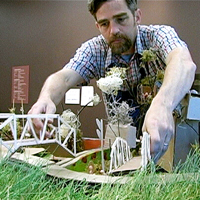
Like “In Smog and Thunder,” Dante’s “Inferno” began as a series of paintings that Birk then decided to make into a film. Using live actors for the project would have been prohibitively expensive — upwards of a million dollars — so Birk decided to make the film using paper cut-out puppets. Set in contemporary San Francisco, the film follows the experiences of a blue jeans-wearing Dante and his guide, the Roman poet Virgil, as they tour the depths of Hell, finally meeting the Devil himself.

Sandow Birk was raised in Southern California. He lives and works in Los Angeles. Birk earned a B.F.A. from the Otis Parsons Art Institute in Los Angeles and studied painting and art history at both the American College in Paris and the Bath Academy of Art in England. Birk was the recipient of a Guggenheim Fellowship in 1995, a Fulbright scholarship in 1997 and a Getty Award for the Visual Arts in 1999. His work has been shown in galleries and museums throughout North America and Europe.

Array

  • Array
  • Array
  • Array

Kathy Foley

Kathy Foley’s scholarly pursuit of Southeast Asian puppetry has taken her through most of that region. She is a professor of theater arts at UC Santa Cruz, the editor of “Asian Theater Journal” and has performed as a dalang (puppetmaster) of wayang golek rod puppets and wayang orang dance drama for more than 20 years. She is currently writing a book on mask and puppet performance in Southeast Asia.

Spark visits with Foley at the Asian Art Museum to get an expert look at their collection of Wayang Golek puppets from the Sundanese highlands. She explains the traditional use of the rod puppets and their significance in Southeast Asian culture and demonstrates her skills as a puppeteer.

  • Array
  • Array

Christopher Brown

Veteran Bay Area artist Christopher Brown paints scenes drawn from memory. For more than 30 years, Brown’s large canvases have been populated with remembered figures, objects and vistas that the artist continually reuses. Many of the images emanate from photographs that Brown has taken over the years; many reside only in the artist’s own recollection.

Although Brown is primarily a figurative artist, many of his paintings involve formal examinations of relations of scale and depth. Space in Brown’s canvases is often irrational, an almost dream-like landscape where scale and distance fail to cohere. Brown’s collages of memory images and photographic records converge in irrational, even surrealistic juxtapositions — confounding representation and abstraction and testing the boundaries between pictorial modes.

Brown obsessively works and reworks his images, painting over large areas of his canvases to redefine colors, objects and distances. Spark catches Brown in his studio, hard at work on a large painting of a building that will be the centerpiece for a solo show at San Francisco’s John Berggruen Gallery. Inspired by the artist’s tenure in New York in the mid-1990s, the painting depicts an immense apartment block that entirely fills the canvas. Brown painstakingly fills in each of building’s windows, continually changing the shading and color tones.

Midway through his painting, Brown decides to fill a section of the image with a photographically rendered stampede of horses that appear to charge from the picture’s surface toward the building, confusing the building’s assertion of space and stability within the image. The artist continues to work on the painting until the day of the show.

For Brown, exhibitions are rare moments when his normally solitary practice of making paintings gives way to social interactions, wherein his work is exposed to public view. The show is an opportunity for the painter to see his images anew, to experience his own expression reflected back at him.

Christopher Brown was born in Camp Lejeune, North Carolina. Brown earned his B.F.A at the University of Illinois and his M.F.A at the University of California, Davis. He has shown his work in galleries across the United States and is represented in several museum collections, including the San Francisco Museum of Modern Art, the Modern Art Museum of Fort Worth and the Sheldon Memorial Art Gallery.

Array

  • Array

Binh Danh

Each of the faintly rendered faces peering out from Binh Danh‘s leaf prints tells a story, as well as asks questions about history — likewise for Danh, who moved from war-torn Viet Nam as a young child in 1979. His work stems from his own unanswered questions about what happened in his native country. As he attempts to navigate the boundaries existing between personal and collective memories, he has used his work to give a face to the human costs of war.

Danh is not a photographer in the conventional sense — instead he works from an existing archive of photographs depicting the war’s many victims that he collects from various sources. Once he finds an appropriate image, he uses digital technology to make a negative transfer. From there, his work takes on a decidedly organic quality.

A lifelong interest in science primed the young artist to invent his own development process, which he coined “chlorophyll prints.” Danh begins by gathering leaves from his garden. Then he takes his negative image transfer and places it over a leaf, sandwiching the items between two sheets of glass. The arrangement is laid in the sun for a period of time (days or even weeks) until the ghostly visage appears. If it meets his approval, he then fixes the leaf in resin. According to the artist, this form of photography mirrors the continuing cycle of nature.

Spark catches up with Danh as he prepares for a collaborative installation with photographer Elizabeth Moy for their exhibition at the Intersection for the Arts (May 3 through June 17, 2006). Moy, whose father served in Viet Nam, shares an affinity with Danh in that her work seeks to reimagine the past. Seen together, their photographs create a space for reflection and contemplation of history that resonates in present times.

Binh Danh earned his B.F.A. in photography from San Jose State University and his M.F.A. from Stanford University in 2004. He has completed a residency at Cite Internationale Des Arts in Paris and has exhibited widely in the Bay Area, including shows at SF Cameraworks, the Kearny Street Project, the Oakland Museum of Art and the Triton Museum of Art. His work is included in the collections of the Oakland Museum of California and the University of California, Santa Cruz’s Special Collection.

  • Array
  • Array
  • Array

Bill Dan

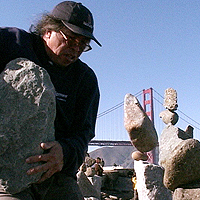
On any given day and in all types of weather conditions, nature artist Bill Dan can be seen balancing rocks at Fisherman’s Wharf, Crissy Field or on the waterfront of Sausalito. Since he began this practice in 1994, he has become a well-known local figure, often attracting large groups of spectators who gather around him while he creates vertical rock sculptures that seem to defy gravity.

Completely self-taught as a rock balancer, he plays upon the possibilities inherent to the interaction of rock, mass and gravity to create his nature art. There are several forces governing his approach: concentration and a positive attitude, along with an understanding of and respect for materials. His philosophy is that balancing rocks is play and work, beauty and craft. Sometimes building up to 10 sculptures in a day, he acknowledges that the act of physical labor, of hours spent stacking heavy rocks, depends upon his being in a good mood.

He keeps his work as simple as possible, to be an antidote to the complications of modern living. His source material is the “stone riprap” for their seemingly endless supply and varying shapes, sizes, colors and textures. The abstract sculptures he leaves behind do not conflict or compete with the beauty of their surroundings — they merely allow viewers to appreciate nature in new ways.

Spark catches up with Dan and witnesses that his work is both public and performance art. The crowds observing him get different things out of it. For some it is meditative and spiritual in its simplicity; for others, Dan’s ability to balance large stones perfectly on small rocks — without the use of any adhesive — is awe-inspiring. Unlike many public art pieces, his are not bound for permanence, and upon completion, the sculptures are left to endure the elements. It is part of his art to accept that his rock formations are temporary and ephemeral, even fleeting.

Bill Dan left his native Indonesia more than 20 years ago. He says that his friends and family back home can’t believe what he does. Still at it, he is out there every day doing what he loves: building sculptures and sharing his simple philosophy with others. Not limited to shores, he has been invited to perform at events and to teach schoolchildren the importance of using creativity and imagination over drugs.

  • Array

Roman Loranc

Roman Loranc works in the great tradition of California landscape photography. His art is as much about preservation as it is about beauty. Like Ansel Adams, who is famous for his commitment to Yosemite Valley, Loranc has been photographing the restoration of the Cosumnes River Preserve for many years.

The Cosumnes is the only river running from the Sierra to the Delta that is not dammed. It is a small river, but during the winter when it reaches the flatlands south of Sacramento, it runs out of its banks across acres of fields. Since the late 1980s, the Nature Conservancy has been buying land and gaining easements in order to restore the natural flood plane and riparian forests of the lower Cosumnes.

Loranc is a patient, thoughtful photographer. He arrives before dawn and waits. There is a brief moment — some days it’s just a minute — when the combination of the early light before sunrise, the mist and the stillness creates the perfect conditions for his images. He captures the reflections off the glass-like surface of the water. Once the sun begins to warm the valley air, breezes come up very quickly and the surface of the water starts to move. Then Loranc is often finished for the day.

The best time to visit the Cosumnes is in the winter when the water has flooded the preserve. In December, the temporary wetlands are filled with migratory birds. There are nature trails for those who simply want to stop by as well as for those who want to make deeper excursions into the preserve.

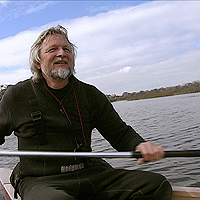
Spark went on a canoe trip with Loranc through the flooded Cougar Wetlands. On that day, heavy winter rains, along with breached levees, had caused flooding all along the lower San Joaquin. The image of water running over its banks across acres of fields gave a clue as to how the wetlands might once have looked and how they might look again. Loranc was very excited and took quite a few photographs that day.

Loranc and his wife, Lillian Vallee, the poet and Czeslaw Milosz scholar, live in Modesto, California. They moved there 20 years ago when they found the Bay Area too expensive. It took them years to begin to appreciate the beauty of the Central Valley; now, they have a profound appreciation of the place and say that people are surprised when they learn where Loranc takes his photos.

Roman Loranc was born in Bielsko-Biala, Poland, in 1956. He immigrated to the United States in 1981. His book, “Two-Hearted Oak: The Photography of Roman Loranc,” features essays and poetry by Vallee. Over the years, Loranc has also been photographing historic architecture and landscapes in Lithuania.

Array

  • Array
  • Array

Gregory Gavin

Gregory Gavin is a visual artist with a social cause. His site specific project called “Riveropolis,” was born out of his interest in bringing inner-city people together in a man-made environment reminiscent of nature. With this project, Gavin hopes to create a meeting place for people in much the same way as a watering hole found in nature is a meeting places for animals.

Spark visits Gavin and “Riveropolis” while in progress at the De Young Museum. The unadorned structures for Gavin’s riverscapes are constructed in his studio and then assembled in public spaces. The finishing work is done by people of all ages, who are invited to create riverside towns and attractions out of the materials Gavin provides. In this art-meets-culture installation, Gavin wants people to be reminded of the simple beauty of life, uncluttered by digital gadgetry.

  • Array
  • Array

John Chiara

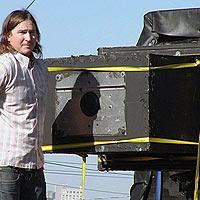
Whereas most of us have embraced digital cameras for their sleek, lightweight design and instant gratification, landscape photographer John Chiara favors his own super-sized camera. In the episode “Experimentation,” Spark catches up with Chiara on location as he sets up his camera obscura atop one of San Francisco’s familiar vista points.

His unique approach is influenced by the early days of photography when artists dealt with heavy, awkward equipment and endured long exposure times and cumbersome developments. Chiara’s own process is a labor-intensive endeavor — often taking him an entire day to get a single image — however, unlike his 19th-century predecessors, Chiara’s images are, like his camera, large, usually measuring 62 inches by 50 inches.

The nature of Chiara’s work is as much about sculpture and performance as it is about photography. His camera, which he designed and built himself, is transported to each location on a flatbed trailer. The pinhole design enables him to shoot and develop simultaneously on oversized photosensitive paper. After making adjustments to orient the camera in the right direction, Chiara must then climb inside it. Immersed in the darkness, he uses the glare of light to help him find the image. Becoming an extension of the camera, he uses his hands, by way of intuition, to control the amount of light entering the lens.

Bearing a strong resemblance to watercolor paintings, his photographs are rendered in soft, faded hues that relay an ephemeral quality. Early in his career he focused on creating pristine, color-saturated pictures. As he began to change his approach, he developed his own processes as well as his own rules. To accommodate the size of his images, he fabricated a drum roll from a sewage pipe to develop them.

His views are not what he considers picture perfect. They seem to be framed as if by accident. The ordinariness of his landscape imagery connects to Chiara’s childhood days spent daydreaming and staring off into the distance. Chiara encourages viewers to spend time with his work in hopes that the images will evoke emotional responses.

Chiara earned a B.F.A. in photography from the University of Utah in Salt Lake City and an M.F.A. in photography from the California College of the Arts in 2004. He has exhibited locally and nationally, including a solo show at the Build Gallery and group exhibitions at New Langton Arts in San Francisco and the Von Lintel Gallery in New York.

Array

  • Array

Kate Pocrass

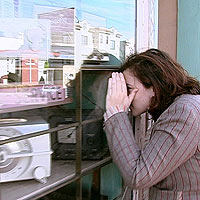
Most artists strive to create unique and unusual representations of the world around them. This is decidedly not the case for Kate Pocrass, a conceptual artist and photographer living in San Francisco. Through her Mundane Journeys project, Pocrass has managed to use the often-overlooked as the basis for her public art.

Every week since starting Mundane Journeys in 2001, Pocrass updates a message on her project’s telephone hotline at (415) 364-1465. She records directions to shops that are off the beaten track, odd-looking tree trunks in city parks, miscellaneous markings on sidewalks, specific foods in specialty markets and anything else that strikes her fancy. “If there’s one reason I do like other people to do these things, it’s [so they] stop and look with intention, not going from point A to B quickly,” Pocrass tells Spark in the episode “Out and About.”

Pocrass’s hotline recordings often come with instructions prompting journeyers to do things like chat with employees at certain shops, visit the far back corner of a big box store for something special or admire a particular scene from a particular vantage point. Callers often leave on the hotline their own messages, suggestions and reactions.

To feed the cult following that demanded Mundane Journeys more frequently than once a week, Pocrass published a guidebook of the same name in 2003 that features 50 sample adventures. The latest version of Mundane Journeys is due out in the summer of 2006. Pocrass also organizes occasional bus tours that shuttle curious fans of her project to her favorite destinations. Armed with a handout describing journeys in the area, bus tour attendees dutifully march out into the streets to experience the people, places and things that have caught Pocrass’s attention over the years.

“The bus tour is a very special atmosphere because there’s art people on the bus, my roommates’ family is on the bus – the dynamics between [them] are so great. People are trying to figure people out. [They’re] not sure how to act. Is this an art tour? Is this some random city tour? Is this some touristy thing? No one really knows what this is,” Pocrass says.

And therein lies part of the project’s intrinsic artistic appeal. Mundane Journeys, which now encompasses the original hotline, a Web site, a guidebook and the bus tour, is as much about the interaction among journeyers and their varied experiences tracking down Pocrass’s mundane destinations as it is about the destinations themselves.

In many senses, Pocrass’s ongoing, constantly growing display of chosen spots challenges the boundaries and meaning of public art. Just as the bus tour escapes neat and tidy definitions, the entire project raises more questions about art than it answers. In fact, even the artist herself isn’t quite sure how her project fits into the art world. “I have no idea how it’s art other than I’m making people look at things they overlook,” Pocrass says.

Kate Pocrass earned a B.F.A from the University of Michigan and an M.F.A. from the California College of Arts. She has exhibited work locally at Southern Exposure, the Rena Bransten Gallery, Spanganga, Pond and New Langton Arts and internationally at the Foundation de Appel, in the Netherlands, and Rooseum, in Sweden. She also was selected to participate in Bay Area Now IV, at the Yerba Buena Center for the Arts. With Mundane Journeys, Pocrass is striving to emphasize the importance of having meaningful art encounters through socially attuned and ephemeral projects.

  • Array
  • Array
  • Array

Todd Hido

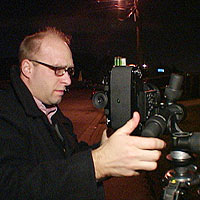
Internationally acclaimed photographer Todd Hido has made a name for himself capturing unsettling images of the suburban landscape. Spark joins the artist at work as he cruises one of his favorite Bay Area neighborhoods in search of the perfect shot. Hido looks for the anonymous, even mysterious aspects of American life, recording buildings and landscapes eerily absent of human presence.

At the center of Hido’s work is a certain degree of realism. He uses only available light and does not move objects when composing his images. Hido shoots his signature residential landscapes at night using long exposure times and employing the ambient atmosphere that surrounds his subjects. His minimalist, moody images, set in architecturally homogeneous settings, suggest sinister narratives.

Hido’s technique of using long exposure times presents particular challenges. When photographing a house or landscape, any temporary change in light affects the picture. The headlights of a car driving by can create the desirable effect of brightening the image, whereas the lights of a plane flying overhead can create an unwanted streak across the sky.

For his latest book, Hido is taking a different approach to pursuing the themes of isolation and loneliness evident in his earlier work. Spark travels with the photographer to a hotel in San Francisco’s Tenderloin neighborhood, where he is working with a model to create a series of portraits. For Hido, old hotels provide an exciting range of possibilities. Details like old fixtures and furniture can be rife with suggested stories and associations when captured in the just the right way. He still uses only natural light, although he may use curtains to alter or block light.

Lately, Hido has been using a vintage 126 camera that his wife found in a thrift shop. He first used the camera to help his models relax before he would begin shooting with his professional equipment, but soon he noticed that the vintage camera’s flash created an amateurish snapshot look. Hido found this aesthetic appealing, so he decided to use the camera in his work.

For Hido, editing and sequencing his images for publication adds meaning to them. The photographer considers his books to be like paper movies – arrangements of images that suggest loose narratives. Scenes are sometimes tied together through formal criteria, such as light, composition or a particular tonal palette, and sometimes through stories and characters that seem to inhabit the images themselves.

Todd Hido earned a B.F.A. from Tufts University in 1991 and an M.F.A. in photography from the California College of Arts and Crafts in 1996. His work has been shown in galleries and museums across the United States and in the United Kingdom. Hido’s photographs can be found in many prominent collections, including the Guggenheim Museum and the Whitney Museum of American Art, both in New York City, and the San Francisco Museum of Modern Art. He has published four books, “Roaming” (2005), “House Hunting” (2001), “Outskirts” (2002) and “Taft Street” (2001). Hido is represented by the Stephen Wirtz Gallery of San Francisco.

Array

  • Array
  • Array
  • Array

Felipe Dulzaides

If Felipe Dulzaides has his way, his art will make people question their everyday environments. Spark talks to him about his public art piece, “Double Take: A Billboard Project,” a collaboration with New Langton Arts consisting of eight billboards that were installed throughout San Francisco over the course of a year from December 1, 2004 to December 31, 2005.

Before the project began, Dulzaides and city developer David Prowler scouted locations from playgrounds to parking lots and photographing particular views or aspects of the site. Dulzaides then played with the scale of the images, turning them into giant billboards. The result is a head-turning mix of the ordinary and the unexpected.

Cuban-born visual and performing artist Felipe Dulzaides earned a B.F.A. in theater from Instituto Superior de Arte de la Havana and an MFA in new genres from the San Francisco Art Institute. His work has been exhibited locally at numerous venues including SFMOMA and the Yerba Buena Center for the Arts, and internationally at Centro Cultural de EspaƱ:a in Cuba, and Buro Spors in Germany. He was a 2003 artist in residence at the Headlands Center for the Arts, a recipient of a 2002 Artadia Award and a 2001 Cintas Fellowship.

  • Array

Andrew Kleindolph

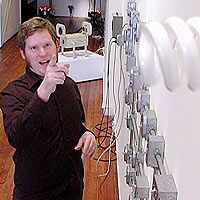
In the proverbial battle between man and machine, you might say that Andrew Kleindolph is on the machines’ side. Many of the artist’s interactive electronic sculptures play games with their human counterparts, instead of the other way around. Spark follows Kleindolph from his workshop at the Headlands Center for the Arts to his show at San Francisco’s RX Gallery as he demonstrates his interactive artwork.

One recent Kleindolph creation resembles a video game like any other. The catch? The game never starts. Instead, Kleindolph’s machine sends its users through an endless series of pointless prompts and error screens. At a Kleindolph show, players’ increasing frustration with an obstinate video game, onlookers’ confusion over which switches illuminate which light bulbs and baffled stares at a contraption emitting manipulated audio tracks of wild animal calls are as much a part of the art as the machines themselves.

The tension between humans and machines is an overarching theme in both Kleindolph’s three-dimensional electronic pieces and his two-dimensional digital images. The latter looks like a cross between blueprints for the innards of fantastic machines and a busy intergalactic highway frequented by space-age cellular creatures. The images juxtapose electronic circuitry and organic forms in a way that’s both playfully cartoon-like and technically precise.

Machines have been a part of Kleindolph’s life since childhood. His family owned a vacuum cleaner and sewing machine sales and repair shop in his small hometown of Muscatine, Iowa. His grandfather started the business, and his parents, uncle and cousins worked there. Kleindolph also worked there for a time.

When he begins working on a new piece, Kleindolph doesn’t just do what he already knows how to do. Instead, each sculpture is a learning process in and of itself. An idea, like the one for an “anger meter” that lights up in the presence of body heat, will often send Kleindolph to his studio in the basement of the Headlands Center for the Arts, where he has had space for several years.

As he tinkers with new devices and works on projects sure to baffle and surprise visitors at his next show, Kleindolph is turning the senseless vagaries of life into art. “A lot of the stuff that I’ve been doing looks at everyday situations and how absurd they are. The sort of things that we do everyday can be [absurd]. Yet we just tolerate this and that and just go onward with our business.”

Andrew Kleindolph earned a B.F.A. in painting from the University of Iowa and an M.F.A. in electronic arts from Mills College. While attending Mills, he began teaching at City College of San Francisco. He still works at City College part time, but focuses on his electronics classes at Lick-Wilmerding High School in San Francisco.

  • Array
  • Array
  • Array

Lisa Kristine

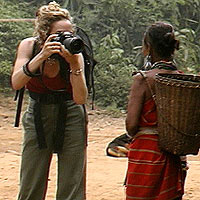
When San Francisco based photographer Lisa Kristine was a child, she pored over “National Geographic” depictions of tribal peoples in faraway lands. Now she has photographed every one of the indigenous groups that once captivated her young imagination. From Papua New Guinea to Ethiopia, Laos to Tibet, Kristine has journeyed the globe to photograph people and places seemingly untouched by our modern world.

“I’m drawn to people who have been living closer to the earth and have very, very old traditions, [people] that have not in any way been altered by modernism,” she explains in the Spark episode “Think Globally.”

A California native, Kristine learned to take black and white photographs when she was 11 years old. Her world travels began in the early 1980s, when a visit to Greece as a teenager morphed into an extended journey that eventually led her around the world, starting with Italy, Israel, Egypt and Thailand.

Since then, Kristine has visited more than 50 countries across six continents. She spends months getting to know her subjects before documenting their private worlds on film. She always travels with a translator and never photographs subjects without their permission.

Traveling the world, visiting places and people that so many of us will experience only through photographs and stories, Kristine is drawn to the human capacity for creating meaning and the different ways global communities produce and perpetuate meaning through religion, tradition, philosophy and culture. She has recently been drawn to capturing America – her own country – in this same way.

Lisa Kristine’s vibrantly colorful photographs depict scenes as simple as a single arched doorway in Morocco and as enigmatic as a geisha’s red smile. Using 4×5 analogue cameras of different sizes, Kristine emphasizes natural light. She is known to spend hours waiting for the light to shift so that it colors her chosen scene in just the right hue. And although she does use a tripod for scenes that move and with large-format cameras, she prefers taking handheld shots of her subjects as they work, pray and perform daily tasks.

  • Array