Category Archives: Visual Arts

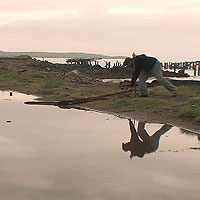
Caleb Duarte

Oakland resident Caleb Duarte is a part of a new generation of Bay Area Chicano artists. As an artist, he works with a combination of found materials, architectural building supplies, painting and drawing to create temporary installations and “sculptural paintings” that evoke poignant narratives of home, shelter and displacement. Spark follows Duarte as he prepares for his first solo exhibition in San Francisco.

The theme of home and shelter is central to Duarte’s work. Influenced by an interest in architecture and various forms of dwellings, Duarte uncovers how our living spaces speak to our realities and our relative placement in the so-called first and third worlds. His work explores what our homes say about the truth of our lives and the widening gap between rich and poor in the contemporary global context.

To create the temporary structures used in his installations, Duarte collects driftwood, old signs and other found materials that have had an existence as natural objects or in human habitats before he reuses them. It’s important to him that these materials are imperfect, that they have had a life that predates his own involvement with them. This use of weathered materials expands the narrative implications of his work, evoking a sense of the past and of lived histories.

Spark documents the progression of Duarte’s exhibition at Jack Fisher Gallery in San Francisco. The show, “Cuartitos” (“Little Rooms”), was inspired by the shantytowns of Mexico, and the beauty and sadness of these neighborhoods that are largely built out of necessity. These towns are constructed from whatever materials are available — combinations of cement blocks, recycled wood and old signs. Duarte’s own grandfather lived near the border town of Nogales, Mexico, where he built a cluster of makeshift houses for people to rent. On a recent road trip through Mexico, Duarte realized the profound influence his grandfather’s endeavors have had on his own work as an artist.

For his exhibition, in addition to a central towerlike form made of driftwood, Duarte fills the gallery space with sculptural wall paintings. To make these three-dimensional pieces, the artist delicately paints figures onto drywall from images he finds in newspapers and magazines, then mounts the images on boards. Some of the images were taken from newspaper articles on the disaster of Hurricane Katrina, others come from random photographs that convey a specific mood. By taking the figures out of their original context, Duarte’s representations remain ambiguous but ever imbued with emotion and humanity.

Duarte creates intimate spaces that impart a sense of humanity’s search for meaning, family, placement and home. The temporary aspect of his installations reflects the cyclical nature of life and the way in which the built environment is constructed and destroyed over and over again. By making changeable and evolving structures, Duarte evokes a ubiquitous aspect of our existence, which, alongside the inclusion of the figures, points to the beauty of human yearning.

Born in 1977, Caleb Duarte migrated from Mexico to the farm communities of the Central Valley of California when he was 4 years old. He began painting at a young age, then went on to attend the San Francisco Art Institute, where he earned a B.F.A. in 2003.

Array

  • Array

Susannah Bettag

British-born, San Francisco artist Susannah Bettag often adapts symbols from other cultures and time periods to create her own vernacular. Spark visits Bettag as she prepares for her debut solo show, “Vanitas Baby,” at the Frey Norris Gallery. For this body of work, she borrows from the vanitas tradition, a style of painting popular in 17th century Netherlands in which symbolism is used to depict mortality and the ephemeral quality of sensory pleasures.

Bettag creates multi-layered paintings which exemplifies her love of color. Her line drawing layer inspired by pornography is topped with her cartoon baby-like creatures. The two play on tensions between women’s eroticism and the dangers and discoveries of childhood innocence.

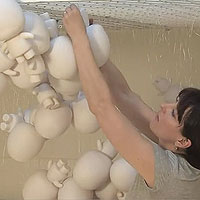
The centerpiece of this show, “Drowning Without You,” consists of thousands of white matte vinyl dolls hanging in a two-story installation shaped like hourglass. The dolls were manufactured based on a character that has appeared repeatedly Bettag’s paintings named “Little Boo.” Bettag says of Little Boo, “There was something about him that was innocent, at the same time being naïve and also a little unnerving.”

  • Array
  • Array

David Hevel

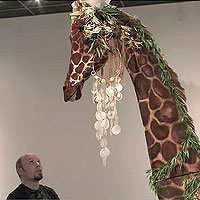
Growing up in Missouri, David Hevel was influenced by the inevitable and distinctly American force-feeding of pop icons and television culture. Hevel worked in film/video performance, commercial illustration and painting, eventually finding his niche in sculpture. Using unique materials, Hevel creates fantastical images of animals that represent such American celebrities as supermodel Tyra Banks and pop idol Justin Timberlake.

Spark chats with Hevel at Heather Marx Gallery as he dismantles his solo show, “Fierce,” and prepares for his next exhibit, “Diva Hound Smack-Down at the Grammys,” in Kansas City.

Hevel’s unique form of art began when he became inexplicably infatuated with stockpiling plastic fruit. Now, years later, he has found a way to channel his infatuation by developing a complex mixed-media operation that relies heavily on glitter, hot glue and his plethora of obsessively collected kitsch — including sparkling beads and butterflies, silk flowers, oversized rhinestones, and faux fur — to embellish Styrofoam forms used by taxidermists. His work teeters precariously between grotesque and gorgeous, providing a humorous narrative that addresses the nature of Americans’ excessive consumption of celebrity gossip.

David Hevel is based in Oakland, and his work has been exhibited internationally. He earned a B.F.A. from Central Missouri State University, an M.Ed. from the University of Missouri and an M.F.A. from California College of the Arts.

Array

  • Array
  • Array

Crown Point Press and William T. Wiley

Tucked in a quiet alley in bustling San Francisco, Crown Point Press stands as one of the most prestigious print studios in the world. Founded by Kathan Brown in a Richmond, California storefront in 1962, Crown Point Press began publishing the etchings portfolios of painters Richard Diebenkorn and Wayne Thiebaud, both of whom are considered to be among the most influential visual artists of the last half-century. Crown Point Press’s roster of artists also includes such luminaries as Sol LeWitt, Robert Bechtle, Chuck Close, John Cage and Kiki Smith.

Crown Point Press publishes the prints of five or six artists a year who are invited to complete artistic residencies that range from two weeks to six months. For this program, Brown enjoys inviting the participation of established artists in addition to those whose specialty is outside the printing sphere, such as photographer John Chiara. Spark visits with William T. Wiley, one of the leaders of the Bay Area’s figurative movement, during his Crown Point Press residency in 2006. The Marin artist guides us through the making of a print, from idea to finished product.

There are many different techniques of printmaking including: relief (woodcut), intaglio (etching), planographic (monotype) and stencil (silkscreen). Crown Point specializes in the many different methods of etching. Brown says, “The difference between an etching and any other kind of printing is that an etching is printed from below the surface of the plate, so the paper molds down in. That makes a big difference, because it’s physically embedded. Every other printing — lithography, woodcut — prints from a surface to a surface. So it sits on top. So you have an energy that’s different.”

More about Crown Point Press:
In 1997, Crown Point Press celebrated its 35th anniversary with an exhibition at the National Gallery of Art, Washington, D.C. It has a gallery that is open to the public and two large etching studios. Their summer workshops are open to all artists.

  • Array
  • Array
  • Array

Shuji Ikeda

A native of Okayama, Japan, ceramicist and ikebana artist Shuji Ikeda originally hoped to become a filmmaker. He came to the United States in 1973 to study film at San Francisco State University and graduated cum laude. But he grew frustrated by the challenges of breaking into the business and, in a serendipitous turn of events, turned to pottery as a means of therapy.

Now renowned for his craftsmanship and innovative methods — including his unusual woven baskets made of hundreds of delicate strands of clay and his organically elegant dancing pots — Ikeda has carved a unique niche for himself in the ceramics world. His work has been exhibited everywhere from San Francisco’s Museum of Craft and Folk Art to Gump’s to the Smithsonian Institution.

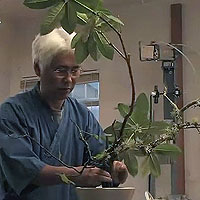
The serene Ikeda is also an expert in the Japanese art of flower arranging, or ikebana. He holds a certificate from the Ikenobo Ikebana School in Japan and passes on his knowledge from his studios in Berkeley. “Flowers,” he says, “provide an opportunity to express oneself and communicate without the benefit of language.”

Like most ceramicists, Ikeda has developed his own distinctive styles of glazing, formulating personal recipes such as the refined “sei shya,” or blue rust, which he uses on his dappled, woven baskets. But it is the philosophy of the age-old ikebana that most clearly informs his work in clay, which can be intricate or simple, highly finished or naturalistic.

Spark visits with Ikeda in his studio and at a “noborigama” in Napa County, which is a 30-foot wood-burning kiln that is kept burning for seven days straight. Such kilns have been used in Japan since the 17th century. The noborigama’s wood-firing technique produces a unique natural ash glaze.

  • Array
  • Array

Stanlee Gatti

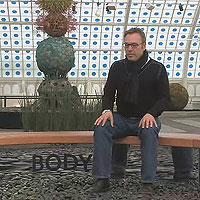
Event designer Stanlee Gatti is known to throw some of the biggest parties in San Francisco (the Mayoral Inaugurations of Gavin Newsom and Willie L. Brown and receptions for likes of Elton John) featuring some of his amazing floral arrangements. So it wasn’t a huge stretch that the Conservatory of Flowers invited Gatti to be the first artist to create a large-scale, site-specific installation in their Golden Gate Park facilities.

Spark visited with Gatti as he explained his intent behind “ONE: An Earth Installation,” which ironically happens to be composed without using a single living organism except for a small grouping of cattails. His inspiration for this exhibit came from his reverence for nature and admiration of Native American culture.

Although Gatti has spent years building a name for himself within the San Francisco social scene, “ONE” marks his first public exhibition. However, Gatti is no stranger to the public art world either since he served as the president of the San Francisco Art Commission for nine years, starting in 1996.

Stanlee Gatti, a New Mexico native started out studying music, physical education, and art at the University of Northern Colorado. After some self-reflection he redirected his studies to the University of Oregon where he studied architecture and art history.

  • Array
  • Array

Lawrence Ferlinghetti

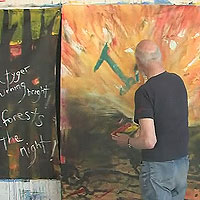
Over the past six decades, Lawrence Ferlinghetti has established himself as one of the most renowned poets and publishers in the world. A founder of City Lights Books and a noted Beat writer, he is commonly considered one of the greatest literary figures of the 20th century. But Ferlinghetti has been painting for almost as long as he has been writing. Spark visits Ferlinghetti in his studio as he prepares a series of works for a show at San Francisco’s George Krevsky Gallery.

Ferlinghetti first took up painting in 1948 while living in Paris on the G.I. Bill, at a time when French artists were heavily influenced by Spanish surrealism in general and the work of Pablo Picasso in particular. Like many American painters at the time, Ferlinghetti interpreted these influences to produce abstract expressionist works. But the artist quickly became dissatisfied with nonobjective painting, abandoning it in favor of works that incorporated both figuration and the written word.

Now in his late 80s, Ferlinghetti still paints fervently, and most mornings he can be found working in the Hunter’s Point Shipyard studio that he has kept since 1979. All the paintings that he is preparing for his show at the Krevsky Gallery combine provocative, sometimes mystical imagery with written words: some of his own, others from canonical wordsmiths such as Blake and Eliot.

Though he began painting early in his career, Ferlinghetti didn’t exhibit his work until the 1980s, after George Krevsky himself approached the poet following a reading. Krevsky complimented Ferlinghetti highly on his writing, and the poet/artist responded that the gallery owner should see his paintings. Krevsky’s visit to Ferlinghetti’s studio began a relationship that has lasted more than 20 years.

Lawrence Ferlinghetti was born in Yonkers, New York, in 1919. He graduated from the University of North Carolina at Chapel Hill before serving as an officer in the U.S. Navy during the Second World War. Returning to New York, Ferlinghetti earned a master’s degree from Columbia University and a doctorate from the Sorbonne, in Paris. While living in France, he met the influential poet Kenneth Roxroth, who encouraged Ferlinghetti to move to San Francisco, where he eventually came to be known as one of the founders of the Beat movement. In 1953, Ferlinghetti founded the City Lights bookstore with Peter D. Martin; the publishing house was founded two years later, in 1955. Ferlinghetti has since published more than 25 books of poetry and has won numerous literary awards.

Array

  • Array
  • Array

Rene Garcia Jr.

Editor’s note: Rene Garcia Jr. passed away on May 8, 2015.

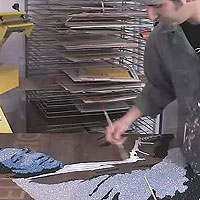
Painter, graphic designer, illustrator, sculptor and stereo photographer Rene Garcia Jr. re-imagined popular art in many different ways, but it’s his large format sculptural glitter paintings that have gotten the most attention. Reproducing such things as retro ads and celebrity photos in glitter, Garcia’s photorealistic pieces have taken more than 100 hours to complete. Spark visits him in his dazzling studio that any grade school class would envy.

  • Array

Jaime Guerrero

Since the late 1990s, Jamie Guerrero has been creating striking one-of-a-kind glass pieces that have gained him recognition around the Bay Area and nationally. In his work, Guerrero draws from his experiences growing up in East Los Angeles as well as from imagery of the Mayan and Aztec cultures. Spark drops in on Guerrero and his team at San Jose’s Bay Area Glass Institute (BAGI) as they are hard at work on a new piece.

Guerrero had worked in a variety of sculptural media for years before stumbling into the glass studio while studying at San Francisco’s California College of the Arts. The young artist was immediately won over, by the fluidity of the medium as well as by the precise timing and close teamwork that glass demands. Guerrero made a name for himself early on by crafting vivid multicolored glass vessels, but quickly decided that he did not want to become a production glass blower, making the same pieces repeatedly.

Discovering a new technique that allowed him to work with multiple colors simultaneously, Guerrero began making his “Homies” series, which explores character types and situations that he experienced as a youth in East Los Angeles. He soon expanded his repertoire to include representations of Aztec and Mayan deities, drawing parallels between these ancient civilizations and contemporary life.

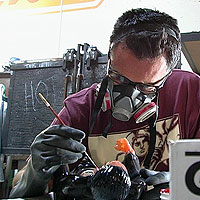
Spark catches Guerrero working on a glass sculpture of the Aztec deity Quetzalcoatl, the feathered serpent. It is a challenging project, demanding perfect coordination among all the members of the Guerrero team. Thanks to a fellowship, Guerrero has at his disposal the BAGI’s state-of-the-art facilities, essential for making such a complicated piece.

Once the glass has been liquefied – at above 2000 degrees – Guerrero and his team add color by rolling the hot glass in pigment, then they shape the individual pieces of the sculpture while maintaining a constant and even temperature. It is a one-shot deal that will work only if all the crucial elements come together. After the piece has been assembled, the team equalizes its temperature before it is allowed to slowly cool in a 950-degree oven.

Jaime Guerrero lives and works in the San Francisco Bay Area. He earned a B.F.A. from California College of the Arts in 1997. His work has been exhibited at local and national venues, including La Peña Cultural Center, CBS Marketwatch, Galería de la Raza and the Albany Arts Gallery. Guerrero has received grants and awards from the Ryman Master Program and California College of the Arts, and he was an artist-in-residence at San Jose State University in 2001.

Array

  • Array
  • Array
  • Array

Taraneh Hemami

Iranian-born painter, installation and conceptual artist Taraneh Hemami has two homes — and she also has none. When Hemami came to the United States in 1978 to attend the University of Oregon at Eugene, she had little idea of what the future held. Within a year of her arrival in this country, the Iranian Revolution had changed her homeland forever and prevented her from visiting for more than a decade.

As an Iranian living in the United States, it’s not surprising that Hemami’s art would explore her complex relationship with the concept of home and her struggle to secure a sense of belonging from both her country of residence and the country and culture of her youth. In many ways, Hemami’s art is her home. “There is a sense of satisfaction in placing myself within the walls that I create,” says Hemami.

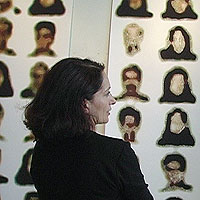
Among Hemami’s many projects is an installation she began in 2000 called “Hall of Reflections.” She collected hundreds of personal photographs, portraits and images from Iranian Americans and transposed them onto more than 400 glass and mirror tiles using silkscreen, prints and transparencies that fade and age over time. The resulting multidimensional installation, inspired by traditional Iranian mirrored gathering halls, explores the lives of the individuals fixed on her tiles and their experiences as immigrants, mothers, fathers, children and a community.

Spark follows Hemami as she gathers footage, photographs and stories from a Castro Valley Iranian woman named Nosrat, who is known as “Mommy” and whose life is the cornerstone of Hemami’s multimedia display exploring the layers of history and connected stories within a family home. The finished product is an exhibit she titled “Homes,” which was displayed at ZeroOne San Jose: A Global Festival of Art on the Edge and the Thirteenth International Symposium of Electronic Art in August 2006.

Taraneh Hemami’s work has been exhibited in the Yerba Buena Center for the Arts, the Artist’s Gallery of the San Francisco Museum of Modern Art, the San Francisco Arts Commission gallery, and numerous other locations around the country and the globe. Her themes revolve around the Iranian American experience, notions of memory and the ephemeral nature of concrete space.

  • Array
  • Array
  • Array
  • Array
  • Array

Rebar

Rebar members Matthew Passmore and John Bela wanted to preserve the cultural integrity of the 32-year-old Southern Exposure gallery; not through photographs or a painting, but by drilling out a chunk of the gallery’s wall and canning it. Yes, canning it. This may sound a bit strange but their intentions are quite clever. The two got the idea by looking into the history of the gallery. Before SoEx’s existence, the building was a can manufactory called the American Can Company.

The process of canning the walls was a project created by Rebar, a San Francisco-based arts collective. For Rebar’s “Encanment” project, Passmore, Bela and their team clad in work suits, hard hats and goggles drilled 2 ½ inch holes all over the gallery’s walls so that they could be processed, condensed, labeled and sold. This took place during Southern Exposure’s last exhibit, “Between the Walls,” before their move to a temporary new location so the gallery could undergo a seismic retrofit and renovation. Luckily, Spark made it just in time to visit the “encannery” process.

For just $20 dollars, one can holds three pieces of 2 1/2 inch of wall immersed in mineral oil, sealed shut and labeled with the words “Best Quality Gallery Space”. The money benefits Rebar and Southern Exposure.

  • Array
  • Array

John Abduljaami

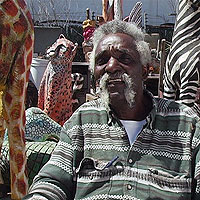
In a West Oakland lot at 2205 Magnolia, just off West Grand, sculpture artist John Abduljaami lets the wood be his guide. He’s there almost every day working from 9am to 5pm. Sometimes he sees a bird. Other times it’s a dog, a cowboy on horseback, a rat or a walrus. “Then I start drawing with the chainsaw,” Abduljaami tells Spark.

Abduljaami’s fascination with wood began when he was a child. Living in a makeshift home that he describes as a shanty, Abduljaami’s family depended on a wood-burning stove and heater for cooking and warmth. His father regularly toted wood home at the end of the day. By the time Abduljaami was 11, he was sneaking the family’s best butcher knife to carve his figures, much to his mother’s consternation. Later, Abduljaami had a job cutting wood, which was where he learned how to use a chainsaw.

“A chainsaw is like getting on a jet plane — something that would normally take three or four days to get there, and you get there with seven or eight minutes with a chainsaw,” Abduljaami says of his primary tool.

A prolific artist who dreams of building a legacy through the wood sculptures he leaves behind, Abduljaami estimates he has produced 500 pieces thus far. If he had his druthers, he would produce a new piece each day. Along with a chainsaw, he uses such tools as an adze, a hammer and a chisel. He often turns to photographs and images of his subjects to guide him while he carves, cuts and shapes the wood before him. While some pieces are delicately rendered birds and jackalopes, others — like his 2,600-pound walrus complete with wrinkly, cracked skin — are much larger in scale. Carving the two-ton walrus meant starting with a 3,500-pound chunk of wood that had to be moved with a forklift.

Pulling distinct figures from anonymous chunks of wood may not yield fame and fortune for John Abduljaami during his lifetime, but being remembered years from now is much more important to this artist. He says, “I want to be here more than 100 years. That is why I am doing all this wood sculpturing, so my name will be here — although I am poor and broke and don’t have anything, I will be one of the rich people then because my name will be in books somewhere.”

Abduljaami’s work can be seen by appointment by calling (510) 967-8816.

  • Array

Bruce Beasley

Since the mid 1960s veteran Bay Area artist Bruce Beasley has remained at the forefront of modern sculpture. Beasley’s large-scale geometric pieces articulate a powerful visual language that has won the artist critical acclaim and sustained a career that has spanned over four decades. Spark visits Beasley at his West Oakland studio to catch a glimpse of this sculptor at work.

Beasley’s work enjoyed critical success from a very early point. In 1962, when the artist was only 22 years old, the Museum of Modern Art in New York acquired one of his sculptures, making him the youngest artist ever to have his or her work in the museum’s collection. But despite this early success, Beasley has continued to challenge himself, experimenting with new materials and forms.

While his early pieces were executed in cast aluminum, in the late 1960s, Beasley began experimenting with molded transparent acrylic. Since he was working with a relatively new material, largely unexplored by artists, Beasley began research on the substance, eventually discovering new techniques for working with the medium. He developed a casting technique that was eventually adopted by NASA in the development of the first acrylic undersea submersible.

With each new material, Beasley strives to find forms appropriate to his new medium. As he began working with cast bronze, the fluid organic forms characteristic of the acrylic pieces gave way to intersecting geometric volumes. Beasley now designs his sculptures on a computer, planning, rotating and moving sculptural elements until he finds the right composition. Beasley’s computer model is then reduced to a pattern with which to make accurate cuts into sheet metal.

Throughout his career, Beasley has been guided by organic forms readily found in nature. His extensive collection of animal skulls has been an unending source of inspiration and instruction, outlining elegant forms, transitions, and textures. The bones provide a basis for all his sculpture, suggesting a set of solutions to formal problems.

Born in Los Angles. Bruce Beasley attended Dartmouth College before completing his B.A. at the University of California, Berkeley in 1962. His work can be found in museums and public collections internationally, including the Museum of Modern Art, New York, the Solomon R. Guggenheim Museum, the Djerassi Foundation, and in the collection of Kleinewefers GmbH, Krefeld, Germany. His sculpture garden is open by special appointment and available for tours by arts and cultural groups. He plans to turn this complex into a West Oakland outpost of the Oakland Museum of California after his death. This will be a home for his work as well as a resource and workspace for the sculpture community.

Array

  • Array

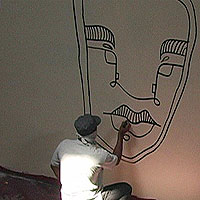
Crude

©rude is a tag artist whose mark is recognizable as an African mask, which was influenced by his research into outsider art as well as American folk art.