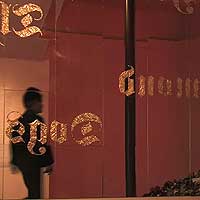
Cultures collide in the work of Julio Cesar Morales, an artist offering hisinterpretation of a post-apocalyptic city based on his experiences growingup on the border of California and Mexico. Morales’s exhibit “There’s Gonna Be Sorrow” was also influenced by the first album he ever purchased, David Bowie’s “Diamond Dogs.” Bowie’s album, which was influenced by George Orwell’s dystopian novel, “1984.” Spark catches up with Morales to chat about his installation at Galería de la Raza.
San Francisco-based Morales is a conceptual and installation artist who expresses his thoughts on labor issues and personal identity through sculpture, photography, video and other medias. In “There’s Gonna Be Sorrow” Morales employs idiosyncratic symbols to express his bi-cultural identity, fusing elements of traditional Mexican culture with contemporary, technology-infused aspects.
Born in Tijuana, Mexico, Julio Cesar Morales studied new genres at the San Francisco Art institute. An artist, educator and curator, Morales founded San Francisco gallery Queen’s Nails Annex and has exhibited throughout the world. He has received awards from The Rockefeller Foundation, The Arts Council, The Fleishhacker Foundation, and The Creative Work Fund.
A dirty kitchen, a motionless man watching a flock of birds taking flight, a woman disappearing around the corner of a motel building — these are the kinds of seemingly mundane scenes photographer Henry Wessel has been capturing since the 1960s. But under his careful hand and watchful eye, these scenes are transformed into unique and unforgettable images of life in the American West, and in California in particular, that led the San Francisco Museum of Modern Art to launch a major retrospective of Wessel’s work in 2007.
“He’s a photographer’s photographer — a craftsman of the highest caliber,” says Corey Keller, an associate curator of photography at the SF MOMA.
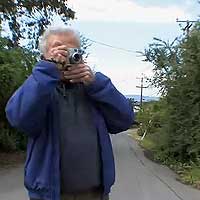
Indeed, Wessel — who is one of the Bay Area’s most respected artists — is often credited with changing the art world’s perspective on landscape photography. Wessel began traveling around the country taking pictures in 1967 and was immediately drawn to the quality of light in California. Shortly after, he moved to the Golden State, so that he could photograph year-round. Spark takes a walk with him and his camera.
“It can happen anytime, anywhere. I mean, you don’t have to be in front of stuff that’s going to make a good photograph. It’s possible anywhere,” says Wessel, whose process involves finding intrigue in everything.
A prolific photographer who works mostly in black and white using a manual camera, Wessel prints hundreds of contact sheets each year and stores them in his studio. Years later, after he has had time to distance himself from the images, he will sift through them, looking for the special ones that catch his eye.
“You’re suddenly seeing the coherence and the interconnectedness of everything, left to right, top to bottom, front to back. It’s all connected, and, somehow, it’s all in balance. And that’s, of course, when you go, ‘Yes!'” says Wessel.
Born in 1942 and raised in New Jersey, Henry Wessel earned a B.A. in psychology from Pennsylvania State University and an M.F.A. in photography from the State University of New York. He is the recipient of three National Endowment for the Arts fellowships and two Guggenheim fellowships. Wessel has been living in Point Richmond since the early 1970s and is a resident faculty member of the San Francisco Art Institute.
After looking at Mitra Fabian‘s work, it’s not surprising to learn that she got her start fabricating sculpture for the HBO series “Six Feet Under.” She works with everyday materials creating forms that mimic or hint at organic growths. Often resembling organs or tumors, these “growths” are seductively grotesque, tactile, beautiful and playful.
Her impeccably clean studio is full of small, seemingly medical instruments, looking more like a doctor’s office than a typical artist’s studio. Working in a pseudo-scientific manner, Fabian painstakingly pieces individual lengths of tape together to create bulbous forms reminiscent of growths or cancerous mutations. She finds her labor-intensive process to be deeply meditative.
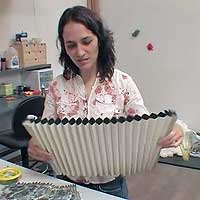
Spark checks in with Fabian as she creates “Multiplicity” and “Ventilate” for an exhibition at the San Jose Institute for Contemporary Art. The former resembles hatched insect eggs and is composed of casts made of white glue. The latter is a sculptural experiment made from window blinds, and it highlights Fabian’s signature awareness of how materials relate to the human body.
Fabian aims to shift the way viewers relate to common materials, giving them a new understanding of what those materials can do. Her fascination with mysterious biological forms is a reflection of her personal relationship with loved ones who have battled cancer. Although she doesn’t intend for every viewer to connect on this level, her work does evoke an eerie sense of isolation and contemplation.
Los Angeles native Mitra Fabian earned an M.F.A. in sculpture from California State University, Northridge. She teaches sculpture at Sacramento City College during the week and returns to her art studio in San Jose on weekends. Her work has been exhibited internationally.
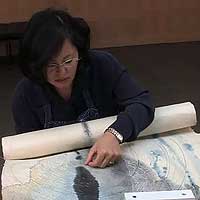
For Lucy Arai, communication has very little to do with words. In fact, the mixed media artist learned “sashiko,” traditional Japanese embroidery that appears throughout her body of work, without speaking at all. Spark tags along with Arai as she installs a commissioned piece and demonstrates her craft at the Asian Art Museum.
The daughter of a Japanese mother and a European American father, Arai struggled to reconcile her bicultural heritage with her own identity while she was growing up in the 1960s. In 1971, her parents sent her to Tokyo to experience her mother’s native culture firsthand. While there, she lived with her aunt and uncle, neither of whom spoke English — and Arai spoke no Japanese. So instead of communicating with words, Arai and her uncle began interacting through art as he taught her sashiko.
“He would see me make a mistake, and without blinking, without taking his eyes off the TV, he would take it out of my hand, take the stitching out, give it back to me, and I would have to figure out what I did wrong,” Arai says. “That’s how I learned, figuring it out on my own without the benefit of language.”
More than three decades later, Arai’s work continues to carry on its own wordless conversation. White and gray silk threads neatly march across handmade paper painted with sumi ink and indigo cotton dye. The rich black brush strokes of the ink create an unspoken exchange, a kind of aesthetic tension with the concentric circles stitched ever so carefully upon the paper’s surface.
In recent years, Arai has added gold leaf detailing to the conversation. Finished works often have forms reminiscent of Japanese landscape paintings, calligraphy and the natural world, though Arai, who has been known to stitch upwards of 18 hours a day, says she only discovers those resemblances after completing a work.
“I don’t have in mind that the work has anything narrative about it, and I don’t have anything specific in mind when I’m working. I look at my response and what’s going on with pigments mostly as gesture and formal elements, and it’s only after the fact that I see things that suggest landscape or narrative,” she explains.
Lucy Arai earned a B.F.A. in ceramics, an M.F.A. and a graduate certificate of museum practices from the University of Michigan. She lives with her husband in Oakley, California.
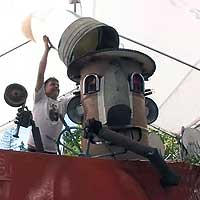
Drive into Sebastopol, a town of about 7,800 people located 50 miles north of San Francisco, and you won’t be greeted with the sort of welcome plaque commonly posted at the entrances of so many small towns. Instead, you’ll meet the “Star Caster,” a fanciful fisherman created by artist Patrick Amiot using more than 1,000 can lids and other cast-offs. Another 170 of his sculptures are scattered up and down the town’s streets. On Florence Avenue, where Amiot lives, at least 25 sculptures are on display, many on neighbors’ lawns.
There’s “Surfer Girl,” who rides an ironing board across a wave made from a Volkswagen car hood, and the “Garden Lady,” whose floppy hat gives new life to a battered washtub. And who could miss the “Zucchini Brothers,” a three-man juggling act reaching high into the air?
“When I do a project, I never know where it’s going to lead me. It all has to do with what kind of junk I’ll find,” Amiot tells Spark as he goes to work on a sculpture for Sebastopol’s annual Apple Blossom Parade.
Amiot is nothing if not prolific. His yard is littered with the fruits of his labors and with fodder for many more. The raw materials for his work come from any number of sources: junkyards, flea markets, locals who barter old car parts and other cast-offs. Many donate their junk to Amiot instead of throwing it away. Once a ceramicist living in Montreal, Amiot became known for his junk art sculptures after a months-long cross-country road trip that landed the artist and his family in this Northern California town in 1997.
“The way it started was that I had this desire to do something other than my clay, so I decided to make this giant fisherman. I just put it right in front of the house and figured, well, if there was a city ordinance that tells me to take it away, that’ll be fine. To my amazement, people actually enjoyed looking at it. People slowed down and waved. So that was the beginning, and then came another one, and they eventually started to go onto other people’s front yards — on my street, of course — and then after six months I sold my first one,” he says.
Today, Amiot’s body of work includes the junk sculptures for which he is best known as well as ceramics and pop rivet sculptures made of metal pieces, which are painted by his wife, Brigitte Laurent. For Amiot and his family, the art literally spilling out of their home and throughout Sebastopol is about much more than art for art’s sake. Amiot sums it all up perfectly: “What it says is, ‘Welcome to our humble, but whimsical, fun, recycled, conscientious community.”
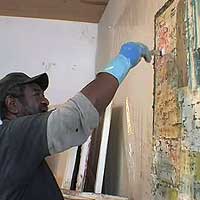
As a successful blues man, Mike Henderson has performed widely and released several albums. As a painter, Henderson’s work has been exhibited across the country. And as if that weren’t impressive enough, he’s also an accomplished filmmaker. Spark visits Henderson in his San Leandro home studio as he jams on the guitar and creates a new series of paintings for the Haines Gallery.
As a young artist and musician in the mid-1960s, Henderson entrenched himself in the political rallies of the era. Inspired by these events, his artwork leaned toward the figurative, but after a fire destroyed many of his unsold paintings in 1985, he began to create increasingly more abstract pieces.
His oil work today is characterized by large brush strokes, spread and layered thick, then scraped away, leaving bold panes of color that many times reflect his visual interpretation of music. “I started painting these thoughts I had about music, using this big red, like Ray Charles screaming or an Albert King lick.”
Born in the small farming town of Marshall, Missouri, in 1944, Mike Henderson was supposed to work in the local factory with his father. But his passion for art led him across the country to one of the first integrated art schools in the United States, the San Francisco Art Institute. He earned a B.F.A. in 1969 and an M.F.A. in 1970. Henderson has been teaching art and art history at the University of California at Davis ever since, and he is considered a prominent figure among the second generation of Bay Area abstract painters.
June Schwarcz did not set out to become a legend. In fact, the enamel artist first encountered the medium for which she would become famous on a lark. She was introduced to it by some friends who were taking enameling classes at the Denver Art Museum in 1954.
Fascinated by the complexities of enameling, a process in which glass fuses to metal when fired at high temperatures, Schwarcz began experimenting and was soon breaking new ground by enameling electroplated gold, silver and copper forms. Since then her work has garnered enough attention for the California State Assembly to pass an official resolution recognizing Schwarcz as a Living Treasure of California.
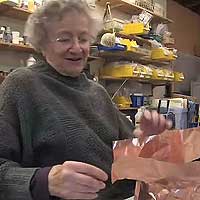
Over the decades that she has been creating enamel pieces, Schwarcz’s bowls and abstract vessels have come to be synonymous with the medium itself. Working from her Sausalito home studio, Schwarcz begins her process with a three dimensional maquette made out of paper. Next, she builds the vessel using thin copper sheets or metal mesh. She then has the form electroplated to render it sturdy enough to undergo the enameling process. Finally, she carefully applies enamel.
“I’m very drawn to subtle colorations and the quality of light, maybe because I live with a lot of fog — or maybe I like light behind a little bit of obscurity. Lots of people wish I’d do brighter, stronger things, but by now I figure, ‘I’m old and I can do what I want,'” she tells Spark with her characteristic chutzpah.
In January 2007, June Schwarcz, along with artists Bill Helwig and Bill Harper, was selected to exhibit at the Long Beach Museum in the first major retrospective of American enamel art held in the United States since 1959. Her work is held in the permanent collections of premier art institutions, including the de Young Museum, the Museum of Arts and Design in New York, the Metropolitan Museum in New York, the Museum of Fine Arts in Boston, and many others.
As Silicon Valley’s next-door neighbor, San Jose is often considered prime stomping grounds for techies and corporate desk jockeys — not necessarily the sort of place one would expect to find a burgeoning underground art movement. But in 2001, a program called Phantom Galleries began filling empty downtown storefronts with the work of local artists, and San Jose has since become one of the Bay Area’s most art-friendly cities.
One of the most recent venues to open as part of the Phantom Galleries program is the Kaleid art gallery. This once-empty space in a downtown parking garage now shows the work of 60 local artists and holds a monthly reception for featured artists during the city’s ongoing South First Fridays Gallery Walk. This provides artists in and around San Jose with an opportunity to exhibit and sell their work close to home. Spark visits with two of these artists while they prepare for an exhibit at Kaleid.
Longtime South Bay artist and educator Charlotte Kruk N’Kempken’s dresses and capes made from thousands of candy wrappers may have yielded cease and desist letters from candy corporations over the years, but her intricately tailored designs have also won her myriad fans. “It sort of seemed to work for me to express some ideas that I had — kind of looking at our society and the way that we package everything and the way that we package ourselves to present ourselves to society,” Kruk N’Kempken says of her art.
Ema Harris-Sintamarian, a recent transplant to the Bay Area from Romania, works with another kind of recycled material — ideas. Inspired by magazine advertisements and popular culture, Sintamarian employs a variety of techniques, ranging from graffiti to architectural composition, to create larger-than-life drawings that are narrative and imbued with dreamlike fantasy.
“We were really pegged as software companies and a bunch of techies who stayed in our cubicles from 9 a.m. to 9 p.m., but the truth is that a lot of these people who work in those corporations are also artists,” says designer Cherri Lakey, one of the founders of Phantom Galleries.
Kaleid and the Phantom Galleries program are produced by Two Fish Design in partnership with the San Jose Downtown Association and the San Jose Redevelopment Agency. The South First Fridays Gallery Walk also includes Anno Domini, GreenRice Gallery, MACLA, San Jose Institute of Contemporary Art, San Jose Museum of Quilts & Textiles, Works San Jose and various other Phantom Galleries’ locations.
For Seyed Alavi, creating objects and asking questions are equally important in his art-making process. For nearly two decades, the Bay Area artist has been working with public institutions to create conceptual works of art to be experienced by passersby. Spark follows Alavi as he offers a guided tour of his art and working process.
Though Alavi produces tangible objects, he thinks of himself as a conceptual artist, that is, the ideas behind his works are centralized over the finished object. Whereas many artists choose to master a specific medium and explore multiple subjects through it, Alavi works in several media. He develops a concept, plans the work for a specific location, then outsources the actual fabrication of the piece.
Alavi has created some of his most penetrating works with the help of high school students. His first such project was a series of text pieces painted under the overpasses of Interstate 580 in Oakland. Collaborating with a group of students from the region, he helped them to develop wordplays that would cause those who viewed them to think about the topics raised. Stenciled in capitalized serif fonts, the murals provocatively announce “INVISIBLE COLORS,” “INFORM(N)ATION,” and “D FFERENCE,” the last suggesting that one needs to include his or her “I” to make the “difference.”
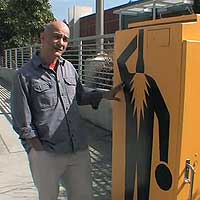
Another project done in collaboration with students is a series of variations on the ubiquitous schematized human figures found on street signs. Together with a team of students, Alavi came up with 17 surreal alterations of the figures. They then painted their versions onto utility boxes scattered throughout the town of Emeryville, Calif., in order to raise questions about the nature of human identity, interaction and existence.
Spark also trails Alavi to San Francisco’s Exploratorium, where he and four other artists have been invited to create installations in the museum’s space based on the notion of “liminality,” the condition of being between states. Alavi’s concept provides the physical challenge of closing off the skylights in the Exploratorium’s massive space so that he can program the illumination of lights clustered in a ball high above visitors. As museumgoers move in and around the space, their relationship to the moving lights continually changes, thereby making them aware of their constant state of liminal perception.
Seyed Alavi earned a B.S. from San Jose State University and an M.F.A. from the San Francisco Art Institute. He has created site-specific installations for locations in New York, Long Beach and the Bay Area. He has taught classes and workshops at the San Francisco Art Institute, the California College of the Arts, San Francisco State University and the University of California at Davis.
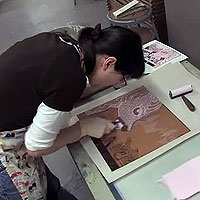
Kathy Aoki describes herself as a sneaky feminist. Teddy bears, butterflies and cherub-faced girls populate the prints and sculptures in her latest series, “Modern Girlhood.” But while the seemingly innocent and cartoon-like characters in her work wear exuberant smiles, sinister things are happening all around. Bulldozers mow down stuffed animals. A giant tube of lip gloss becomes the latest civic monument added to an otherwise pristine outdoor landscape.
“The work I make is showing this messed-up system that’s perpetuated by the media that makes girls want to conform and buy into this cuteness,” Aoki explains when Spark visits her Santa Clara studio while she prepares for a solo exhibition at the LMAN gallery in Los Angeles. And although her message is a bold one, Aoki’s use of anime-inspired images and candy colors yields results that are more likely to provoke conversation than arguments.
The ideas for Aoki’s linoleum cut prints and installation pieces have their roots in both the past and the present. The daughter of two Yale-educated doctors, Aoki recalls how her own mother struggled with being a female in a male-dominated profession. But she also finds inspiration from current-day phenomena, like the Cartoon Network’s popular “Powerpuff Girls” television show and everyday representations of women in magazines and the media.
“I try to use humor and pattern and color, things that will attract an audience that might not necessarily want to stick around for strong feminist messages. I have a hard time myself looking at angry feminist work, and I feel it often puts a wall between the artist and the viewer,” she says.
After studying French at the University of California at Berkeley, Aoki earned an M.F.A. in printmaking from Washington University in St. Louis, Mo. She has received numerous fellowships and awards, including the San Francisco Arts Commission’s Public Art Award for her 2004 Market Street kiosk poster series depicting super heroes performing random acts of kindness. Her work appears in the permanent collections of the San Francisco Museum of Modern Art, Harvard University Art Museums, the New York Public Library and many others. She is currently an assistant professor in studio and computer art at Santa Clara University.
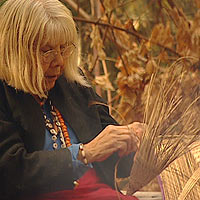
For Julia Parker, weaving baskets connects her to the lives and traditions of her ancestors, telling the story of a people that for more than 4,000 years populated villages throughout the Yosemite Valley. In the Spark episode ” Legacies,” Parker guides viewers through the area where her village had once been as she explains the traditional process of making her baskets.
Born in 1929 in Sonoma County of the Coast Miwok and Kashaya Pomo peoples of the Yosemite, Parker moved to the Yosemite Valley in 1949 to live in the village of her husband, of Miwok Paiute descent. As a young woman, Parker was compelled to learn everything she could about the old ways of basket weaving. She studied basketry with the elders of her village, including her husband’s grandmother Lucy Telles. Telles was a highly innovative and celebrated weaver, whose masterpiece — a colossal 3-foot-by-19-inch storage basket — is now on display at the Yosemite Museum. Parker remained in her husband’s Yosemite Valley village until 1969, when the government bulldozed the region to make way for campsites.
Concerned that these ancient methods of making baskets would die out with the weavers of Telles’s generation, Parker dedicated her life to passing on the knowledge and skills she’d gained. Since 1960, Parker has demonstrated basket weaving behind Yosemite’s Indian Museum, in the same spot where Telles used to weave and sell her baskets and beadwork to tourists. She graciously answers visitors’ questions in an effort to share her culture with others.
Parker is an innovator in her own right, with samples of her work in the Smithsonian Institution and in the collection of the Queen of England. Her baskets demonstrate a staggering complexity of design, that is unparalleled in the work of her colleagues. She makes every one of her baskets by first collecting the needed grasses and sticks, then treating them with moisture and heat in order to make them supple. She also prepares the dyes from natural materials. And since there are no established patterns for different types of baskets, the entire design of the basket has to be formed in Parker’s mind before she begins weaving. The process is slow and labor-intensive, which means that a single basket can take several months, sometimes well over a year to complete.
Parker, now in her 70s, has inspired her daughter Lucy Parker and granddaughter Ursula Jones to continue making traditional basketry. Spark follows Parker and her family as they make the 350-mile journey to see the work of their ancestors at the Phoebe A. Hearst Museum of Anthropology at UC Berkeley, which houses approximately 9,000 baskets.
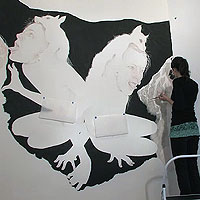
San Francisco artist Josephine Taylor makes large-scale drawings in pencil and ink. Her work is narrative and is related to being in the dream state and recalling childhood memories. Spark visits Taylor in her studio to see the process behind her imagery.
Taylor earned a B.A. in religious studies and East Indian translation languages from the University of Colorado and an M.F.A. in painting from the San Francisco Art Institute. She was awarded a residency at the Headlands Center for the Arts and a SFMOMA SECA Award in 2004.
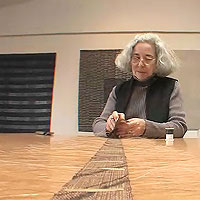
Without ponies and parties, textile artist Adela Akers would not be able to produce the intricately woven wall hangings she has become known for over the last decade. She weaves horsehair imported from China and hundreds of recycled metal foil strips made from the tops of wine bottles into her painstakingly detailed pieces. Spark visits Akers in Sonoma County in a converted apple warehouse that she uses as a studio.
Born in Santiago de Compostela, Spain, in 1933, Akers became interested in weaving and textile art only after studying pharmacy at the University of Havana and working as a biochemist. In her late 20s, her burgeoning interest in tapestries brought her to the United States to study weaving at the Art Institute of Chicago and the Cranbrook Academy of Art. Akers was a weaver-in-residence at Penland School of Crafts, and she taught for more than two decades at Temple University’s Tyler School of Art. In 1995, Akers relocated to Northern California with her husband.
Earlier in her career, greatly influenced by the abstract expressionism movement of the 1950s, Akers became known for her large textile works that incorporated folds and curves created through weaving techniques, like pulling warp. But in recent years, the striking detail in Akers’s wall hangings comes not from the linen pieces at the foundation of her works, but from the horsehair and foil strips sewn, painted and otherwise adhered to them. To Akers, the geometric lines and repeated metal strips suggest language, communication and ideas revealed through abstract forms.
“I started doing the stitching — the first pieces using the metal were about memorials, so the stitching became like a name or a word,” Akers says. “The metal adds another layer, another dimension of the work. The fact that I use the hair, it becomes like a veil and the metal shines through.”
Her work can be found in the collections of the Smithsonian Institution, the Metropolitan Museum of Art, and the Museum of Art and Design, as well as in many private collections.
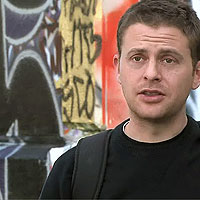
Adam5100 has been working with a spray can since his days as a teenage graffiti writer living in Albuquerque, New Mexico. Confessing that his early tagging was “the blight of society,” Adam5100 has since become one of the Bay Area’s most talented young painters. Spark joins the artist as he prepares for an exhibition at the White Walls Gallery by “layering the stencils of life.”
When Adam5100 reached his early 20s, he realized that he could accomplish more complex graffiti pieces, including large-scale images of faces and hands, in the same amount of time it took him to spray-paint a tag. In 2000, after abandoning tagging as a street activity, Adam5100 relocated to San Francisco and began training at the California College of the Arts. Positioning himself in the discipline of painting and printmaking, he realized that his prior graffiti work had a place in the world of fine art. He has stated that it was his exposure to painting, printmaking and fine art photography that was the impetus for his journey toward his current art practice. Placing his work squarely between these three disciplines, Adam5100 has taken on the challenging and complex issue of the urban landscape.
Feeling more at home in the hidden places than in the public, Adam5100 often explores the back alleys, forgotten streets and forbidden rooftops of the East Bay, photographing spaces as reference for new paintings. The importance of his private journeys are evident in each painting, each of which intimately reveals the forgotten elements of society and the struggle to find a sense of place. By shifting gallery goers’ attention to the forgotten spaces of urban centers, his work sheds light on parts of a city most would not see while retaining the subversive mischief of a graffiti artist.
Holding steady to his street sense of humor, Adam5100 often invents contemporary narratives in his work, a kind of fake pop culture similar to cheap tabloid news. His painting of baseball legend Nolan Ryan’s house and another of an Italian soccer fan leaving the scene of a crime are prime examples of how Adam5100 plays with humor, history and consumer culture.
Adam5100 pays homage to his graffiti contemporaries by using layers of hand-cut stencils to create layers of value. Making a stencil painting is a laborious process, requiring intense dedication and an enormous amount of time, all to create elements that remain hidden from the viewer. Twelve or more complex stencils are painstakingly cut for different values and colors of the painting; the end result endows the final piece with the illusion of three dimensions. Although stencils have been used for thousands of years as a means to reproduce images, Adam5100 turns the process on its side by integrating so many of his stencils into one single piece. In this respect, the work is much more closely related to the quick delivery of graffiti writing than fine art printmaking, in which the edition is the revered method of production.