Category Archives: Visual Arts

Kerry James Marshall

Chicago-based artist Kerry James Marshall’s large-scale artworks participate in the tradition of history painting — larger-than-life depictions of historical events. But whereas traditionally, history paintings have often relayed official accounts of nationhood, Marshall uses his work to bring untold history and counter-histories to light. Spark visits with Marshall as he works with San Francisco’s Precita Eyes muralists in creating Visible Means of Support, two specially commissioned murals for SFMOMA’s Haas Atrium.

Marshall’s sense of social responsibility guides his depictions of African American figures often absent in art institutions. His museum pieces place African Americans front and center in an array of situations that range from idyllic romantic scenarios to scenes of leaders from key historical events, like the Civil Rights Movement. The idea is to present African Americans in the full range of human experience.

Often emphatically depicted in deep shades of black, Marshall’s figures stand in stark contrast to their surroundings. These renderings have been controversial for some, but for Marshall, the decision to portray his figures in this manner is both aesthetic and political. Their absolute blackness lends a pictorial power that demands the viewer pay attention to them.

In this sense, the two murals at SFMOMA are a departure from Marshall’s usual style. The two enormous panels, each measuring 27 by 32 feet, represent what on the surface appear to be standard depictions of American history: Mount Vernon and Monticello, the estates of George Washington and Thomas Jefferson, respectively. Marshall’s usual strategy of dramatically announcing his African American figures is missing from these murals. At first glance, the large anamorphic renderings of Washington and Jefferson are the only figures one sees.

Upon closer examination, it becomes clear that Marshall has employed visual trickery to embed a series of figures in the scene — images of the African American slaves that supported these plantations. They aren’t apparent immediately, but as one looks more closely, they emerge everywhere: in the trees, the sky, the flowers, the fields, the water, and even subtler, more hidden places: In one section, Marshall has included connect-the-dot images that form African American figures, and even the dots themselves are small icons of African American heads.

To accomplish this optical trickery, Marshall has borrowed a visual language from preschool activity books — at once universally recognized and entirely unusual for history painting. The flat, un-modulated colors and heavy outlines suggest children’s coloring books, as do the connect-the-dot figures and hidden imagery that populate the murals. It’s an invitation with a simple message: Engage with this history — it’s open, it’s not difficult, it can even be fun.

Kerry James Marshall was educated at the Otis Art Institute in Los Angeles, where he earned a B.F.A. In 1999, the institute awarded him an honorary doctorate. Marshall has shown his work at several international venues, including the 2007 and 1997 editions of Documenta, the 2003 Venice Biennale, the 1999/2000 Carnegie International and the 1997 Whitney Biennial. Among the many honors he has received are a MacArthur Fellowship, a National Endowment for the Arts Visual Arts Fellowship, a Wexner Center Residency Award and a Skowhegan Medal for Painting. Marshall’s work is represented in major private and museum collections throughout the world, including the Koplin del Rio Gallery, Culver City; the Jack Shainman Gallery, New York City; the Los Angeles County Museum of Art; the Museum of Modern Art, New York City; the Walker Art Center, Minneapolis; and the Whitney Museum of American Art, New York.

Array

  • Array
  • Array
  • Array

Contemporary Jewish Museum

In any given year, spring would be an appropriate season for an art institution to explore Passover themes. But the Contemporary Jewish Museum exhibit New Works/Old Story: 80 Artists at the Passover Table comes during an especially fitting year. As the San Francisco museum’s invitational exhibition showcases artists’ interpretations of the seder plate used during Passover, a holiday with history and retelling at its core, the museum itself is both looking to its future and reflecting on its past.

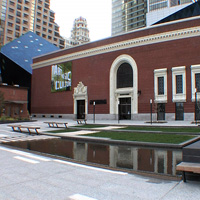
In June 2008, after nearly a decade of planning and construction, the Contemporary Jewish Museum settled into its new home, a Daniel Libeskind-designed adaptation of the landmark Jessie Street Power Substation. Noted for its striking blue steel façade, the redesigned historic building, on Jessie Square in San Francisco’s SoMa neighborhood, provides more than 10,000 square feet for the museum’s exhibition space, education center, store and café.

The institution celebrates its 25th anniversary in 2009. With its quarter-century history and long-awaited new home both squarely in the spotlight, the museum devotes its 2009 Dorothy Saxe Invitational to the central object in one of Judaism’s most widely celebrated holidays. Key to the ceremony, but without religious guidelines regulating its form, the seder plate, which is used to hold the traditional foods served on the first night of the eight-night holiday commemorating the Israelites’ exodus from Egypt, lends itself to a particularly wide variety of artistic interpretations.

Not surprisingly, the seder plates created for the exhibition range from traditional versions to conceptual objects, from the irreverent to straightforward displays of craftsmanship. A hand-carved limestone and brass serving plate by Amy Klein Reichert looks like it could be part of a real seder meal; a plate constructed of pencils and office supplies by Grace Hawthorne and Phoebe Streblow of Readymade magazine plays with the idea of everyday objects in a ceremonial space. Artist Gay Outlaw’s stackable paper plates reference the simplicity and haste associated with the first Passover meal, and Harriete Estel Berman’s ornate metal plate abounds with symbolic imagery from Jewish history.

Spark gets a closer look at this show. Taken together, the many objects on display during this juried exhibition combine to educate onlookers about Judaism’s past while raising questions about its present and future — not unlike the holiday itself.

  • Array
  • Array
  • Array
  • Array

Katherine Westerhout

Instead of glamorous hotspots, famous faces and iconic structures, Oakland-based photographer Katherine Westerhout prefers just the opposite. Rather than the latest and greatest venues du jour and the throngs that flock to them, Westerhout has built a career on creating large-scale images which capture the empty places long since forgotten by the general public — including abandoned hospitals, churches, and theaters.

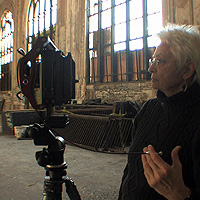
“I’ve been photographing in abandoned buildings for about 12 years now, and what I am so drawn to is the way the light enters these buildings and the way it carries color, from the outside, depending on the time of day,” Westerhout explains to Spark during a photo shoot at the train depot at 16th and Wood streets in West Oakland.

Using only available light, Westerhout prefers to work from October to April, when the sun is closest to the horizon. She is attracted to subjects like the deteriorating station, which is a 1912 Beaux Arts gem and historical landmark, for the sense of mystery that accompanies the absence of human sound and movement. At the same time, Westerhout uses her photography to preserve a part of history that would otherwise be erased as new buildings and developments arrive to replace the old.

“The train station itself has a special feeling because of its history, because of its inherent beauty. But I also grew up in Oakland. And so the opportunity to photograph here, it feels like I’m giving a little back to my city and helping to preserve it,” she says.

Westerhout earned a B.A. in art from San Francisco State University and has been exhibiting her photographs since the late 1990s. Her work has appeared in shows in the United States and internationally, at such venues as New York’s Sepia International Gallery, the San Francisco Museum of Modern Art Artists Gallery, the Oakland Museum of California, the San Jose Museum of Contemporary Art, the Berkeley Art Center, the Michael Hoppen Gallery (London, England) and the Biblioteca Nacional (Havana, Cuba).

More about the 16th Street Station:
West Oakland’s 16th Street Train Station is an important historic and cultural landmark. Built in 1912 at the terminus of the Transcontinental Railroad, for decades the station served as a beacon of hope for European immigrants and American migrants seeking a better life in California. Designed by Chicago architect Jarvis Hunt in the Beaux Arts style, the station boasted an intermodal transportation system ahead of its time — cross-country travelers could arrive on Southern Pacific trains and transfer to streetcars that would take them to destinations throughout the Bay Area.

The train station was abandoned after damage from 1989 Loma Prieta earthquake rendered it unsafe. Since then it’s fallen victim to vandals, the elements, and general neglect. Originally purchased in 2000 by Holliday Development, plans for restoration and redevelopment of the station (now known as Central Station) are currently being spearheaded by Oakland developer Phil Tagami. Once plans and funding sources have been finalized, Central Station will operate as a nonprofit community center, alongside parks, shops and new homes in the 29-acre area.

  • Array
  • Array

Ron Nagle

Master ceramicist and singer-songwriter Ron Nagle claims to have little patience. But to anyone familiar with the painstakingly rendered, diminutive forms he has become best known for over the last three decades, impatience seems an unlikely quality to ascribe the San Francisco artist.

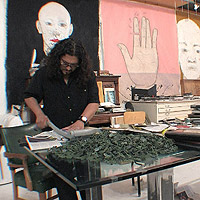
“Yes, it does take an amazing amount of patience, which, if you ask anybody — particularly my wife — I have none of. Except when I’m in here,” Nagle says as he works in his studio.

Nagle apprenticed with the late ceramic artist and UC Berkeley professor Peter Voulkos and was further influenced by the work of renowned ceramicist Ken Price and the Italian painter Giorgio Morandi. Nagle often applies bold colors, which are inspired by the 1950s hot rods of his youth, to his ceramic vessels and abstract forms. Achieving the deep, rich hues and painterly mingling of colors that characterize his work can require each piece to undergo firing 10 times — and often many more.

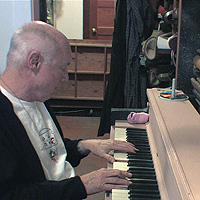
When he’s not consumed with clay, Nagle’s talents play out in an entirely different kind of studio. Since the late 1960s, Nagle has achieved steady — if under-the-radar — acclaim for his music. He has been in two different bands, the Durocs and the Mystery Trend, and has put out a solo album, Bad Rice. He also has written songs recorded by the likes of Barbra Streisand, Jefferson Airplane and the Tubes. As Spark catches up with him, Nagle is hard at work on his first new album in 30 years, with songwriting partner Scott Mathews.

And although the mediums with which Nagle works and the worlds within which he works may be separate, his goal for both is the same. “I just want to perpetuate the things that I’ve been moved by and that I love, and, in turn, I want to do something and hope that something I make will blow somebody’s mind,” he says.

A teacher at Mills College since 1978, Ron Nagle is currently the Joan Danforth Faculty Chair and head of the school’s studio art department. He is the recipient of two Mellon Grants and multiple fellowships from the National Endowment for the Arts, among other awards. His work can be found in the private collections of the San Francisco Museum of Modern Art, the Los Angeles County Museum, the Metropolitan Museum of Art in New York and the Shigaraki Museum of Contemporary Ceramic Art in Japan.

  • Array
  • Array

Wayne Thiebaud

Originally making his mark as part of the Pop Art movement of the 1960s, Wayne Thiebaud‘s careful studies of everyday objects, figures and landscapes have come to be part of the art world vernacular. Spark checks in on Thiebaud as he reflects on a career that has spanned more than seven decades.

Thiebaud began working in the commercial arts in the late 1930s, primarily as a cartoonist and designer. During World War II, he served as an artist for the U.S. Air Force. Upon his return to civilian life, he continued working as a commercial artist until enrolling in the master’s program at Sacramento State College. After earning his M.A. in 1952, Thiebaud went on to teach at Sacramento City College, eventually landing a position at the University of California, Davis.

In the 1960s, Thiebaud took a leave of absence from UC Davis to spend some time in New York, where he met abstract expressionists Willem de Kooning and Franz Kline, along with then-emerging artists Robert Rauschenberg and Jasper Johns. Impressed with their work, Thiebaud began a series of small paintings showing food displayed in windows – subject matter that he returned to again and again throughout his career. In fact, Thiebaud’s subject matter forms a kind of record of the artist’s life, as new experiences and environments brought new objects and views to represent.

Although Thiebaud may be best known for his everyday subject matter, his works are also painstaking examinations of the fundamental language of paint: light, color, space, composition and surface. Each canvas offers him an investigation of a series of formal problems. A painting of a bowl of cherries might reveal a study of varied light effects, while a San Francisco cityscape might allow him the opportunity to play with rational space.

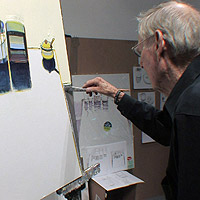
Spark visits with Thiebaud in his studio as he prepares for a traveling retrospective of his work from the past 50 years, including more than a hundred paintings. Though many of the paintings were completed years before, Thiebaud tirelessly works and reworks aspects of images that he wants to change, often building up the surfaces of his backgrounds, resolving the image, then reopening it again.

Array

  • Array
  • Array

Maya Lin

Maya Lin

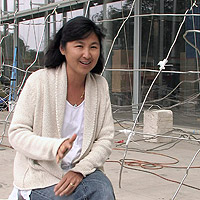
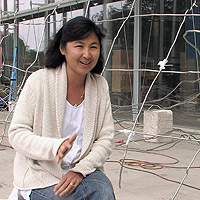
Spark follows renowned artist and architect Maya Lin as she plans, constructs, and installs her sculptural work for the California Academy of Sciences in San Francisco’s Golden Gate Park. The site-specific piece is a topographical imagining of the San Francisco Bay. It is placed on the western facade of the new building designed by Renzo Piano, which is set to open to the public in September 2008.

Lin became well known in 1981, when as a senior at Yale University, she entered the national competition to design the Vietnam Veterans Memorial in Washington DC. Her submission was selected from thousands, and her stark, non-representational design became an important landmark for a grieving nation. Since then, Lin has designed several other memorials, including the Civil Rights Memorial in Montgomery, Alabama, and the Women’s Table at Yale University.

In Lin’s recent artwork, she has explored new ways of looking at the landscape, utilizing topographical maps, sonar imaging, and other scientific data. It was this interest in the natural sciences, as well as a life-long passion for environmental conservation, that prompted Lin to respond to the call for proposals issued by the San Francisco Arts Commission and the California Academy of Sciences in 2006. This public art installation for the CAS will be the first permanent work by New York-based Lin in the City of San Francisco.

  • Array
  • Array
  • Array

Victor Cartagena

The work of visual artist Victor Cartagena defies stylistic or cultural categories. Cartagena’s installations, paintings, assemblages, and video-based work shift easily from medium to medium, while remaining resolutely provocative, causing his audience to think carefully about what are often thorny topical issues.

Cartagena left his native El Salvador in 1985 and came alone to San Francisco at the age of 19, fleeing a bloody civil war that had begun in 1980. As a result, Cartagena’s early work drew on his experiences from that terrible time of suffering, exploring memories and images from his experience of the civil war. As Cartagena’s work developed, he began to turn his eye to his adopted home and beyond, taking on several of the major issues of the 21st century.

Spark visits the Galeria de la Raza for Cartagena’s “Invisible Nation” show, which deals directly with the challenges that many immigrants face when they arrive on American shores. Several of the works in the exhibition draw on a collection of passport portraits that Cartagena acquired from a photo store in downtown San Salvador. Since the outbreak of the Salvadoran Civil War more than 25 years ago, over 2 million people have come to America from Cartagena’s native country.

Arriving as refugees, many Salvadorans became low-paid laborers. Cartagena addresses their stories in an installation called “Labor Tea,” a pun on the word “liberty.” Affixing the small photos to tea bags, the images are repeatedly dunked into teacups filled with water. As Cartagena explains, it’s a strong commentary on the back-breaking work many recent immigrants perform, which sucks as much energy as possible out of the laborers before they are replaced with others.

Cartagena’s work also relates to local issues in San Francisco’s Mission District, like homelessness and gang warfare — issues that have touched the artist directly. Cartagena’s younger brother got involved with gangs and was shot. Partly in response to this, Cartagena created “Bang Bang Toy Gun,” an installation that combines dozens of toy guns suspended from the gallery ceiling with video images of young boys shooting toy guns directly at the camera. The piece speaks to a culture of violence that the artist sees in America, which he feels is supported by the Second Amendment to the American Constitution, which guarantees the rights of citizens to bear arms. The installation draws relationships between play violence and the real life violence that is part of the everyday reality of many young people, both here and in war torn regions.

Cartagena draws on contemporary world events in his work and the manner in which he has experienced them. On the eve of the Iraq war, Cartagena was at a dinner party with friends. Despite the fact that Cartagena and his friends were concerned about the impending invasion, they did not discuss it. The experience helped crystallize an idea that the artist had been exploring in his scrapbooks, eventually leading to “Con los Ojos Vendados (With their Eyes Blindfolded).” The installation features an elegantly set table, with blindfolded faces made of bread dough served on the plates. The work evokes images of war prisoners and hostages, but also suggests American’s detachment from the war, far from the horror of the conflict.

Victor Cartagena has exhibited throughout the Bay Area at Southern Exposure, Palo Alto Cultural Center, the University Art Museum at UC Berkeley, Galeria de la Raza, New Langton Arts, Ampersand International Arts, Intersection for the Arts, Catharine Clark Gallery, Euphrat Museum, the Mission Cultural Center, MACLA/Center for Latino Arts, and the Sonoma Museum of Visual Arts, among others. Cartagena has also exhibited in New York, Philadelphia, Honolulu, Los Angeles, Mexico, Argentina, Chile, Japan, El Salvador, Spain, Belarus, Ecuador and Greece. He has served as Artist-in-Residence at ZEUM, Southern Exposure, and SF Art Commission’s WritersCorps, and has taught at New Age Academy.

Array

  • Array

Hijos del Sol

Like many immigrant children, Jose Ortiz had trouble adjusting to living in new country when his family moved the United States from Mexico when he was 11 years old. His awakening happened when a teacher noticed his artistic talents and encouraged him to start working on canvas. However, it wasn’t until Ortiz was in college that he took meaningful art classes.

Now a successful artist, Ortiz decided that other kids who needed a place to learn about art shouldn’t have wait as long as he did. So in 1992 he started Hijos del Sol, an after school program in East Salinas focusing on murals helping keep youth off the streets. All are welcome at Hijos del Sol but most of the participating youth are immigrants due to the fact that Salinas is a farming town, where migrant workers and their families have settled.

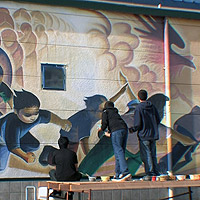
Spark follows the Hijos del Sol crew as they finish up a mural for a group called Healthy Start, which provides social services to immigrant families in East Salinas. The mural is full of vibrant colors and symbolic images. The focus is on the family and the most striking image is of a mother letting her child go so that he may soar over the fields of strawberries.

Many of Ortiz’s former students have returned to work with him and gone on to teach art. Rafael Estrada painted with Hijos del Sol at nine years old until he was in high school. He is now a teacher and recognizes the importance of passing on the knowledge and guidance that Ortiz gave him, to others.

There are now many Hijos del Sol murals around the city including ones by Ortiz’s former students. East Salinas is still struggling with its gang problems, but Ortiz keeps his eyes out for new artists to help him keep painting the walls of this community and pass on his artistic legacy.

Besides being a muralist, Jose G. Ortiz is also an illustrator, painter, and sculptor. He is the visual art director for the Alisal Center for the Fine Arts, which provides arts instruction and arts programming to East Salinas. He received the Benefactor of the Arts Award from the Cultural Council of Monterey County in 1995 and was a Distinguished Fellow for California State University Monterey Bay in 2000.

  • Array

Stephanie Syjuco

San Francisco-based conceptual artist Stephanie Syjuco believes that politically engaged art can also be fun. Often dealing with issues of globalization and outsourcing, Syjuco’s work intersects with some of the most heated debates of the 21st century but does so in a ways that are often surprising and playful. Spark checks in on Syjuco as she exhibits the “Counterfeit Crochet Project (Critique of a Political Economy)” at Yerba Buena Center for the Arts.

Much of Syjuco’s work deals with what she likes to call “improper ways of interfacing with capitalism” — bootlegs, knockoffs, and otherwise reworked commodities, taking high-tech or luxury items and remaking them as low-tech and debased. She has used simple, cheap materials like foam core, contact paper, scrap wood, and glue to make cheap, non-functional replicas of expensive consumer goods like digital cameras, cell phones, and mp3 players.

Playing on the booming black market trade of designer handbags and accessories, the “Counterfeit Crochet Project” assembles copies of these luxury items ironically — and often beautifully — rendered in the medium of crochet, a technique more closely associated with homespun creations. Syjuco began the project by creating a Web site to reach out to the crafting community and soon was able to enlist makers from all over the world to participate in her project.

Organizing and collecting the resulting works, Syjuco has presented the exhibition of the collection and associated workshops across the globe. Before the show in San Francisco, Syjuco exhibited the collection in locations across Europe and Asia, including Turkey, China, and the Philippines.

Syjuco’s process loosely mirrors that of outsourced labor, by enlisting the work of producers abroad. But while corporations outsource manufacturing in order to take advantage of cheaper means of production, the works that Syjuco elicits from her manufacturers is never offered for sale but remains the property of the people who make them. Syjuco’s exhibitions underline this aspect of the project and the workshops allow the participants to get together to work, exchange ideas, and learn to crochet these unique versions of luxury goods.

Stephanie Syjuco earned a B.F.A. from the San Francisco Art Institute and an M.F.A. from Stanford University. She has shown nationally and internationally at P.S.1 Contemporary Arts Center, the Whitney Museum of American Art, The New Museum, SFMOMA, The San Diego Museum of Contemporary Art, and The Contemporary Museum Honolulu. Her work was included in the California Biennial at the Orange County Museum of Art. She has held residencies The Atlantic Center for the Arts, Headlands Center for the Arts, KALA Art Center, Skowhegan, and the Center for Metamedia, Czech Republic.

Array

  • Array
  • Array

Fletcher Benton

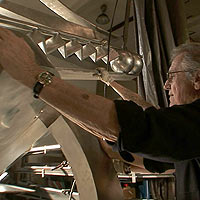
Fletcher Benton moved from a small town in Ohio to San Francisco in the late 1950s to pursue his dream of becoming a painter, yet found success as a sculptor. In the 1960s he began experimenting with kinetic sculpture, or art that moves. It was the golden age of kinetic art, and Benton’s colorful sculptures made of metal and plastic won him accolades from the art world.

In the late 1970s Benton abandoned kinetic art as quickly as he had picked it up, switching to a more traditional sculptor’s palette — bronze and steel. Today, Benton makes large-scale sculptures for private and public commissions, as well as collectors and museums. In 2008, the International Sculpture Center honors Benton with their lifetime achievement award.

Over the years, the materials and the scale of Benton’s work have radically changed, yet he has remained committed to geometric abstraction, drawing inspiration from the circle, the square, letters, and numbers. Spark visits Benton in his sculpture studio, and at the de Saisset Museum in Santa Clara during their exhibits “Flashing Back” and “Eye on the Sixties,” which feature an eclectic mix of paintings, drawings, and sculptures made in the 1960s.

  • Array
  • Array
  • Array

Mel Ramos

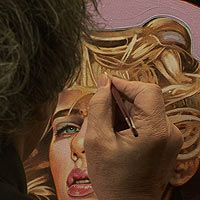
Mel Ramos began making his mark on the art world in the early 1960s as part of the Pop Art movement exhibiting alongside artists like Andy Warhol, Claes Oldenburg, and Roy Lichtenstein. The imagery of Ramos’s work is borrowed from popular culture and mass media ranging from comic book heroes and celebrities to nude women provocatively posed with over-sized mass consumed products such as soda bottles, cigarette packs, and candy bars.

Ramos was born in Sacramento in 1935 into a Portuguese-American family. At his high school’s career day, he was introduced to painter Wayne Thiebaud, who became Ramos’s mentor for the next four years. Initially, Ramos had dreamt of becoming an abstract expressionist but decided that he “wasn’t depressed enough to be a good abstract expressionist” and wanted to do “something that’s fun.” As a result, his work is humorous and teeters between eroticism, camp and classic portraiture.

Ramos divides his time between Oakland, CA and Cataluna, Spain. He works in his studio every day and has been working on a new collection of work entitled “The Lost Paintings of 1965,” as well as a sculpture series based on his paintings of the female form with large-scale commercial objects. He is represented by Modernism in San Francisco and Louis K. Meisel Gallery in New York. Spark visits Ramos as he plans a retrospective of his work with at Modernism.

  • Array
  • Array
  • Array
  • Array

Mark Fiore


View Spark segment on Mark Fiore. Original air date: February 2008. (Running Time: 8:15)


View the segment on Mark Fiore. A co-production of Spark and PBS NewsHour for This Week in Northern California. Original air date: May 2010. (Running Time: 6:59)

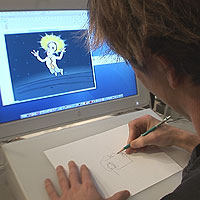
In an era where audiences prefer more comedic news sources like the Jon Stewart Show and the Colbert Report, political cartoonist Mark Fiore believes that animation gives him a bigger arsenal to both captivate and inform. His hectic production process for a two-minute cartoon consists of researching, storyboarding, creating a soundtrack, drawing caricatures, and animating — crammed into three days so that he can stay current with the latest headlines.

When selecting his subject matter, he explains, “I just go after something that makes me mad. If I can’t believe what I’m reading, those are always the best starting points for a cartoon.” Spark visits with Fiore as he creates a cartoon riffing on Hillary Clinton’s emotional moment before the 2008 New Hampshire primary, and the media frenzy that followed.

Mark Fiore began his career as a print cartoonist at the San Jose Mercury News. He left in 2001 to turn his attention to the animated realm. His cartoons appear on a variety of online news sites including SF Gate, CBS News, and Slate. He has been awarded a Robert F. Kennedy Journalism Award and has also received an Online Journalism Award from the Online News Association and the Columbia Graduate School of Journalism.

  • Array
  • Array
  • Array
  • Array
  • Array

Ann Hamilton

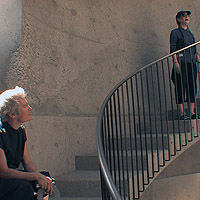
Ann Hamilton‘s eight-story tower, built on the grounds of the Oliver Ranch in Geyserville, Calif., is more than just a work of art to be observed. With its cylindrical walls, staggered windows, open ceiling and winding stairways, the space also serves as a unique venue for performance art. Spark visits with Hamilton and Meredith Monk for the unveiling of “The Tower.”

The product of almost nine years of discussion and three years of construction, Hamilton’s tower was inspired by a 16th-century Italian well that led farm animals down to water via one staircase and — because they couldn’t turn around on their own — back to the top via another. Yet unlike a well deep in the ground, Hamilton’s work rises high above the landscape.

In the structure’s center, a reflecting pool sets the stage for the two spiral staircases, which shaped like a double helix never connect or cross each other in a seemingly M.C. Escher fashion. Adding to the illusion, the 128 steps in each of the staircases get progressively narrower as they ascend.

Poured from more than 2,000 tons of concrete and sandblasted for an instant antiquing effect, “The Tower” features windows in various shapes and sizes that, much like the holes on a woodwind instrument, allow sound to escape. At the same time, these openings provide an unconventional seating schema for audiences.

“What interested me about the form of the double helix in this situation is that it means that one stairway can be a moving performance and one can be a static or moving audience. But you’re wound within each other, in the same space,” Hamilton explains.

Steve and Nancy Oliver’s 100-acre ranch has become one of the most prestigious private art preserves in the country over the last two decades. Hamilton’s tower is the 18th site-specific structure that the Olivers have commissioned on their Sonoma property.

Based in Columbus, Ohio, Ann Hamilton earned an M.F.A. in sculpture from Yale University. She was awarded a MacArthur Fellowship in 1993 and was the 1999 American representative to the Venice Biennale. She is a faculty member at the University of Ohio.

  • Array
  • Array
  • Array

Favianna Rodriguez

For more than a decade, Favianna Rodriguez has been creating posters and graphics supporting social justice movements and political activism. Carrying on the tradition of the Chicano arts movement of the 1960s and 1970s, Rodriguez is part of a new generation of artists devoted to public awareness and community involvement in grassroots causes.

A largely self-taught artist, Rodriguez learned about silk-screening in her teens by taking free art classes offered in the Fruitvale district of Oakland, where she grew up. For Rodriguez, silk-screening is an art of the people, as evidenced by its use in social and political movements throughout the last 100 years to educate and organize the masses. Along with her longtime collaborator, Jesus Barraza, Rodriguez designs posters to raise awareness on issues ranging from genetically modified foods to immigration rights to globalization.

As an activist, Rodriguez goes far beyond creating posters and other graphic work. She helped found the EastSide Arts Alliance, an organization that supports Oakland neighborhoods through arts programs and by making available performance and studio space and even a number of affordable housing units. In addition to her work with EastSide, Rodriguez is a co-owner of TUMIS, an East Oakland-based design firm that provides design, technology and communication strategy services for social justice organizations and nonprofits.

One of Rodriguez’s latest projects is the compilation of images for a book entitled “Reproduce and Revolt: Radical Images for the 21st Century.” The images, which will also be made available online, are offered for free to be used for noncommercial activist purposes. For Rodriguez, it’s a way to put powerful graphics in the hands of anyone interested in supporting progressive struggles globally.

While working as an artist-in-residence at Berkeley’s Kala Art Institute, Favianna Rodriguez put together a poster for the California Day Laborer’s conference held at San Francisco State University. Based on a series of snapshots Rodriguez took of day laborers, the image suggests the workers’ experience while conveying a sense of both struggle and dignity. Spark follows Rodriguez as she presents the poster at the conference and solicits feedback that will help her to refine the image and make it more effective.

Array

  • Array
  • Array
  • Array
  • Array