Category Archives: Visual Arts

Jim Campbell

One of the most innovative artists in the country, Jim Campbell leads the way in the use of computer technology as an art form in his customized electronic sculptures and installations.

Now living in San Francisco, the Chicago-born Campbell holds degrees in mathematics and engineering from MIT. As an electrical engineer, he possesses more than a dozen patents in image processing and high-definition television; however, as an artist, he parlays his technical expertise into the aesthetic exploration of low-resolution video displays. In the mid-1980s, he transitioned from filmmaking to interactive video installations.

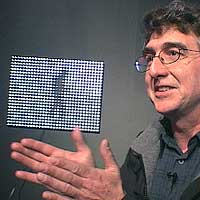
Campbell’s art consistently has probed into the questions of perception, time and memory. Much of his recent work harnesses the visual impact of LED (light emitting diode) displays, by transmitting digital video through LEDs, in order to create moving-image sculptures. But these works are not so much about an LED display as they are about the perception of a recognizable moving image through extremely low resolution and with very small amounts of information.

Spark follows the development of a series of works, in which Campbell explores the very essence of movement and information in a group of LED pieces called “Motion and Rest Studies,” which focuses on people with physical disabilities, a personal inspiration for Campbell, who grew up with parents who had physical disabilities. Sherry Petrini, one of six people featured in “Studies,” comments: “My overall feeling about it [is] that it’s a gentle rendering of a very profound human experience … a feeling of warmth and humanity.”

  • Array
  • Array
  • Array

East Palo Alto Mural Art Project

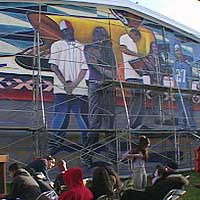
Founded in collaboration with the Boys & Girls Club of the Peninsula and the Ravenswood School District in March, 2001, the East Palo Alto Mural Art Project (EPAMAP), which began as a summer project, was created in response to the lack of teen enrichment programs and employment opportunities in East Palo Alto. Following the completion of two large murals in September 2001, and with tremendous encouragement from the community and project collaborators, EPAMAP ultimately expanded its summer program to include after-school programs which run throughout the year.

At EPAMAP, local youths are employed and trained in color theory, perspective drawing and painting. However, EPAMAP’s educational outreach does not stop at art. In addition to honing their art skills, students are also given the chance to develop research skills as they conduct directed research to assist in the design and fabrication of each mural. EPAMAP also give students the opportunity to use their mathematical capabilities as they rely on algebra, geometry, and physics to transform an artist’s sketch into a 60 foot mural. Besides providing educational enrichment, EPAMAP offers students a safe and supportive environment where they can earn money and acquire positive work experience.

In the “Next Generation” episode, Spark joins EPAMAP as they work on a mural for the Green Oaks Academy in East Palo Alto. Watch as over the course of 8 weeks, students contribute to every stage of the mural’s creation, from priming walls to voting on the mural’s design.

  • Array
  • Array
  • Array
  • Array

Ann Weber

The highs and lows of dumpster diving are all too familiar to Northern California artist Ann Weber. Whenever she runs out of her medium of choice — cardboard — Weber hunts through hulking metal trash receptacles for more. Pieces with clear packing tape or panels faded by sun make Weber’s eyes light up. “It gives a nicer bit of variety in the texture of the piece,” she explains.

Weber’s lightweight, often large-scale pieces are a significant departure from the uniform bowls and plates she once made and sold through her own fine porcelain business in New York City. After years of working with clay, Weber became frustrated with heavy materials and the seemingly endless hours she spent churning out utilitarian pieces at her potter’s wheel. Weber then discovered cardboard, an ordinary medium that presented limitless challenges and possibilities. She still creates objects inspired by forms that look as if they could have come off a potter’s wheel, but her newfound medium allows her the freedom to work on a monumental scale.

Spark captures the process Weber uses to transform abandoned cardboard into voluminous, often towering, sculptures characterized by their rounded, organic shapes. The way Weber uses cardboard in her art differs from piece to piece. She can cut the cardboard into strips and weave it into shapes or wrap sections of cardboard in a circular fashion similar to the coil method used in creating ceramic pots. She then uses polyurethane to bind the pieces together into shapes.

Weber was one of 24 California artists chosen to contribute art to a new five-building government complex in the state Capitol. To create this permanent installation, Weber faced a challenge. She had to create her sculpture using materials more durable than cardboard. With the help of the Manuel Palos studio in San Francisco, Weber was able to transform her original cardboard forms into lasting fiberglass reproductions. Now on display in Sacramento, the “Enough, Not Enough” project resembles a large basket overflowing with translucent forms and shapes.

“I wanted these forms to represent abundance,” Weber explains. “But also since the sculpture is precariously balanced, I wanted to talk about abundance or the lack of it, how some people have it and some people don’t.”

Ann Weber received a BA from Purdue University and an MFA from California College of Arts and Crafts, where she studied under Viola Frey. She has had solo exhibits across the country including at the SFMOMA Artist Gallery and Greenwich House Pottery New York City. She has created commission pieces in California and in Washington state (“Slow Life” for the Seattle Arts Commission).

  • Array
  • Array
  • Array
  • Array

Nikolas Weinstein

Nikolas Weinstein was born in New York City into a family involved in the visual arts. His aesthetic derives from a long-standing interest in the natural world. The influence of organic forms on his work dates to a young age, established during his internships at the American Museum of Natural History and the Scripps Institution of Oceanography. After moving to San Francisco, Weinstein briefly worked as a graphic designer’s assistant before founding Nikolas Weinstein Studios.

Nikolas Weinstein and the artists in the Nikolas Weinstein Studio produce glassworks for commissions, custom projects and limited editions series. The glassworks range in style, form and color, including architectural and contracting works, objects, and lighting pieces. The pieces vary greatly in size, from just a few pounds to multiple tons. The works that Nikolas produces at the studio are primarily “natural” forms that resemble the organic shapes and colors of the natural world.

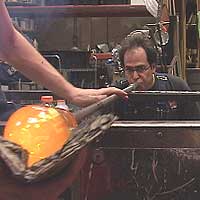
Glass is a difficult and temperamental material to work with, requiring artists to work quickly with precision under hot and dangerous circumstances. To create works of large-scale, cohesive and familiar teamwork is essential. An integral and important part of Nikolas Weinstein’s work is the collaborative teamwork of the studio. Similar in organization to historical glassmaking guilds and studios, Nikolas Weinstein Studio consists of artists of different skill levels bringing with them skills in design, fabrication, collaborative studio work and fine arts that enhance the range of the studio’s work and ability.

In the Spark “Taking Craft to the Limit” episode, we watch the artist and the studio team work on two pieces: a large architectural chandelier piece and a commissioned work of strung glass beads. The “Pariser Platz 3 Chandelier” (named after the street on which the building is located) was commissioned by renowned architect Frank Gehry to hang in the atrium of the DZ Bank in Berlin, Germany. Weighing two and half tons, the chandelier consists of 34 glass panels suspended on cables across a 2,000 square foot glass ceiling. Despite the word “chandelier” in its title, the panels are not lights, but are designed to enhance the openness of the atrium by dispersing light without obstructing the view through the glass.

Like many artists who push the boundaries of traditional materials, Weinstein continuously challenges himself to invent new processes to accomplish new ideas. For the chandelier, the studio built a custom kiln to arch the panels into the desired shapes. For the beaded piece, Weinstein created a strong armature of metal wire from which to suspend the blown glass beads. In both cases, Weinstein and the studio had to solve a myriad of technical and design problems in the execution of the works, challenging the usual fabrication methods of the material.

Nikolas Weinstein Studios
nikolas.net
Where: 1649 Valencia St., San Francisco
Phone: (415) 643-5418; studio visits are welcome, please call for an appointment.

Array

  • Array
  • Array
  • Array

David Kuraoka

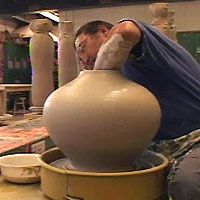
Although master ceramicist David Kuraoka lives in San Francisco, he has been named a State Living Treasure in Hawaii, where he was born and returns to several months each year. Kuraoka throws enormous pots weighing 100 pounds and more, a process that requires an extraordinary level of skill, patience and strength. Spark watches him at work in his studio at San Francisco State University, where he is a professor of art and head of the ceramics department.

  • Array
  • Array

di Rosa Preserve

Editor’s note: Rene di Rosa passed away on October 3, 2010.

Having made his fortune growing some of Napa Valley’s most sought-after grapes, Rene di Rosa transformed his Napa Valley property into an art preserve devoted solely to Bay Area art. Spark traveled along with di Rosa as he scouted galleries and studios, seeking out artists and artworks that appealed to his eclectic tastes.

Rene di Rosa was born in Boston in 1919. After graduating from Yale University and serving in the Navy, di Rosa moved to France, where he started collecting art. Today, the collection of di Rosa and his late wife, Veronica, consists of more than 2,000 works of art by more than 750 contemporary Bay Area artists.

In 1960, di Rosa purchased 460 acres in Carneros Valley near Napa. A portion of this land has been established as the di Rosa Preserve to house his art collection and serve as a wildlife refuge. The preserve includes three large galleries and a sculpture meadow that are open to the public. Migratory birds, vineyards, ancient olive trees, a 35-acre lake, a 130-year old stone winery and an extraordinary art collection amassed throughout the last four decades makes the di Rosa Preserve an unparalleled haven where art and nature share the landscape.

Reservations are required.

From the di Rosa Web site:
The art on display may not be age appropriate for all groups. Children must be under adult supervision at all times.

Array

  • Array
  • Array
  • Array

Natalie Jeremijenko

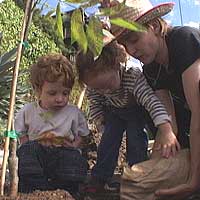
One of the hottest topics in modern science is genetic cloning. In this episode of “Art Meets Nature,” Spark trails along with artist and engineer Natalie Jeremijenko as she moves forward with her ambitious project, “OneTree(s),” a combination of art, science and nature.

A long-term project, “OneTree(s)” is a citywide enviro-social sculpture that encourages individual action and community dialogue around contemporary environmental issues. In partnership with Pond, 100 pairs of cloned trees will continue to be planted at locations throughout San Francisco. Over many decades, Jeremijenko expects these genetically identical trees to exhibit patterns of cultural and climactic differences between their locations, painting a vast portrait of the city.

In crossing the boundaries of science, engineering and art, Jeremijenko explores the material culture that surrounds our everyday lives. Using many ideas and methods drawn from science, she experiments with digital, electromechanical and interactive systems in her art installations. In paying attention to particular details in material objects, or what Jeremijenko likes to call “everydayness,” she hopes to inspire audiences to notice and understand the subtle, yet profound truths about life in a technological age.

  • Array
  • Array
  • Array

Ned Kahn

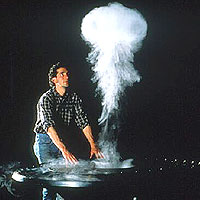
Giant whirlwinds, spiral galaxies and oceanic currents are just a few forces at work in Ned Kahn‘s art. This Sebastopol artist applies his background in science to the engineering of wondrous sculptures and public installations that transform natural phenomena into dynamic visual experiences, unveiling the mystery of the physical world surrounding us. Spark tracks Kahn in his studio and machine shop as he churns out the final details of his monumental project “Wind Portal.”

Internationally renowned for his installations, Kahn’s creative impetus began in the Bay Area. Soon after graduating from the University of Connecticut, he became an apprentice to the late Frank Oppenheimer, legendary founder of the San Francisco Exploratorium. Kahn continued working at the Exploratorium as an exhibit designer for 10 years, where numerous works of his are still on display. Other art installations by Kahn can be found around the Bay Area, including 14 exhibits at the Chabot Space and Science and “Wind Portal” at the San Francisco International Airport BART station.

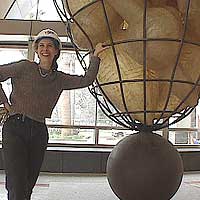
Providing many with their first exposure to environmental art, “Wind Portal” encircles the top of the main escalators at the new BART station. A 55 foot-long shimmering lattice supporting 200,000 one-inch, stainless steel discs detect and reflect every subtle shift in the wind currents passing through the station. As pedestrians enter and exit the station, they can see invisible rhythms in the wind’s behavior.

Lauding the complex beauty of fire, water, fog and wind, Kahn’s art retains a fluid momentum that conveys perpetual play of order and chaos. Although his artworks allude to numerical science, Kahn’s ultimate fascination lies in the visual wonders of natural phenomena. In Kahn’s own words, “I am less interested in creating an alternative reality than I am in capturing, through my art, the mysteriousness of the world around us.”

  • Array
  • Array
  • Array

Bill Dan

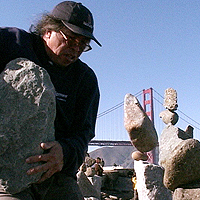
On any given day and in all types of weather conditions, nature artist Bill Dan can be seen balancing rocks at Fisherman’s Wharf, Crissy Field or on the waterfront of Sausalito. Since he began this practice in 1994, he has become a well-known local figure, often attracting large groups of spectators who gather around him while he creates vertical rock sculptures that seem to defy gravity.

Completely self-taught as a rock balancer, he plays upon the possibilities inherent to the interaction of rock, mass and gravity to create his nature art. There are several forces governing his approach: concentration and a positive attitude, along with an understanding of and respect for materials. His philosophy is that balancing rocks is play and work, beauty and craft. Sometimes building up to 10 sculptures in a day, he acknowledges that the act of physical labor, of hours spent stacking heavy rocks, depends upon his being in a good mood.

He keeps his work as simple as possible, to be an antidote to the complications of modern living. His source material is the “stone riprap” for their seemingly endless supply and varying shapes, sizes, colors and textures. The abstract sculptures he leaves behind do not conflict or compete with the beauty of their surroundings — they merely allow viewers to appreciate nature in new ways.

Spark catches up with Dan and witnesses that his work is both public and performance art. The crowds observing him get different things out of it. For some it is meditative and spiritual in its simplicity; for others, Dan’s ability to balance large stones perfectly on small rocks — without the use of any adhesive — is awe-inspiring. Unlike many public art pieces, his are not bound for permanence, and upon completion, the sculptures are left to endure the elements. It is part of his art to accept that his rock formations are temporary and ephemeral, even fleeting.

Bill Dan left his native Indonesia more than 20 years ago. He says that his friends and family back home can’t believe what he does. Still at it, he is out there every day doing what he loves: building sculptures and sharing his simple philosophy with others. Not limited to shores, he has been invited to perform at events and to teach schoolchildren the importance of using creativity and imagination over drugs.

  • Array

Chris Johanson

Visual artist Chris Johanson dodges the spotlight since being jettisoned to international art stardom when his site-specific installation was included in the 2002 Whitney Biennial. Also, in 2002, he was one of four recipients of the SECA award, for emerging artists from San Francisco Museum of Modern Art. In the episode “Fame,” Spark explores the impact this success has had on his gritty, street-based works, journeying with him from his studio in San Francisco to the Deitch Projects gallery in New York City.

With no formal art training, Johanson learned his craft in everyday jobs — painting skateboards and houses. In 1989, he found a home and a community of artists in San Francisco’s diverse Mission District. His early work consisted of deeply observational drawings of distinctive cartoon characters, using black Sharpies on restroom walls and lampposts. He continues to work in the “documentary” spirit but his work has evolved into more colorful, show-stealing, grandiose works. Ever modest, Johanson professes that “art is really about sharing information and ideas … that’s more important than the artist.”

Like the work of many artists who are identified with what is now dubbed the Mission School, Johanson’s works are a direct response to his suburban upbringing. The Mission School, known for filtering themes on urban realism through graffiti art and social commentaries on found or recycled materials, also includes internationally acclaimed artists Barry McGee (aka Twist), Alicia McCarthy and the late Margaret Kilgallen.

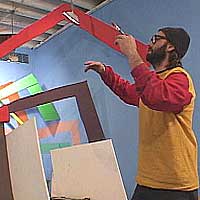
Spark follows Johanson and his neighborhood artist-friends as they install the Deitch show “Now is Now.” This solo exhibition of Johanson’s individual pieces constructs one continuous document about life. In the exhibition, paintings of crudely drawn figures lead to the centerpiece sculpture of a ship that is mechanically going around in circles, chasing a bag of money with a brightly painted backdrop of abstracted swastikas.

Array

  • Array
  • Array
  • Array
  • Array
  • Array

Asian Art Museum


View Spark segment on the opening of the new Asian Art Museum building with Pop Zhao. Original air date: March 2003 as part of the episode “Opening Nights.” (Running Time: 8:15)


View Spark segment on the Shanghai exhibit at the Asian Art Museum. Original air date: February 2010 as part of a This Week in Northern California episode. (Running Time: 6:08)

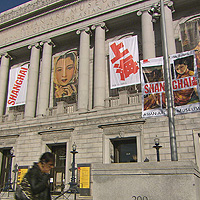
Shanghai at San Francisco’s Asian Art Museum is the first large-scale exhibition to feature the cultural productions of the city of Shanghai. Using a wide range of visual artifacts, the exhibition traces the impact that globalization has had on molding the city’s dynamic, international character. Spark gets a guided tour of this unprecedented exhibit.

Shanghai runs from February 12 through September 5, 2010, and is the cornerstone of the Bay Area-wide yearlong celebration of San Francisco’s illustrious sister city. The celebration features concerts, performances, films, lectures, special events, programs, and exhibitions presented by local arts organizations in honor of the 2010 World Expo in Shanghai, to be held May 1 through October 31. The theme of the World Expo is Better City — Better Life, heralding Shanghai’s 21st-century status as a major economic and cultural center. It is expected to generate the largest number of visitors in the history of World Expos.

More about the Asian Art Museum
Originally housed in a wing of the de Young Museum in Golden Gate Park, the Asian Art Museum has been in the works since 1959, when Asian art collector Avery Brundage donated 8,000 works of art to the city of San Francisco. Since then the museum has managed to raise enough money to move out of its temporary location in the de Young Museum to its new home, the renovated site of San Francisco’s old main public library. With architect Gae Aulenti overseeing the dramatic transformation of San Francisco’s former Main Library, the new structure features 40,000 square feet of gallery floor, enhanced with state-of-the-art interpretive displays and programs.

The Asian Art Museum is one of the largest museums in the Westernworld devoted exclusively to Asian art. Its holdings include nearly 15,000 treasures spanning 6,000 years of history and representing cultures throughout Asia. Nearly 2,500 objects are on display at any given time with many hundreds rotating throughout the year.

Array

  • Array
  • Array
  • Array
  • Array