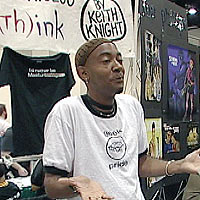
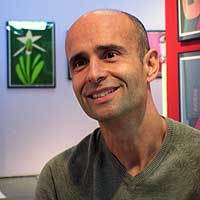
Comic artist and rapper, Keith Knight is the creator of the “K Chronicles” and “(th)ink” and heads up a hip hop/garage band. Knight talks to Spark about what it takes to be a cartoonist and how it relates to his music career.
Born in the greater Boston area and educated at Salem State College, Keith now lives and works in San Francisco, where he develops his cartoons and performs with his band The Marginal Prophets. His weekly K Chronicles comic strip, which ran in the “San Francisco Examiner” for five years, is often an irreverent combination of politics, race, family and humor. He highlights the “aha!” moments and the “huh?” questions we share as humans struggling to make sense and meaning of our complex, contemporary urban society.
Since Knight crafts his comics from his own life and experience, they regularly address issues related to his experience and observation of racism. As an African-American cartoonist, Knight raises issues of race with the same poignant combination of witty insinuations and gravity he uses to handle sensitive political topics and personal epiphanies, balancing the obligations of humor and insight without compromising the veracity of the content.
Knight has received praise from cartoonist Garry Trudeau “Doonesbury,” filmmaker Spike Lee and author Maya Angelou, among others. Knight’s work has appeared in a number of magazines, including “MH-18,” “Cracked,” “Futures,” “Fabula” and “Pulse!” He has published three books of the “K Chronicles” with Manic D Press, the most recent of which, “What a Long Strange Strip It’s Been,” came out in July 2003.
Keith Knight is committed to sharing his voice, not just through his images, but also as a speaker through Speakout: The Institute for Democratic Education and Culture, offering his experience and perspective to schools and other community venues to inspire colleagues and young people alike.
View a Gallery Crawl segment on 111 Minna Gallery from May 2006.
View Spark segment on the Surf Style exhibit at 111 Minna Gallery. Original air date: August 2003. (Running Time: 3:88)
The place to see and be seen is also a contemporary art gallery showcasing some of the art worlds most promising up-and-comers and established figures. From painting to installation, the 111 Minna Gallery has been a consistent presence in the city’s vibrant art scene. Always attracting large crowds who come for the bar, the music as well as the visual art, they have rotating exhibitions of edgy work.
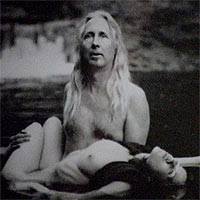
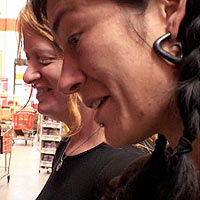
They live together, work together, make art together — meet Charlie Castaneda and Brody Reiman, known in the art world as the single entity castaneda/reiman. Neither lovers nor twins separated at birth, Castaneda and Reiman were both born in 1970, received BFAs from Carnegie Mellon University in 1992, and MFAs from the University of California at Davis in 1994. Since completing school, the two have lived together as roommates and worked together on a series of jobs, including construction and a dog-walking business they started together called Two Girls Walk Dogs.
In the episode “Collaborations,” Spark enters the creatives life of this seamless duo as they prepare their site-specific installation of conceptual sculptures titled “Floor Plan Landscape” for DCKT Contemporary Gallery in New York City. The collaborators’ experience of working together informs the content of much of their current artwork, which is made of cement, plywood, drywall, insulation and other “male-identified” construction materials. Provoking the sentiments associated with domestic settings, the works minimally reference the illusions of security and comfort associated with the physical spaces of a home.
castaneda/reiman has exhibited in the Bay Area and throughout the United States, gaining critical regard for their works. They have won a number of awards in the United States and abroad. Recently, the San Francisco Museum of Modern Art acquired one of their pieces. Their years of collective existence and artistic creation break the stereotypes of gender roles and the self-possessed artist working alone in a studio. Through differences and shared vision, castaneda/reiman truly embodies the concept of collaboration — in art, work and life.
Painter Mary Lovelace O’Neal and composer Olly Wilson create an audio-visual chamber music experience called “Call and Response” with the San Francisco Contemporary Music Players. Spark eavesdrops they create a series of musical pieces.
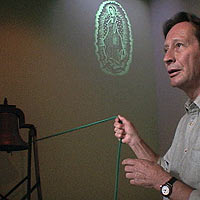
As Bay Area pioneer of conceptual art, Paul Kos helped define a West Coast approach to the form that emphasizes the elegant use of materials to explore issues of perception, social relations and life activities. In the Spark episode “Trailblazers,” audiences get a firsthand introduction to the artist, his fertile imagination and his 30-year body of humorous and provocative conceptual artwork. We examine individual works with the artist at his studio and the Berkeley Museum of Art, which has mounted the first major retrospective exhibition of Kos’s work, “Everything Matters.”
Kos relocated to San Francisco in 1967, arriving in the middle of a dynamic period in the history of the Bay Area characterized by cultural openness and curiosity and marked political activism. Already an important hub for artistic innovation, Kos and his peers experimented with new mediums through which to communicate contemporary ideas about the culture in which they lived. With the use of these new materials (most of them technologies designed for other purposes) as creative and expressive vehicles, over traditional artistic media such as drawing, painting, and sculpture, came the placement of concept as the driving force in artistic expression.
As a genre, conceptual art is art that aims to find its own definition by investigating the language of art and the system within which it exists. Conceptual artists question how we communicate by experimenting with different forms, thereby using the forms of visual phenomena to comment directly about how we engage with, apprehend and derive meaning from visual phenomena.
In his work, Kos has used a wide variety of media to explore a distinctive range of ideas, from the concept of time to the structure of the Catholic Church to the international divisions of global politics and cultural assumptions. Of primary concern to the artist is the employment of a unique language of art — finding the right combination of message and media that can transcend the limits of language and verbal communication.
Kos received both his BFA and MFA from the San Francisco Art Institute, where he has been a faculty member for the past 25 years. He has exhibited widely on the West and East coasts, has received numerous prestigious arts awards, including five National Endowment for the Arts fellowships, and a Rockefeller Foundation fellowship. His work is also in the collections of the Institute of Contemporary Art in Philadelphia, the San Francisco Museum of Modern Art, the Museum of Modern Art in New York, and the Stedelijk Museum in Amsterdam, Holland.
More Paul Kos sound bites from the Spark interview:
“My feeling is, if an artist develops fairly rigorous formalism in their education … after that, one should be able to move from craft to craft.”
“All art should have good craft — that’s just an assumption. But good craft is not art. Art is that magic that happens somewhere between the viewer, the object and the artist. The artist initiating it, but the viewer being that receiver of that triangle.”
“In new genres, the craft is thinking on one’s feet. And being able to use a material based on a site, maybe the site determines what the material is. It tells you everything.”
“Often I think a conceptual artist, unlike the painter or sculptor begins with a concept. And then finds the material that best suits that concept, that somehow the concept has some indigenous qualities to it that tell the artist what to use.”
“I respect painting probably the most because they are to the arts like philosophy is to the humanities.”
“When I was young I really loved magic tricks. I loved the idea of doing … a piece could have an element in it which is a surprise.”
“When everything matters, essentially, every detail counts.”
“Work should not necessarily be read like language is — left to right top to bottom. Instead, the work has its own language system.”
“I’m trying to pare down and pare down — use less adjectives and less adverbs, trust the verb and some nouns.”
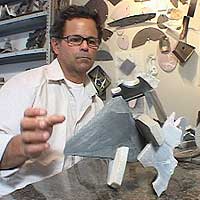
Working with materials that can weigh up to several tons, sculptor Richard Deutsch applies artistry and technology as he pushes the physical limits of his materials and creates gravity-defying art works in the process. In the episode, “Engineering of Art,” Spark visits Deutsch in his studio and at the worksites of his latest projects as he creates works that will outlast us all.
Born in 1953, Deutsch holds a BFA in fine arts from the University of California at Santa Cruz. Working with granite, bronze, fiberglass, and repurposed materials such as industrial objects, Deutsch uses solid media to explore the fluid themes of form, movement, space, and human interaction. As he designs and creates abstract sculptures for both public and private commissions, Deutsch’s finished works range from small studio pieces to monumental outdoor installations.
Spark tags along as Deutsch works on two of these monumental installations, one a fiberglass piece commissioned by Pineapple Sails, and the other, a larger-than-life granite stone sculpture for a private residence in Napa Valley. At Pineapple Sails, Deutsch utilizes the same ultra-light material the sailing company uses to create the hulls of its racing boats to create two 15 foot by 15 foot fiberglass pieces, which, with the help of a crane, are mounted in an outdoor display. At his project site in Napa, Deutsch, inspired by Italian ruins, creates a sculpture of rough-hewn granite slabs from Yosemite, entitled “Seven Stones.” Deutsch wants “Seven Stones” to evoke mystery like a contemporary Stonehenge, with the hopes that in several years viewers will ask, “How did this get here?”
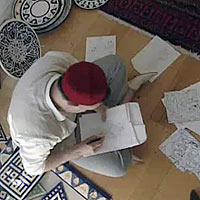
Berkeley-based artist Khalil Bendib is practicing a craft that goes back over a millennium, almost to the beginnings of the Muslim religion. Bendib paints on ceramic in a style initiated during the Moorish occupation of Spain in the Middle Ages, usually referred to as the Andalucian or Al-Andalus style. Spark visits Bendib in the studio as he works in this centuries old tradition.
Bendib comes from a long line of Andalus-style painters, stretching back through generations of his family. He first learned to paint from his uncle, Mustapha Maiza, a well-known ceramic artist in Algeria. Eager to continue his studies, Bendib went on to attend the Beaux Arts school of Algiers, working under the acclaimed painter Mohammed Temmam.
Though his work looks back to traditional designs and themes, Bendib often tries to interweave his own personal interests into his subject matter. Paintings often begin with a dream or recollection that will trigger an idea for a design. After working out a sketch on paper, Bendib then transfers the image onto a piece of ceramic in the form of a line painting. Finally, Bendib fills in his design with color, bringing the image to life.
Khalil Bendib grew up in Morocco and Algieria. After finishing his bachelor’s degree in Algiers, Bendib came to the United States, completing a MA at the University of Southern California in 1982. In addition to being a professional sculptor, Bendib produces political cartoons that have been published around the United States.
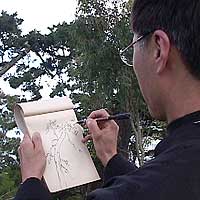
Landscape painter Li Huayi talks to Spark about his life as an artist and the different forms of art that have shaped his work over the course of his life — traditional Chinese landscape painting, modern American abstraction and Chinese propaganda posters from the Cultural Revolution — in terms of composition, content and style. In his contemporary works, Li Huayi is able to unite aspects of traditional and modern styles and genres to create innovative paintings that are highly regarded throughout the world.
Li Huayi was born in 1948 in Shanghai, a major international port city in the People’s Republic of China. Schooled as a painter from the age of 6, Li Huayi was educated in the techniques and traditions of landscape and flower painting by some of China’s most accomplished artists. As a teenager, he studied Western drawing and painting with a Chinese artist educated at the Royal Academy in Belgium. When he was in his 20s, the Cultural Revolution of the Communist Party was fully under way under the chairmanship of Mao Tse Tung, and Li Huayi was forced into a job as a “worker artist” creating propaganda images for the Socialist Party. Li Huayi finally left China in 1982 at the age of 34, relocating to San Francisco. Once here, Li Huayi was drawn to the powerful Northern California landscape, an inspiration that eventually drew him back to landscape painting after completing his studies at the Academy of Art in San Francisco.
Although Li Huayi’s paintings appear to be classical paintings, they are actually contemporary artworks that are made in the style and tradition of Chinese landscape paintings using traditional materials, subjects and compositions. He has brought his experiences in graphic arts as a creator of propaganda as well as his recent studies of American abstraction and modern art into the tradition of Chinese painting.
Spark visits Li Huayi at work in his studio and at the San Francisco Museum of Modern Art, where he discusses the similarities between Chinese painting and abstract expressionism, particularly the energy and spontaneity of the brushstrokes. This energy or “ch’i” (dynamic force), forms the basic compositional direction of Li Huayi’s paintings, defining the direction of verticals and horizontals as well as large areas of light and dark.
Editor’s note: Judith Scott passed away on March 14, 2005.
Since 1973, Oakland’s Creative Growth Art Center has been a nurturing ground for adults with mental, emotional and physical disabilities, providing them with creative art programs, educational and independent living training, counseling, and vocational opportunities. As the first independent visual art center and art gallery, this nonprofit organization also serves as an advocate for the disabled and provides services to teachers, caregivers, families, therapists and other persons who work in the fields of arts and disabilities.
Creative Growth is a productive playground for more than 130 hardworking artists in a variety of media, including painting, woodworking, ceramics and textiles. The artists exhibit their work at the Center’s Gallery as well as galleries and museums around the world. Spark investigates the creative impulses behind this miraculous place and the people who work and create there.
Just one of the amazing artists from this art center was Judith Scott, who was born with Down’s syndrome and could neither hear nor speak. Institutionalized for 35 years before her twin sister brought her to Creative Growth at the age of 44, Scott spent most of her life isolated from social contact with very little concept of language and no grasp of art. Yet when artist Sylvia Seventy of Creative Growth introduced her to fiber art in 1987, Scott was able to communicate through the mysteriously abstract beauty of her sculptures. Scott’s elaborate labyrinths of yarn, which surround a myriad of found objects, gained her the attention of art collectors and art critics around the world.
Nestled in the coastal wilderness of the Marin Headlands are historic military buildings that house Headlands Center for the Arts, a nationally-acclaimed residency program that provides artists from around the world with the scarce resources of time and space to pursue further development of their work. Resident artists Felipe Dulzaides and Nathan Lynch introduce Spark to the rhythm of life at the center and explain why the program represents a rare opportunity for experimentation and interaction among the lucky few chosen to participate.
Founded in 1986, Headlands Center for the Arts offers the Headlands’ Artists-in-Residence Program and a full array of public programs, including lectures, artist talks, performances and panels on topical issues in the arts, in order to cultivate understanding of and appreciation for the arts in the greater Bay Area.
The Headlands’ Artists-in-Residence Program has an international reputation for uniting pioneering artists in the visual, performing and literary arts, film/video, and interdisciplinary fields from the US and abroad. The program offers fully funded, live-in and live-out residencies to about 30 artists each year. Headlands assumes travel costs and provides each artist-in-residence with a studio, housing, a stipend and five meals a week. Residencies range from four weeks to 11 months, with an average stay of three months. Applications are due in June for residencies the following year. Historically, the center has collaborated with public and private agencies to fund artists from other parts of the US and the world.
More about Felipe Dulzaides Video and performance artist Felipe Dulzaides’s work is action-based. He states, “I use a situation or a context as a frame and a container.” He participated in “Bay Area Now 3” at Yerba Buena Center for the Arts and at Art Basel in Miami. Dulzaides has exhibited at numerous venues in the Bay Area, including The Lab, Refusalon Gallery, the Exploratorium and the San Francisco Arts Commission Gallery. He also has shown at multiple venues in Havana, Cuba, where he graduated with a BFA in theater from Instituto Superior de Arte de la Havana. He holds an MFA in new genres from the San Francisco Art Institute.
More about Nathan Lynch Nathan Lynch’s ongoing performance “Where is Your Wheel” has toured the United States from New York and Washington DC to San Francisco and Los Angeles. He also has presented projects at the Windhover Center for Performing Arts in Gloucester, MA and the Olive Hyde Art Gallery in Fremont, CA. Nathan received a BFA from the University of Southern California, and a MFA from Mills College. Lynch has taught at the University of Southern California and Mills College and is currently teaching at California College of Arts.
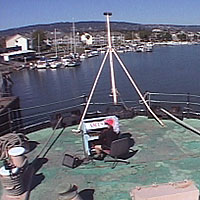
The Artship was one of the more unusual Bay Area arts venues. A cargo-passenger ship built in 1939, the vessel was used as a gallery, studio, classroom and performance space by visual and performing artists from 1999 to 2004. Unfortunately, the public gathering space and house for the arts lost its East Bay dock space due to commercial development.
Spark takes you inside the Artship as it was. Today, the Artship organization continues to support and produce exhibitions and performances through their dance/theater and urban/visual arts programs. The program particularly encourages artistic endeavors that build community by working to reclaim public space or increase audience/performer exchange.
Threading the past into the present, fabric has permeated through every civilization as a vehicle of creative expression. Stroke by stroke, painter Andrea Higgins applies her brushmarks to emulate the stitch-by-stitch patterns of fabric swatches, creating dynamic abstractions in her compositions. The Spark episode “Threads” zooms into Higgins’s current series of oil paintings, “The Presidents’ Wives,” which explore the relationship between women, fashion and power through visual abstractions based on the wardrobes of America’s first ladies.
Formally trained as a painter, Higgins gravitated towards textiles in childhood when her grandmother took her shopping at Britex Fabrics in San Francisco. Fascination transformed into dedication when Higgins visited Indonesia in 1995 and observed how Hindu women weaved extravagantly intricate sarongs under rudimentary environments. This inspired Higgins to approach a refined technique in her own artworks: finely-woven, geometric-intricate patterns painting on canvas requiring countless studio hours exacting repetitive brushstrokes.
Beyond their crafted abilities, Higgins was struck by the amount of time that these Hindu women spent aestheticizing their clothes prior to temple ceremonies, in hopes of luring gods’ attention. Upon returning to the United States, Higgins correlated this type of “power dressing” to that of American first ladies in personifying a certain public image.
According to Higgins, the clothes and the colors a first lady wears represent the social, economical, and political climate of the incumbent administration. For instance, her painting “Laura” references Laura Bush’s purple tweed suit reflecting a growing nostalgia for a simpler America under the Bush’s administration. In contrast, Hillary Clinton’s signature black pantsuits point to a country getting “down to business.” In another era, Higgins’s painting “Nancy” highlights Nancy Reagan’s flamboyant red epitomizes the extravagance under the ebullient trickle-down economics of the 1980s.
Higgins holds a BA from Dartmouth College and an MFA from the San Francisco Art Institute. She is one of four recipients of the 2002 SECA Art Award for emerging artists from the San Francisco Museum of Modern Art (SFMOMA). Her work has been exhibited at SFMOMA and venues throughout the United States and Asia.
In the Spark episode “Threads,” we follow Consuelo Jiménez Underwood as she installs new works at the San Jose Museum of Art for the “Un/Familiar Territory” exhibition, which includes 10 artists addressing the relationships between place and culture and personal identity. Discussing her roles as both artist and teacher at San Jose State University, Underwood raises two important issues that have surfaced in textiles recently — the contemporary interest in textiles as an expressive art form and the legacy of textiles as a craft traditionally practiced by women.
Underwood does not create textiles in the traditional sense, but uses textiles to express personal ideas the same way that a painter or sculptor might, by combining traditional textile materials with those not commonly used (barbed wire, plastic coated wire and safety pins). Because textiles have served utilitarian functions in history, the art world has generally thought of weaving as a craft. This assignation has served to relegate fiber arts outside what is considered to be the fine arts. Contemporary artists such as Underwood further push the boundaries of traditional craft materials by using them in new and different ways.
In her piece “Frontera Rebozo’s Noche/Dí:a,” Underwood uses safety pins to hold together hundreds of swatches of fabric. Each of the small square swatches of fabric in this work are screen-printed with the same image of a family running. This image is found on the highways along the border between the United States and Mexico, serving as a warning to motorists that people and families might be running across the road. As a cultural symbol, this image represents the border between North America and Mexico — describing a line that divides cultures. Underwood uses this symbol to represent her own history as a migrant agricultural worker, signifying her hybrid culture as well as the arbitrary lines that divide her homes.
The Fine Arts Museums of San Francisco (FAMSF) is the city’s largest public arts institution. Composed of the M.H. de Young Memorial Museum and the California Palace of the Legion of Honor, the FAMSF is one of the largest art museums in the United States. The FAMSF conservation staff includes specialized professionals in the areas of painting, objects, textiles and works on paper. Together with the curators, the conservation staff carefully monitors all of the works in the FAMSF’s collections, removing from storage or exhibition those that require treatment.
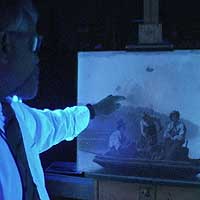
There are two critical aspects to taking care of works of artistic and historical value — conservation and preservation. Conservation concerns the correction of problems affecting a work of value, such as previous repairs and damage. Preservation is a proactive practice, seeking to minimize –and if possible, prevent — the effects of environment and other factors on a work. The Spark “Preservation” episode features two conservation staff members, Tony Rockwell and Carl Grimm, as they use a combination of art and science to restore George Bingham’s “Boatmen of the Missouri River” and a portrait that may have been painted by El Greco.
In another episode, called “Threads,” Spark learns about traditional Borneo textile weavings and the gender and social power significance of such traditional art forms. While traditional gender roles in Borneo directed women to weave the textiles and men to headhunt, the two practices were considered socially equal. Diane Mott, textile curator at FAMSF, explains the ways in which the weaving as well as their female creators were integral to the cultural practice of headhunting.
More about the de Young Museum thinker.org/deyoung Where: 50 Hagiwara Tea Garden Dr., San Francisco Phone: (415) 863-3330 Located in Golden Gate Park, the de Young is San Francisco’s oldest museum. Its collections include American paintings, decorative arts and crafts, and arts from Africa, Oceania and the Americas as well as Western and non-Western textiles. The de Young is particularly recognized for its many educational arts programs for children and adults. The de Young museum reopened in 2005 in a magnificent new building designed by Pritzker Prize-winning architects Herzog & de Meuron.
More about the Legion of Honor thinker.org/legion Where: 100 34th Ave., San Francisco Phone: (415) 863-3330 Built to commemorate California soldiers who died in World War I, the Legion of Honor is a beautiful Beaux-arts building located in San Francisco’s Lincoln Park overlooking the Pacific Ocean, Golden Gate Bridge and all of San Francisco. The Legion of Honor displays a collection comprising 4,000 years of ancient and European art. The collection includes Rodin’s “Thinker,” which sits in the museum’s Court of Honor, European decorative arts and paintings, ancient art, and one of the largest collections of prints and drawings in the country.