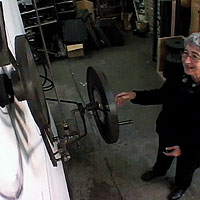
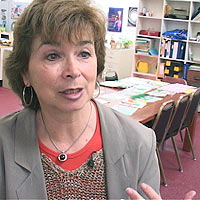
Bella Feldman creates what she calls “anxious objects” — ranging from large-scale, imposing pieces to smaller more intimate pieces. Her art and vision of the world is affected by hearing Hitler’s speeches on the radio as a child. Spark visits Feldman in the studio to see her “War Toys” and mechanical glass and metal sculptures.
Her “War Toys Series 1992” and “War Toys Redux Series 2003” were provoked by the Gulf War and bio-terrorism and are ominous yet playful renditions of weaponry. While the fanciful construction of her missiles and cannons makes them clear parodies of their all-too-real counterparts, Feldman’s toys help remind us of the dangerous human obsession with war and weapons.
During a trip to Europe in 1975, the artist and librarian John Held Jr. found a store in Amsterdam that sold visual rubber stamps. He bought several and began using them in the pen and ink drawings that he was doing at the time. After returning to New York, he discovered that rubber stamps were commonly being used in a burgeoning network of underground artists involved in mail art.
The variety and heterogeneity intrinsic to mail art makes it difficult to define the practice exactly; however, the term generally refers to a range of artworks that are exchanged through the postal services. The act of mailing the artwork is an essential component of the work, which seeks to establish a network or community of individuals for the exchange of objects and ideas. Many mail artists address social and political concerns, including examinations and critiques of the fine art world, its institutions and traditional channels of circulation. Some of the objects exchanged in mail art include postcards created by or modified by artists, nonofficial postage stamps called artistamps, decorated envelopes, found objects, and one of a kind or limited edition artist’s books.
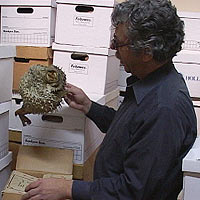
In the story about John Held Jr. in the Spark episode “The Fine Art of Collecting,” Held takes viewers through some of his expansive collection of mail art, one of the most extensive in the world. For more than 25 years, Held has been collecting art sent to him through the mail, and the collection amounts to well over 30,000 pieces. He has since donated part of his collection to various art institutions, including New York’s Museum of Modern Art, the J. Paul Getty Foundation and the Smithsonian’s Archives of American Art, but Held still keeps much of his collection of correspondences.
Since the only way to receive mail art is to produce it and send it to others, at its core mail art is about communication, exchange and the creation of a kind of virtual community of participants. In this sense, mail art anticipates the cyber communities founded on the Internet. It is not surprising, then, that Held and others believe that the Internet has extended the possibilities and scope of mail art. But even as new technologies transform the practice, introducing email lists, message boards and online exhibitions, Held contends that mail art continues in its material, postal form, renewed by and working hand in hand with new means of digital communication.
At the heart of Held’s interest in mail art is the way the art form merges fine art with the experiences of everyday life. With more traditional forms, art objects are exhibited in galleries and museums — places far removed from people’s daily experience. By using the post office as a means of circulating their works, mail artists sidestep the usual means of artistic distribution, effectively turning a regular aspect of daily life — collecting and opening mail — into an opportunity for an artistic encounter.
In this spirit, many artists find similar ways of turning aspects of their everyday life into works of art. Spark talks to Held’s other mail artists friends — like Robert V. Rocola, who has been involved in this art form since his army days in the ’60s, and Diana Mars, who has been hosting a dinner every week for 10 years, turning the meal into a means of generating art objects. Mars, who is also involved in mail art, produces materials relating to her dinners each week, including invitations, artist’s postage stamps, photographs, a guest book and other kinds of documentation of the event. The dinners themselves are also catalysts for collective performances, which are then also documented by Mars.
Exchange your own art with mail artists: John Held Jr. P.O. Box 410837 San Francisco, CA 94141
Robert V. Rocola 740 Dutton Ave. San Leandro, CA 94577
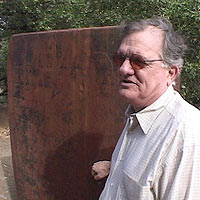
Thirty years ago, building contractor Steven Oliver didn’t give a second thought about art. But since 1985, he and his wife Nancy have assembled at their Sonoma County ranch one of the most ambitious private collections of site-specific sculpture in the United States. In the Spark episode “The Fine Art of Collecting,” get a personal tour of their collection.
When Oliver and his wife became frustrated at the increasing commercialization of art, they decided to take a more proactive approach to encouraging “art for art’s sake” and commissioned art that could neither be moved nor sold. Their first piece was done by artist Judith Shea, and almost 20 years later the Olivers have commissioned 18 more works from some of the world’s most respected artists. However, not just a collector of art, Oliver takes an integral role in the artistic creation process and helping artists create pieces that otherwise would not have been possible.
When Oliver comissioned artist Bruce Nauman to build a quarter-mile-long staircase from the ranch to his home, it took Oliver and his construction crew five months just to pour the concrete for the 289 steps, then Nauman uniquely tailored each step’s height to the hillside. In order to create the pieces “Snake Eyes” and “Box Cars” with artist Richard Serra, Oliver hired Jorgenson Forge of Seattle to accommodate Serra’s exact specifications, as it was one of the only facilities in the world to handle steel blocks of such massive proportions.
In his quest to engender and nurture the growth of art, Oliver forms close, meaningful friendships with the artists he works with. Rather than dealing with a gallery dealer, a museum director or a curator, artists opt to work with Oliver for a more “earthy experience.” As artist and Oliver-collaborator Roger Berry puts it, “A lot of collecting is collecting and then standing in front of the thing you colllected. In Steve’s case, he’s standing behind it. He’s embracing it.”
Oliver also personally gives weekend tours to visitors throughout the spring and fall months. Touring the Oliver Ranch and seeing one-of-a-kind works is no cheap ticket, but all the proceeds go to nonprofit arts organizations such as SFMOMA. Contact your local Bay Area visual arts organization to set up a tour.
Artists with site-specific work on the Oliver Ranch include Terry Allen, Miroslaw Balka, Roger Barry, Ellen Driscoll, Bill Fontana, Kristin Jones, Andrew Ginzel, Andy Goldsworthy, Dennis Leon, Jim Melchert, Bruce Nauman, Martin Puryear, David Rabinowitch, Jim Jennings, Fred Sandback, Richard Serra, Judith Shea, Robert Stackhouse and Ursula Von Rydingsvard. Currently, Ann Hamilton is working on the next Oliver Ranch installation.
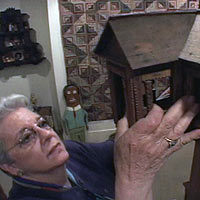
Bonnie Grossman has been collecting tramp art, kitchen utensils, walking sticks, and other craft and folk art for more than 30 years. In fact, she acquired so much that she founded a public gallery in a residential area of Berkeley in order to share her collection with others.
Her home-turned-gallery, The Ames Gallery, primarily exhibits pieces by self-taught or outsider artists, as well as folk art and Americana. Grossman gives Spark a tour of her space highlighting some of her favorite pieces.
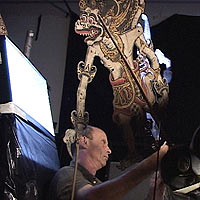
Spark follows puppet master Larry Reed as he and the Gamelan Sekar Jaya orchestra prepare for a performance of “Wayang Bali: Dangerous Flowers” at the Julia Morgan Theatre. For more than 30 years, Reed has studied, performed and developed the ancient art form of Balinese shadow play, producing unique performances that have stretched the bounds of the tradition.
Wayang kulit, or Balinese shadow puppet theater, is a tradition that has been passed down through generations for more than 1,000 years. Mythic tales and archetypal characters are played out, blending high drama, improvisation and slapstick comedy. In one performance, more than 20 intricately carved leather puppets are manipulated by one puppeteer, the “dalang” or “shadowmaster,” who assumes the role of the conductor, director, actor and all the voices. The shadow puppets are animated atop a banana log in between a large screen and a coconut oil flame so that their images cast shadows onto the screen.
The traditionally wayang kulit shadow plays are accompanied by an ensemble of two to four gamelan musicians, who respond to every move of the dalang. Gamelan, meaning “orchestra,” refers to the instruments themselves, which exist as an inseparable set. Each bronze key and gong of the gamelan instrument is forged at the same time. They are then tuned and blessed as a whole and cannot be individually sold.
Introduced to shadow plays in the ’70s while in Bali, Reed found himself drawn to the complex spiritual and ancient tradition and the powerful ephemeral nature of shadows. Reed spent the next 10 years learning the art form in the traditional manner, apprenticing himself with shadowmasters. Today, Reed performs in the traditional style, but he has also created his own company, ShadowLight Productions, a changing ensemble of actors and puppeteers who create modern shadow puppet works on a cinematic scale with scene changes, lighting cues and a larger music ensemble.
Editor’s note: In 2005, Montalvo changed its name to Montalvo Arts Center.
Not your traditional landscape artist, Herb Parker redefines nature-based sculpture, bringing a contemporary innovation and vision to the traditional art form that leaves topiary rabbits in the leafy dust. Since the early 1980s, Parker, who is a professor of art at the College of Charleston in North Carolina, has created more than two dozen structures throughout the United States, Canada and Italy, harmonizing the disciplines of art and landscape. Parker’s “grass temples” and “houses made of lawn” function as fun, organic shelters that create, as Parker puts it, “environments for people to interact with.”
Visiting Parker on the site of his piece, “Caracol,” (Spanish for snail) Spark gets a firsthand look at how he turns sod into art. Inspired by his 4-year-old son’s snail collection, “Caracol,” like Parker’s other works, is fashioned almost entirely out of natural materials. Using tightly compacted clay and sand as a base, Parker constructs his nautilus-shaped creation entirely out of sod. Parker says he enjoys working with sod “because it is a living, growing entity” that eventually becomes “a very exciting support.”
Sod is not Parker’s only support — the artist relies on volunteers and assistants to make his art a reality. Although the unveiling of Parker’s pieces is a celebration, Parker admits he gets a little depressed at the end as he says goodbye to his collaborators. “It’s not just an object I’m placing somewhere,” Parker says of his art, “it’s a place I’m building with people.”
Commissioned by the Montalvo Association’s artist in residency program, Parker’s commission marks the launch of a new phase of growth and development for Montalvo that includes the construction of 10 new artist studios. Originally the estate of Senator James Duval Phelan, Villa Montalvo is now the 175-acre home to a nonprofit organization dedicated to inspiring love of the arts; presenting literary, performing and visual arts; and supporting practicing artists.
For five weeks during the summer of 2003, artists Jon Brumit and Marc Horowitz took over the San Francisco gallery New Langton Arts, and reinvented themselves as the business team of Sliv & Dulet, the fictional enterprise behind 2001’s much-publicized one-minute art show. In the Spark episode “The Bleeding Edge … is this really art?” meet these unusual art entrepreneurs as they collaborate with 25 other artists to “develop new products and services” for The Summer Line 2003, an experiential installation that comments with great humor on the conventions of office life and the art world.
Brumit and Horowitz, who met through the Artist-in-Residence Program at San Francisco Recycling & Disposal, create interactive performance works that predominately focus on social exchanges and the creative potential of ordinary objects. Incorporating elements of absurdity and the mundane, Brumit and Horowitz have collaborated on numerous Bay Area events that push the boundaries of public/performance art including: The One-Minute Show (2001), a 30-person group exhibition that took place in 60 seconds; Bring Your Own Big Wheel Race (2002), an annual public big wheel race down historic Lombard street; and the first annual Duct Tape Festival (2002) in Oakland.
Jon Brumit holds an MFA from Cranbrook Academy of Art. He designs tools, instruments, and scenarios for interaction which often produce unpredictable results — oftenhumorous and highly interpretable — although typically arising frompublic spectacles, dynamic failures and intentionally problematizedconstructions. Solo projects include “Door to Door,” “VendettaRetreat,” and “BYOBW.” Collaborative projects include NeighborhoodPublic Radio and numerous performance installations such as “Crossover” and “Strip Club.”
Marc Horowitz communicates through the highly personal and often ironic language of material objects in his installations and sculptures, which have been described as “encounters.” He often uses photography as a way of presenting visual and conceptual discordance and harmonies. In 2001 he founded Your Local Gallery in Oakland, and has curated and performed in numerous exhibitions including Think Again, Pictures, Photos, Sculptures, Sounds & Installation, and Stuffed Animal Golf over the Great Highway, a collaborative public performance. Horowitz holds a degree in marketing from Indiana University and lives and works in San Francisco.
Editor’s note: SOTA was renamed the Ruth Asawa San Francisco School of the Arts in 2010.
Spark visits the San Francisco School of the Arts (SOTA), humming with end of the year excitement as students prep for final art shows, theater reviews, and end of the year concerts. Meet, among others, student Anna Pasternak and teacher Elvia Marta, who give an insider’s look at SOTA’s dance department as students prepare for final exams — a four-night run of concerts.
SOTA is a public visual and performing arts high school dedicated to providing students with an alternative educational program that fosters artistic development and creativity. Since its founding in 1982, SOTA has admitted students selected by audition from all over the Bay Area in areas of performing, visual, and literary arts, thus creating an ethnically diverse and energetic student body.
In what the school calls its “pre-professional” program, SOTA engages students in a curriculum that combines academics with art instruction. SOTA offers art instruction in nine disciplines, including creative writing, dance, film and video arts, instrumental music, piano, theater arts, theater design and technology, visual arts, and voice. The teaching staff at SOTA, which is comprised of specialized arts teachers as well as artists in residence, create an educational program which allows students to study their selected discipline for at least two hours a day.
SOTA was originally founded by a group of renegade artists and teachers, and has continued to be a work-in-progress, frequently changing campuses and even sharing spaces with other schools. However, as of fall 2002, SOTA moved to its own campus where it has since been awarded the title of California Distinguished School. SOTA is not merely being recognized on a local level but also is well on its way to establishing a national reputation for itself. Pending on the allocation of funds, the school may eventually move to the Civic Center where it would neighbor the Symphony, Opera, Ballet, and Asian Art Museum. By joining the art mecca of downtown San Francisco, SOTA would no doubt increase its visibility and attract even more students to its growing population of young and emerging artists.
Editor’s note: In May 2004, Young Audiences of San Jose and Silicon Valley merged with Young Audiences of the Bay Area to become Young Audiences of Northern California
Young Audiences of the Bay Area (YA Bay Area) is the area’s oldest and largest provider of arts education programs and services. Founded in 1958, YA Bay Area is one of 32 non-profit chapters of Young Audiences, Inc. across the nation. Collectively, Young Audience chapters are the single largest provider of arts education programs in the US. In 2001-02, the 5,016 professional artists working for YA chapters provided 102,980 arts programs for 8.1 million young people and educators.
As one of the YA network’s top 10 chapters, YA Bay Area is dedicated to making the arts (classical, contemporary, and multicultural) an essential part of every young person’s education and life. Founded in 1958, the organization offers performance assembly performance, workshops, artist residencies, and professional development in dance, music, theater, media, storytelling, and circus, literary, and visual arts to K-12 and public audiences.
In 2000-2001, YA Bay Area reached 189,976 students, teachers, and families through its in-school, community, and public programs in ten counties of the Bay Area. YA Bay Area’s diverse roster includes over 150 professional artists and ensembles from the Bay Area and the greater US. All of YA Bay Area’s artists are auditioned on an annual basis by YA Bay Area staff and advisory committee to ensure the highest quality programs.
In the Spark episode “Art Goes Back to School,” tag along with a few of the artists represented by YA Bay Area from in-school assemblies with Kulintang Dance Theatre and Eddie Madril from Native American Dance & Arts, to artist residencies with Poet Gail Newman and Photographer Shashari Murphy. Assembly performances are 45-minute performance demonstrations designed to introduce an artform(s) and usually the culture or tradition of the practicing artists. Artist residencies are longer-term (8-32 weeks) experiences between an artist(s) and a group of students designed to provide hands-on learning beyond the introductory level.
In addition to these valuable educational programs, YA Bay Area also offers the ArtsCard, a free family arts program offering discounts to over 50 arts and culture organizations throughout the Bay Area — including discounts on admission, special events, membership, and classes. Enrollment is open to all families with children between preschool and grade 12.
Editor’s note: Ann Chamberlain passed away on April 18, 2008.
Visual artist Ann Chamberlain worked in a variety of contexts (ranging from public art and printed books to installations) where she incorporated all kinds of media, including text, photographic imagery and found materials. In her works Chamberlain explored how public spaces and places express the identity, history and experience of the communities they serve.
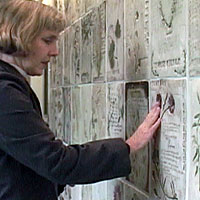
Spark joined Chamberlain as she visited the UCSF Mount Zion Women’s Health Center, where she worked with others to replace a barren, concrete courtyard with a lush garden where cancer patients could share their personal stories with others. Wanting to give the patients’ stories a more permanent home, Chamberlain decided to take the Healing Garden “inside,” and created a 70 foot-long wall of ceramic tablets, each tablet containing the impression of a plant and the story of someone who had dealt with illness.
Spark also visited with Chamberlain while she worked on two other collaborations: a memorial to the Abraham Lincoln Brigade (a group of Americans who fought fascism during the Spanish Civil War) and a project for the residents of Laguna Honda Hospital. By relating the narratives of everyday life through public art, Chamberlain created art that not only celebrates ordinary people, but also offers satisfaction and enrichment for the surrounding community.
Formerly the program director at the Headlands Center for the Arts in Marin, her public art commissions in California include a collaborative work with Ann Hamilton at the San Francisco Public Library and an exhibit at the California Supreme Court Building.
Driven by a need to explore family memories and identity, at the age of 40 South Bay resident Flo Oy Wong decided to embark on a path of artistic creation that has resulted, 25 years later, in a body of provocative artwork that illustrates the rich yet painful history of Asian Americans. Spark follows Wong down the collective memory lane of the Asian American experience.
Born in 1938, Wong was raised in Oakland’s Chinatown, where her family owned a variety of businesses (grocery store, a Chinese lottery and two restaurants) from the 1940s through the 1960s. After graduating from the University of California at Berkeley, and California State University Hayward, Wong began a teaching career. However, in her late 30s Wong decided to pursue her passion for art and enrolled in community college art classes, where she started to explore gender, racial and cultural issues. Since then, Wong has become widely recognized for her mixed media installations.
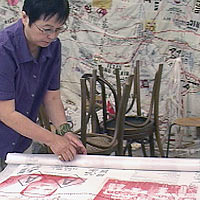
Her project “made in usa: Angel Island Shhh,” is a three-year oral history-based project that explores the false identities that many Chinese immigrants were forced to adopt when detained and interrogated in the United States. The installation uses rice-sacks embellished with text, beads, sequins and American flags in order to narrate the stories of Chinese immigrants, including Wong’s own parents, who assumed false identities in order to enter the country following the creation of the 1882 Chinese Exclusion Act.
In another work, entitled “Kindred Spirit,” Wong relates the plight of Wen Ho Lee, the Chinese American scientist who was wrongly accused of passing nuclear secrets to China in the 1990s and subsequently jailed. By using certain foodstuffs that Lee was denied during his 278-day incarceration, Wong portrays Lee not as a scientist, but rather, as a father who was taken away from his home and family.
Spark also visits Wong as she works on her latest project, “1942: Luggage From Home to Camp,” a collaboration with the Japanese American Museum of San Jose. Wong’s homage to the internment of Japanese Americans consists of a re-created internment camp barracks filled with suitcases containing personal items and photos of six Japanese Americans who were detained during World War II.
Wong is co-founder of the Asian American Women Artists Association and has exhibited at various venues around the country, including the M.H. de Young Memorial Museum, the Oakland Museum of California and the Smithsonian Institution.
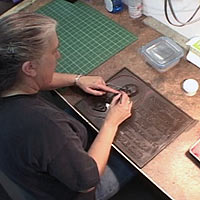
Virginia Harrison began creating what she calls “memory markers” after the death of her young son. These unique bronze plaques commemorate loved ones. In addition to the memory markers, she also creates other bronze artwork such as intricate baskets woven from bronze wire. Spark visits with Harrison at her foundry.
Like everything else in San Francisco, the world of art dealing is a bit more laid back here than in other major cities. Spark joins Lincart gallery owner Charles Linder, whose business model is based on providing a comfortable environment to view art and working with artists that he and his gallery employees like on a personal level. We follow Linder in a typical day, from Rebecca Miller’s art opening at Linc to the studio of Tucker Nichols.
An artist himself, Linder came to the Bay Area in 1987 to attend the San Francisco Art Institute. After receiving his MFA from University of California Berkeley, he started his first art gallery, refusalon, in his home, a converted garage South of Market. Eventually, he moved refusalon out of his home, then sold it in 1999. In 2000, Linder opened Lincart with business partner Holly Fouladi.
Linc has become a venue for contemporary fine art, design and lifestyle branding. What makes Linc unique is an informal environment combining elements of domesticity and informality in which visitors may view new artwork, art books and videos. In addition, Linder and Fouladi firmly believe that collecting art is a learned passion that reflects a collector’s enthusiasm for knowing the artists. “We make an investment of time and space. Then the artist, we hope or assume, will return the favor in terms of … giving us great work and effort,” says Linder. The gallery usually presents solo exhibits, but at least once a year, Linc curates a group show featuring new local and international work.
Relative to New York or Los Angeles, the San Francisco art scene tends to be seen as small and regional. Artists sometimes feel they need to move to bigger cities in order to get national and international recognition. Art galleries like Lincart, work against the sense of regional limitations by taking the work of Bay Area artists to European art capitals and by bringing the work of European artists to San Francisco.
Cut it, tweak it, weld it, and crank it up to your wildest imagination. Welcome to the creative obsession of the art car world with grand crankster David Best, the modern master of assemblage who has transformed more than 30 vehicles into mobile works of art. In the Spark episode “Art Meets Pop Culture,” tag along as Best and his team transform a 1973 Cadillac into a 40-foot rocket car, their mode of transportation at the 2003 Burning Man Festival.
In creating his art cars, Best strips vehicles down to the core before reconstructing them, striving to make the car’s original form unrecognizable. Rather than merely gluing objects to the body of a car, Best, who religiously goes to the dump, likes to use found object materials that ultimately take on their own personality. After making 30 art cars and 2 buses, Best has worked with over 10,000 people. The car artist attributes his success to his collaborators, as he believes a mixture of talents is what brings spark to his projects.
Based in Petaluma, Best’s work has been shown at the San Francisco Museum of Modern Art, the Oakland Museum of California, the San Jose Museum of Art, and the di Rosa Preserve, where the collection includes Best’s “Rhinocar” and “Mother Tina’s Car.”