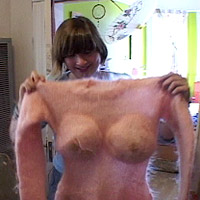
San Francisco-based artist Anna Maltz uses humor and sculptural textiles to explore identity and societal taboos. For her series One Size Fits All, she takes conventional portraits of families (of various configurations) wearing her “naked” suits — full body, pink-colored mohair outfits with anatomically correct appendages. Spark tags along with Maltz on a photo shoot.
Born in London, England, Anna Maltz earned a B.F.A. from the Middlesex University in London and an M.F.A. from California College of Arts in 2004. Her work has been exhibited internationally.
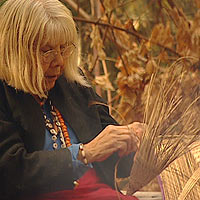
For Julia Parker, weaving baskets connects her to the lives and traditions of her ancestors, telling the story of a people that for more than 4,000 years populated villages throughout the Yosemite Valley. In the Spark episode ” Legacies,” Parker guides viewers through the area where her village had once been as she explains the traditional process of making her baskets.
Born in 1929 in Sonoma County of the Coast Miwok and Kashaya Pomo peoples of the Yosemite, Parker moved to the Yosemite Valley in 1949 to live in the village of her husband, of Miwok Paiute descent. As a young woman, Parker was compelled to learn everything she could about the old ways of basket weaving. She studied basketry with the elders of her village, including her husband’s grandmother Lucy Telles. Telles was a highly innovative and celebrated weaver, whose masterpiece — a colossal 3-foot-by-19-inch storage basket — is now on display at the Yosemite Museum. Parker remained in her husband’s Yosemite Valley village until 1969, when the government bulldozed the region to make way for campsites.
Concerned that these ancient methods of making baskets would die out with the weavers of Telles’s generation, Parker dedicated her life to passing on the knowledge and skills she’d gained. Since 1960, Parker has demonstrated basket weaving behind Yosemite’s Indian Museum, in the same spot where Telles used to weave and sell her baskets and beadwork to tourists. She graciously answers visitors’ questions in an effort to share her culture with others.
Parker is an innovator in her own right, with samples of her work in the Smithsonian Institution and in the collection of the Queen of England. Her baskets demonstrate a staggering complexity of design, that is unparalleled in the work of her colleagues. She makes every one of her baskets by first collecting the needed grasses and sticks, then treating them with moisture and heat in order to make them supple. She also prepares the dyes from natural materials. And since there are no established patterns for different types of baskets, the entire design of the basket has to be formed in Parker’s mind before she begins weaving. The process is slow and labor-intensive, which means that a single basket can take several months, sometimes well over a year to complete.
Parker, now in her 70s, has inspired her daughter Lucy Parker and granddaughter Ursula Jones to continue making traditional basketry. Spark follows Parker and her family as they make the 350-mile journey to see the work of their ancestors at the Phoebe A. Hearst Museum of Anthropology at UC Berkeley, which houses approximately 9,000 baskets.
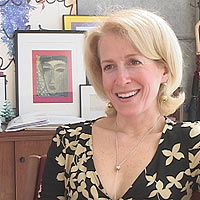
Enter the world of Angela McConnell, executive director of the Community School of Music and Arts (CSMA) in Mountain View. Her task: to raise almost $9 million within three years. Hired July 2001 in the depths of the dot-com crash, two months before September 11, McConnell was charged with raising the funds necessary to give the CSMA something it has never had in its 36 years of existence: a permanent home to call its own.
Founded in 1968, the CSMA has served Silicon Valley residents for more than three decades, already providing education for 325,000 Bay Area residents — adults and children alike, following its motto, “Arts for All.” The school offers a variety of classes and programs in its effort to accommodate the region’s cultural diversity. Examples of these include after-school classes, private lessons, free family concerts, community outreach events and the Arts in Action programs in local schools.
The unfortunate truth is that even in the world of art, money makes the world go ’round. Add to that a soft economy, a quarter-century of Prop 13 in California (a law that held down property values, cutting off a major source of revenue for the state government and leading to drastic cutbacks in arts education), and you’ve got yourself a local institutional maelstrom. That McConnell succeeded in raising the funds, let alone within three years, is a great victory for the community. But it could also be seen as a natural extension of McConnell’s own interests — she sings opera, and her twins, Emily and Jake, currently take classes at CSMA.
In the Spark episode “Movers and Shakers,” see how McConnell makes everything happen. A usual day for her starts at 5:30am with some time at the gym that includes networking. Then she’s off to meetings with local figures, such as the mayor of Mountain View. Also on her agenda: seeking the attendance of Governor Arnold Schwarzenegger at a CSMA event and obtaining funding from giants like the Silicon Valley-based Google. In the end, it is her hard work and her ability to inspire the members of her own organization that has made McConnell one of the most formidable fund-raisers of her kind — and a pricelessresource for the advancement of arts in the Bay Area.
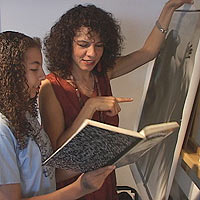
“The New York Times” has called her “the answer to the book industry’s multicultural dreams.” “If There Would Be No Light: Poems from My Heart” was published when she was 8 years old; the forward was written by Gloria Steinem. Her work has been praised by the likes of Phoebe Snow, Bill Cosby, Quincy Jones and Bonnie Raitt. This kind of literary accomplishment would be enough for most kids in middle school; however, writing is only a part of artist Sahara Sunday Spain‘s creative arsenal. In addition to being an accomplished poet, Spain is a dancer, a songwriter, a singer, a visual artist and a globe-trotting social activist.
One cannot look at Spain without looking at her environment as well. Her talents, impressive regardless of context, might have languished without the presence of her mother, professional photographer Elisabeth Sunday. It was Sunday’s decision to raise Spain in a world scrubbed clean of the noxious influence of popular culture. Without television, electronic toys or junk food to impede her creative development, the young poet was speaking in complete sentences by 14 months. Spain was 5 years old when she wrote her first poem, entitled “Mother’s Milk,” which reads, “When I drink mother’s milk/my heart sweats with love.”
As for her activism, Spain keeps with the family spirit. Her father is Johnny Spain, a former Black Panther who has spent a long time in jail and is no longer an active presence in his daughter’s life. Nevertheless, she carries on his tradition of activism. She has taken it upon herself to aid village girls in Mali by creating the Kah-Monno group — a name taken from the one she was given by Mali elders. “Kah-Monno” means unity and understanding through conversation. Spain plans to fund the education of 35 girls there, hoping to use the proceeds from her sale of rights to a song she wrote, “The Night of the Day.”
If you’re an artist with a family, working to nurture your child’s creativity while sustaining your own can become two sides of the same coin. Sunday herself notes, “We are a creative family. It’s easy to be inspired.” Indeed, in addition to having a photographer for a mother, Spain has a grandfather who’s a stained-glass designer, a grandmother who’s a potter and a great-grandfather who’s a painter. For this reason, Spain’s second book of poetry, “River of Ancestors,” is an homage to her deeply artistic heritage.
In the Spark episode “All in the Family,” spend a day in the life of Sahara Sunday Spain and her mother Elisabeth Sunday, the latter working hard to make it as both an artist and a single parent, having to squeeze her creativity in between dropping Spain off at school in the mornings and picking her up in the afternoon. Learn about the artistic stream running through Spain and Sunday from their relatives. Above all, see that behind these artists is a loving family to support and inspire them.
The Phantom Galleries program in San Jose was launched in 2000 as a partnership between Two Fish Design, San Jose Downtown Association, and the San Jose Redevelopment Agency. The program utilizes empty downtown storefronts as exhibit spaces for local artists.
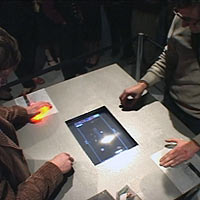
The “Bang the Machine” exhibit at the Yerba Buena Center for the Arts (YBCA) from January 17 through April 4, 2004, brings a whole new dimension to digital gaming. For example, those brave enough to play “Painstation” have their hands shocked, whipped, and burned for making mistakes in a game of Pong. As Spark tours the exhibit, artists discuss gender in the world of interactive technology and the connection between visual artistry in digital games.
Incorporated in 1986, YBCA was built by the San Francisco Redevelopment Agency to help transform a once dilapidated area of the city into an urban cultural center. The YBCA presents contemporary work by visual and performance artists from the Bay Area and around the world.
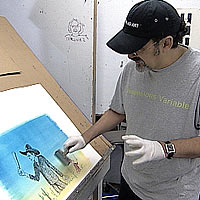
In his prints, drawings and other works on paper, Mexican-American artist Enrique Chagoya appropriates and reorganizes images taken from the American mass media, Mexican folk art and religious sources, using them to create biting and often very humorous political and social satire. Spark follows Chagoya as he works on a new series of satirical prints aimed at George W. Bush entitled “Saint George and the Dragon.” In the new series, Chagoya is experimenting with new printing techniques with master printmaker David Salgado from Trillium Graphics in Brisbane, California.
Born in Mexico City, Chagoya credits the nurse that helped raise him with his first exposure to the culture and history of the Mexican indigenous peoples. He earned a bachelor’s degree in political economics at the Universidad Nacional Autónoma de Mexico in 1975. As a student, he worked on several rural development projects, which helped cement his interest in political and social activism. In 1977, Chagoya immigrated to the United States, where he worked as a freelance illustrator and graphic designer, sometimes in the service of farm laborers in Texas. In 1984, he graduated with a B.F.A. from the San Francisco Art Institute, then went on to earn an M.A. and an M.F.A. from the University of California at Berkeley. Chagoya worked as director of Galeria de la Raza, helping to establish the gallery as San Francisco’s premier venue for Chicano art. Since 1995, Chagoya has been teaching printmaking at Stanford University.
Chagoya uses his work to critique the manner in which history has traditionally been written by those nations that have dominated and colonized others. He calls his practice “reverse anthropology,” and he intends to overturn the direction of influence in Western art. For centuries, Western artists have mined folk and indigenous cultural production to use in their own work — Pablo Picasso incorporated African tribal masks to develop the cubist style; British sculptor Henry Moore turned to Aztec sculpture as an influence in his modernist bronzes; and American architect Frank Lloyd Wright used forms derived from Mayan structures. Each of these artists appropriated these forms but removed them from their original context, recasting them in terms of the development of Western high art. In his work, Chagoya reverses this process, taking images from the dominant American culture and placing them within the contexts of indigenous and developing-world perspectives.
Ambivalence about American culture plays into Chagoya’s work, which also seems to revel in the diversity of the United States, a world where, as Chagoya notes, “all cultures meet and mix in the richest ways, creating the most fertile ground for the arts ever imagined.” Chagoya’s complex and colorful prints often reflect this melding and mixing of cultures and influence, ripe with potential for new expressions and provocative humor.
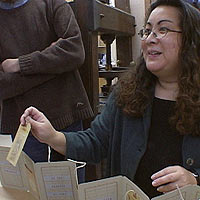
Julie Chen is a groundbreaking innovator in the growing field of the artist’s book. Her works defy traditional definitions of bookmaking, combining original works of poetry and three-dimensional paper techniques to stunning effect. Spark visits her in the studio and classroom and accompanies her on the hunt at Flax for materials for her latest work.
Inexplicably drawn to the book art form after completing a degree in printmaking, Chen entered the book arts program at Mills College in 1984 with no formal training and not a single book project in her portfolio. Initially intrigued by the language, the equipment and the materials, she worked diligently to learn the tricks of the craft. Today, Chen’s books are considered exceptional for their craft and quality. Chen regularly gives lectures on bookmaking and teaches workshops in cities across the nation.
The Spark episode “Works on Paper” gives you a chance to survey the startling variety of Julie Chen’s books — constructed as shells, eggs and boxes or designed as playful sculptures meant to be assembled. Each one holds embedded messages to be discovered and journeys to be taken, in form and text. Her experimentation has brought her to her newest work, “Personal Paradigm,” a game the readers play by moving pieces and recording their actions in a logbook.
Chen works like a conceptual artist, allowing an idea to determine its form and content. Her book forms reflect the variety of concepts that fascinate her, including language, history, memory and time. Every element — structure, shape, color, material — is in symbiotic relationship with the concept. To read one of Chen’s books is to engage with a complete, discrete experience that is simultaneously literary and sculptural.
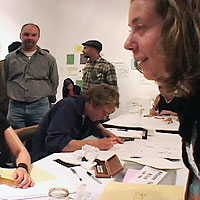
Editor’s note: Southern Exposure has moved since this video was released. Their new address is listed below.
Southern Exposure, a non-profit artists organization as part of Project Artaud, has been an integral part of the arts community for over thirty years. Their large and open space occupies 2,400 square feet and has two galleries. Artists contribute to the organization’s policies, planning along with their advisory board. Southern Exposure shows contemporary artwork that is conceptually diverse spanning across several mediums from painting and photography to cutting edge multi-media installations. In addition to their visual art exhibitions, they offer programs such as public lectures, residencies and a youth advisory board.
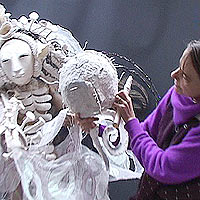
It’s wonderfully difficult to describe the work of Sha Sha Higby. Her costumes, or moving sculptures, are tornados of colors, textures and shapes. They look like everything and nothing at the same time. There are no analogies that can fully characterize Higby’s work, but one might be reminded of a Venetian Carnivale mask, African tribal art or a character in Japanese Noh theater.
That familiar images make up an otherworldly whole in her costumes is perhaps appropriate, given the experience of the artist herself. The path of Higby’s artistic development has been a journey through distant places, landing her here in the Bay Area. When Higby was a child, she made birds, filling her house with paintings and drawings of them. Her parents were divorcing at the time, and she described the birds as “something to divert me, a way out.” This artwork was a form of escape, but it was also the first step in her development as an artist.
After college, Higby’s career took flight, carrying her from her home in Marin to Asia. Her experiences abroad give her work its marked Eastern influence. “I studied with a craftsman who creates for the Noh theater. They have very elaborate costumes — and these heads, these masks — they move so slowly, they’re like sculptures. They have this strong, emotional quality, but it’s very slow. It’s subtle.”
Later, Higby received a Fulbright scholarship to study shadow puppetry and make sculptures in Indonesia, a country whose artistic sensibilities balanced well with Japan’s. “I went to Indonesia to study the elaborateness,” she explains. “Japan is simplicity. Indonesia is the fullness of the ornate. … It’s like a flat landscape when you look at it, but when you peel it away, there’s all this richness and complexity of layers, which I like in my work.”
In the Spark episode “Fusion,” get a glimpse of Higby’s creative process, a process that has wandered through time, leaped over oceans and slowly grown by accretion. Each individual costume that is used in performance can take years to make and is informed by a lifetime of experience. The semi-abstract nature of Higby’s costumes allows viewers to color the experience with their own imagination — one might end up in a place far away that the artist herself may not have imagined. With her art, Higby has found her journey and achieved her escape. The hope is that the viewers will find theirs as well.
Jason Mecier‘s art is certainly one of a kind. It takes somebody with an unusual amount of imagination and humor, not to mention patience, to create a portrait of Martha Stewart entirely out of vegetables, Demi Moore from dog food, the Spice Girls with candy, and Sigmund Freud from tablets and pills. In the episode “From Life,” Spark visits Mecier in the studio and takes a look at his quirky portraits.
Mecier uses a variety of household odds and ends, found items and food products to create his kitschy mosaics. His artwork has caught the attention of the stars, and he has done artwork for Parker Posey, Bjork and Farrah Fawcett. Phyllis Diller recently sent him a box of her jewelry and personal items to incorporate into his portrait of her.
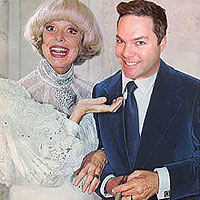
Mecier often depicts images that come straight from posters, magazines or television. One of his favorite subjects, Tammy Faye Baker, is Mecier’s pen pal. Other subjects of his include Jerry Seinfeld, Willie Nelson and Carol Channing. “A lot of people struggle with being appreciated in the art you do and finding a niche for it, so I feel fortunate that the general mood is, ‘I like it.'” Mecier is represented by Maslov/Weinberg Agents Internationale, and his work has been featured internationally.
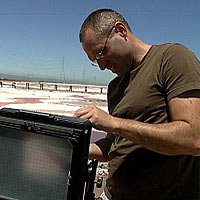
Best known for his international photojournalism, Olivier Laude is making a new name for himself with a series of carefully staged art photographs that explore human images and stereotypes. In the Spark episode “From Life,” watch Laude in action, casting subjects such as lumberjacks, hobos and Inuits.
Laude often casts his friends and acquaintances, and sometimes just people he meets on the streets, as characters in his elaborately conceived tableaux that spoof ethnographic portraits. He goes to great lengths to find the perfect props, costumes and location. For one shoot, he costumed his friend Marisa, a Filipina American, in a blue dress and fur-collared coat. Unconventionally shooting at high noon on the San Francisco Bay salt flats, he conjures up a desolate image of a lone figure, fish in hand, standing against a vivid blue sky on an icy landscape. Laude’s dioramic photographs make ironic commentaries on art, fashion and politics.
Laude’s ever-changing interests have led to exploration of a wide array of subjects. A preoccupation with stereotypes of masculinity led to a series of uproarious lumberjack portraits. Inspired by Chinese propaganda posters, Laude created a series featuring young women as revolutionary peasants, their hair tied neatly in braids, with rifles or Mao’s Red Book in hand. “I choose to portray specific people in specific situations,” Laude says. “But I find it amusing that we’re all stereotypes of each other and we all see each other. I don’t know, I’ve always liked that in life, when someone surprised you. When you have a particular vision of who someone is, or what they’re like, or what they might be thinking, and they completely prove you wrong.”
Born in Corsica, a Mediterranean mountain island, Laude moved to the United States when he was 15. He traveled the world photographing for “The New York Times Magazine,” “National Geographic Adventure,” “Time,” “Newsweek” and many other publications before settling in San Francisco, focusing for the past two years on more personal work. His photographs are often composed of crisp, vibrant colors and always reflect his unique vision of inspiration in everyday situations. Something as simple as the look of someone in his neighborhood, the Haight-Ashbury district, will spark an idea. “Sometimes, I just go scouting, and I’ll see something and, for whatever reason, an image will pop up in my mind. And I don’t know why it’s there or what it’s for.”
Editor’s note: Viola Frey passed away on July 26, 2004.
From the mid-1950s to her recent passing in 2004, Viola Frey broke boundaries in ceramics, breaking the association of her medium with small-scale craft to a world of monumental sculpture. In the Spark episode “From Life,” viewers watch Frey working in her studio on a series of colossal clay figures for a show in New York.
Spark followed Frey in the months just before her death when, in her early seventies and physically impaired from a number of strokes, she relied greatly on her studio assistant of 17 years, Sam Perry, to help her realize her seemingly ceaseless flow of ideas. Despite her physical limitations, Frey continued to be prolific until her death, going to her studio six days a week and often working on five or six massive sculptures simultaneously. Producing these figures was so important to Frey that it was her work in the studio that helped her recover from her physical setbacks, and kept her going.
Frey’s sculptures are at a scale nearly unprecedented in ceramics. Traditionally, ceramic artists produce small objects either by hand-building or working on a potter’s wheel. But Frey’s figures are nothing short of monumental, many of them standing in excess of 10 feet tall and weighing thousands of pounds. To build her pieces, Frey first allowed the clay of the entire figure to dry. The figure was then sawed into pieces, each of which was individually glazed and fired in a kiln. Once fired, the 100 pound (or more) pieces were painted by Frey and then reassembled into the final sculpture. In contrast to their larger-than-life scale, many of the colossal figures that Frey produced were inspired by the artist’s collection of ceramic kitsch. She reused many of the forms of these much smaller objects in her work.
Frey was a longtime resident of the Bay Area, and her influence is felt on multiple levels. Frey showed her work regularly and had several public artworks, including one at San Francisco’s Moscone Convention Center. Perhaps more significantly, Frey was a member of the faculty of the California College of the Arts from the mid-1960s until her death, teaching ceramics to several generations of artists. In the late 1960s and 1970s, Frey helped to redefine the place of her medium in the art world, along with fellow Bay Area ceramic artists Robert Arneson, Manuel Neri, Peter Volkous, and others. And, lastly, as a woman working in a field often dominated by men and in accomplishing work on a scale taken on by few, Frey distinguished herself as an exceptional artist.
Editor’s note: David Ireland passed away on May 17, 2009.
Internationally renowned Bay Area artist David Ireland‘s retrospective, “The Way Things Are,” at the Oakland Museum of California (November 22, 2003, through March 14, 2004), cuts straight to the heart of Ireland’s work. Instead of manipulating materials in order to create pleasing images and objects, Ireland’s drawings, prints, sculptures, assemblages and environments draw attention to the beauty and poetry of everyday things, inviting his viewers to look more carefully at the world around them. While Ireland has sought to redefine the way that his audiences look at art, his art in turn has managed to alter the way that we perceive the objects in our daily lives.
The Spark episode “The Grey Eminences” looks back on Ireland’s career as the Oakland Museum mounts a 30-year retrospective of the artist’s work. Viewers are offered a rare glimpse into Ireland’s home and studio at 500 Capp St., San Francisco, where the artist has transformed a run-down 1886 Victorian into what he calls an “environmental sculpture in progress.” When Ireland bought the building in 1975, it had been poorly cared for, and as he endeavored to organize the house, he began to collect the remnants of its previous owner. At some point, Ireland began to understand that his actions — the collecting of evidence of the past owner — were not only serving a particular function, but in a sense they had taken on ritual or symbolic meanings as an integral new part of his daily life — something like meditation or prayer. He began to think of this activity as art and recorded his work by preserving this “evidence” into jars, as one might with scientific specimens, and under layers of clear varnish, as one would a painting. Eventually, Ireland applied the same process of collecting to the traces of his own existence, collecting fingernail clippings, hair, toilet paper rolls and more, and rolling them into balls or collecting them in jars, unearthing the aesthetic beauty in the most mundane of objects.
Later, he became interested in the “bones” of the building and began removing the plaster and moldings that surrounded the windows and walls. By revealing the way the house was built, he became more aware of the structure he was living and working in. He finally decided to “exhibit” his work in progress and for a time opened his home to the public, in an effort to heighten others’ awareness of the environment that surrounds them.
Despite the wide attention and critical acclaim that Ireland has received, the Oakland Museum show is the artist’s first major retrospective, and its catalogue is the first sustained analysis of his career. In keeping with the spirit of Ireland’s work, the Oakland show diverges in several ways from most major retrospectives. “The Way Things Are: The Art of David Ireland” covers a gallery space of more than 10,000 square feet, an area usually reserved for more than two exhibits, and features more than 90 works, many of which have never been publicly exhibited before. And while most retrospective exhibits attempt to reconstruct a chronological account of an artist’s career, Ireland has instead used the opportunity to turn the show into a kind of artwork in itself. For the past three years he has met with curator Karen Tsujimoto and exhibition preparator David Rudell to help design the exhibit.
Ireland has also produced a number of new works for the installation, including a 16-foot-tall chair that houses a small reading room where museum visitors can sit and read about Ireland’s work. The form of the chair, an arrangement of simple geometric shapes, contrasts spectacularly with another work installed behind it that Ireland also developed for the exhibition: a pile of debris collected from the demolition of the gallery’s previous exhibition. Like Ireland’s collection of materials from his renovation of 500 Capp St., the debris pile records the process of the artist’s work. But the pile also has an aesthetic function, providing a striking visual foil for the clean white forms of the chair. It causes the viewer to reevaluate what might otherwise be considered worthless and to see in it an intrinsic value, beautiful in its own way.
The breadth of Ireland’s work is particularly amazing considering that he didn’t begin his career as an artist until he was in his 40s after he was a safari guide in Africa. His art has been presented in more than 40 solo exhibitions, at venues including the Walker Art Center, the Hirshhorn Museum and Sculpture Garden at the Smithsonian Institution and the Museum of Modern Art.