Category Archives: Visual Arts

Nathan Oliveira

Editor’s note: Nathan Oliveira passed away on November 13, 2010.

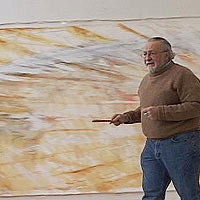
For more than 30 years, internationally recognized painter Nathan Oliveira occupied a serene studio nestled in the foothills above Stanford University, where he taught for decades. Spark visited Oliveira where he created some of his most famous works.

Oliveira is well-known as a major painter associated with a group of artists called the Bay Area Figurative School. Taking a cue from the abstract expressionist style that characterized East Coast painting in the postwar period, Oliveira and others used a thick, painterly style, but used it to represent rough, abstracted figures and landscapes.

Over the last 20 years, Oliveira had intermittently worked on “The Windover,” a series of paintings named for a poem by Gerard Manley Hopkins. The canvases, which depict abstract forms recalling wings, were inspired by the red-tailed hawks living in the foothills that surround Oliveira’s studio. In an effort to keep the series of nearly 20 paintings together as a group, Oliveira had been meeting with Stanford officials to create a quiet space somewhere in the foothills to house “The Windover” and be designed as a peaceful refuge where visitors can go to meditate and collect their thoughts.

Nathan Oliveira earned a B.A. in 1951 and an M.F.A. in 1952 from the California College of Arts and Crafts (now known as the California College of the Arts). He has won several awards, including an Artist’s Grant from the National Endowment for the Arts and the distinction of Ann O’Day Maples Professor in the Arts at Stanford University. In 1999, he was named Commander of the Order of Henry the Navigator, the highest civilian honor awarded by the Republic of Portugal, for contributions to Portuguese culture. His work can be seen in international collections, including the Metropolitan Museum, the Museum of Modern Art, the Whitney Museum of American Art and the Guggenheim Museum in New York, the Tate Gallery in London, and Smithsonian American Art Museum and the Hirshorn Museum in Washington, D.C.

  • Array
  • Array
  • Array

Robert Bechtle

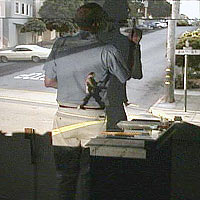
For more than 40 years, Robert Bechtle has been widely recognized as one of the founders of American photorealism, a style of painting that rivals the detail and objectivity of a photograph. In “Paint x 3,” Spark watches Bechtle at work rendering one of his favorite subjects — his Potrero Hill neighborhood — and talking about his motivations and images as he prepares for a retrospective exhibit of his work at the San Francisco Museum of Modern Art (February 12 through June 5, 2005).

When Bechtle began painting in the late 1950s and 1960s, the local art scene in the Bay Area was dominated by figurative and abstract expressionist painters who used the broad, painterly gestures of the East Coast abstract expressionist style to depict figures and landscapes. Bechtle initially began working in this expressionist style, but quickly found himself drawn toward making carefully detailed portrayals, observed and executed with the unblinking accuracy of a camera. Along with fellow realist artists Ralph Goings and Richard McLean, Bechtle helped popularize photorealism, a mode of painting whereby the artist covers over any trace of brushwork to produce an image that approximates a photograph as closely as possible.

The camera is an essential tool in making Bechtle’s paintings. His process begins by making photographs of the landscape around him, which he uses as a kind of sketchbook, selecting single images to develop into paintings. Bechtle projects the image onto the canvas and traces the basic lines and shadows of the image. He then completes the painting by matching his paints to the colors in the photograph.

Bechtle chooses as his subject matter the urban and suburban landscape that surrounds him — a terrain populated by neat bungalows and gleaming cars bleached by the California sun. His neutral, near featureless scenes — often devoid of any human presence — of neighborhood streets of San Francisco, Oakland and other communities reveal the deep-seated sense of alienation that characterizes the American middle-class neighborhood of the early 20th century.

Bechtle earned a B.A. in 1954 and M.F.A. in 1958, both from the California College of Arts and Crafts. From 1969 until he retired in 1999, he taught in the painting department at San Francisco State University. His works have been exhibited widely throughout the United States and Europe, as well as in Japan, Australia and New Zealand. Bechtle’s paintings can be found in the collections of the Metropolitan Museum, the Whitney Museum of American Art and the Museum of Modern Art in New York, the National Gallery of Art in Washington, D.C., the San Francisco Museum of Modern Art, the Oakland Museum, and many other public and private collections across the United States and abroad.

Array

  • Array
  • Array
  • Array

Catherine Wagner

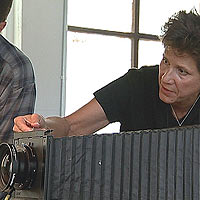
For more than 25 years, Catherine Wagner‘s photographs have served to record the world around us in ways that make the ordinary suddenly appear infused with mystery and wonder. In “Through the Lens,” Spark looks in on Wagner’s latest project, “Flux Density: A Narrative of Bubbles,” a large-scale commission for Frisson, a San Francisco restaurant.

Wagner’s past series have captured the world of our lives, from detailed black and white images of microscopic cell structures to our architectural environment. In the late 1990s, Wagner documented the construction of San Francisco’s Moscone Center in stages, from the excavation of the foundation to the cladding of the finished structure. Wagner’s “Home and Other Stories” series from the early 1990s chronicled domestic interiors. Always absent of human figures, the photographs focus instead on the conscious and unconscious details of living spaces that most reveal aspects of those who live within them.

In the last few years, Wagner has turned her lens increasingly toward the natural sciences. “Art & Science: Investigating Matter” brought Wagner into the laboratory to shoot the equipment and materials of scientific investigation. With “Cross Sections,” Wagner used magnetic resonance imaging technology to render materials transparent and reveal the internal structure of the organic world.

For “Flux Density,” Wagner shot a cloud of tiny aqueous bubbles onto a black and white 8-by-10-inch negative, rendering an extreme close-up with a startling degree of detail and precision. Though Wagner usually shoots on film, the negative for “Flux Density” was translated into a large digital file for transfer onto three large Plexiglas sheets. The sheets were then mounted onto a light box, creating a mammoth 6-by-30-foot image that is a stunning meditation on the beauty of everyday things.

Catherine Wagner earned a B.F.A. in 1975 and an M.A. in 1977, both from San Francisco State University. She has shown her work internationally and has held a faculty position in the art department at Mills College since 1979.

  • Array
  • Array
  • Array

David Choe

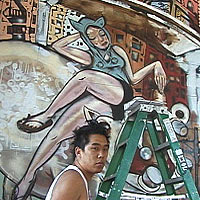
Like the sketches and murals that clutter his brain and blaze through his fingertips, David Choe confounds predictability. The South Bay graffiti artist is celebrated for startling visual intensity crossed with streetwise vision. He paints fast and furious — using aerosol, acrylic and watercolors — able to nimbly capture the slightest emotional serration. His works bridge two worlds and mindsets — the street and the gallery.

As a young man, Choe earned a reputation as a talented, free-spirited, law-flaunting graffiti artist, hustler and world traveler. His self-published award-winning graphic novels, “Bruised Fruit” and “Slow Jams,” have attracted people who were theretofore clueless about museum art and graphic novel genres. David’s talent for illustrating, through words and pictures, minute details of hopelessness, boredom and inner turmoil earned him a cult following. His work also earned equal amounts of criticism and acclaim for its flagrantly explicit and nihilistic nature.

The years passed, and his work matured with subtle depth, dignity, beauty and richness. His paintings commanded higher and higher prices; he produced illustrations for high-profile magazines and mounted dozens of gallery shows. In late 2003, Choe was invited to Tokyo to create a mural and participate in a group art show, and while there, he had a life-changing run-in with the law that resulted in his being curled up in pain in a Japanese jail cell. The charges, “committing violence,” stuck, and he spent three months in prison, the bulk of the time in solitary confinement.

While in jail, the last book he thought he would turn to was the Bible. Too cliché, too predictable, he thought. But like the born-again junkies and fallen rock stars and actors before him, the Bible became his saving grace. In the episode “Up from the Street,” Choe gives Spark his first on-camera interview since returning from jail. He talks about the incarceration, his new motivations and how his artwork may — or may not — change.

  • Array
  • Array
  • Array

Tommy Guerrero

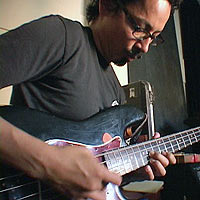
Native San Franciscan Tommy Guerrero is a legend in the skateboarding world. An original member of the famous Bones Brigade skateboarding team, Guerrero pioneered street skating in the 1980s and 1990s. Though he still skates and designs skateboards, lately Guerrero has been following his musical passions. As a solo artist and with his group Jet Black Crayon, Guerrero has been developing a hypnotic, pulsing style of music that is echoed in the sounds of the city he lives in. In “Up from the Street,” Spark checks in on one of San Francisco’s most versatile performers.

Guerrero made his name in skateboarding in 1984 when, as a young teenager, he entered the first streetskating competition, held in Golden Gate Park. The only amateur involved in the event, Guerrero won, beating out 15 well-known professionals. Propelled by this unprecedented success, Guerrero went pro, signing to the Powell Peralta skate team. Over the following years, Guerrero remained at the forefront of street skating, and in 1990, he helped found Real/Deluxe Skateboards, a San Francisco-based company that designs boards for skaters by skaters. Still a part owner in the company, Guerrero works as a designer for Real/Deluxe, creating graphics for decks, stickers, T-shirts, caps and other gear.

These days, though, Guerrero has been putting much of his energy into his musical projects. He has recorded several down-tempo, trip-hop records under his own name and two full-lengths with Jet Black Crayon, as well as doing guest spots on a number of other projects. Though writers and critics are fond of calling him an ex-professional skater turned musician, Guerrero is quick to point out that music has always been a part of his life, a track that has run parallel to his more public persona as a skater.

Just as Guerrero’s skating style took him to the city streets, rather than to skate ramps or empty swimming pools, so does his music turn to the urban environment for inspiration. Using music that evokes the sounds that might intertwine and drift through the streets, Guerrero’s moody, atmospheric music perfectly captures the tenor of San Francisco’s more urban neighborhoods. Listening to a Jet Black Crayon record, one might imagine an experience of the streets: hip hop beats pumping out of passing cars, a street performer strumming a guitar, the cacophony of passing conversations in multiple languages — all melding together into a hypnotic soundtrack for the city itself.

Array

  • Array
  • Array
  • Array
  • Array

Gary Stevens

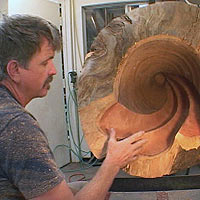
For more than thirty years, Gary Stevens has been working with wood. Since his days sitting at the lathe in his high school’s wood shop, Stevens has endeavored to create works of art that are themselves as moving and ruggedly striking as the wood from which they are made. In the Spark episode “By Hand,” Stevens takes viewers through his creative process, beginning with harvesting unusual pieces of wood from ancient redwood forests and continuing through the painstaking work that produces his uniquely beautiful wood vessels.

Stevens’s wood art begins with a careful selection of material carried out no farther away than the towering redwood forests that surround his Soquel, California, studio. As an artist who is sensitive to environmental issues, Stevens looks for fallen wood and tree stumps left by loggers. Mostly, Stevens searches out rare and unusual knotted and twisted burls often found at the base of trees. Many of these are more than a thousand years old, and their sinewy grain displays a patina that can only be produced by centuries of exposure to the elements. Removing these stumps, which can weigh well over a ton, is no small task. Stevens uses chainsaws, tractors and industrial cranes to get these rare pieces of wood to his studio, where he then faces the daunting undertaking of hoisting them and mounting them onto lathes.

It is the pieces of wood themselves that suggest to Stevens the forms that the finished work will take. Many woodworkers look for even, flawless material for their pieces to facilitate their crafting works that boast smooth, regular forms. Stevens values the eccentricities of his material, working his designs out of imperfections and unique growth patterns. Turning his pieces on the lathe and using chainsaws as well as finer planing and sanding tools, Stevens accentuates his material’s idiosyncrasies to produce challenging and hauntingly beautiful forms.

Stevens got his professional start in carpentry, and even though he has enjoyed a great deal of commercial success as an artist, he has never been tempted to quit his day job. Spark follows Stevens to a construction site in Alabama, where he has been called in to install some very rare antique white oak beams. In maintaining a career as a carpenter, Stevens has never had to rely on his art for his income, which has in turn afforded him a great deal of artistic freedom. Liberated from concerns about public taste and commercial viability, Stevens has been free to create challenging works that are helping to shape the future of wood art.

Array

  • Array
  • Array
  • Array

Pamina Traylor

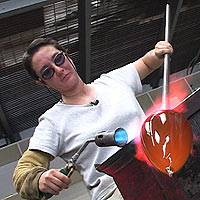
On the Spark episode “By Hand,” glass artist Pamina Traylor turns molten glass into pieces of lyrical beauty. Even though Traylor’s glass work is by hand, her hands initially can’t touch the glass itself. She begins by dipping a pipe into a lake of molten glass the consistency of honey, gathering it out, and starting to shape and blow the glass. Then Traylor often relies on many sets of hands to strike while the glass is hot.

Having received her undergraduate degree in mathematics, Traylor was pursuing an M.B.A. at SFSU and working in the stock transfer department of a downtown San Francisco securities firm. She stumbled upon the art glass program at San Francisco State University and signed up for her first glass course the very next day. The sudden interest turned into passion as Traylor traded a planned career in business for a new life as a full-time artist.

When she told her parents that she wanted to be an artist, they assumed that they would have to support her, but Traylor has been able to earn a living through teaching, producing studio glass work and creating her art. She began a new path in education, receiving her M.F.A. from the Rochester Institute of Technology, and has completed additional studies at the Haystack Mountain School of Crafts, Pilchuck Glass School and San Francisco State University. She was awarded fellowships at the Creative Glass Center of America in both 1995 and 2003.

She is currently an adjunct professor at California College of the Arts, where she was chair of the glass program in 1999 and 2000. She also works at Pinzette Studios for Michael Sosin, producing handmade functional glassware for sale in galleries and museum shops. She produces 50 to 80 pieces a day when working at Pinzette Studios, which works out to about one piece every six minutes. Traylor says the repetitive experience of working in the shop has been the best way to learn. “When you do it over and over again, that’s when you start to get good at it.”

A hot shop requires a furnace to be operating 24/7 at over 2000 degrees Fahrenheit to keep hot glass from hardening and damaging the furnace. Few artists can afford to have their own; working at Pinzette Studios enables Traylor to utilize their hot shop for her own personal work. In addition, she and her partner have just completed the conversion of an old office into a live/work space so now Traylor can do cold work in her home studio, sanding, etching and finishing her pieces.

Traylor’s personal works are now on display in galleries and collections across the country. Much of her current work involves combining other materials with glass. Some of the new pieces have text and photographic images so you can look through the object and see how it magnifies and distorts the words. “It makes you think a little bit about how words are distorted when we speak to each other … how what you say is different from what is heard.”

The ambiguity of language is a common theme in Traylor’s work, often represented by glass shaped into tonguelike forms. She uses tongues as a symbol of language, using extreme versions iconically. Though she tends to have an overall view of the piece before creating it, she is more excited by moving around roadblocks during the process. She says, “The best pieces are the ones that develop because of things you discover along the way.”

  • Array
  • Array
  • Array

Chris Natrop

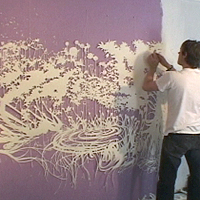
Chris Natrop’s large-scale, hand-cut paper art is inspired by his environment and stream of consciousness. The pieces are unique and comprised of intricate and entwined designs that are reflected into multiple dimensions with the shadows that they cast. He draws directly on the paper with a utility knife, eliminating the possibility of correction and making his work more free-form.

Chris Natrop earned an B.F.A. at School of the Art Institute of Chicago in 1993. He is a Los Angeles-based artist and has exhibited nationally and internationally.

  • Array

Sixth Street Photography Workshop

When George Eastman produced the first commercially available camera, called the Brownie, in 1900, he hoped that photography would become accessible to everyone — providing people from all walks of life with an easy and fun method to document the world around them. In 1992, when photographer Tom Ferentz founded the Sixth Street Photography Workshop, his vision was as egalitarian, but with a specific focus — to bring photography and creative exploration to the residents of San Francisco’s hotels and shelters in the Sixth Street corridor.

Ferentz started the program in connection with TODCO, a SOMA housing/community development nonprofit organization. Today, housed in the somArts Cultural Center, the Sixth Street Photography Workshop serves the residents and residences of Sixth Street, SOMA and the Tenderloin, including homeless, transient residents and other people living below the poverty line. Many people living and working in these neighborhoods are involved in the program whether as photographers, subjects or audiences. Ferentz and program associate and darkroom manager Amanda Herman manage all aspects of this program, from teaching to fund-raising to organizing and hosting exhibitions and openings.

More than 300 photographers have gone through the program to date. Despite the many challenges that face its members, participation in the workshop is consistent. The flexibility of membership enables photographers to take just one class or to stay for months or even years to hone their craft in the weekly sessions. In addition to Ferentz’s and Herman’s facilitation of the program, a group of some 20 experienced photographers volunteer their time to teach participants the technical aspects of framing, composition and exposure and advanced printing techniques. With this focused attention, some Sixth Street photographers commit stridently, developing full series and otherwise investigating of their subjects or ideas.

Beyond the classes and the darkroom, the workshop offers its participating photographers different projects and opportunities to show their work in the community, including exhibitions and portrait events. Each year, exhibitions are held in some of San Francisco’s low-income and transient housing complexes in gallery-like settings — providing powerful works of art for the residents and offering unique and diverse perspectives on a world rarely shown, by artists embedded in its culture.

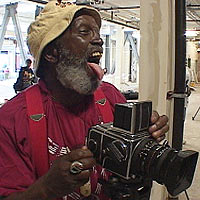
Spark follows a few of the photographers that are part of this program including Robert Farrell and Max Nolan.

Array

  • Array
  • Array
  • Array

Eleanor Coppola

In Circle of Memory, Eleanor Coppola has created a sanctuary for those experiencing painful grief from loosing a child. Spark checks out Coppola’s emotional and thought provoking installation at the Oakland Art Gallery.

Circle of Memory is one of Eleanor Coppola’s first major art installations. However, she is a seasoned veteran within the arts. Her books, films, and costume designs have all earned her praise. Coppola’s first book, Notes on the Making of ‘Apocalypse Now’ is a first-person narrative that describes the intense production of the movie Apocalypse Now, and was later adapted into the Emmy Award winning film called Hearts of Darkness: A Filmmaker’s Apocalypse. Published in 2008, her second book Notes on a Life compiles 30 years of journal writing and letters with friends and also covers the death of her eldest son, Gio, which inspired the creation of Circle of Memory.

When Coppola visited a friend in Ireland, she was introduced to an ancient tomb used for rituals dealing with birth and death. This powerful experience inspired her and five other artists to reinterpret the passage tombs, and thus, Circle of Memory was created. Coppola created a structure made of straw bales based on the cairns the passage tombs formed. At the center is a circular room for reflection which provides visitors slips of paper to write on and contribute to the work. As Circle of Memory travels around the world, the space evolves with the addition of visitors’ messages left in the straw. Combined with sound and shadow interplay elements, this public space is a multi-sensory experience allowing for the loss and remembrance of children who have died or been lost. Coppola hopes the exhibit provides a universal place of remembrance, especially as the current culture often does not provide a place to reflect on one’s losses.

Upon completing her degree at UCLA in applied design, Eleanor Coppola worked as a freelance designer doing fabric-and-collage murals for architectural installations. In 1962, she was the assistant art director for Dementia 13, a low-budget independent film. There she met writer/director Francis Coppola and the two married the following year. She has designed costumes and stage décor for the ODC Dance Company San Francisco and her drawings, photos and conceptual art pieces have been exhibited in many galleries and museums.

  • Array

Sandra Woodall

Though Sandra Woodall is not on stage, her costume work is an integral part of stage performances. In the episode “Backstage Crafts,” Spark looks at this costume designer from inspiration to execution. Woodall and her colleagues speak of her process and work, showing examples from a variety of performances. An award-winning costume designer, Woodall works in many genres including ballet, modern dance, performance art and theater.

An Oakland native and graduate of the San Francisco Art Institute in painting, Woodall was taught to sew at an early age by her grandmother. Upon graduation, she became a design assistant at the San Francisco Opera House. Since 1970, Woodall has had a studio in the heart of San Francisco’s SOMA district, where for 18 years she employed up to 35 seamstresses to produce and build costumes for designers from all over the world. Woodall now uses the space exclusively for design.

With more than 200 productions to her credit, Woodall often works on designs for multiple projects at any given time. Organizations like the San Francisco Ballet think of their costumes as major assets that can be used again for future productions or rented out to other companies. For a full-length ballet, the costume budget alone can run as high as $250,000.

Woodall takes all aspects of the production into account, and each piece is injected with her unique perspective and sense of the beautiful and unexpected. She is able to evoke different feelings with even the simplest of details — such as creating a sense of the feminine with the custom placement of delicate lace to the use of black lights to mimic a jellyfish in the ocean.

Woodall often uses motifs of nature and is inspired by the images and objects that she collects. When Woodall was a Fulbright scholar in Taiwan (1999-2000), she began collecting local insect specimens, which became a springboard for her costumes for “Welcome to Shangri-La,” a play about a man whose life was in conflict with nature.

Collaboration for Woodall starts at the beginning of each piece, and she is insistent that even if her vision is correct, the costume can’t be realized if the sketch is not. Because of this, great attention to detail takes place at every step of the process, from the medium in which the sketch is created to the fabrics that she selects. For A.C.T.’s production of Henrik Ibsen’s “A Doll’s House,” Woodall used a collage process in which she combined a photo of a costume of the period with an overlay with sketches of her own.

Though Woodall is still in high demand for her costumes, she has been shifting her focus, returning to her early interest in painting. “When I was growing up, I never imagined I would be working in theater. I always thought I would be an artist.” She continues to work on things that interest her, but states, “I have to really discover what my painting style is going to be.”

  • Array
  • Array
  • Array

Oxbow School

Since 1999, The Oxbow School, in Napa Valley, has been giving young people from around the country an opportunity to develop their artistic skills in advanced programs that go beyond those offered in high schools. In the episode “The Young and the Restless,” Spark follows the progress of a group of students from their arrival on campus to graduation day.

Ann Hatch, who also founded San Francisco’s residence gallery Capp Street Project, conceived The Oxbow School as a way for high school students to study art in a professional environment, interacting with living artists and surrounded by other students interested in making art. Oxbow’s program mirrors those of college undergraduate and graduate programs, creating a close-knit community of artists who work together and exchange ideas about art. Students get to participate in critique sessions in which they present their work in front of teachers and peers, who respond with questions, constructive criticism and suggestions.

Oxbow offers small programs, with only 48 students and eight faculty members attending each semester. The result is an intimate environment, in which students interact on a daily basis, living in residence together, taking meals together and exploring the Bay Area arts scene together. As a way of expanding the classroom outside the school’s walls, students are taken on field trips to art institutions and art colleges in the region, as well as to the studios of working artists to get a glimpse into the workings of the contemporary art scene.

At the end of the semester, students present a final project, the culmination of the skills and knowledge that they have gained over the preceding months. Parents come to visit from all over the country and are often surprised by the high level of work produced by their children. For many students, the Oxbow program has been a transformative experience, providing them with new ways of thinking about their work and an in-depth understanding of the art world. While some may go on to become working artists, many others have found that the experience has made them more aware of other creative outlets they could pursue professionally, such as music, video production and fashion.

Array

  • Array
  • Array
  • Array

Anna Von Mertens

Anna Von Mertens‘s quilts are works of extraordinary depth and complexity. Composed of bold colors in broad geometric patterns, Von Mertens’s quilts at first glance resemble color field paintings or minimalist sculptures. Up close, however, it becomes apparent that Von Mertens has superimposed multiple systems and layers of meaning in a single piece, merging the psychological with the geographic, the aesthetic with the scientific. The Spark episode “Needlework” follows Von Mertens as she begins work on her new series of three quilts, provisionally titled “Gray Area.”

For Von Mertens, the process of making a quilt requires an enormous investment of both time and painstaking labor. Once she has developed the concept for a piece, Von Mertens begins her design on a computer, working out the colors and overall arrangement of the piece. Using the colors she has selected in the computer model, she goes about hand-dyeing the material for the quilt, attempting to match the colors of the model as closely as possible. After she has cut and machine sewn the individual pieces of the quilt, she goes back to the computer to work out the stitching pattern, which can come from a variety of sources — from geological profiles of landmasses to patterns of energy dispersion to the topography of her own body. Using a transparency, Von Mertens projects the pattern and traces it onto the material itself. Von Mertens then sets about the laborious process of stitching the pattern. Since a single work may incorporate as many as 100,000 stitches, this arduous task may take several months to finish.

Von Mertens’s most recent series uses the West Coast as a metaphor for the future and the inevitable uncertainty that comes with it. The works draw on the vibrant colors of the Western sunset, laid out in wide bands that are pulled out to a point just beyond the surface of the quilt. For Von Mertens, this suggests the uncertainty of the future, a point beyond the horizon that is always just outside of view. For the stitched layer, Von Mertens has decided to use the tide patterns of the San Francisco Bay, but has rotated and overlain them to create an image of chaos.

Whereas many contemporary quilt artists have tried to separate their quilt making from the medium’s traditional status as craft by hanging their work on walls as one might a painting, Von Mertens insists on exhibiting her work on flat platforms, in order to deliberately associate her creations with beds. For Von Mertens, the bed provides a context rich in associations — birthing, sexual activity, sleeping and dreaming, death — that embody themes to which Von Mertens regularly returns.

Array

  • Array
  • Array
  • Array

Don Ed Hardy

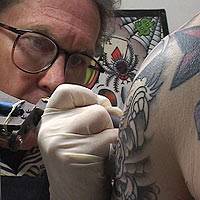
Ever since Don Ed Hardy was a boy, he has been making tattoos. At the age of 10, Hardy opened a toy tattoo shop out of his mom’s house and drew designs on the neighborhood kids using colored pencils and eyeliner. Since then he has done literally hundreds of thousands of tattoos. The Spark episode “Needlework” joins one of the world’s best-known tattoo artists as he looks back on a lifetime of putting ink to skin, a journey that has taken him from the tattoo parlor to the gallery and back again.

Hardy is internationally recognized as a pioneer in tattooing, having been among the first to cross Western and Japanese tattoo styles. Western tattoos are typically single, isolated emblems; Japanese tattoos often integrate a number of images in a single design that might cover a person’s entire torso. Hardy first became interested in Japanese tattooing in the early 1950s — his father had taken an engineering job in Tokyo and began sending him Japanese artifacts and clothes as well as books of Japanese art.

In the mid-1960s, Hardy attended the San Francisco Art Institute, where he completed a B.F.A. in printmaking. He was offered a scholarship to Yale in the M.F.A. program, but decided instead to pursue tattooing full time. He sharpened his technical skills working in a series of shops in sailor districts along the West Coast and forged contacts with accomplished older artists, such as the legendary Honolulu tattooist Sailor Jerry Collins.

In 1973, Hardy became the first non-Asian to gain access to the Japanese tattooing subculture when he was invited to study with renowned classical tattoo master Horihide. He returned to California after six months and began doing tattoos by appointment, working collaboratively with his customers to develop large-scale designs. Later, in San Francisco’s North Beach, he opened Tattoo City, which has since become a mecca for tattoo enthusiasts.

Hardy has helped to transform tattooing in America, bringing to it a greater sophistication, depth and sense of experimentation. What had been a marginal practice when Hardy began making tattoos in the 1960s, something relegated to drunken sailors, is now a widespread, even mainstream phenomenon. The number of tattoo artists in North America has risen from about 500 when Hardy began his career to about 50,000 now.

Although Hardy mainly did only tattoos for about 20 years, lately he’s been doing other forms of art. To celebrate the new millennium — a dragon year in the Chinese zodiac — Hardy produced a 500-foot-long painting on paper featuring 2,000 dragons. The piece took him seven months to complete and opened him up to producing more gallery work. For Hardy, painting and tattooing are not separate activities; rather, they inform one another. With all his artwork, Hardy attempts to create a world of mystery, humor and weird beauty that eludes categorization.

Array

  • Array
  • Array