Category Archives: Visual Arts

Alice Wingwall

When noted photographer and sculptor Alice Wingwall began losing her sight, she became determined to continue making visual art. Now almost completely blind, Wingwall remains a vital visual artist, making lyrical and poignant photo-based works that often express her experience of being without sight. Spark checks in on Wingwall as she works on a new series of architectural photographs.

Wingwall suffers from retinitis pigmentosa, a hereditary degenerative disease of the eye. After all but losing her perception of light a number of years ago, Wingwall discovered that a great deal of her experience of vision happens in her mind. The brain is capable of representing line, color and perspective even without the help of eyesight.

She rarely photographs all alone — she asks colleagues, including her husband, architect Donlyn Lyndon, to look through her lens and describe what they see. During this collaborative process, she describes her “mind’s eye” image and asks if the camera captures this view, using her deep store of memory for other comparison points.

Along with her memory, Wingwall relies to a great degree on her other senses in making her photographs. She may feel the heat of the sun in order to get a sense of the strength and direction of the light source, and she may similarly sense the reflected light radiating from her subject.

Wingwall often uses auto-focus cameras to capture images. In addition, she uses an array of lenses intended to capture her failing sight. Although a 50-millimeter lens renders an image close to what the human eye sees, Wingwall is fond of using wider lenses and panoramic cameras that warp the image and represent her newfound inner vision of the world.

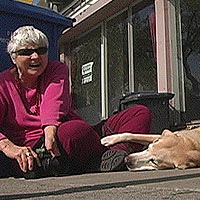
Several of Wingwall’s photographs deal with her experience of working as a visual artist without the aid of sight. Many of her works feature architecture — one of her favorite subjects — superimposed with images of her guide dog, Slater, or his predecessor, Joseph. These images highlight the ways in which her negotiation of the world around her is now mediated through another being, and the intimate relationship that that establishes between her and her dogs.

Alice Wingwall earned an M.F.A. in sculpture from UC Berkeley and was a professor of sculpture and director of the studio arts program at Wellesley College. She has explored many different mediums, and she trained in stained-glass fabrication in Paris. She co-directed a film with Wendy Snyder MacNeil titled “Miss BlindSight/The Wingwall Auditions,” which won Best Independent Film at the 25th anniversary New England Film and Video Festival.

  • Array
  • Array

NIAD

The facility of the National Institute of Art and Disabilities (NIAD) in Richmond includes an art studio and gallery that serves 50 adult artists of a range of ages and ethnic and socioeconomic backgrounds. Spark visits with the artists in the NIAD’s award-winning day program as they find new forms of expression, independence and dignity.

One of the NIAD artists is Mike Starosky, who is fondly known as “Big Mike.” Starosky was diagnosed with schizophrenia and developmental disabilities at 12 years old. Under the guidance of five professional artists, Starosky and his fellow artists learn skills in drawing, painting and printmaking as well as ceramics, textile arts and sculpture.

NIAD teachers demonstrate a variety of approaches and aid the artists in their exploration of different materials and techniques to develop their own individual styles. Weekly classes in independent living skills, including interpersonal social skills, money management, mobility training, self-care and culinary skills, also help the artists to become more self-reliant.

Another important part of the NIAD’s work is its exhibition program. The organization develops and curates up to seven exhibitions a year with art made by its resident artists. Through this program, the artists see their work in a gallery setting, which validates their role as artist and increases their self-esteem. Proceeds from the sales of the art are split with the artist. The NIAD uses its proceeds to fund the exhibition program.

Dr. Elias Katz, a clinical psychologist, and the late Florence Ludins-Katz, an artist and educator, co-founded the NIAD in 1982. The organization has received the Helen Crocker Award from the San Francisco Foundation, the Vineyards Award from the Golden Gate Chapter of the National Association of Fund-Raising Executives, and recognition from the California State Council on Developmental Disabilities and Advocacy Inc. The NIAD was awarded a grant in 1998 from the National Endowment of the Arts to develop a traveling exhibition.

Array

Chris Drury

For more than a quarter-century, internationally recognized British artist Chris Drury has used the materials and processes of nature in his work. Drury’s lyrical, often temporary installations mimic patterns that already exist in the natural world. Spark visits with Drury as he prepares a series of works for a six-week residency at the Montalvo Arts Center in Saratoga, California, culminating in a show called “Whorls: Installationsby Chris Drury,” an indoor and outdoor exhibition featuring three site-specific nature-based installations.

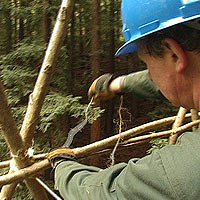
Of Drury’s projects at Montalvo, the most ambitious is “Redwood Vortex,” an installation in the redwood groves above the complex. With the help of assistants, Drury created a spiraling vortex of willow branches that surrounds one of the area’s towering redwoods. The installation reaches more than 60 feet above the ground. Drury decided on the spiral form in order to express the flow of sap, which follows a corkscrew movement up the tree’s trunk. The project proved to be no simple task, as the branches that Drury chose turned out to be less supple than expected, and the team spent a month in the redwoods building the vortex.

Much of Drury’s work explores connections between common shapes and movements that can be found in the natural world as well as in our own bodies. In addition to “Redwood Vortex,” Drury produced indoor works for the center’s gallery that examine these concordances. Two of these works are based on the cardiac twist, a double spiral pattern that describes the movement of blood in the human heart, a pattern that can also be found in fingerprints as well as in many places in nature.

For the large “Fingerprint Mural,” Drury projected images of fingerprints onto a wall, then had his assistant paint latex onto the white areas and paint the wall with dirt. When the latex was removed, the result was a series of interwoven fingerprints painted with materials that refer to the pattern’s prevalence in nature. Drury reused the cardiac twist in a floor piece called “Sequoia Whirlpool,” in which sequoia sticks are arranged in a double vortex pattern around a stone, again emphasizing the commonality of the form in both the human body and the natural landscape.

More about Montalvo Arts Center
The Montalvo Arts Center is a nonprofit organization dedicated to forging meaningful connections between art and artists and the communities it serves, through creation, presentation and education. The organization was founded in 1930, when Senator James Duval Phelan left the 175-acre property, including a stunning villa, to the people of California for the encouragement of art, music literature and architecture. In 2005, the organization changed its name from Montalvo to Montalvo Arts Center to commemorate its 75th year as an arts center and to better communicate its mission to expanding local, national and international audiences.

Montalvo
montalvoarts.org
Where: 15400 Montalvo Rd., Saratoga
Phone: (408) 961-5800

Array

  • Array
  • Array

Jim Denevan

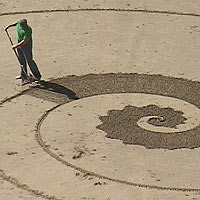
Jim Denevan performs drawings — making temporary sculptures on the sandy beaches of Northern California. Using only a stick and a rake, Denevan’s work is monumental in scale but as fleeting as any live performance. Spark tails Denevan in San Francisco and Santa Cruz as he composes two sand works and talks about his meditations and his process.

It was Denevan’s passion for surfing that led to his vision of the beach as a blank canvas. The shapes he fashions — spirals and other simple geometrics — are familiar, yet their scale and location are particular and proportions amazingly precise. The drawings exist for a few precious hours before they are erased by the incoming tides, and one has to view the drawings from 150 feet up or more in order to see them in their entirety.

Denevan considers process an integral part of his artwork and chooses his locations thoughtfully. In his mind, every step is a kind of temporary sculpture. Denevan then walks for miles, leading his chosen drawing stick in a dance performed to the music of the ocean and the spirit of the place. Denevan says, “My movement has a present. And then where I want to be, that’s the future. … Then the line has a past.”

Jim Denevan, who is also a chef, has received increasing attention in the past few years for both his art and his cooking. Denevan’s work was included in the “Big Deal” exhibition at San Francisco’s Yerba Buena Center for the Arts (January through April 2005), along with artists Scott Snibbe, Christopher Tagg and Johnston Foster. In addition, a feature-length documentary film about Denevan called “Sandman,” directed by award-winning director Chesley Chen, is slated to be released in late 2005.

Array

  • Array
  • Array

Ruth Asawa

Editor’s note: This story was originally published in 2005. Ruth Asawa passed away on Aug. 6, 2013.

For more than five decades, sculptor Ruth Asawa has been associated with some of the most notable figures in American 20th-century art. As a young woman, she studied at the legendary Black Mountain College under Josef Albers and Buckminster Fuller, alongside John Cage, Merce Cunningham, Robert Rauschenberg and Anni Albers. In addition to producing an impressive body of work, Asawa has been a vocal advocate for arts education.

Asawa’s elegant cast bronze, stainless steel and glass-fiber reinforced sculptures have graced the Bay Area since 1968. As public works of art, their weight and permanence belie the importance of process to the artist, who obsessively manipulates materials to find forms translatable into large-scale works. For Asawa, the path that leads to the production of a finished piece is as important as the work itself. Two of Asawa’s large cast sculptures and fountains began as folded paper, others were modeled from baker’s clay, and her signature wire mesh had their beginnings when she learned a local metal looping technique while visiting Toluca, Mexico as a student volunteer in 1947.

Spark visited Asawa as she and her family assembled an expansive retrospective for the reopening of Golden Gate Park’s de Young Museum in October 2005. In preparation for this exhibition, Asawa’s daughter, Aiko Cuneo, had been busily organizing her mother’s work as well as selecting a variety of drawings and preparatory works. It is a labor of love for Cuneo, whose memories of childhood are interwoven with her mother’s constant art-making.

As a strong supporter of public arts education, Asawa helped found San Francisco’s only public high school devoted to the arts (renamed in 2010 as the Ruth Asawa San Francisco School of the Arts) and spearheaded the Alvarado Arts Program, which brought working artists into San Francisco’s public schools. Asawa has fought hard to enhance the level of arts teaching and curriculum in San Francisco’s public schools. Activism in favor of arts education has become a tradition in Asawa’s family; at time of filming, her son, ceramicist Paul Lanier, was an artist-in-residence at Alvarado Elementary, where the Alvarado Arts Program originated. Lanier attended the school as a child.

Ruth Asawa left Black Mountain College in 1949. Her work has been exhibited internationally and can be found in major collections, including the San Francisco Museum of Modern Art; the de Young Museum; the Museum of Modern Art, New York; the Solomon R. Guggenheim Museum; and Whitney Museum of American Art. She has received numerous awards, including the Fine Arts Gold Medal from the American Institute of Architects and the Award for Outstanding Achievement in the Visual Arts from the Women’s Caucus for Art. In 1982, Feb. 12 was declared Ruth Asawa Day in San Francisco.

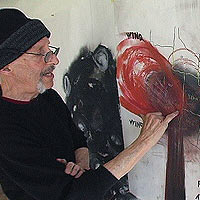
Richard Kamler

Artist, educator and curator Richard Kamler has gained a reputation for taking on tough subject matter. Since the mid-1970s, Kamler has produced work built on the premise that art can help to effect social change and cultural transformation. Spark visits the artist in the studio as he works on an installation that documents his own battle with cancer.

Kamler is an installation artist whose works are often designed for locations outside the traditional museum or gallery space. “Table of Voices,” which Kamler made in the mid-1990s, was one of several he created for prisons. Installed on Alcatraz Island, the piece brought together recordings of the voices of parents of murdered children with those of the perpetrators. Visitors to the installation could pick up a phone on one side of a long table and hear the voice of a victim’s family member and move to the other side of the table to hear the voice of a convicted murderer. The controversial piece generated a heated public debate that helped to initiate a reconciliation program for offenders and victims.

More recently, Kamler has approached another subject very close to his heart. In 2004, Kamler was diagnosed with thyroid cancer, an event that temporarily suspended his art-making activities. He had his thyroid gland removed before enduring a series of radiation treatments. Kamler was struck with the paradox that the treatment for his cancer was linked to what may have caused the illness in the first place. Having grown up in an area close to numerous government nuclear testing sites, Kamler has come to believe that these tests are responsible for his cancer and that this constitutes a criminal act on the part of the government.

Dedicated to change through art, Kamler is transforming his rage over this negligence into a work of art chronicling his illness alongside the history of government nuclear testing in America. Spark visits Kamler at his studio in the Headlands Center for the Arts as he transforms his meticulous journals into a series of large charcoal drawings to be used in a broad and multilayered installation.

Richard Kamler received a B.A. in 1963 and an M.A. in 1974 from the University of California, Berkeley. He has received numerous awards, including a National Endowment for the Arts Visual Arts Fellowship in the New Genres category, an Alaskan State Arts Council/NEA grant, several California Arts Council Artist-in-Residence awards, and grants from the Gunk Foundation for Public Art, the Institute of Noetic Science and the Potrero Nuevo Fund. He is currently the chair of the visual arts department of the University of San Francisco, where he is also responsible for the art outreach program “Artist as Citizen in Contemporary Society,” which places artists into various communities.

  • Array
  • Array
  • Array

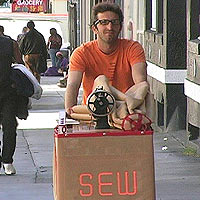
Michael Swaine

On the 15th of every month, from noon to 6pm, performance artist Michael Swaine sets up shop in San Francisco’s blighted Tenderloin District. Pushing a homemade cart mounted with a treadle-operated sewing machine, Swaine offers his services as a street tailor, mending whatever garments the neighborhood’s denizens bring him. In the episode “Street Art,” Spark visits the artist in action as he makes his monthly rounds.

Swaine’s ongoing tailor piece began as part of “The Generosity Project: Strategies for Exchange in Contemporary Art,” held in 2001 at the California College of Art’s Wattis Institute. Originally titled “Reap What You Sew,” the performance consisted of the artist pushing his cart around the city on a predetermined route for an entire week. Swaine considers the project a collaboration between himself and those whose clothes he patches, mends, hems and darns — an opportunity to create social interaction where there would otherwise be none.

Born in Buffalo, New York, Michael Swaine earned a B.F.A. from New York State College of Ceramics at Alfred University before going on to study advanced ceramics and sculpture at the School of the Art Institute of Chicago. Since 1999, Swaine has collaborated on numerous projects with Amy Franceschini as part of the artists collective Futurefarmers.

  • Array
  • Array
  • Array

Chris Cobb

Installation artist Chris Cobb‘s “There Is Nothing Wrong in This Whole Wide World” involved reclassifying the books at the Mission District’s Adobe Books — by color. Cobb, along with nearly 20 assistants, spent an entire night arranging all of the neighborhood bookstore-and-sometime-gallery’s estimated 20,000 books to create a continuous spectrum, covering the whole shop. The installation remained in place from November 12, 2004 until January 20, 2005. Spark checked in on Cobb and his team as they transformed an everyday space into a stunning work of art.

Adobe was a carefully chosen site for Cobb, who saw his project as a tribute to the shop’s endurance as a kind of resource and community center for book lovers and artists. In the 15 years since Adobe first opened its doors, it has become a launching pad for many young, up-and-coming San Francisco artists and musicians. By turning the shop itself into a work of art, Cobb wished to pay tribute to the store’s history and to celebrate its future.

Installation art differs from more traditional forms in that it is concerned with the alteration of an entire space rather than the production of an isolated object. Part of the lyricism of Cobb’s project at Adobe came from the fact that the artist has neither added nor taken away anything in the bookstore, but merely rearranged what was already there to create a completely dreamlike space.

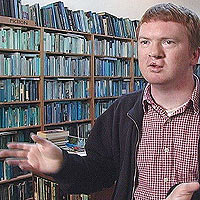
Adobe Books employee Shi Ananda, who assisted in reshelving the books when the installation ended, noted that blue-colored books sold the most, brown books were most often stolen and red books tended to remain on the shelves. There were more white books in the store than any other color, whereas very few books were colored yellow.

Cobb earned a B.F.A. from the San Francisco Art Institute and is currently studying in the graduate art practice program at the University of California, Berkeley.

Adobe Books
adobebooks.org
Where: 3166 16th St., San Francisco
Phone: (415) 864-3936

  • Array
  • Array
  • Array

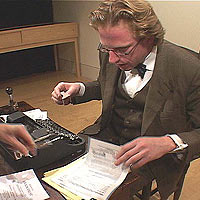
Jonathon Keats

San Francisco writer, critic and conceptual artist Jonathon Keats is looking for God, and he thinks he may have found Him — in a petri dish. Spark trails Keats as he works on his latest project, “Divine Taxonomy,” which attempts to find God’s place on the phylogenetic tree.

Keats works with what he calls “found processes,” procedures that he discovers in the activities of everyday life that he then appropriates for his art. In “Brain Trust,” Keats adopted the process involved with buying shares of a company’s stock. Keats offered futures contracts for shares of his brain to be exercised upon his death, at the bargain price of 10 dollars per 1 million neurons. The complicated process draws attention to the procedure itself rather than to what the process apparently seeks to accomplish.

Keats’s latest work attempts to determine what God’s DNA might look like by discovering whether it is closer to that of a fruit fly or blue-green algae (cyanobacteria). With the assistance of Smithsonian zoologist Mark Moffett and Berkeley geneticist Tom Cline, Keats assembled three groups of each species and exposed them to continuous tape loops of prayers from the three major monotheistic religions — Judaism, Christianity and Islam. Keats also established a control group that was exposed to recordings of talk radio.

“Divine Taxonomy” could be seen as a test for the creationist/evolutionist debate. Cyanobacteria are simple, single-cell organisms and are believed to be the oldest life form on Earth, whereas fruit flies exist on the same phylogenetic branch as human beings. If evolutionary theory is accurate, then God’s DNA should most resemble cyanobacteria. On the other hand, if the creationists are correct, then God’s genetic makeup will prove to be more like those animals closest to those He created in His own image.

Jonathon Keats has published in several venues, including “The New York Times,” the “San Francisco Chronicle” and “Wired,” and has written columns for Artweek and “San Francisco Magazine.” “Lighter Than Vanity: A Novel,” his second long work of fiction will be published by Eksmo Press.

Array

  • Array
  • Array
  • Array

Laura Splan

Mixed media artist Laura Splan borrows from anatomy and medicine to make works of art that are both unsettling and oddly beautiful. Spurred by advances in medical science and technology, Splan’s paintings, sculptures, photographs and videos explore connections between the inside of our bodies and the world outside. In the “Artist in Search of a Medium” episode, Spark gets a guided tour of Splan’s remarkable objects.

Splan comes from a family involved in the medical field. Both her father and her sister work for a company that makes artificial bones and other medical implants, and her grandmother was a nurse. Following in their footsteps, Splan moved to California to study biological sciences at the University of California, Irvine, but soon abandoned her major to study art instead. When she went on for her M.F.A. at Mills College, she continued to pursue her interest in the medical sciences by complementing her art education with an independent study in microbiology.

Splan’s work regularly combines medical imagery and materials with objects associated with home and domesticity. In the “Wallpaper/Samples” series, begun in 2003, the artist uses samples of Victorian wallpaper designs, painting over their intricate lines in her own blood. The patterns, intended to evoke a sense of familiarity and comfort, are put in tension with the visceral and potentially disturbing medium in which Splan has chosen to render them. Similarly, in her 2004 “Doilies” series, Splan created a series of beautifully intricate doilies — icons of quaint domestic interiors — but built their patterns on the structures of viruses — SARS, herpes, influenza and HIV.

Other of Splan’s works deal with the culture and practice of medicine. Her “Stethoscope” extends the tubing of a normal stethoscope to an absurd 25 feet, and her “Tongue Depressors” and “Cotton Swabs” are stretched to four feet. Before the invention of the stethoscope in 1816, doctors would put their head directly on the chest of the patient. The instrument introduced a mediating distance between professional and client. These works speak to the sense of alienation engendered by these objects in what would otherwise be very intimate acts.

Laura Splan’s work has been exhibited at many Bay Area venues, including SFMOMA Artist’s Gallery, the San Jose Institute of Contemporary Art, the Catharine Clark Gallery, the San Francisco Arts Commission Gallery, the Headlands Center for the Arts and Southern Exposure, and in galleries around the country. In 2003, Splan was the recipient of a Trillium Fund Grant, and in 2004, she won a Kala Art Institute Fellowship.

  • Array
  • Array
  • Array

Garry Knox Bennett

For more than three decades, Garry Knox Bennett has been at the vanguard of furniture making with his unusual tables, desks, chairs, clocks and lamps. Working in the face of woodworking purists, Bennett became one of the first furniture craftsmen to use Formica, plastic, aluminum and other unconventional materials in his pieces. In “Elevating the Everyday,” Spark visits the artist at work as he produces chairs for an exhibition called “Garry Knox Bennett: Preoccupations of a Serial Chairmaker.”

Bennett has gained a reputation in the world of woodworking as something of a revolutionary for his daring innovations and often whimsical creations, perhaps best demonstrated in his piece “Nail Cabinet” (1979). In part as a response to the woodworking mainstream, Bennett produced a lavishly crafted cabinet that rivaled even the most canonical examples of the form. When the piece was finished, Bennett drove a large nail into the cabinet’s door, scandaling the more traditional woodworkers.

Bennett’s “Preoccupations of a Serial Chairmaker” is composed of 50 chairs for an Oakland Museum of California offsite exhibition (January 20 through March 25, 2005) at Gallery 555 and the Sculpture Court. Several of the chairs rework Gerrit Rietveld’s 1934 design, the classic Zig Zag, whereas others offer modifications to standard mass-produced garden and lawn chairs. The diversity of pieces is a reflection of Bennett’s working method: Rather than beginning with sketches and drawings, Bennett goes straight to the materials, working them part by part into a finished idea. It is a technique that allows Bennett the freedom to change the direction of a piece several times before it is complete.

In addition to being a renowned master craftsman and innovator, Bennett is also a collector of rare and unusual furnishings and decorative objects. He and his wife, Sylvia, share a collection that spans 40 years, selections from which formed the inaugural show at San Francisco’s Museum of Craft and Design, “Dovetailing Art and Life: The Bennett Collection,” in 2004.

Array

  • Array
  • Array
  • Array

Richard Shaw

Since the late 1960s, Bay Area ceramicist Richard Shaw has been steadily re-creating the world around him in clay, piece by piece. Shaw’s remarkable sculptures mimic everyday objects with an accuracy that belies their medium. Spark visits the artist in his Fairfax studio as he scrambles to finish work for a one-person gallery show.

Shaw is associated with Bay Area Funk, a movement characterized by its irreverent, sometimes surreal assemblage of everyday objects into artworks that can be alternately whimsical and disturbing. But rather than use readymade found objects, Shaw fashions his pieces out of porcelain, perfectly cast to replicate exactly the ordinary things that surround us.

The kind of work that Shaw produces is known as trompe l’oeil, a French term that literally means “fool the eye.” In order to produce these amazing effects, Shaw has developed an array of techniques that extend to printmaking and overglaze transfer decals, which help to increase the realism of his objects. Shaw keeps a library of hundreds of molds in his workshop, a vocabulary of objects that he inverts, varies and combines in his assemblages.

Richard Shaw earned a B.A. from the San Francisco Art Institute in 1965 and an M.F.A. from the University of California, Davis, in 1968. He has won grants from the National Endowment for the Arts. His ceramics can be found in major collections across the country, including the Smithsonian’s National Museum of American Art in Washington, D.C., and the Whitney Museum of American Art in New York, as well as in collections in Europe and Japan. Shaw is currently an art professor at the University of California, Berkeley.

Array

  • Array
  • Array
  • Array

Laurel True

For nearly 15 years, artist Laurel True has been making mosaics, a practice that has taken her around the world. But True’s latest mural decorates a building much closer to home — the rough industrial space that sits right across the street from her Oakland studio. In “Elevating the Everyday,” Spark visits True onsite while she creates public art.

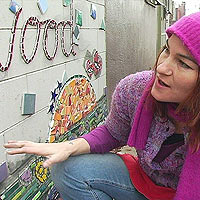
After years of looking out her studio at the tree-trimming business across the road, True decided to replace its makeshift “Free Wood” sign with an elaborate mural covering a large section of the building’s façade. Using handmade tile and glass, along with commercial tile, broken dishes and pieces of mirror, True and her team created an arbor-themed diptych featuring fantastical trees that surround the words “Free Wood.” The mural is typical of True’s work, which regularly employs fluid, sinuous lines and organic forms executed in a colorful array of tiles and glass. True especially enjoys incorporating mirrored surfaces that reflect light, movement and the mural’s viewer.

Laurel True studied art and design in schools in New York, Chicago, San Francisco, Dakar, Senegal and Ravenna, Italy. She produces murals and other works in her studio, True Mosaics, which she founded in 1991. Her architectural, sculptural mosaics adorn parks, hospitals, schools, restaurants, shops and private residences across the United States. One of True’s projects took her to West Africa, where she designed and facilitated a community mosaic mural project in a fishing village in Ghana.

Array

  • Array
  • Array
  • Array

Hung Liu

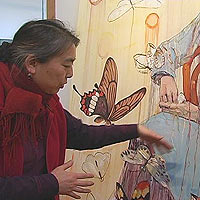
Oakland painter Hung Liu combines Western and Chinese traditions to create larger-than-life images of everyday people who have been lost in the sweep of history. In “Paint x 3,” Spark visits Liu in her studio as she works on a series of canvases for an exhibition in New York in May 2005.

Born in China in the 1940s, Liu came of age during Chairman Mao’s Cultural Revolution. As a young woman, Liu was sent to labor in a remote village and learn a distorted account of Chinese history as part of her “reeducation.” Four years later, she trained as an artist in Beijing, where she was taught to paint in the Social Realist style so that she would be able to serve the state by making colossal mural paintings of Mao and other prominent members of the Communist Party.

In 1984, after years of working as an artist and teacher in China, Liu immigrated to the United States and began making paintings informed by a wider perspective on her nation’s history. Her work was enhanced when, during a 1990 visit to China, Liu discovered several hundred photographs from the time of the Cultural Revolution. These photographs have formed a basis for much of her work since. Personal photos from this era are rare because families often destroyed images that might be used as evidence that they were not proletarians.

Many of these images are extremely rare portraits of prostitutes, made in limited numbers for distribution to patrons. Liu’s latest series monumentalizes these anonymous young women by depicting them in a style usually reserved for historical figures. Her canvases are rendered in a photorealist mode that looks back to her work for the Communist Party, yet they are populated by individuals that are the object, rather than the subject, of history.

The photorealism of the works is tempered by Liu’s technique of diluting her paint with linseed oil, which then is dripped onto the surface, blurring and distorting the portrait. The painting becomes akin to a memory image, which cannot claim to be objective, but fades and changes over time.

Liu earned a B.A. in education at Beijing Teacher’s College before studying mural painting at Beijing’s Central Academy of Fine Art. In 1986 she earned an M.F.A. from the University of California, San Diego. Liu has received numerous awards, including two painting fellowships from the National Endowment for the Arts. Her work has been exhibited nationally and internationally in such venues as the Smithsonian Institution, the Tokyo Metropolitan Museum of Photography, the National Museum of American Art and the Walker Center. She currently resides in Oakland and is a professor of visual arts at Mills College.

Array

  • Array
  • Array
  • Array
  • Array