Category Archives: Visual Arts

Michael Arcega

Conceptual artist Michael Arcega likens the titles of his works to punch lines. There’s “El Conquistadork,” the 10-foot high Spanish galleon he made from manila folders and sailed on Tomales Bay, and “Conquistadorks I & II,” elaborate suits of armor also crafted with manila folders.

Although their titles speak to the artist’s quirky sense of humor and his obsession with word play, the pieces themselves delve into weightier issues. Born in Manila, the 30-something artist is as concerned with Filipino history, imperialism and global socio-political issues as he is with puns.

“I use manila folders to talk about trade and business and colonialism. Having paper armor, I think, shows the frailty of military strength,” he tells Spark in the “Think Globally” episode.

Tucking himself into the paper-hulled vessel, Arcega managed to sail his “El Conquistadork,” a tiny, masted ship, in open waters without springing any leaks. The boat’s solid construction is characteristic of Arcega’s meticulous approach to his work.

With “Conquistadorks I & II,” which first appeared in the 2006 solo show “Getting Mid – Evil” at the Heather Marx Gallery in San Francisco, Arcega emphasizes the frameworks of power that fueled the 16th- and 20th-century European and Spanish conquests in the Philippines. As for the paper armor so prominently displayed in the same show, Arcega says that it points to both the common material’s economic implications and its fragility.

His other works comment on and satirize contemporary themes, like the United States’ complicated relationship with oil production. “In Gaud We Trust,” a 12-foot-high gothic cathedral constructed with black petroleum-based plastic, features oil derricks as its spires and a cross that looks as if it is spitting out black gold.

Although many of his most recognized pieces are mixed-media sculptures, Michael Arcega is a true interdisciplinary artist whose works range from paintings to installations, videos to drawings. He earned a B.F.A. in interdisciplinary studies at the San Francisco Art Institute in 1998 and was awarded residencies at the de Young Museum in 2002 and at the Headlands Center for the Arts in 2005. Arcega is represented by the Marx & Zavattero gallery in San Francisco.

Array

  • Array
  • Array

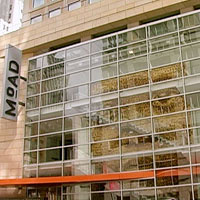
MoAD (Museum of the African Diaspora)

The Museum of the African Diaspora (MoAD) uses art, culture, history and technology to foster cross-cultural communication while it also provides an exhibit space and resource for African-American artists. MoAD is the newest addition to the collection of museums in the Yerba Buena arts district, surrounded by SFMOMA, the Cartoon Art Museum, the Museum of Craft and Folk Art, and the future sites of the Jewish and Mexican museums. MoAD receives international support from institutions such as the British Museum and the Museum of African Art, which have made it a truly global collaborative effort.

  • Array

Tracey Snelling

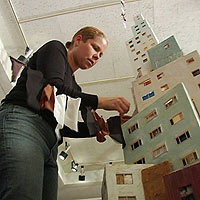
Tracey Snelling‘s miniatures are little tributes to ordinary American settings. Her small-scale renderings of run-down, neglected and overlooked buildings cast a nostalgic look back at a landscape of handmade signs, ad hoc architecture and highway development that is rapidly disappearing. In “New American Landscape,” Snelling takes Spark on a tour of her artistic process.

Snelling’s multimedia constructions boast a painstaking attention to detail, often combining electric light, still photography, moving images and sound. Drawing on imagery of small towns and desolate road stops, her landscapes eerily evoke the subtle moods of the places they represent. They resemble movie sets abandoned long after the film has been shot, inviting observers to project their own narratives onto them.

Spark follows Snelling as she installs her solo exhibition at the de Saisset Museum at the University of Santa Clara. The highlight of the show, which is entitled “Dark Detour,” is a meticulously crafted miniature tenement complex, complete with peeling paint, clotheslines, and a looping soundtrack of television sounds, plumbing and barking dogs, along with moving images in some of the windows. The piece re-creates for gallery visitors the voyeuristic experience of dense city living as they share in the sounds and sights that are central to apartment life.

Before experimenting with sculpture, Snelling worked primarily in photography, a medium that retains a central role in her process. Snelling’s miniatures often begin with a photograph that she has taken or found. Once she has re-created the photograph’s subject, Snelling photographs her miniatures in real-world settings, often creating surreal images depicting complex relationships between varying levels of representation.

Tracey Snelling earned a B.F.A. from the University of New Mexico, Albuquerque. In addition to her show at the de Saisset Museum, her work has been featured in solo exhibitions at the Mission 17 gallery in San Francisco, the Stephen Cohen Gallery in Los Angeles, and the Museum of Art and History in Santa Cruz as well as in group exhibitions at the Kala Art Institute in Berkeley, Intersection for the Arts in San Francisco and the Center on Contemporary Art in Seattle.

Array

  • Array
  • Array

Paul Madonna

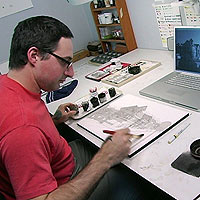
Paul Madonna‘s work captures the subtle and intricate tones, spaces and moods of San Francisco neighborhoods. Madonna draws “All Over Coffee,” a lyrical and often enigmatic comic strip published in the San Francisco Chronicle. Spark catches up with the artist as he begins work on a Mission District scene for his strip.

Madonna works directly in ink on paper, painstakingly rendering minute architectural details. He forgoes pencil sketches of his subjects, so oftentimes his renderings aren’t perfect, lending them a detached quality that offsets their otherwise photographic detail. Once he has captured his subjects in contour drawings onsite, Madonna goes back to his studio and uses photographs of the site to aid him in shading his drawings with ink washes.

The snatches of text that complete the strips often pre-exist the drawings and usually bear a tangential or obscure relationship to the scene that Madonna has represented. Sometimes words in Madonna’s strips appear to be excerpts of an overheard conversation, whereas other times they seem like meditative thoughts. Madonna carefully plays with the relationship between image and text in his work, creating an open and fluid association between the two.

Madonna adds to the mystery of his strips by removing any sense of movement from his scenes; otherwise busy streets are portrayed eerily empty, absent of human figures and cars. The overall tone is one of stillness and reflection. His images appear almost as memories, and the captions seem like disembodied voices emanating from unseen sources.

Paul Madonna grew up in Pittsburgh, Pennsylvania. While still in high school he began attending art classes at Carnegie-Mellon University, where he eventually completed a B.F.A. in 1994. During his senior year of college, Madonna became the first art intern ever taken in by MAD Magazine. Upon graduation, he moved to San Francisco and began making minicomics, which he left in public places for free. In 2004, Madonna began doing “All Over Coffee,” which appears weekly in the San Francisco Chronicle.

  • Array
  • Array
  • Array

Trevor Paglen

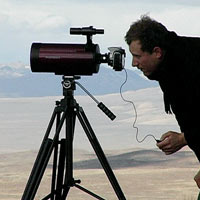
The work of artist Trevor Paglen explores the intersection of conceptual art, geography and activism. Paglen’s ongoing project of photographing and otherwise documenting restricted military bases and testing facilities operates at the limits of vision, rendering visible landscapes normally invisible to the naked eye. In “The New American Landscape,” Spark joins Paglen on an expedition to the edges of the restricted area that surrounds the Tonopah test range to catch a glimpse of the artist and geographer at work.

According to Paglen, it is not illegal to photograph secret government bases, provided one does not enter a restricted area to do so. Tonopah is a vast area containing multiple test sites and secret military bases, including the famed Area 51. It encompasses 3.1 million acres and 12,000 square miles of airspace — an area roughly the size of Switzerland.

Bases like the ones at Tonopah are located in remote areas and surrounded by hundreds of miles of restricted empty land, making these facilities literally invisible without the aid of a telescope. To photograph these areas, Paglen uses technologies borrowed from astrophotography. He notes that these areas are so well buffered that it is actually easier to photograph the planet Jupiter because there are only about six miles of breathable atmosphere between someone standing on Earth and the outer planets, whereas dozens of miles of restricted area may separate Paglen from his subject matter.

Even with the assistance of the latest telescopic technology, photographing remote targets such as these presents a unique set of challenges. Paglen is limited in terms of composition, because usually there are only a few vantage points from which he can observe a site. His palette is restricted to the colors of the Nevada desert, and Paglen often shoots during a particular season to exploit its subtle changes in color. In addition, the thickness of the atmosphere creates a painterly effect, impinging on the crispness of the image.

By Paglen’s estimates, the United States is currently spending more money on classified programs than ever before. To demonstrate the extent of these programs, Paglen created the “Code Names” installation, a list of code names for classified military programs whose names have been declassified or have otherwise entered the public domain. Paglen constantly updates the list, adding new names as they become available and removing those of programs believed to have been ended. Though the list includes more than 2,000 entries, it represents only a small portion of active secret programs because the code names of the vast majority of them remain classified.

Trevor Paglen earned an M.F.A. from the School of the Art Institute of Chicago and is currently pursuing a Ph.D. in geography at the University of California, Berkeley. His work has been exhibited at the Chicago Museum of Contemporary Art, the University of California San Diego and the California College of Art, among other places. He is a contributing editor to the “Journal of Aesthetics and Protest” and develops tactical media projects with the prison-abolitionist group Critical Resistance. Paglen’s writing has been published in “Blu Magazine,” “Art Journal” and the collection “Spaces of Terror.”

Array

  • Array

Liz Hickok

Artists have long been concerned with capturing the spirit of the cities they live in. Liz Hickok is no exception. In her “San Francisco in Jell-O” sculpture series, she has crafted jiggling and jewel-colored landscapes out of one of America’s favorite desserts. Spark caught up with her working on her creations.

Hickok started off as a photographer, shooting scale models of cities used by architects and urban planners. While studying sculpture in graduate school, she decided to create her own San Francisco landscape. The offbeat beauty and unstable consistencies of Jell-O made it the perfect medium. Hickok starts her process with scale models, which then become cast rubber silicone molds. After the Jell-O filled molds set, she arranges them on Plexiglass lit from below.

Liz Hickok is a multi-media artist who works in video, painting, and installation. She was the recipient of a fellowship from the Kala Art Institute and has earned an M.F.A. from Mills College. She has earned a B.F.A. and B.A. from the School of the Museum of Fine Arts and Tufts University in Boston, Massachusetts. In spring of 2006, Hickok’s Jell-O sculptures were included in an exhibit that commemorated the 1906 earthquake at the Exploratorium.

  • Array

Djerassi Resident Artists Program

For decades, the Djerassi Resident Artists Program has provided a place where artists from all over the country could come together, reflect and work in a beautiful natural setting located in Woodside, California. But after Hurricane Katrina devastated Louisiana’s Gulf Coast, Djerassi has made it a priority to host displaced artists from that region, offering them an environment in which to regroup and re-energize their creativity. Spark checked in on two New Orleans artists that found refuge at Djerassi.

After Katrina hit, the Alliance of Artists Communities set about creating the Gulf Coast Artists Hurricane Relief Program to take in displaced artists. Through this program, Djerassi, along with several other organizations in California (the 18th Street Art Center, Montalvo, the Kala Art Institute, Headlands Center for the Arts and the Exploratorium), has been able to provide a peaceful, inspirational and meditative environment far from the trauma of the disaster.

One of the artists selected for the Djerassi program was Rashida Ferdinand, a ceramicist whose studio in New Orleans’s Ninth Ward was destroyed during the hurricane. The Djerassi program provided her with a work space to resume projects interrupted by the hurricane. For Ferdinand, the experience has added another layer to her psyche as well as to her work, causing her to re-examine the uneasy balance that exists between financial interest and human life.

Another artist selected was writer Michael Patrick Welch, who was also evacuated from New Orleans but who has since returned home. Spark visited him as he worked on a collection of essays about his experience of the flood and its aftermath. Each story revolves around his pet goat, Chauncy. For Welch, the Djerassi program provided the mental and physical rehabilitation he needed after the trauma of Katrina as well as the peace and quiet he needed to write.

More about the Djerassi Resident Artists Program
The Djerassi Resident Artists Program was founded in 1979 by Dr. Carl Djerassi in honor of the memory of his daughter Pamela, a painter and poet who died the previous year. In the 1980s, with the renovation of structures on a nearby ranch into fully operational living quarters and studio spaces, the project was transformed into a comprehensive residency program. Today the Djerassi Resident Artists Program is the largest program of its kind in the West and ranks among the best in the country. Tours of the sculptures on the Djerassi property are offered.

Djerassi
djerassi.org
Where: 2325 Bear Gulch Rd., Woodside
Phone: (650) 747-1250

  • Array
  • Array
  • Array
  • Array

de Young Museum


View Spark segment on the de Young Museum. Original air date: March 2006. (Running Time: 5:39)

View Spark Web extra on the de Young Museum. (Running Time: 1:25)

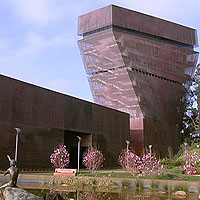
After closing its doors three years ago, the de Young Museum reopened in a spectacular new building in October 2005. Since then, the museum, located in Golden Gate Park, has been host to more than 100,000 visitors a month. Spark pays a visit to the museum to find out what’s new at the new de Young.

Hailed as being among the finest modern museum buildings in the world, the new de Young is considered a masterpiece of the internationally acclaimed Swiss architectural team of Jacques Herzog and Pierre de Meuron. Replacing a traditional mission-style building, the new design is an angular, asymmetrical structure that provides exciting and unexpected views from every angle. The majority of the building is clad in a copper foil that will oxidize over time, giving it a green patina. The museum’s design also incorporates the work of a number of sculptors, including a subtle path of cracks created by English environmental sculptor Andy Goldsworthy.

With a new building come new opportunities. The de Young now has ample temporary galleries capable of housing major traveling exhibits from all over the world. And gallery space for the de Young’s famous permanent collection of American art has been greatly expanded. The new museum now displays fully a third of its collection of paintings, whereas most other American museums have space for only about 5 percent of their collections.

The new de Young also contains an artist’s studio, accommodating month-long artist-in-residence programs. Spark visits with Sharon Virtue, a San Francisco-based ceramics artist hard at work on a major installation. Virtue is building a full-sized African mud structure completely by hand. The vessel represents a womb, the interior walls of which Virtue is planting with submissions from children meant to represent their best intentions for the future.

  • Array
  • Array

ASCEND School

ASCEND School is a unique K-8 school located in the Fruitvale neighborhood of Oakland. It is one of a growing number of small autonomous schools in the Oakland Unified School District in Alameda County. The school is an arts-integrated, Expeditionary Learning school that prioritizes family and community partnerships. Arts integration means that students participate in instruction with objectives in an art form and another content area — for example, math, English or history.

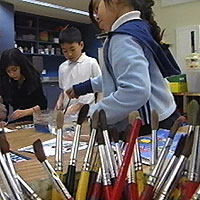
In “New Beginnings,” Spark visited ASCEND as it transitioned from temporary classrooms to a new building and dropped into a class in which students were learning the art of storytelling. They began by reading several Native American myths. What resulted was the students’ own theatrical production, “Raffa and the Gold Volcano,” a morality-hinged musical created by combining attributes taken from the various Native American mythic and legendary sources they had studied. As the students prepared to stage their musical, they learned that storytelling incorporates much more than the spoken word, that stories could be told through music, movement, costumes and setting and through an understanding of how character traits inform actions.

Founded in 2001 with fewer than 100 students, today the school has more than 250 students. The first priority at ASCEND is student literacy — teaching students to be fluent and comfortable with the written and spoken word, technology, contemporary culture, history, media, mathematics, science, arts and the environment. The inquiry-based model employed in the school curricula pushes students and teachers alike to grow and change, maximizing student performance and providing valuable professional development and personal growth for teachers.

ASCEND is one of more than 30 arts learning anchor schools, which is part of a larger initiative spearheaded by the Alameda County Office of Education. The first phase of implementation of a new countywide strategic plan will provide equitable classrooms through arts learning for every child, in every school, every day. ASCEND aspires to grow into a K-8 learning community and family center serving 380 students with 40 to 44 students, at each grade level.

Although it is a local model, ASCEND is also exemplary of a national movement in which schools all over the United States, in rural, suburban and urban communities, are addressing seemingly ever-increasing problems with solutions that put a more holistic approach to student learning at the center, despite the conflicting mandates from the state and federal education systems requiring increased standardized testing, with fewer resources. In their mission and philosophical approach, these schools are actively responding to a growing body of research that continues to reveal the critical importance of arts study and learning to the growth and development of all students throughout their education and throughout life.

Array

  • Array
  • Array

Bill Owens

Bill Owens is rediscovering an artistic medium that he thought he had left behind more than 20 years ago. Owens made his mark on the art world in the 1970s with “Suburbia,” a collection of photographs that documented suburban life in Livermore, California. The book won him critical acclaim, including a prestigious Guggenheim Award. But by the time Owens was working on his fourth book, money ran out, and he decided to follow other paths in order to pay the bills.

More than 20 years later, the reissue of “Suburbia” in 1999 brought new interest in Owens’s achievements, providing the artist with fresh opportunities. Spark checks in on the Bay Area photographer as he mounts an exhibition of his photographs and short films at the Berkeley Art Museum.

After giving up photography in the 1980s, Owens turned to teaching as well as a variety of odd jobs and business enterprises to make ends meet. He even sold his cameras to raise some extra money. But the renewed acclaim for Owens’s work after the reissue of “Suburbia” enabled him to publish his unfinished Leisure collection. He also decided to return to photography, now made cheaper and more accessible by digital technology.

When he discovered that his new digital cameras could also be used to make short videos, Owens began exploring the possibilities of motion pictures. He now has a collection of short films that he directed, shot and edited entirely himself. Like his still images, his short videos are meditations on daily routines, capturing the commonplace realities of everyday life.

Recently, Owens has returned to a subject that was conspicuous in his earlier series in the 1970s – food. Spark follows the artist to the Berkeley Bowl market, where Owens collects images for a photo essay and new book dedicated to what and how we eat. As they did with his “Suburbia” series, Owens’s photos still endeavor to capture American habits directly, honestly and without judgment.

After graduating from California State University at Chico in 1963, Bill Owens began to pursue photography while serving in the Peace Corps. In 1968, he landed a job as a newspaper photographer for the “Independent News” in Livermore, where he was assigned the daily beat of the suburban activities of his friends and neighbors. He published his first book, “Suburbia,” in 1972, which was followed by “Our Kind of People” (1976), “Working” (1978) and “Leisure” (2004).

  • Array
  • Array
  • Array

Andy Goldsworthy

In the episode “Work in Progress,” Spark visits with international artist Andy Goldsworthy as he installs “Drawn Stone” (formerly called “Faultline”) in the entrance courtyard of the new de Young Museum. The site-specific piece consists of carefully placed paving stones and boulders brought from a quarry in England and installed over the course of a few months in spring 2005.

Goldsworthy is an artist who creates artworks in the natural landscape using nature’s materials to form sculptural work of deceptive simplicity, often achieving amazing feats of balance and timing in the process. Whether ephemeral, permanent or designed to age with time, Goldsworthy’s works inspire quiet introspection about the beauty of the world as a living organism in a state of continuous change.

Across the expanse of the courtyard stones, a long crack draws visitors into the de Young Museum. Spark hears Goldsworthy’s vision and the challenges he faced in creating this major installation for the new building. Designed by the Swiss architecture firm Herzog & de Meuron and San Francisco’s Fong & Chan Architects, the building is scheduled to open in October 2005 in Golden Gate Park in San Francisco.

Goldsworthy is just one of the renowned artists to be offered commissions at the new de Young Museum, joining James Turrell, Gerhardt Richter and Kiki Smith. “Drawn Stone” is Goldsworthy’s fourth large-scale permanent commission, following “Stone River” (2001) at Stanford, “Garden of Stone” (2003) at New York’s Museum of Jewish Heritage and “Roof” (2004) at the National Gallery in Washington, D.C.

The original de Young Museum was a complex of buildings constructed between 1919 and 1965 that had suffered damage in the 1989 earthquake and was torn down in 2002. The de Young spent 10 years raising funds for a new facility to showcase its world-class collection of American paintings, decorative arts and crafts, art of Africa, Oceania and the Americas, and textiles. It also offers a wide range of education programs about these fields of art.

The paving stones Goldsworthy used in “Drawn Stone” are of Appleton Greenmoore sandstone, a stone imported from Yorkshire, England, where Goldsworthy was raised. The stone, with its rich orange and red colors from oxidized iron, was chosen to carry through the colors of the copper exterior of the new building.

Andy Goldsworthy holds a B.A. in fine art from Preston Polytechnic. He has produced numerous commissions and has had solo exhibitions internationally. He has received many awards, including the North West Arts Award, the Yorkshire Arts Award and the Northern Arts Award, which he won numerous times. In the 1980s, Goldsworthy began publishing books of photographs documenting his work. German director Thomas Riedelsheimer created a documentary about Goldsworthy in 2001 called “Andy Goldsworthy’s Rivers and Tides.”

Array

  • Array
  • Array
  • Array
  • Array
  • Array
  • Array

Lu Huan

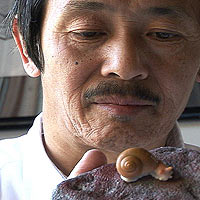
An accomplished painter, sculptor and poet, Lu Huan was one of China’s most celebrated artists. Now living in the United States, Lu Huan is struggling to build a reputation for himself in America. Spark visits this extraordinary artist at his home in Alameda as he works on a new carving of a rare Australian insect known in China as the Emperor’s Scorpion.

Lu Huan is best known in China for his miniature carvings of insects and amphibians done in painstaking detail. His works are made of single pyrophyllite stones — rare and valuable metamorphic rocks that the artist imports from mines in China and Inner Mongolia. The stones contain veins of surprising color and clarity that Lu Huan transforms into astonishingly lifelike creatures.

Each of Lu Huan’s carvings contains a poem that the artist composes and inscribes into the stone. The poems are written in classical five- and seven-word verse format and make use of a sparse imagery, reflecting the artist’s ascetic disposition. The poems are often meditations on animal behavior that reveal deeper truths about human existence and interactions.

Lu Huan was born in 1948 in Hebei Province, China. After graduating from the Central Academy of Fine Arts in 1969, he became an artist-in-residence at the Palace Museum in Beijing (also known as the Forbidden City) for 16 years. In 1989, after touring the United States accompanying a solo exhibition of his work, he decided to remain in America. His carvings can be seen in the Palace Museum, where Lu Huan enjoys the distinction of being the only living artist whose sculptures are in the collection.

Thai Bui

Vietnamese-born sculptor Thai Bui makes haunting works of art that speak to a sense of displacement and longing that has characterized the artist’s own turbulent life. Bui’s extraordinary objects combine references to his experiences in both the United States and Vietnam, simultaneously communicating a witty humor and penetrating sense of loss. In “Looking East,” Spark visits with Bui as he installs a major public commission for the city of Palo Alto.

Growing up in Hanoi during the Vietnam War, Bui’s childhood was marked by uncertainty and terror. In 1981, at the age of 21, Bui emigrated to the United States to study art. The transition was difficult for the artist, who has had to deal with language and cultural barriers. In addition, as a northerner, Bui often feels like an outsider within the Vietnamese community in the Bay Area, which is largely composed of southern Vietnamese.

Much of Bui’s work deals with these experiences, making reference to childhood games as well as feelings of displacement. Spark visits the artist in his studio as he makes a series of shallow clay bowls. While they are still wet, Bui slams the bowls onto the floor, blowing a hole in the base of the pots and making a loud sound. The activity references a simple childhood game in which the participant that makes the loudest sound wins. Bui then gathers the remnants and incorporates them into an installation.

In several other works, Bui creates odd juxtapositions that suggest his own experience of being a cultural and linguistic outsider in the United States, mixing diverse materials, forms and cultural references. In “Twins,” Bui pairs two materials, one natural — wood — one man-made — concrete — in a diptych. Though the title suggests that the two objects are identical, in fact they are opposites of one another, each alternating the others arrangement of wood and concrete blocks. For Bui, these combinations connect his own experience with the opposing, but harmonious cosmological forces of yin and yang that help to form the basis of Zen philosophy.

Thai Bui earned a B.F.A. from the San Francisco Art Institute in 1988 and an M.F.A. from Stanford University in 1992. He has taught sculpture at Stanford and the University of California, Santa Cruz. Bui is the recipient of a Skowhegan scholarship, a SOBEL scholarship, a Stanford University scholarship and the Harold E. Weiner Memorial Prize. His work has been shown in locations across California and in galleries in New York.

Array

  • Array
  • Array

Richard Serra

Richard Serra is perhaps the most recognized site-specific artist in the world. He boasts a career that spans four decades, over the course of which he has produced a series of large-scale public and private commissions in locations all over North America and Europe. Spark catches up with Serra as he installs an enormous public work for the University of California, San Francisco’s new campus at Mission Bay.

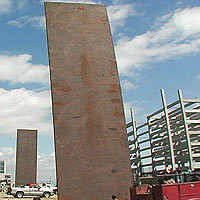
Serra’s design for UCSF is composed of two steel plates, each nearly 50 feet by 15 feet wide, installed vertically in the main pedestrian walkway. The monoliths program the space around them by dividing the 400-foot-long plaza into thirds. They lean noticeably by approximately 18 inches — roughly two degrees — creating a dramatic impact in relation to the adjacent campus buildings.

From a distance, the plates appear thin, like blades that cut into the ground, but up close, their five-inch width gives them a weight that the viewer may compare with his or her own stature. Serra’s choice of corten steel means that over time the piece will oxidize, first showing a reddish, then deeper purple highlights.

Installing Serra’s work was no simple task. It’s 160-ton weight, combined with the fact that Mission Bay is built on landfill, posed serious challenges to the engineers and installation crew. In order to stabilize the piece, piles were driven more than 200 feet into the ground — over four times the length of the Serra’s monoliths — to provide an adequate structural foundation for the work.

Born in San Francisco, Richard Serra earned both a B.F.A. and an M.F.A. from Yale. He has had solo exhibitions in museums around the world, including the Museum of Modern Art, New York; the Musée Nationale d’Art Moderne, Paris; the Museo Nacional Centro de Arte Reina Sofía, Madrid; and the Museum Haus Lange, Krefeld, Germany. His work can be found in major collections internationally, including the Guggenheim Museum. In 1994, Serra was awarded the Praemium Imperiale by the Japan Art Association and an honorary doctorate of fine arts from the California College of Arts and Crafts (now known as the California College of the Arts), in Oakland.

  • Array
  • Array