Category Archives: Music

San Francisco Symphony Chorus

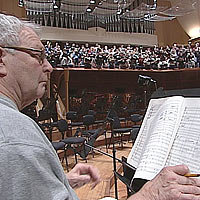
They come from all over the Bay Area, commuting into San Francisco from as far away as the Central Valley. Rehearsing up to three times a week and performing at least 26 times a season (in 2004, they will have performed 32 concerts), they sing texts in French, Russian, German and Italian, a task complicated enough to require the help of voice coaches and linguists. They are the 200 members of the San Francisco Symphony Chorus, making it one of the largest of its kind in this country. Even more remarkable is the fact that 170 of the choristers are volunteers.

What makes people dedicate themselves to a task such as this? Perhaps it is the prestige of being a member of a celebrated singing ensemble. Or perhaps, more fundamentally, it is the opportunity to take one’s voice and blend it in with a couple of hundred others that can’t be replicated in any other setting. Spark goes behind the scenes while the San Francisco Symphony Chorus rehearses and performs Gabriel Faure’s “Requiem” at Davies Symphony Hall in San Francisco.

More about the San Francisco Symphony Chorus
The San Francisco Symphony Chorus was established in 1972, created at the request of Seiji Ozawa, then the music director of the San Francisco Symphony. Louis Magor served as the chorus’s director during its first decade. In 1982, Margaret Hillis, from the Chicago Symphony Chorus, assumed the ensemble’s leadership, followed by Vance George in 1983 and then Ragnar Bohlin in 2007. Since then, they have sung under such conductors as Michael Tilson Thomas, Laureate Herbert Blomstedt, Kurt Masur, Wolfgang Sawallisch and Robert Shaw.

San Francisco Symphony
sfsymphony.org
Where: Davies Symphony Hall, 201 Van Ness Ave., San Francisco
Phone: (415) 864-6000

  • Array
  • Array

Sonos Handbell Ensemble

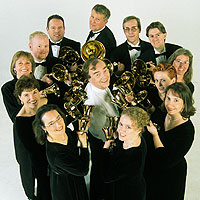
Watching the members of the Sonos Handbell Ensemble prepare, you might think that they were getting ready to play in a major sporting event — rather than preparing to play music: taping fingers, wrapping wrists, stretching, and putting on gloves. But Spark learns that being part of a handbell ensemble is more challenging and fun than anyone might expect.

The ensemble was founded in 1990, and hopes to move handbells out of the church-only realm and into the world of more mainstream contemporary music. The group has toured nationally, recorded three CDs and performed with the San Francisco Symphony Chorus, Oakland East Bay Symphony and San Jose Symphony.

  • Array

Cal Performances and Robert Cole

Since he became director of Cal Performances in 1986, Robert Cole has turned the performing arts presenter of the University of California, Berkeley, into a venue that rivals New York’s Carnegie Hall and Washington, D.C.’s Kennedy Center. The Spark episode “Movers and Shakers” offers a glimpse into one of the country’s most renowned performing arts centers.

After studying music at the University of Southern California, Cole began his career as a high school music teacher and part-time conductor. As a conductor, he became interested in other aspects of the orchestra, raising money and organizing a board of directors for a little opera company and a ballet company. In the 1970s, Cole moved from his native California to New York, where he took the job of associate conductor under Michael Tilson Thomas at the Buffalo Philharmonic and began presenting companies like the New York City Ballet and the Dance Theater of Harlem.

When he came to Cal Performances, Cole saw a unique opportunity to turn U.C. Berkeley’s Zellerbach Hall into the premiere performing arts theater in the region, attracting acts accustomed to playing the most prestigious venues of London, New York, Paris and other cultural centers. He also set out to expand the number and variety of performances, and over the course of his tenure has increased annual ticket sales nearly tenfold, from $700,000 to more than $6 million.

In 1991, Cole booked a little known mezzo-soprano, Cecilia Bartoli, who has since become internationally celebrated as one of the greatest opera talents of her generation. In recent years, Cole has taken on the role of producer as well, enabling artists like choreographer Mark Morris to create new works whose world premieres are presented by Cal Performances.

Cole has been able to achieve this remarkable expansion in part by booking a combination of world-renowned performers and emerging young talents. Every January, Cole travels to the Arts Presenters Conference in New York, where he selects acts from among the thousands that meet there. Over the years, the New York conference has enabled Cole to bring performers from more than 50 countries to Berkeley, attracting new audiences to Cal Performances from the diverse ethnic communities that are characteristic of the Bay Area.

Cal Performances
calperfs.berkeley.edu
Where: U.C. Berkeley, Zellerbach Hall, Berkeley
Phone: (510) 642-9988

  • Array
  • Array
  • Array
  • Array

Community School of Music and Arts

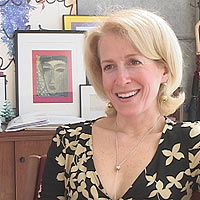
Enter the world of Angela McConnell, executive director of the Community School of Music and Arts (CSMA) in Mountain View. Her task: to raise almost $9 million within three years. Hired July 2001 in the depths of the dot-com crash, two months before September 11, McConnell was charged with raising the funds necessary to give the CSMA something it has never had in its 36 years of existence: a permanent home to call its own.

Founded in 1968, the CSMA has served Silicon Valley residents for more than three decades, already providing education for 325,000 Bay Area residents — adults and children alike, following its motto, “Arts for All.” The school offers a variety of classes and programs in its effort to accommodate the region’s cultural diversity. Examples of these include after-school classes, private lessons, free family concerts, community outreach events and the Arts in Action programs in local schools.

The unfortunate truth is that even in the world of art, money makes the world go ’round. Add to that a soft economy, a quarter-century of Prop 13 in California (a law that held down property values, cutting off a major source of revenue for the state government and leading to drastic cutbacks in arts education), and you’ve got yourself a local institutional maelstrom. That McConnell succeeded in raising the funds, let alone within three years, is a great victory for the community. But it could also be seen as a natural extension of McConnell’s own interests — she sings opera, and her twins, Emily and Jake, currently take classes at CSMA.

In the Spark episode “Movers and Shakers,” see how McConnell makes everything happen. A usual day for her starts at 5:30am with some time at the gym that includes networking. Then she’s off to meetings with local figures, such as the mayor of Mountain View. Also on her agenda: seeking the attendance of Governor Arnold Schwarzenegger at a CSMA event and obtaining funding from giants like the Silicon Valley-based Google. In the end, it is her hard work and her ability to inspire the members of her own organization that has made McConnell one of the most formidable fund-raisers of her kind — and a pricelessresource for the advancement of arts in the Bay Area.

  • Array
  • Array
  • Array

East Bay Center for the Performing Arts

East Bay Center for the Performing Arts (EBCPA) was founded in 1968 by five teachers to provide music lessons for 45 students in a rented church. Since then the organization has grown to include many other performing art forms that reflect the diverse range of the communities on the East Bay. Spark visits EBCPA and talks with the center’s artistic director, Jordan Simmons.

  • Array

Sahara and Elisabeth Sunday

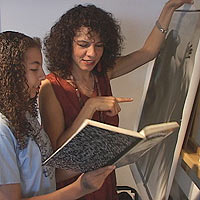
“The New York Times” has called her “the answer to the book industry’s multicultural dreams.” “If There Would Be No Light: Poems from My Heart” was published when she was 8 years old; the forward was written by Gloria Steinem. Her work has been praised by the likes of Phoebe Snow, Bill Cosby, Quincy Jones and Bonnie Raitt. This kind of literary accomplishment would be enough for most kids in middle school; however, writing is only a part of artist Sahara Sunday Spain‘s creative arsenal. In addition to being an accomplished poet, Spain is a dancer, a songwriter, a singer, a visual artist and a globe-trotting social activist.

One cannot look at Spain without looking at her environment as well. Her talents, impressive regardless of context, might have languished without the presence of her mother, professional photographer Elisabeth Sunday. It was Sunday’s decision to raise Spain in a world scrubbed clean of the noxious influence of popular culture. Without television, electronic toys or junk food to impede her creative development, the young poet was speaking in complete sentences by 14 months. Spain was 5 years old when she wrote her first poem, entitled “Mother’s Milk,” which reads, “When I drink mother’s milk/my heart sweats with love.”

As for her activism, Spain keeps with the family spirit. Her father is Johnny Spain, a former Black Panther who has spent a long time in jail and is no longer an active presence in his daughter’s life. Nevertheless, she carries on his tradition of activism. She has taken it upon herself to aid village girls in Mali by creating the Kah-Monno group — a name taken from the one she was given by Mali elders. “Kah-Monno” means unity and understanding through conversation. Spain plans to fund the education of 35 girls there, hoping to use the proceeds from her sale of rights to a song she wrote, “The Night of the Day.”

If you’re an artist with a family, working to nurture your child’s creativity while sustaining your own can become two sides of the same coin. Sunday herself notes, “We are a creative family. It’s easy to be inspired.” Indeed, in addition to having a photographer for a mother, Spain has a grandfather who’s a stained-glass designer, a grandmother who’s a potter and a great-grandfather who’s a painter. For this reason, Spain’s second book of poetry, “River of Ancestors,” is an homage to her deeply artistic heritage.

In the Spark episode “All in the Family,” spend a day in the life of Sahara Sunday Spain and her mother Elisabeth Sunday, the latter working hard to make it as both an artist and a single parent, having to squeeze her creativity in between dropping Spain off at school in the mornings and picking her up in the afternoon. Learn about the artistic stream running through Spain and Sunday from their relatives. Above all, see that behind these artists is a loving family to support and inspire them.

  • Array
  • Array
  • Array

La Familia Peña-Govea

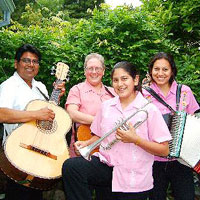
Michael Govea is a Latin composer and artist, and leader of other bands like Los Compas and Cascada de Flores. He met a musician and lawyer named Susan Peña more than twenty years ago. Today, the two of them and their daughters Rene and Cecilia form, the band known as La Familia Peña-Govea, and play Latin music around the Bay Area. They have released two recordings, “Rene at 15” and “Cohetes.”

Spark joins the the family as they practice in their living room: each member alternates between guitar, accordion, vocals and percussion. Playing primarily Tex-Mex and Colombian music, La Familia Peña-Govea has recorded two CDs and appears at festivals and events around Northern California.

  • Array

Opera San Jose

Far removed from the designer reality-show sets, a different “real world” plays out, a short distance away from the overpriced bungalows of Silicon Valley. Each year, Opera San José chooses budding vocalists for its resident company. They live in a 14-unit apartment complex and pursue the dream of becoming a professional opera singer. Spark drops in on this unique solution to the affordable housing crisis: a generous arts organization enabling gifted singers to live and work together full time as they prepare for their débuts. Currently in production is the 19th-century George Bizet opera “The Pearl Fishers.”

A principal artist at New York’s Metropolitan Opera for 20 seasons, general director Irene Dalis founded Opera San José in 1984. With support from a dedicated subscriber and sponsor base, the company acquired two 24,000-square-foot operations facilities and two apartment buildings (14 units total) for free artist housing. The singers participate in the equivalent of opera boot camp: They perform at least four feature or leading roles in Opera San José productions during one season. All the singers receive an annual salary, benefits and free housing.

Dalis and music director David Rohrbaugh patterned this residency after Dalis’s experiences as a youth in a German opera company whose singers were housed together. The arrangement allowed residents to completely immerse themselves in their art without worrying about rent. It is this spirit of community and creativity that Dalis successfully transplanted to San Jose.

In its explorationof the Opera San José company, the Spark episode “Making Room for Art” shows that drama isn’t limited to the stage. Six of the company singers live in an apartment building located a 15-minute drive from the rehearsal hall. A husband and wife singing duo live with their two children (it is rare in the opera world to be parents because of the high risk of catching colds). They all take vocal lessons, experience a pending theater relocation, and go through production issues and wardrobe malfunctions. When they return to their apartments, it’s back to bills, dirty diapers (for some) and what’s for dinner.

The program accelerates the learning process and prepares singers for the rigors of a professional opera career. They don’t have to deliver pizzas or singing telegrams to make a buck. What Opera San José has accomplished is one of the most innovative artists-in-residence programs in the country — a program that enables artists to work on their craft 24/7. In a unique twist to reality programming, nobody gets voted off.

  • Array
  • Array
  • Array

Midori

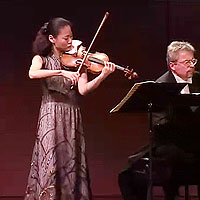
Born in Osaka, Japan in 1971, Midori received her first violin at the age of 4 years old, when she began studying violin under the direction of her mother. In 1981, they moved to the United States so that Midori could further her studies at the Aspen Summer Music School and the pre-college division of the Juilliard School.

Midori began touring the world in 1986. Today, she performs over 100 concerts worldwide each season. However, despite her rigorous performing schedule, Midori finds time to engage the community and founded the non-profit organizations, Midori & Friends in New York City and Music Sharing in Japan.

When she is not on the road, Midori lives in Los Angeles. Spark caught up with the violinist for a one-night appearance at San Francisco Performances.

  • Array
  • Array

Punk Rock Orchestra

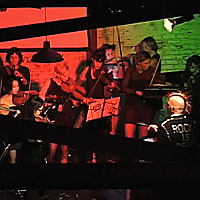
Mohawks and pink hair are not the usual hair-dos for classical musicians, but the Punk Rock Orchestra breaks many stereotypes. The 50+ member orchestra’s musical taste is apparent from the other ensembles they have played with — everything from the San Francisco Symphony and San Francisco Opera to The Dead Kennedys.

Lead by conductor John Gluck and his trusty toilet cleaning brush, the Punk Rock Orchestra plays songs from punk bands like Black Flag and the Sex Pistols on classical instruments. Craigslist brought them together in 2002, and since then the group has recorded an album and played at venues such as Yerba Buena Center for the Arts and the Herbst Theater. Spark caught up with them at one of their rare performances.

  • Array

Pauline Oliveros

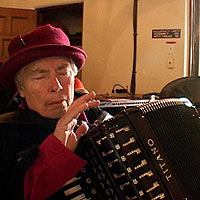
“Hear with your ears, listen with your heart” can be dismissed as fortune cookie musing, but anybody who knows or has heard of Pauline Oliveros will say it’s the pioneering musician and composer’s guiding principle. Spark takes you into Oliveros’s world filled with improvisational jam sessions, accordions, frogs and extreme slow walking (she’ll explain).

Soul music comes in many forms, and nowhere is this taken to its most literal extreme than with Oliveros. The Oakland-based teacher, composer, performer and musical ambassador is deeply attuned to the meditative qualities of sound. Since the ’60s, she has pioneered the electronic and improvisational mediums, creating theories of “sonic meditation” and “deep listening” — accomplishments that have brought her and her Mills College program worldwide acclaim.

Born in Houston, Texas, in the early ’30s, Oliveros learned piano from her mother and grandmother before switching to accordion. After high school, Oliveros moved to San Francisco to attend college and discovered new methods of making music. In 1961, she joined up with like-minded composers at San Francisco Tape Music Center, which pioneered techniques of sound gathering and archiving in electronic music, which later became the Center for Contemporary Music at Mills College. During the ’70s, she sought to strengthen the connection between music (and atmospheric sounds) and the soul leading her to begin a series of performances and practices called “sonic meditations” and “deep listening,” the most minute sound or unintentional noises are amplified in the composition’s importance.

Transmitting from Kingston, New York, Oliveros — now over 70 years old — still teaches music composition at Mills College and practices deep listening techniques with fellow musicians using her bandoneon (an accordion-like instrument). Her performances range from peaceful to restless, thoughtful to transcendent, and ultimately embody a spiritual freedom that defies borders and categorization. She often encourages her audience to not just listen but to participate at recitals. Through her work, Oliveros explores what music and sound means to each individual, something that goes back to the “listening versus hearing” thing — a dichotomy far removed from conventional (fortune) cookie cutter wisdom.

  • Array
  • Array
  • Array
  • Array
  • Array

Marc Bamuthi Joseph

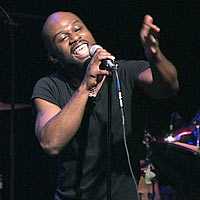
Marc Bamuthi Joseph is one of an emerging class of hip hop theater artists who combines a variety of art forms in his work. Bamuthi uses theater, West African and tap dance, spoken word, poetry, and live music to stretch the bounds of traditional hip hop and create a new forum for expressive performance art. His works challenge audiences of all ages to reevaluate the relationship between spoken language, body language and the body politic.

Bamuthi has been a performer since childhood, working on commercials at the age of 5, Broadway stage by age 9 and a television series when he was 12 and 13. At 21, Bamuthi found himself in San Francisco, entering the arena of spoken word and performance poetry, first in poetry slams, then as a playwright. Bamuthi has already received four spoken word poetry awards and was featured on Russell Simmons’s Def Poetry Jam in 2003.

In the Spark episode “Telling Stories,” meet Bamuthi as he prepares for his first solo theatrical work based on his experience of becoming a father. “Word Becomes Flesh” is a highly personal piece that is a performed series of letters from a single unwed father to his unborn son. Bamuthi translates the words from the page to the stage, narrating his very personal experience through creative expression that combines spoken word with movement, visual art and music.

Bamuthi is also the current artistic director for the Living Word Project and program director for Youth Speaks. Through the spoken word medium, he leads students through a process of examining their world and the issues that are important to them and turning their perspectives into meaningful expression. His mission to be an agent for social change fuels much of his work, taking him far beyond the need for recognition into the realm of spiritual and personal expression.

Array

  • Array
  • Array
  • Array

Michael Franti

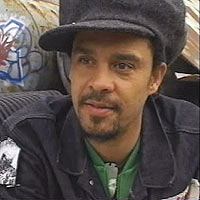
“The bass, the treble, don’t make a rebel/Having your life together does.” Those words, rapped by Michael Franti back in 1992, seem eerily prophetic today. In an industry notorious for perpetrating fantasy and the philosophy of “getting mine,” the Bay Area-based musician is a thinking, feeling person joyously out of step with his contemporaries in the music industry. Spark talks politics with Franti, from the set of his latest music video to backstage of a free performance at Amoeba Music.

Franti’s dedication to making politics personal began in the late ’80swith the agitprop punk band The Beatnigs, continued in the early ’90s with the industrial hip-hop forum Disposable Heroes of Hiphoprisy, to arrive at what he is today: a mesmerizing spoken word artist and leader of the politically astute San Francisco band Spearhead.

He makes conscious music that engages brain, booty and soul in a funky soundtrack of hip-hop, reggae, Latin, blues, spoken word and R&B. He’s stepping in the oversized footprints of Curtis Mayfield, Marvin Gaye, Bob Marley, Gil Scott-Heron, Sly Stone, Linton Kwesi Johnson and Chuck D yet creating his own path — embracing new music and communities as he goes along. Live shows have included drum circles, alternative energy generators, DJs, potlucks, massage therapy and information tables.

He’s rapped about AIDS awareness (“Positive”) and homelessness (“Hole in the Bucket”). After the band’s second major-label album, “Chocolate Supa Highway,” Spearhead put attracting mainstream attention on the back burner to remain true to its consciousness-raising mission. Its 2001 album “Stay Human” centered on the death penalty. In July 2003, the band released “Everyone Deserves Music,” a conscious party that drags speakers onto the White House lawn until the break of dawn.

Franti documents injustice, but more important, he does something about it. He’s inhaled tear gas on the front lines of anti-WTO rallies and lent his time and talent to support Mumia Abu-Jamal, anti-death penalty legislation, marijuana decriminalization, conscientious objector groups and the anti-war organization Not in Our Name.

For artists struggling to make it in the rap game, songs with politically progressive messages practically beg for radio banishment and audience alienation. Michael Franti has put his mind on record for more than 15 years and enjoys a supportive and loyal worldwide fan base. And he doesn’t wait for an election year to get political. The heart that beats inside his chest — booming louder than any passing car stereo system — simply won’t let him.

  • Array
  • Array
  • Array

Ashkenaz Music & Dance Community Center

Ashkenaz

Ashkenaz Music & Dance Community Center is a non-profit music and culture venue that has operated as a self-contained global village, specializing in the presentation of live roots music. The mission of Ashkenaz is to bring people of all classes, races, cultures and ages together with musical programs. Their programs are as diverse as the communities it hosts, including Balkan, Celtic, Cajun/Zydeco, Middle Eastern, African, Caribbean, and Reggae, as well as American roots traditions from Appalachian to the Blues. In the Spark episode “Community Institutions for the Arts,” viewers visit this nationally renowned venue and meet its dedicated staff as they provide a much-needed space for thousands of people in the Bay Area to enjoy traditional music and dance from around the world.

In 1973, David Nadel founded Ashkenaz as a community gathering place, expressing his belief that dancing and moving to music was akin to a spiritual experience that united peoples of all ages, backgrounds, and ethnic heritages. What began as a folkdance venue with recorded music gradually expanded to feature live bands representing the diversity of the region. And indeed, people from all over the Bay Area come for the performances and dance classes. Even Sue Schleiffer, the Executive Director, started coming to Ashkenaz in the 1970s to enjoy folk dancing and has been there ever since.

Despite the fact that Nadel himself is no longer part of the daily life of Ashkenaz, his spirit lives on. Nadel was shot and killed in 1996 by a disgruntled visitor who was asked to leave and returned to the venue after-hours. Dedicated friends and colleagues have worked tirelessly to keep the organization and Nadel’s dream going, exemplified by staff members such as night manager Larry Chin, who has worked at Ashkenaz for 20 years. Today, Chin walks in Nidel’s footsteps, doing everything from bartending to taking care of the artists.

Many artists and national acts come to Ashkenaz knowing that it may not be as profitable as performing at other venues, but the loyal, diverse, and appreciative audience amply compensates. Additionally, folk artists often find that there is a sense of community at Ashkenaz that immediately connects them to their audience, as if they are playing to people from their own countries, hometowns, and villages, encouraging them on their path towards sharing their traditions and cultures.

Ashkenaz Music & Dance Community Center
ashkenaz.com
Where: 1317 San Pablo Ave., Berkeley
Phone: (510) 525-5054

Ashkenaz is wheelchair accessible and family friendly with free admission for those 12 and under.

Array

  • Array
  • Array
  • Array