Category Archives: Music

Woodminster Summer Musicals

Woodminster Summer Musicals

Jim and Harriet Schlader have been staging Woodminster Summer Musicals since 1967. In the Spark episode “Community Institutions for the Arts,” take a behind-the-scenes look at as the Schladers direct cast and crew for their production of “Singin’ in the Rain” with only 40 hours of rehearsal over three weeks.

After completing successful Broadway careers — Harriet was a dancer at Radio City Music Hall, while Jim acted in original productions of “The Music Man” and “Brigadoon” — the Schladers moved to Oakland and founded Producers Associates, Inc., a non-profit organization dedicated to bringing American musical theater to new generations. Since its inception in 1967, Producers Associates Inc. has staged more than one hundred productions, making summertime Broadway musicals along-standing tradition for many Bay Area families at the Woodminster Amphitheater in Oakland’s Joaquin Miller Park.

Besides providing an opportunity for family members to come together and enjoy American musical theater, the long-time married couple has transformed Woodminster into a family legacy with the passing of the directorial torch to their son, Joel. However, far from retiring, Jim and Harriet continue to be involved at Woodminster, with Jim planning to stay on as producer, and Harriet continuing to manage the box-office and oversee costumes and choreography.

To date, Jim and Harriet have directed more than 2000 actors on stage, including their own four children. Many of these performers have continued to return to Woodminster over the years, such as choreographer Cynthia Ferrer and actor Carl Danielsen. Ferrer, who started at Woodminster when she was thirteen, says “I always feel likethe best stuff I learned, everything I learned, I learned here.” Carl Danielsen, whose role in “Singin’ in the Rain” marks his fifty-first show at Woodminster, attributes his career in theater to his “second parents” Jim and Harriet, without whom, he says, “I wouldn’t be in the theater.”

Woodminster Amphitheater
woodminster.com
Where: 3300 Joaquin Miller Rd., Oakland
Phone: (510) 531-9597

  • Array
  • Array
  • Array

Kuumbwa Jazz Center

Kuumbwa

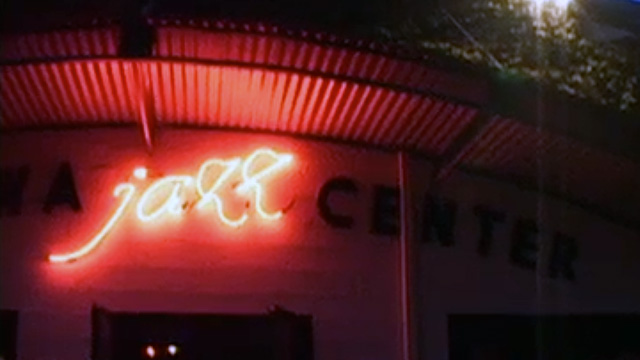
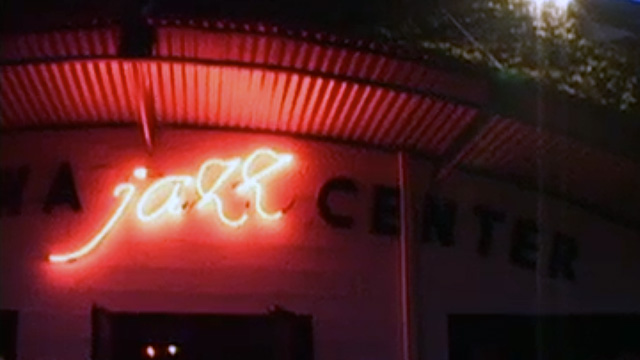
Spark heads to Santa Cruz’s Kuumbwa Jazz Center for their 28th year celebration as the West Coast’s oldest year-round jazz performance venue and education center. The place seats just 200, which means a chance to get up close and personal with well-known artists like John Scofield.

  • Array

Loren Chasse

Spark follows sound artist Loren Chasse as he scavenges for unique acoustic environments from which he uses found objects in a variety of techniques such as dragging, rubbing, or striking them together. Chasse then takes this vast repertoire of sounds back to his studio to manipulate into layers of sound, placing multiple recordings together or complementing them with previously recorded clips, creating soundscapes that are evocative of another place or perhaps even planet.

The origin of sound art dates back to the early 1900s, when artists responded to the intense changes in the urban landscape by embracing the mechanical noises around, using the world as their instruments to create pieces celebrating industry. Chasse works like a visual artist, creating a palette of unique and interesting sounds from the natural world to create sonic landscapes. As part of the movement of experimental and free music, Chasse explores unlikely sources for sound, such as industrial ruins, natural environments, and simple common objects used in unlikely ways. Using his microphone as an extension of his ear, Chasse makes acoustical portraits of places and things we might otherwise never hear.

At the heart of Chasse’s work is his interest in and ability to listen. Using his sound locations as both the instrument and the studio, Chasse looks for particularly resonant and acoustical situations that are reflected in a peculiar way. Like many artists who push the boundaries of traditional art forms, Chasse is continuously drawn to seek new acoustic possibilities, and he is continually searching for new venues and modes of self-expression. Chasse has completed many aural projects and has worked with many other artists and bands, such as Thuja and idBattery. His work is also becoming increasingly popular to exhibit in visual art galleries as part of the ever-blurring line between visual art and other forms of creative expression.

Chasse credits his work with young people for helping him recognize the importance of listening in the moment. It is important to just listen, Chasse believes, and not feel obliged to capture and preserve every sound on tape. This valuable lesson is one that he passes on to his students as a teacher in the San Francisco Unified School District. Chasse is also the Director of Education of the sound arts collective called 23five, a non-profit organization dedicated to increasing the awareness of sound in the public arena.

Also, in this Spark story follow Chasse and a group of young people from the Julia Morgan Center for the Arts’ summer camp as they take a “listening hike,” an outdoor search for and exploration of sounds. Under Chasse’s guidance, the students gain first-hand experience of the physics of sound as they explore how the near poetic qualities of listening awaken the imagination.

Array

  • Array
  • Array
  • Array
  • Array

San Francisco School of the Arts (SOTA)

Editor’s note: SOTA was renamed the Ruth Asawa San Francisco School of the Arts in 2010.

Spark visits the San Francisco School of the Arts (SOTA), humming with end of the year excitement as students prep for final art shows, theater reviews, and end of the year concerts. Meet, among others, student Anna Pasternak and teacher Elvia Marta, who give an insider’s look at SOTA’s dance department as students prepare for final exams — a four-night run of concerts.

SOTA is a public visual and performing arts high school dedicated to providing students with an alternative educational program that fosters artistic development and creativity. Since its founding in 1982, SOTA has admitted students selected by audition from all over the Bay Area in areas of performing, visual, and literary arts, thus creating an ethnically diverse and energetic student body.

In what the school calls its “pre-professional” program, SOTA engages students in a curriculum that combines academics with art instruction. SOTA offers art instruction in nine disciplines, including creative writing, dance, film and video arts, instrumental music, piano, theater arts, theater design and technology, visual arts, and voice. The teaching staff at SOTA, which is comprised of specialized arts teachers as well as artists in residence, create an educational program which allows students to study their selected discipline for at least two hours a day.

SOTA was originally founded by a group of renegade artists and teachers, and has continued to be a work-in-progress, frequently changing campuses and even sharing spaces with other schools. However, as of fall 2002, SOTA moved to its own campus where it has since been awarded the title of California Distinguished School. SOTA is not merely being recognized on a local level but also is well on its way to establishing a national reputation for itself. Pending on the allocation of funds, the school may eventually move to the Civic Center where it would neighbor the Symphony, Opera, Ballet, and Asian Art Museum. By joining the art mecca of downtown San Francisco, SOTA would no doubt increase its visibility and attract even more students to its growing population of young and emerging artists.

  • Array
  • Array
  • Array

Young Audiences of Northern California

Editor’s note: In May 2004, Young Audiences of San Jose and Silicon Valley merged with Young Audiences of the Bay Area to become Young Audiences of Northern California

Young Audiences of the Bay Area (YA Bay Area) is the area’s oldest and largest provider of arts education programs and services. Founded in 1958, YA Bay Area is one of 32 non-profit chapters of Young Audiences, Inc. across the nation. Collectively, Young Audience chapters are the single largest provider of arts education programs in the US. In 2001-02, the 5,016 professional artists working for YA chapters provided 102,980 arts programs for 8.1 million young people and educators.

As one of the YA network’s top 10 chapters, YA Bay Area is dedicated to making the arts (classical, contemporary, and multicultural) an essential part of every young person’s education and life. Founded in 1958, the organization offers performance assembly performance, workshops, artist residencies, and professional development in dance, music, theater, media, storytelling, and circus, literary, and visual arts to K-12 and public audiences.

In 2000-2001, YA Bay Area reached 189,976 students, teachers, and families through its in-school, community, and public programs in ten counties of the Bay Area. YA Bay Area’s diverse roster includes over 150 professional artists and ensembles from the Bay Area and the greater US. All of YA Bay Area’s artists are auditioned on an annual basis by YA Bay Area staff and advisory committee to ensure the highest quality programs.

In the Spark episode “Art Goes Back to School,” tag along with a few of the artists represented by YA Bay Area from in-school assemblies with Kulintang Dance Theatre and Eddie Madril from Native American Dance & Arts, to artist residencies with Poet Gail Newman and Photographer Shashari Murphy. Assembly performances are 45-minute performance demonstrations designed to introduce an artform(s) and usually the culture or tradition of the practicing artists. Artist residencies are longer-term (8-32 weeks) experiences between an artist(s) and a group of students designed to provide hands-on learning beyond the introductory level.

In addition to these valuable educational programs, YA Bay Area also offers the ArtsCard, a free family arts program offering discounts to over 50 arts and culture organizations throughout the Bay Area — including discounts on admission, special events, membership, and classes. Enrollment is open to all families with children between preschool and grade 12.

Array

  • Array
  • Array
  • Array

SFJAZZ Jazz in the Middle

California public schools are notoriously lacking in funds for adequate arts education. That’s why in 2001 SFJAZZ started the Jazz in the Middle program, which brings music into the language arts classroom. The curriculum, which is based on the artistic connections between language and music, exposes students to the teachings of professional jazz artists and the San Francisco poet laureate. Spark goes into the classrooms to meet students participating in the program as they perform their own poems in collaboration with jazz musicians.

  • Array

Michael Morgan

Michael Morgan

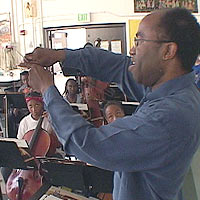
Currently in his 14th year as music director of the Oakland East Bay Symphony (OEBS), Michael Morgan has led an impressive turnabout of a once-troubled orchestra and inspired a broad revitalization of the musical landscape in the East Bay. From middle school visits and young musician tutorials to symphony and opera rehearsals, Spark tries to keep up with Morgan and his busy schedule.

Born in 1957 in Washington DC, Morgan began conducting at age 12 while attending public school. While a student at Oberlin College Conservatory of Music, Morgan spent a summer at the Berkshire Music Center at Tanglewood, where he studied under Gunther Shuller and Seiji Ozawa and worked with Leonard Bernstein. In 1980, he won first prize in the Hans Swarovsky International Conductors Competition in Vienna, and later went on to become the assistant conductor at the St. Louis and Chicago symphony orchestras and conductor at the Civic Orchestra of Chicago and the Chicago Youth Symphony Orchestra.

In September 1990, Morgan was named music director at the OEBS, which was founded in 1988 when musicians from the former Oakland Symphony and the Oakland Symphony League joined together to form a new orchestra. Besides being music director at OEBS, Morgan serves as artistic director of the Oakland Youth Orchestra, Music Director at the Sacramento Philharmonic, and Artistic Director of Festival Opera in Walnut Creek. As if his schedule were not hectic enough, he also makes appearances as a guest conductor with orchestras throughout the United States including the New York Philharmonic.

In the episode “Leaders,” Spark follows Morgan as he juggles conducting the Oakland East Bay Symphony, working with young musicians such as those in Randy Porter’s class at Westlake Middle School in Oakland, and helping promising, young musicians get private music lessons with instructors like Debbra Schwartz. Each year, Morgan makes more than 100 visits to public schools to speak about the importance of arts education, as well as about minority participation in the arts.

  • Array
  • Array
  • Array
  • Array

Klein International String Competition

The Spark episode “The Business of Art” charts the progress of the young competitors of the Irving M. Klein International String Competition as they vie for the grand prize of $10,000 and the chance to headline a series of prestigious concerts. In a field where many are called but few are chosen, watch these up-and-coming musicians get last-minute advice from teachers and steel their nerves to play their best for the judges. “When you go out there, a billion things could be going through your head. But you must be focused and clear, alert and active, spontaneous and free. I just think — you make your music, you show them what you have to offer,” says Eunice Keem, a 2003 competitor.

In 1985, Mitchell Klein founded the Irving M. Klein String Competition in memory of his father, a well-known chamber musician. His vision was to create opportunities for young string musicians to compete for very prestigious awards in an environment that was less cutthroat and aggressive than that of many other such events. The prizes range from $200 to $10,000 as well as a series of debut performances as a concerto soloist and recitalist.

With fewer and fewer performing opportunities available to solo artists, musicians depend on competitions to gain notoriety and establish their careers. Among them, the Irving M. Klein Competition is seen by many as one of the most prestigious international events. Mitchell Klein sums up the experience, saying, “It’s a hard life they’ve chosen for themselves. If you succeed the rewards are fabulous. You get to play the greatest music, commune with the greatest artistic minds and perform with wonderful colleagues … but there are no guarantees, that’s for sure. It’s a great life, but it’s not open to too many people.”

For the 2003 competition, Klein received applications from more than 60 musicians from 11 countries. Virtually all of those who apply are students of renowned teachers and conservatories and are on the edge of major careers as solo performers. Of these, only 12 were chosen to compete in the semifinals. Each participant must prepare a Bach piece, a movement from a sonata and one major concerto. They are also asked to perform part of a new work commissioned just for the competition that they have never seen before. From the semifinalists, the judges select five finalists to return the next day to present a longer performance. From these contestants, the top three finalists are chosen to perform a full concerto backed by an orchestra on the final evening of the competition, which is open to the public.

Array

  • Array
  • Array
  • Array
  • Array

Keith Knight

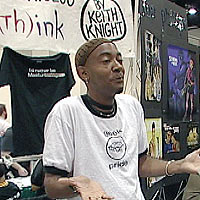
Comic artist and rapper, Keith Knight is the creator of the “K Chronicles” and “(th)ink” and heads up a hip hop/garage band. Knight talks to Spark about what it takes to be a cartoonist and how it relates to his music career.

Born in the greater Boston area and educated at Salem State College, Keith now lives and works in San Francisco, where he develops his cartoons and performs with his band The Marginal Prophets. His weekly K Chronicles comic strip, which ran in the “San Francisco Examiner” for five years, is often an irreverent combination of politics, race, family and humor. He highlights the “aha!” moments and the “huh?” questions we share as humans struggling to make sense and meaning of our complex, contemporary urban society.

Since Knight crafts his comics from his own life and experience, they regularly address issues related to his experience and observation of racism. As an African-American cartoonist, Knight raises issues of race with the same poignant combination of witty insinuations and gravity he uses to handle sensitive political topics and personal epiphanies, balancing the obligations of humor and insight without compromising the veracity of the content.

Knight has received praise from cartoonist Garry Trudeau “Doonesbury,” filmmaker Spike Lee and author Maya Angelou, among others. Knight’s work has appeared in a number of magazines, including “MH-18,” “Cracked,” “Futures,” “Fabula” and “Pulse!” He has published three books of the “K Chronicles” with Manic D Press, the most recent of which, “What a Long Strange Strip It’s Been,” came out in July 2003.

Keith Knight is committed to sharing his voice, not just through his images, but also as a speaker through Speakout: The Institute for Democratic Education and Culture, offering his experience and perspective to schools and other community venues to inspire colleagues and young people alike.

Array

  • Array
  • Array
  • Array
  • Array
  • Array

Mary Lovelace O’Neal and Olly Wilson

Painter Mary Lovelace O’Neal and composer Olly Wilson create an audio-visual chamber music experience called “Call and Response” with the San Francisco Contemporary Music Players. Spark eavesdrops they create a series of musical pieces.

  • Array

Center for Contemporary Music

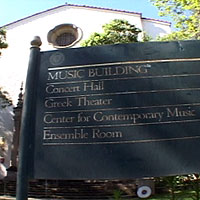
Originally founded in 1961 as the San Francisco Tape Music Center, the Center for Contemporary Music (CCM) moved to Mills College in 1966. Since then a tradition of experiment music has taken root at Mills through the program’s of composers such as Henry Cowell, John Cage, and Lou Harrison. Spark visits students at CCM as they explore the relationship between audience and performer.

In addition to traditional instruments, CCM maintains a variety of electronic equipment. They also offer studios, instruction and technical assistance as well as access to archives of audio recordings. The center serves as a resource to the community by holding public concerts and lectures, and is open to independent composers and musicians.

  • Array
  • Array
  • Array
  • Array
  • Array

Best of Broadway presents “Wicked”

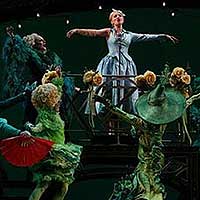
“Wicked: The Untold Story of the Witches of Oz” premiered on Broadway in October 2003. But before it hit theaters in New York, the multimillion dollar production impressed San Francisco audiences with a test run by the Best of Broadway company. In the Spark episode “The Engineering of Art,” we watch as the production crew tries to mount sets on a scale rarely seen at the Curran Theatre. From coordinating a fire-breathing dragon and flying monkeys to a spinning bed and enormous moving gears, the production team puts on a special effects show worthy of the great Wizard of Oz himself.

Based on the 1995 novel by Gregory Maguire, “Wicked” includes music and lyrics by Stephen Schwartz (“Godspell” and “Pippin”). The musical tells the story of two girls in the Land of Oz, one of whom become the Wicked Witch of the West and the other the Good Witch, Glinda. The stars of the original production were Tony Award winner Kristin Chenoweth, Tony nominee Idina Menzel (the original Maureen in “Rent”) and legendary two-time Tony winner Robert Morse.

The process of bringing “Wicked” to stage was no easy engineering feat. Costing $14 million, the play’s production involved over 150 people and took almost two years to become a reality. Built in Calgary, Ontario the show’s complex set took over a year and a half to design and had to travel over 1,500 miles to the Curran Theatre in San Francsico. Although the labor intensive set includes flying houses, a mechanized fire-breathing dragon, and individually hand-dyed corn fields, the hardest part of design proved to be staying away from the visual images of the original film version of “The Wizard of Oz.”

Under the direction of Carole Shorenstein Hays and Scott E. Nederlander, Best of Broadway is committed to bringing high-quality musicals and award-winning plays to the Bay Area. Over the years, local subscribers to the Best of Broadway have enjoyed a host of works, from the Tony Award-winning play “Fences” to the spectacular United States premiere of Baz Luhrmann’s production of Puccini’s “La Boheme.” Best of Broadway venues in the San Francisco-Bay Area include the Curran Theatre, the Golden Gate Theatre, and the Orpheum Theatre.

  • Array
  • Array
  • Array
  • Array

Roberto Borrell

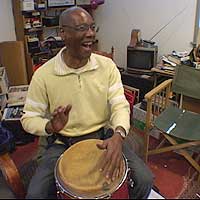
In the Spark “Transplanting a Tradition” episode, master percussionist, dancer and bandleader Roberto Borrell brings his passion for Cuban music and dance to students and audiences, reiterating the need to preserve the roots of Cuban music so that it will continue to grow and so that future generations can experience it. Viewers get to sit in on a dance class, see a segment of a performance by Borrell’s 12-piece Orquesta La Moderna Tradici贸n and get a glimpse of the life of a traditional artist living outside his native country.

Borrell grew up in the 1950s and 1960s in Havana, Cuba, during the heyday of popular dance hall music, when danz贸n orchestras and big bands played all night performing a variety of genres, such as danz贸n-cha, cha-cha-ch谩, son-montuno, mambo and boleros. He enjoyed a successful career, first with the Conjunto Nacional de Cuba and later directing his own dance company. With the advent of the Cuban Revolution in 1959, however, many aspects of the culture in Cuba changed, and it became an increasingly difficult environment for artists, especially those who refused to join the Communist Party. Like many other thousands of Cubans, Borrell fled to the United States in 1980. Upon relocating to the Bay Area, Borrell met violinist, composer and arranger Tregar Otton, and together in 1996 they founded Orquesta La Moderna Tradici贸n, perhaps the only ensemble in the United States that is dedicated to presenting traditional Cuban dance music, especially the lilting grooves of danz贸n.

Danz贸n, one of Cuba’s first unique dance/music genres has a long history that represents a fusion of African and European elements, and it represents the roots for many popular dance styles today. One of the most unique and compelling characteristics of danz贸n is the intricate connection between the music and the dance and between the musicians and the dancers. Following the musical structure and specific musical cues, dancers of classic danz贸n change their steps accordingly and move with musical phrases, at times allowing for some improvisation within the structure. This requires them to listen very closely to the music in order to hear an important cue, such as when to pause, when to make a big turn or when the music is about to end.

Array

  • Array
  • Array
  • Array

Philharmonia Baroque Orchestra

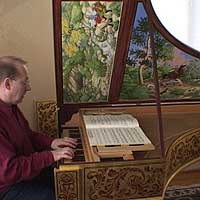
The genre of baroque music refers to a style of composition that flourished in Europe from about 1600 to 1750, characterized by exuberance and elaborate ornamentation through the use of major and minor tonality (rather than modes). Since 1981, the Philharmonia Baroque Orchestra has been dedicated to reproducing historically informed performances on original instruments, recreating the period’s authentic sound. Spark takes you into the rehearsal hall of Philharmonia, the home of conductor Nicholas McGegan to view his extraordinary collection of period and reproduction instruments, and the shop of harpsichord maker John Phillips.

Under the musical direction of Cambridge- and Oxford-educated McGegan since 1985, Philharmonia has repeatedly appeared in the Great Performers Series at New York’s Lincoln Center and has collaborated with the likes of San Francisco Opera Center, Long Beach Opera and Mark Morris Dance Group. Over the years, Philharmonia has released more than 20 CDs and received a Grammy nomination for its live recording of Handel’s oratorio “Susana” in 1990.

The ensemble is made up of roughly 40 musicians who play the works of a variety of Baroque composers, from Handel and Bach to Telemann and Vivaldi. Recognized as “America’s period-instrument orchestra,” Philharmonia has become the foremost early-music ensemble not only in the Bay Area but also in the country. Appearing locally in San Francisco, Berkeley, Palo Alto, San Rafael and Walnut Creek, the ensemble also is in demand around the world, frequently embarking on national and international tours.

  • Array
  • Array
  • Array
  • Array