Asides

Stanlee Gatti

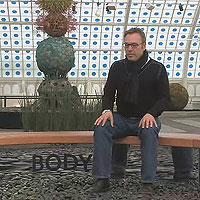
Event designer Stanlee Gatti is known to throw some of the biggest parties in San Francisco (the Mayoral Inaugurations of Gavin Newsom and Willie L. Brown and receptions for likes of Elton John) featuring some of his amazing floral arrangements. So it wasn’t a huge stretch that the Conservatory of Flowers invited Gatti to be the first artist to create a large-scale, site-specific installation in their Golden Gate Park facilities.

Spark visited with Gatti as he explained his intent behind “ONE: An Earth Installation,” which ironically happens to be composed without using a single living organism except for a small grouping of cattails. His inspiration for this exhibit came from his reverence for nature and admiration of Native American culture.

Although Gatti has spent years building a name for himself within the San Francisco social scene, “ONE” marks his first public exhibition. However, Gatti is no stranger to the public art world either since he served as the president of the San Francisco Art Commission for nine years, starting in 1996.

Stanlee Gatti, a New Mexico native started out studying music, physical education, and art at the University of Northern Colorado. After some self-reflection he redirected his studies to the University of Oregon where he studied architecture and art history.

  • Array
  • Array

Lawrence Ferlinghetti

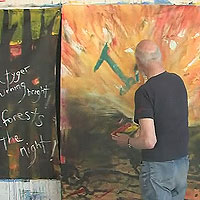
Over the past six decades, Lawrence Ferlinghetti has established himself as one of the most renowned poets and publishers in the world. A founder of City Lights Books and a noted Beat writer, he is commonly considered one of the greatest literary figures of the 20th century. But Ferlinghetti has been painting for almost as long as he has been writing. Spark visits Ferlinghetti in his studio as he prepares a series of works for a show at San Francisco’s George Krevsky Gallery.

Ferlinghetti first took up painting in 1948 while living in Paris on the G.I. Bill, at a time when French artists were heavily influenced by Spanish surrealism in general and the work of Pablo Picasso in particular. Like many American painters at the time, Ferlinghetti interpreted these influences to produce abstract expressionist works. But the artist quickly became dissatisfied with nonobjective painting, abandoning it in favor of works that incorporated both figuration and the written word.

Now in his late 80s, Ferlinghetti still paints fervently, and most mornings he can be found working in the Hunter’s Point Shipyard studio that he has kept since 1979. All the paintings that he is preparing for his show at the Krevsky Gallery combine provocative, sometimes mystical imagery with written words: some of his own, others from canonical wordsmiths such as Blake and Eliot.

Though he began painting early in his career, Ferlinghetti didn’t exhibit his work until the 1980s, after George Krevsky himself approached the poet following a reading. Krevsky complimented Ferlinghetti highly on his writing, and the poet/artist responded that the gallery owner should see his paintings. Krevsky’s visit to Ferlinghetti’s studio began a relationship that has lasted more than 20 years.

Lawrence Ferlinghetti was born in Yonkers, New York, in 1919. He graduated from the University of North Carolina at Chapel Hill before serving as an officer in the U.S. Navy during the Second World War. Returning to New York, Ferlinghetti earned a master’s degree from Columbia University and a doctorate from the Sorbonne, in Paris. While living in France, he met the influential poet Kenneth Roxroth, who encouraged Ferlinghetti to move to San Francisco, where he eventually came to be known as one of the founders of the Beat movement. In 1953, Ferlinghetti founded the City Lights bookstore with Peter D. Martin; the publishing house was founded two years later, in 1955. Ferlinghetti has since published more than 25 books of poetry and has won numerous literary awards.

Array

  • Array
  • Array

Shailja Patel

During her childhood in Nairobi, Kenya, South Asian Indian poet Shailja Patel had the distinct feeling that her world could disappear at any moment, and for good reason. In 1972, neighboring country Uganda expelled its South Asian residents, many of whom had called Africa home for generations. “I grew up very much with this sense of ‘we don’t have a future here,'” says the Oakland-based artist.

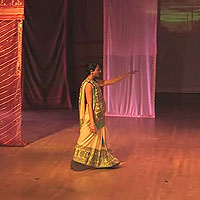
It should come as no surprise, then, that Patel’s one-woman show, “Migritude,” addresses the immigrant experience. The performance piece combines spoken word, dance, photography and 18 traditional Indian saris to unravel the notion of otherness and to explore those parts of immigrant identity that become altered, changed and sometimes lost within another culture’s dominating forces. The name of the play is a term Patel coined herself. Derived from the words “migrant,” “attitude” and “negritude,” it refers to, in Patel’s words, “a generation of migrants who don’t feel the need to be silent to protect themselves.”

The brightly colored saris Patel folds and unfolds, wraps about her body, and waves overhead during her performance are much more than props. For 30 years, Patel’s mother collected the saris for her daughter’s trousseau. Instead of passively protecting and adorning her body as they might have, had she married and remained in her native country, the garments have become active participants in Patel’s quest to reveal and celebrate otherness through rhythmic language, movement, and sharp observations about the mind, body and spirit.

Directed by Kim Cook, “Migritude” is Patel’s first one-woman show. Since arriving in the United States in 1997, Patel has been an active participant in the Bay Area’s slam poetry movement. She has won championships in competitions, including the Santa Cruz Poetry Slam and the Lambda Literary Festival, and has participated in events at colleges and cultural institutions ranging from Yale University to the Artwallah Festival in Los Angeles. She has performed in New York City’s Javits Center and Lincoln Center, San Francisco’s ODC Theatre, and many other venues.

  • Array
  • Array

Ronn Guidi

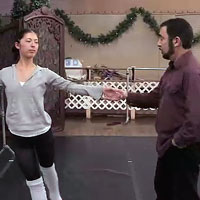
Passion for the art of dance is perhaps the defining quality of Oakland’s Ronn Guidi, director of the Oakland Ballet Academy and founder of the famous Oakland Ballet. An ever-energetic mainstay of the East Bay dance scene, Guidi created the Oakland Ballet in 1965 and led the small regional company to international attention in the 1970s with his canny choices of repertoire.

Bolstered by a National Endowment for the Arts grant and ambitious world premieres, like Eugene Loring’s “The Tender Land” — for which composer Aaron Copland himself conducted the opening night — Guidi’s enthusiasm and efforts paved the way for the troupe to become a major force in dance as one of the few remaining companies in the world performing the lavish and inventive ballets created for Sergei Diaghilev’s Ballets Russes. It was Guidi who brought in such living legends as Leonide Massine, Frederic Franklin and Irina Nijinska to stage authoritative restorations of “Boutique Fantasque” and “Les Biches.”

Guidi expanded the company’s scope over the next decade with ballets by some of the giants of 20th-century dance, including works that were rarely seen anywhere at the time — Kurt Jooss’s “The Green Table,” Agnes de Mille’s “Fall River Legend,” Ruthana Boris’s “Cakewalk,” Bronislava Nijinska’s “Les Noces” — as well as more than 50 of his own creations and restagings of classics like “Giselle” and “Les Sylphides.” In addition, he commissioned works from notable local choreographers, such as Betsy Erickson, Tandy Beal, Margaret Jenkins and Remy Charlip, all of which inspired several generations of dancers in the Bay Area.

After 33 years at the helm of the Oakland Ballet, Guidi retired from the company in 1998, to be succeeded by Karen Brown, who directed the company until 2005, when it was forced to close its doors after its 40th anniversary season. Spark follows Guidi’s revival of the company he founded and its return to the stage with a triumphant performance of his own “Nutcracker” in 2006.

  • Array
  • Array

Rene Garcia Jr.

Editor’s note: Rene Garcia Jr. passed away on May 8, 2015.

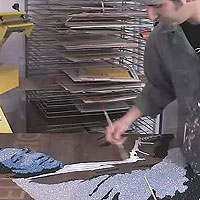
Painter, graphic designer, illustrator, sculptor and stereo photographer Rene Garcia Jr. re-imagined popular art in many different ways, but it’s his large format sculptural glitter paintings that have gotten the most attention. Reproducing such things as retro ads and celebrity photos in glitter, Garcia’s photorealistic pieces have taken more than 100 hours to complete. Spark visits him in his dazzling studio that any grade school class would envy.

  • Array

The Crooked Jades

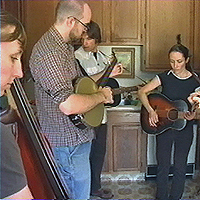
The Crooked Jades are on a mission to revive some of America’s oldest music. Aficionados of “old-time” music, the members of this Bay Area band perform their own take on rural folk music from the days before radio. Spark catches up with The Crooked Jades as they prepare to leave on their European tour.

Old-time music is a branch of American roots music that originated in the South, mostly around Kentucky and Georgia, and extended north as far as New England. Its base is a mixture of folk songs and instrumentation that go back to the country’s earliest settlers. Old-time music was instrumental to the folk revival of the 1960s, and it’s currently enjoying a renewed interest among young and old audiences alike. The Crooked Jades are amongst a number of old-time bands that have sprung up across the country in recent years in an effort to revitalize this rich heritage.

For Crooked Jades bandleader Jeff Kazor, old-time music offers a way to connect today’s world with the country’s earliest days — the songs evoke conjure common feelings of alienation and suffering. As the chief songwriter of the band, Kazor finds his inspiration by listening to old recordings and selecting songs to rediscover and reinterpret. The band then convenes to practice the new tunes in Kazor’s kitchen.

Kazor is fond of the spontaneous nature of old-time music’s instrumentation, which was often determined more by availability than by musical considerations. At a time when instruments were scarce and expensive, an old-time band made do with jugs, washboards, washtubs and spoons.

The Crooked Jades are Jeff Kazor (guitar/ukulele); Jennie Benford (mandolin/guitar), of Jim & Jennie & the Pinetops; Adam Tanner (fiddle/mandolin); Megan Adie (bass); and Seth Folsom (banjo/slide guitar). The band has toured across the United States and Europe and plays regularly in California. The Crooked Jades’ releases can be found on independent label Copper Creek Records and on their own label, Jade Note Music.

Array

  • Array
  • Array
  • Array

Miena Yoo

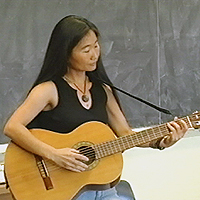
Miena Yoo has been singing and writing her own songs since she was 18 years old, but it was stomach cancer that prompted her to first perform publicly. As a patient at UCSF’s Mt. Zion Cancer Center in San Francisco, Yoo learned about a volunteer musician program that brings local artists to play music for patients and their families.

When she beat cancer after a year-long struggle that included rounds of chemotherapy, Yoo traded in her patient status for that of performer. Today, you’ll find Yoo performing at Mt. Zion Cancer Center, as well as Bay Area nursing homes, the Martinez veterans home, local festivals, cafes and private events. She also has a regular gig at the Cannery at Del Monte Square, where her deep, soulful voice provides a backdrop for the crowds of tourists who frequent the marketplace. Much like the folk greats of yesteryear, she eagerly travels anywhere she can to share her music with others.

A native of South Korea who immigrated to the United States 14 years ago, Yoo creates music that mixes Korean language, phrases and imagery with English. “When I sing in Korean it is my native language. It touches my heart and I see more the experiences of my memories that I had when I was little. It brings … more emotional feelings when I sing,” she explains to Spark.

In 2006, Yoo released the album “At the River Again,” which touches on her childhood in Korea, her family members and natural themes like wildlife, trees and water. Her folk-driven sound carries obvious influence from Korean performers like Hee Eun Yang — famous in the 1960s and 70s — and American songstresses Lucinda Williams and Tracy Chapman.

In the midst of a busy playing schedule and work on her album, Yoo remains focused on giving back to the surrounding community. Along with offering her time and music to ill and elderly Bay Area residents, Yoo plans to donate all proceeds from heralbum to stray animal rescue efforts.

  • Array
  • Array
  • Array
  • Array

Walter Savage

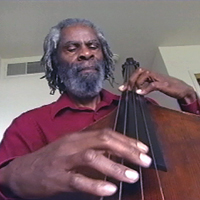
The upright bass is often viewed primarily as a supporting instrument, but local jazz musician Walter Savage has won a reputation for bringing it to the spotlight. Whether he’s playing a gig at a renowned Bay Area jazz institution like Yoshi’s or entertaining the masses at Enrico’s in North Beach, Savage lets the bass shine through as a leading force.

Savage’s love affair with music began early on. “You know my background in music is like a lot of black people in America,” Savage says. “My dad was a preacher. I was forced … to do [music] in the church, you know? I’ve always been interested in music. I can’t remember not singing. Everybody in my family loved to sing.”

Stationed throughout the Pacific during the 1960s, Savage got turned onto the bass after a musician visiting his military base showed him a few jazz chords. At first, he thought the instrument would be easy to master. Now, over forty years later, Savage says he’s still exploring his instrument’s possibilities. “It’s like the more you learn, the more you know you need to learn,” he says.

That thirst for knowledge has led Savage to record two albums featuring his own compositions and vocals. While his music writing and singing talents have garnered praise from jazz fans, Savage’s chief interest these days is showcasing the bass as a solo instrument — as Spark witnesses when Savage headlines at Yoshi’s Jazz House with drummer Eddie Marshall and pianist Alan Steiger.

  • Array
  • Array

Bach Dancing and Dynamite Society

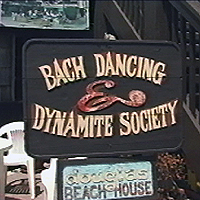
Founded by Pete Douglas in 1964, the Bach Dancing and Dynamite Society is a non-profit organization presenting live concerts of principally jazz, classical and world music. All performances are held at the Douglas Beach House on Miramar Beach, Half Moon Bay on Friday and Saturday nights in addition to Sunday afternoons. To attend, please note that reservations are only taken for current Bach members, but some seating is almost always available at the door.

  • Array

Jaime Guerrero

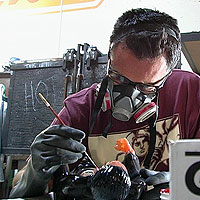
Since the late 1990s, Jamie Guerrero has been creating striking one-of-a-kind glass pieces that have gained him recognition around the Bay Area and nationally. In his work, Guerrero draws from his experiences growing up in East Los Angeles as well as from imagery of the Mayan and Aztec cultures. Spark drops in on Guerrero and his team at San Jose’s Bay Area Glass Institute (BAGI) as they are hard at work on a new piece.

Guerrero had worked in a variety of sculptural media for years before stumbling into the glass studio while studying at San Francisco’s California College of the Arts. The young artist was immediately won over, by the fluidity of the medium as well as by the precise timing and close teamwork that glass demands. Guerrero made a name for himself early on by crafting vivid multicolored glass vessels, but quickly decided that he did not want to become a production glass blower, making the same pieces repeatedly.

Discovering a new technique that allowed him to work with multiple colors simultaneously, Guerrero began making his “Homies” series, which explores character types and situations that he experienced as a youth in East Los Angeles. He soon expanded his repertoire to include representations of Aztec and Mayan deities, drawing parallels between these ancient civilizations and contemporary life.

Spark catches Guerrero working on a glass sculpture of the Aztec deity Quetzalcoatl, the feathered serpent. It is a challenging project, demanding perfect coordination among all the members of the Guerrero team. Thanks to a fellowship, Guerrero has at his disposal the BAGI’s state-of-the-art facilities, essential for making such a complicated piece.

Once the glass has been liquefied – at above 2000 degrees – Guerrero and his team add color by rolling the hot glass in pigment, then they shape the individual pieces of the sculpture while maintaining a constant and even temperature. It is a one-shot deal that will work only if all the crucial elements come together. After the piece has been assembled, the team equalizes its temperature before it is allowed to slowly cool in a 950-degree oven.

Jaime Guerrero lives and works in the San Francisco Bay Area. He earned a B.F.A. from California College of the Arts in 1997. His work has been exhibited at local and national venues, including La Peña Cultural Center, CBS Marketwatch, Galería de la Raza and the Albany Arts Gallery. Guerrero has received grants and awards from the Ryman Master Program and California College of the Arts, and he was an artist-in-residence at San Jose State University in 2001.

Array

  • Array
  • Array
  • Array

San Francisco Young Playwrights Festival

Giving young Bay Area playwrights the opportunity to develop their work is the goal of the San Francisco Young Playwrights Foundation, created in 2005 by Lauren Yee. The author of more than a dozen plays, which have been produced for festivals and theaters around the world, Yee knew firsthand the benefits of gaining early writing experience. In high school and later as a Yale University student, she won awards and gained recognition from events ranging from the California Young Playwrights Festival to the Florida Teen Playwright Festival. But despite the many programs available for teen performers in her hometown of San Francisco, there was a lack of opportunities for students to hone their skills in writing for the stage.

In 2001, as a student at Lowell High School, Yee founded the entirely student-run Youth for Asian Theater. A few years later, she decided it was time for a citywide festival, and in May 2006, she inaugurated the first San Francisco Young Playwrights Festival at the Diego Rivera Theater, City College of San Francisco.

Spark follows four of the high school seniors and juniors whose work was chosen from the dozens of submissions that bring to life stories drawn from the students’ own lives and experiences. The process of selecting and developing the work of the festival’s participants began in September, when the teens submitted their work. After the winners were selected, two months of polishing followed, under the guidance of mentors from the professional theater community. The process culminated in a public performance in May 2006.

Helping to promote young voices and fresh perspectives in the San Francisco theater scene is one of the primary goals of the San Francisco Young Playwrights Foundation. Yee plans to make the Young Playwrights Festival an annual event, and she hopes the festival will encourage more kids to think about writing as a career.

  • Array
  • Array

Taraneh Hemami

Iranian-born painter, installation and conceptual artist Taraneh Hemami has two homes — and she also has none. When Hemami came to the United States in 1978 to attend the University of Oregon at Eugene, she had little idea of what the future held. Within a year of her arrival in this country, the Iranian Revolution had changed her homeland forever and prevented her from visiting for more than a decade.

As an Iranian living in the United States, it’s not surprising that Hemami’s art would explore her complex relationship with the concept of home and her struggle to secure a sense of belonging from both her country of residence and the country and culture of her youth. In many ways, Hemami’s art is her home. “There is a sense of satisfaction in placing myself within the walls that I create,” says Hemami.

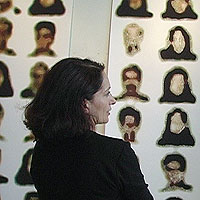
Among Hemami’s many projects is an installation she began in 2000 called “Hall of Reflections.” She collected hundreds of personal photographs, portraits and images from Iranian Americans and transposed them onto more than 400 glass and mirror tiles using silkscreen, prints and transparencies that fade and age over time. The resulting multidimensional installation, inspired by traditional Iranian mirrored gathering halls, explores the lives of the individuals fixed on her tiles and their experiences as immigrants, mothers, fathers, children and a community.

Spark follows Hemami as she gathers footage, photographs and stories from a Castro Valley Iranian woman named Nosrat, who is known as “Mommy” and whose life is the cornerstone of Hemami’s multimedia display exploring the layers of history and connected stories within a family home. The finished product is an exhibit she titled “Homes,” which was displayed at ZeroOne San Jose: A Global Festival of Art on the Edge and the Thirteenth International Symposium of Electronic Art in August 2006.

Taraneh Hemami’s work has been exhibited in the Yerba Buena Center for the Arts, the Artist’s Gallery of the San Francisco Museum of Modern Art, the San Francisco Arts Commission gallery, and numerous other locations around the country and the globe. Her themes revolve around the Iranian American experience, notions of memory and the ephemeral nature of concrete space.

  • Array
  • Array
  • Array
  • Array
  • Array

Rebar

Rebar members Matthew Passmore and John Bela wanted to preserve the cultural integrity of the 32-year-old Southern Exposure gallery; not through photographs or a painting, but by drilling out a chunk of the gallery’s wall and canning it. Yes, canning it. This may sound a bit strange but their intentions are quite clever. The two got the idea by looking into the history of the gallery. Before SoEx’s existence, the building was a can manufactory called the American Can Company.

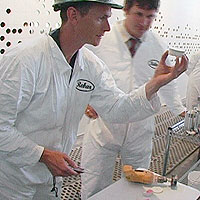
The process of canning the walls was a project created by Rebar, a San Francisco-based arts collective. For Rebar’s “Encanment” project, Passmore, Bela and their team clad in work suits, hard hats and goggles drilled 2 ½ inch holes all over the gallery’s walls so that they could be processed, condensed, labeled and sold. This took place during Southern Exposure’s last exhibit, “Between the Walls,” before their move to a temporary new location so the gallery could undergo a seismic retrofit and renovation. Luckily, Spark made it just in time to visit the “encannery” process.

For just $20 dollars, one can holds three pieces of 2 1/2 inch of wall immersed in mineral oil, sealed shut and labeled with the words “Best Quality Gallery Space”. The money benefits Rebar and Southern Exposure.

  • Array
  • Array

John Abduljaami

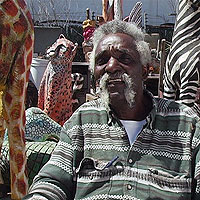
In a West Oakland lot at 2205 Magnolia, just off West Grand, sculpture artist John Abduljaami lets the wood be his guide. He’s there almost every day working from 9am to 5pm. Sometimes he sees a bird. Other times it’s a dog, a cowboy on horseback, a rat or a walrus. “Then I start drawing with the chainsaw,” Abduljaami tells Spark.

Abduljaami’s fascination with wood began when he was a child. Living in a makeshift home that he describes as a shanty, Abduljaami’s family depended on a wood-burning stove and heater for cooking and warmth. His father regularly toted wood home at the end of the day. By the time Abduljaami was 11, he was sneaking the family’s best butcher knife to carve his figures, much to his mother’s consternation. Later, Abduljaami had a job cutting wood, which was where he learned how to use a chainsaw.

“A chainsaw is like getting on a jet plane — something that would normally take three or four days to get there, and you get there with seven or eight minutes with a chainsaw,” Abduljaami says of his primary tool.

A prolific artist who dreams of building a legacy through the wood sculptures he leaves behind, Abduljaami estimates he has produced 500 pieces thus far. If he had his druthers, he would produce a new piece each day. Along with a chainsaw, he uses such tools as an adze, a hammer and a chisel. He often turns to photographs and images of his subjects to guide him while he carves, cuts and shapes the wood before him. While some pieces are delicately rendered birds and jackalopes, others — like his 2,600-pound walrus complete with wrinkly, cracked skin — are much larger in scale. Carving the two-ton walrus meant starting with a 3,500-pound chunk of wood that had to be moved with a forklift.

Pulling distinct figures from anonymous chunks of wood may not yield fame and fortune for John Abduljaami during his lifetime, but being remembered years from now is much more important to this artist. He says, “I want to be here more than 100 years. That is why I am doing all this wood sculpturing, so my name will be here — although I am poor and broke and don’t have anything, I will be one of the rich people then because my name will be in books somewhere.”

Abduljaami’s work can be seen by appointment by calling (510) 967-8816.

  • Array