Asides

Howard Wiley

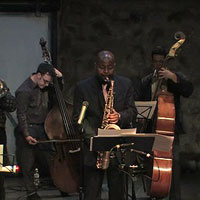
Bay Area jazz saxophonist Howard Wiley has discovered that great works of art sometimes are born of the direst circumstances. Wiley has put together a program based on music found at Louisiana’s notorious Angola State Penitentiary, where gospel songs dating back to the 1930s have been preserved. Spark checks in as Wiley and his ensemble rehearse for a concert at San Francisco’s Intersection for the Arts.

Angola State Penitentiary is one of the largest prisons in the country, holding about 5,000 prisoners and maintaining a staff of 1,000. The facility sits on an 18,000-acre expanse that was originally four separate slave plantations. In 1880, Samuel Lawrence James joined these plantations to form the Angola plantation and contracted convicts from the state to work on it. Louisiana took full control of the plantation in 1901.

Over the course of the 20th century, Angola developed a reputation for violence and abuse. Still a working farm, the prison became known as a holdover from the days of slavery, where the predominantly black inmates were forced to spend life sentences laboring under dehumanizing conditions. In 1952, 31 inmates, who came to be known as the Heel String Gang, severed their own Achilles tendons in protest of the brutal work routine. In 1972, the federal courts finally interceded and ordered a crackdown on the abuse at Angola.

Daniel Atkinson, an ethnomusicologist who studies African American folk traditions of the South, introduced Wiley to the music of Angola. In part because Angola remained a functioning plantation, inmates retained and handed down some of the spirituals and work songs of the slave era, traditions that became mingled with secular performance practices when populations began migrating north and west in the 1920s. This legacy, which Wiley is featuring in his Angola program, was crucial to the development of American music, eventually giving rise to a number of genres, including blues, gospel and jazz.

For Wiley, uncovering the music of Angola State Penitentiary has opened a window onto the musical origins of the South. He has put together the Angola Project, which he describes as a “soul chamber ensemble.” The ensemble combines two vocalists with violins, bass, saxophone, trombone, trumpet and drums. His interpretations of the songs from Angola are based on the call-and-response interplay between leader and congregation in churches. The style adds a stirring, haunting tone to the compositions.

Array

  • Array
  • Array

Adela Akers

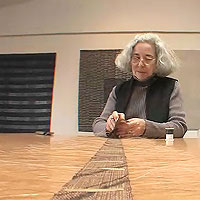
Without ponies and parties, textile artist Adela Akers would not be able to produce the intricately woven wall hangings she has become known for over the last decade. She weaves horsehair imported from China and hundreds of recycled metal foil strips made from the tops of wine bottles into her painstakingly detailed pieces. Spark visits Akers in Sonoma County in a converted apple warehouse that she uses as a studio.

Born in Santiago de Compostela, Spain, in 1933, Akers became interested in weaving and textile art only after studying pharmacy at the University of Havana and working as a biochemist. In her late 20s, her burgeoning interest in tapestries brought her to the United States to study weaving at the Art Institute of Chicago and the Cranbrook Academy of Art. Akers was a weaver-in-residence at Penland School of Crafts, and she taught for more than two decades at Temple University’s Tyler School of Art. In 1995, Akers relocated to Northern California with her husband.

Earlier in her career, greatly influenced by the abstract expressionism movement of the 1950s, Akers became known for her large textile works that incorporated folds and curves created through weaving techniques, like pulling warp. But in recent years, the striking detail in Akers’s wall hangings comes not from the linen pieces at the foundation of her works, but from the horsehair and foil strips sewn, painted and otherwise adhered to them. To Akers, the geometric lines and repeated metal strips suggest language, communication and ideas revealed through abstract forms.

“I started doing the stitching — the first pieces using the metal were about memorials, so the stitching became like a name or a word,” Akers says. “The metal adds another layer, another dimension of the work. The fact that I use the hair, it becomes like a veil and the metal shines through.”

Her work can be found in the collections of the Smithsonian Institution, the Metropolitan Museum of Art, and the Museum of Art and Design, as well as in many private collections.

  • Array
  • Array

Marc Bamuthi Joseph

Marc Bamuthi Joseph is one of an emerging class of hip hop theater artists who combines a variety of art forms in his work. Bamuthi uses theater, West African and tap dance, spoken word, poetry, and live music to stretch the bounds of traditional hip hop and create a new forum for expressive performance art. His works challenge audiences of all ages to reevaluate the relationship between spoken language, body language and the body politic.

Bamuthi has been a performer since childhood, working on commercials at the age of 5, Broadway stage by age 9 and a television series when he was 12 and 13. At 21, Bamuthi found himself in San Francisco, entering the arena of spoken word and performance poetry, first in poetry slams, then as a playwright. Bamuthi has already received four spoken word poetry awards and was featured on Russell Simmons’s Def Poetry Jam in 2003.

In the Spark episode “Telling Stories,” meet Bamuthi as he prepares for his first solo theatrical work based on his experience of becoming a father. “Word Becomes Flesh” is a highly personal piece that is a performed series of letters from a single unwed father to his unborn son. Bamuthi translates the words from the page to the stage, narrating his very personal experience through creative expression that combines spoken word with movement, visual art and music.

Bamuthi is also the current artistic director for the Living Word Project and program director for Youth Speaks. Through the spoken word medium, he leads students through a process of examining their world and the issues that are important to them and turning their perspectives into meaningful expression. His mission to be an agent for social change fuels much of his work, taking him far beyond the need for recognition into the realm of spiritual and personal expression.

Array

  • Array
  • Array
  • Array

Adam5100

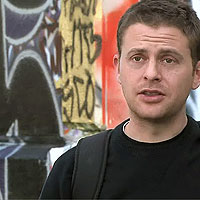
Adam5100 has been working with a spray can since his days as a teenage graffiti writer living in Albuquerque, New Mexico. Confessing that his early tagging was “the blight of society,” Adam5100 has since become one of the Bay Area’s most talented young painters. Spark joins the artist as he prepares for an exhibition at the White Walls Gallery by “layering the stencils of life.”

When Adam5100 reached his early 20s, he realized that he could accomplish more complex graffiti pieces, including large-scale images of faces and hands, in the same amount of time it took him to spray-paint a tag. In 2000, after abandoning tagging as a street activity, Adam5100 relocated to San Francisco and began training at the California College of the Arts. Positioning himself in the discipline of painting and printmaking, he realized that his prior graffiti work had a place in the world of fine art. He has stated that it was his exposure to painting, printmaking and fine art photography that was the impetus for his journey toward his current art practice. Placing his work squarely between these three disciplines, Adam5100 has taken on the challenging and complex issue of the urban landscape.

Feeling more at home in the hidden places than in the public, Adam5100 often explores the back alleys, forgotten streets and forbidden rooftops of the East Bay, photographing spaces as reference for new paintings. The importance of his private journeys are evident in each painting, each of which intimately reveals the forgotten elements of society and the struggle to find a sense of place. By shifting gallery goers’ attention to the forgotten spaces of urban centers, his work sheds light on parts of a city most would not see while retaining the subversive mischief of a graffiti artist.

Holding steady to his street sense of humor, Adam5100 often invents contemporary narratives in his work, a kind of fake pop culture similar to cheap tabloid news. His painting of baseball legend Nolan Ryan’s house and another of an Italian soccer fan leaving the scene of a crime are prime examples of how Adam5100 plays with humor, history and consumer culture.

Adam5100 pays homage to his graffiti contemporaries by using layers of hand-cut stencils to create layers of value. Making a stencil painting is a laborious process, requiring intense dedication and an enormous amount of time, all to create elements that remain hidden from the viewer. Twelve or more complex stencils are painstakingly cut for different values and colors of the painting; the end result endows the final piece with the illusion of three dimensions. Although stencils have been used for thousands of years as a means to reproduce images, Adam5100 turns the process on its side by integrating so many of his stencils into one single piece. In this respect, the work is much more closely related to the quick delivery of graffiti writing than fine art printmaking, in which the edition is the revered method of production.

Array

  • Array
  • Array
  • Array
  • Array

Caleb Duarte

Oakland resident Caleb Duarte is a part of a new generation of Bay Area Chicano artists. As an artist, he works with a combination of found materials, architectural building supplies, painting and drawing to create temporary installations and “sculptural paintings” that evoke poignant narratives of home, shelter and displacement. Spark follows Duarte as he prepares for his first solo exhibition in San Francisco.

The theme of home and shelter is central to Duarte’s work. Influenced by an interest in architecture and various forms of dwellings, Duarte uncovers how our living spaces speak to our realities and our relative placement in the so-called first and third worlds. His work explores what our homes say about the truth of our lives and the widening gap between rich and poor in the contemporary global context.

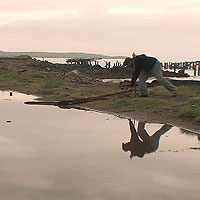
To create the temporary structures used in his installations, Duarte collects driftwood, old signs and other found materials that have had an existence as natural objects or in human habitats before he reuses them. It’s important to him that these materials are imperfect, that they have had a life that predates his own involvement with them. This use of weathered materials expands the narrative implications of his work, evoking a sense of the past and of lived histories.

Spark documents the progression of Duarte’s exhibition at Jack Fisher Gallery in San Francisco. The show, “Cuartitos” (“Little Rooms”), was inspired by the shantytowns of Mexico, and the beauty and sadness of these neighborhoods that are largely built out of necessity. These towns are constructed from whatever materials are available — combinations of cement blocks, recycled wood and old signs. Duarte’s own grandfather lived near the border town of Nogales, Mexico, where he built a cluster of makeshift houses for people to rent. On a recent road trip through Mexico, Duarte realized the profound influence his grandfather’s endeavors have had on his own work as an artist.

For his exhibition, in addition to a central towerlike form made of driftwood, Duarte fills the gallery space with sculptural wall paintings. To make these three-dimensional pieces, the artist delicately paints figures onto drywall from images he finds in newspapers and magazines, then mounts the images on boards. Some of the images were taken from newspaper articles on the disaster of Hurricane Katrina, others come from random photographs that convey a specific mood. By taking the figures out of their original context, Duarte’s representations remain ambiguous but ever imbued with emotion and humanity.

Duarte creates intimate spaces that impart a sense of humanity’s search for meaning, family, placement and home. The temporary aspect of his installations reflects the cyclical nature of life and the way in which the built environment is constructed and destroyed over and over again. By making changeable and evolving structures, Duarte evokes a ubiquitous aspect of our existence, which, alongside the inclusion of the figures, points to the beauty of human yearning.

Born in 1977, Caleb Duarte migrated from Mexico to the farm communities of the Central Valley of California when he was 4 years old. He began painting at a young age, then went on to attend the San Francisco Art Institute, where he earned a B.F.A. in 2003.

Array

  • Array

Susannah Bettag

British-born, San Francisco artist Susannah Bettag often adapts symbols from other cultures and time periods to create her own vernacular. Spark visits Bettag as she prepares for her debut solo show, “Vanitas Baby,” at the Frey Norris Gallery. For this body of work, she borrows from the vanitas tradition, a style of painting popular in 17th century Netherlands in which symbolism is used to depict mortality and the ephemeral quality of sensory pleasures.

Bettag creates multi-layered paintings which exemplifies her love of color. Her line drawing layer inspired by pornography is topped with her cartoon baby-like creatures. The two play on tensions between women’s eroticism and the dangers and discoveries of childhood innocence.

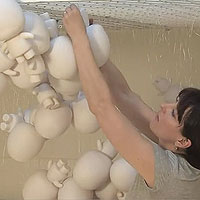
The centerpiece of this show, “Drowning Without You,” consists of thousands of white matte vinyl dolls hanging in a two-story installation shaped like hourglass. The dolls were manufactured based on a character that has appeared repeatedly Bettag’s paintings named “Little Boo.” Bettag says of Little Boo, “There was something about him that was innocent, at the same time being naïve and also a little unnerving.”

  • Array
  • Array

David Hevel

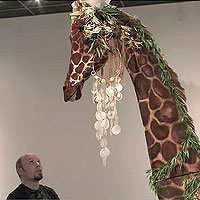
Growing up in Missouri, David Hevel was influenced by the inevitable and distinctly American force-feeding of pop icons and television culture. Hevel worked in film/video performance, commercial illustration and painting, eventually finding his niche in sculpture. Using unique materials, Hevel creates fantastical images of animals that represent such American celebrities as supermodel Tyra Banks and pop idol Justin Timberlake.

Spark chats with Hevel at Heather Marx Gallery as he dismantles his solo show, “Fierce,” and prepares for his next exhibit, “Diva Hound Smack-Down at the Grammys,” in Kansas City.

Hevel’s unique form of art began when he became inexplicably infatuated with stockpiling plastic fruit. Now, years later, he has found a way to channel his infatuation by developing a complex mixed-media operation that relies heavily on glitter, hot glue and his plethora of obsessively collected kitsch — including sparkling beads and butterflies, silk flowers, oversized rhinestones, and faux fur — to embellish Styrofoam forms used by taxidermists. His work teeters precariously between grotesque and gorgeous, providing a humorous narrative that addresses the nature of Americans’ excessive consumption of celebrity gossip.

David Hevel is based in Oakland, and his work has been exhibited internationally. He earned a B.F.A. from Central Missouri State University, an M.Ed. from the University of Missouri and an M.F.A. from California College of the Arts.

Array

  • Array
  • Array

Del Sol String Quartet

Based in San Francisco, the Del Sol String Quartet is asserting itself as a leader in Bay Area new-music performance. This ensemble commissions new music from composers and showcases those and other new works in relevant, responsive and deeply passionate performances. Spark listens to the Del Sol String Quartet rehearse and is there when the quartet debuts the work of three composers — New Zealand native Jack Body, Iranian-American composer Reza Vali and Los Angeles-based Eric Lindsay.

Body’s piece, entitled “Epicycle,” does exactly that: It cycles through a pattern of pitches that are at times played simultaneously and at other times played as distinctly separate notes. The work was originally performed by the Kronos Quartet. “I loved his piece from the minute we picked it up, despite how difficult it is to play,” says ensemble member Hannah Addario-Berry.

Vali, a professor of music at Carnegie Mellon University, helped the Del Sol String Quartet tackle the Persian scale patterns used in his piece. One of the main principles in Middle Eastern music is its use of quartertones, which Western music does not commonly employ. A quartertone is a note that is between the half-step interval, or halftone, the smallest distance between two pitches in Western music. Also, as Vali states, Persian music is not rhythmically in sync in the same way that Western music is. They play the same music, but with a slight time difference.

“Del Sol is at the point where they’re ready to be discovered. They’ve worked very hard and developed a unity that is sensational. They’re exciting — not only the music they choose, but also their performances are electric,” praises Charles Amirkhanian, the executive director of Other Minds, a new-music festival and community.

The members of the Del Sol String Quartet are Kate Stenberg and Rick Shinozaki, violinists, Charlton Lee, violist, and Hannah Addario-Berry, cellist. The quartet began in 1992 at the renowned Banff Centre for the Arts in Canada, after which it was awarded a residency at San Francisco State University in association with the Alexander String Quartet. They tour internationally and are committed to performing outreach work in schools and at other community sites. In January 2006, the quartet was awarded First Prize for Adventurous Programming (Mixed Repertory) from Chamber Music America/ASCAP.

  • Array
  • Array
  • Array

Crown Point Press and William T. Wiley

Tucked in a quiet alley in bustling San Francisco, Crown Point Press stands as one of the most prestigious print studios in the world. Founded by Kathan Brown in a Richmond, California storefront in 1962, Crown Point Press began publishing the etchings portfolios of painters Richard Diebenkorn and Wayne Thiebaud, both of whom are considered to be among the most influential visual artists of the last half-century. Crown Point Press’s roster of artists also includes such luminaries as Sol LeWitt, Robert Bechtle, Chuck Close, John Cage and Kiki Smith.

Crown Point Press publishes the prints of five or six artists a year who are invited to complete artistic residencies that range from two weeks to six months. For this program, Brown enjoys inviting the participation of established artists in addition to those whose specialty is outside the printing sphere, such as photographer John Chiara. Spark visits with William T. Wiley, one of the leaders of the Bay Area’s figurative movement, during his Crown Point Press residency in 2006. The Marin artist guides us through the making of a print, from idea to finished product.

There are many different techniques of printmaking including: relief (woodcut), intaglio (etching), planographic (monotype) and stencil (silkscreen). Crown Point specializes in the many different methods of etching. Brown says, “The difference between an etching and any other kind of printing is that an etching is printed from below the surface of the plate, so the paper molds down in. That makes a big difference, because it’s physically embedded. Every other printing — lithography, woodcut — prints from a surface to a surface. So it sits on top. So you have an energy that’s different.”

More about Crown Point Press:
In 1997, Crown Point Press celebrated its 35th anniversary with an exhibition at the National Gallery of Art, Washington, D.C. It has a gallery that is open to the public and two large etching studios. Their summer workshops are open to all artists.

  • Array
  • Array
  • Array

Marga Gomez

Nationally touring comedienne and actress Marga Gomez writes and performs solo shows based primarily on biographical material. Spark goes backstage with Gomez at The Marsh as she discusses her transitions between the worlds of stage comedy and Hollywood and workshops “Los Big Names,” which is about her experience growing up in a show-business family.

  • Array
  • Array

John Santos

Four-time Latin Grammy nominees John Santos and his Machete Ensemble have been at the forefront of Latin jazz in the Bay Area for more than 20 years. His 11-piece ensemble has explored the boundaries of the genre, incorporating elements of experimental, Afro-Caribbean folk and Latin dance music as well as the blues.

Over the years, the Machete Ensemble has developed a loyal and critical audience appreciative of music that doesn’t fit into simple categories. But economic factors have not been kind to large ensembles, and with reduced bookings, the ensemble has decided to end its two-decade tenure with a farewell concert closing the San Francisco Jazz Festival. Spark follows Santos as he prepares for both the concert and the journey into the next phase of his music career, with the John Santos Quintet.

With family roots in Cape Verde and Puerto Rico, Santos was inspired by his musically talented family and the burgeoning music scene of San Francisco’s Mission District. He started out playing Latin percussion instruments, including the bongos and the conga drums. But it was upon the introduction in the 1960s of the funky Latin fusion music of Carlos Santana that Santos became truly inspired by the possibilities of merging traditional Latin music with modern forms.

After a brief experience as a percussionist in Santana’s band, Santos dedicated himself to a lifetime of study and practice, and today he is one of the foremost authorities on Latin jazz and Latin folk music traditions. After many years as an educator, a historian, a recording artist and a performer, Santos has made it part of his mission to educate the public on Latin music traditions and its strong influence on the development of not just jazz, but all popular American music.

Array

  • Array
  • Array

Shift Physical Theater

The members of SHIFT>>> Physical Theater share an equal involvement in the development of choreography, narrative and structure for each project. Their work is generated out of the performers’ own stories and use modern dance to examine the relationships between people in contemporary culture. Founded in 1998, SHIFT>>> is currently a resident artist at ODC Theater.

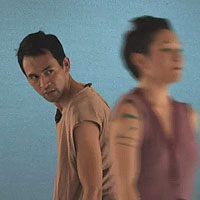
Dancer Manuelito Biag is the artistic director of SHIFT>>>. Spark visits with Biag as they work on “The Shape of Poison,” which was inspired by the Tibetan Buddhist teachings of Klesha, the emotional obstacles to enlightenment. The three main Kleshas are passion, ignorance, and anger.

We watch as Biag works on a duet based on “Passion.” Biag says “When we get too attached to one thing, when we get too passionate about a thing or person or concept … it causes us suffering.” But he says it’s important to forgive ourselves. “We’re human, and that to be aware and to be mindful is the key.”

  • Array
  • Array

Shuji Ikeda

A native of Okayama, Japan, ceramicist and ikebana artist Shuji Ikeda originally hoped to become a filmmaker. He came to the United States in 1973 to study film at San Francisco State University and graduated cum laude. But he grew frustrated by the challenges of breaking into the business and, in a serendipitous turn of events, turned to pottery as a means of therapy.

Now renowned for his craftsmanship and innovative methods — including his unusual woven baskets made of hundreds of delicate strands of clay and his organically elegant dancing pots — Ikeda has carved a unique niche for himself in the ceramics world. His work has been exhibited everywhere from San Francisco’s Museum of Craft and Folk Art to Gump’s to the Smithsonian Institution.

The serene Ikeda is also an expert in the Japanese art of flower arranging, or ikebana. He holds a certificate from the Ikenobo Ikebana School in Japan and passes on his knowledge from his studios in Berkeley. “Flowers,” he says, “provide an opportunity to express oneself and communicate without the benefit of language.”

Like most ceramicists, Ikeda has developed his own distinctive styles of glazing, formulating personal recipes such as the refined “sei shya,” or blue rust, which he uses on his dappled, woven baskets. But it is the philosophy of the age-old ikebana that most clearly informs his work in clay, which can be intricate or simple, highly finished or naturalistic.

Spark visits with Ikeda in his studio and at a “noborigama” in Napa County, which is a 30-foot wood-burning kiln that is kept burning for seven days straight. Such kilns have been used in Japan since the 17th century. The noborigama’s wood-firing technique produces a unique natural ash glaze.

  • Array
  • Array

Amy X Neuburg

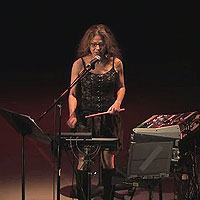
Since the mid-1980s, Amy X Neuburg has been combining her staggering vocal abilities with electronics to create music that defies categorization. Working both as a solo performer and as part of a number of ensembles, Neuburg writes, records and performs a hybrid style of music she calls “avant-cabaret.” Spark pays a visit to this groundbreaking musician as she prepares a new song cycle, entitled “The Secret Language of Subways.”

Neuburg primarily uses electronic instruments in her work — programmable drum pads, mixers and a looper — which allows her to instantaneously record and play back sound. Before she can perform a song, Neuburg must prepare each of these devices, a task that can take weeks of experimenting with an array of configurations and functions. To these tools she adds her voice, which boasts an impressive four-octave range.

In performance, all sounds are executed live: Despite Neuburg’s reliance on electronic instruments, she uses no prerecorded tapes or canned sound. Looping allows her to create a sound live then repeat it to build a dense and dynamic sound texture. In addition, Neuburg leaves little room for improvisation, as each sound is meticulously scripted, every note precisely choreographed.

Subtitled “A Song Cycle About Love and War and New York,” Neuburg’s “The Secret Language of Subways” is composed of 12 songs that were largely conceived while riding New York’s subway system. Using urban metaphors to examine questions of love, loss, deceit, art and social responsibility, “The Secret Language of Subways” is Neuburg’s most ambitious work yet, both in terms of content and musically. Enlisting the help of Bay Area cellists Jess Ivry, Elaine Kreston and Beth Vandervennet, she has put together an unusual and challenging quartet.

Born in Cheltenham, England, Amy X Neuburg began classical training in voice at the age of 13. She earned a B.Mus. from Oberlin Conservatory and a B.A. in linguistics from Oberlin College. Neuburg then went on to pursue a master’s degree at Mills College, where she studied composition under electronic music pioneers Pauline Oliveros and David Rosenboom. In 1987, along with fellow Mills students Joel Davel, Tim Root and Herb Heinz, Neuburg formed the techno-theater ensemble MAP, later performing under the name “Amy X Neuburg and Men.” Neuburg has also performed and toured the world in the operas of veteran minimalist composer Robert Ashley.

Array

  • Array