Asides

Seyed Alavi

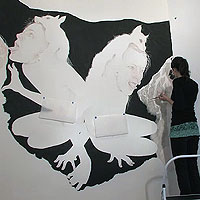
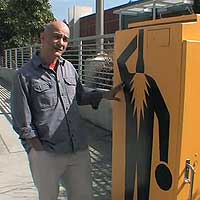
For Seyed Alavi, creating objects and asking questions are equally important in his art-making process. For nearly two decades, the Bay Area artist has been working with public institutions to create conceptual works of art to be experienced by passersby. Spark follows Alavi as he offers a guided tour of his art and working process.

Though Alavi produces tangible objects, he thinks of himself as a conceptual artist, that is, the ideas behind his works are centralized over the finished object. Whereas many artists choose to master a specific medium and explore multiple subjects through it, Alavi works in several media. He develops a concept, plans the work for a specific location, then outsources the actual fabrication of the piece.

Alavi has created some of his most penetrating works with the help of high school students. His first such project was a series of text pieces painted under the overpasses of Interstate 580 in Oakland. Collaborating with a group of students from the region, he helped them to develop wordplays that would cause those who viewed them to think about the topics raised. Stenciled in capitalized serif fonts, the murals provocatively announce “INVISIBLE COLORS,” “INFORM(N)ATION,” and “D FFERENCE,” the last suggesting that one needs to include his or her “I” to make the “difference.”

Another project done in collaboration with students is a series of variations on the ubiquitous schematized human figures found on street signs. Together with a team of students, Alavi came up with 17 surreal alterations of the figures. They then painted their versions onto utility boxes scattered throughout the town of Emeryville, Calif., in order to raise questions about the nature of human identity, interaction and existence.

Spark also trails Alavi to San Francisco’s Exploratorium, where he and four other artists have been invited to create installations in the museum’s space based on the notion of “liminality,” the condition of being between states. Alavi’s concept provides the physical challenge of closing off the skylights in the Exploratorium’s massive space so that he can program the illumination of lights clustered in a ball high above visitors. As museumgoers move in and around the space, their relationship to the moving lights continually changes, thereby making them aware of their constant state of liminal perception.

Seyed Alavi earned a B.S. from San Jose State University and an M.F.A. from the San Francisco Art Institute. He has created site-specific installations for locations in New York, Long Beach and the Bay Area. He has taught classes and workshops at the San Francisco Art Institute, the California College of the Arts, San Francisco State University and the University of California at Davis.

Array

  • Array
  • Array
  • Array

Tippy Canoe and the Paddlemen

Michele Kappel aka Tippy Canoe was a drummer in the rock band The Kirby Grips when she picked up the ukulele and fell in love. She then started writing her own songs for the instrument combining jazz, pop, old time, and girl group music mixed with post-punk influences such as Squeeze and Blondie.

After a few years of performing on her own, Kappel formed her own back up band, The Paddlemen with Rick Quisol on drums, Mikie Lee Prasad on guitar and Chris “T.G.” Green on bass. Spark catches one of their gigs at Alameda’s Speisekammer.

  • Array
  • Array
  • Array

Erika Chong Shuch

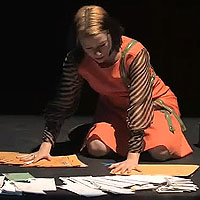
Choreographer, director, dancer and teacher, Erika Chong Shuch crosses over boundaries. She melds theater, dance, science, poetry, music, video and mechanics to formulate works of art that are multidisciplinary — in the truest sense of the word. Inspired by a wide range of subjects, from cannibalism to extraterrestrial intelligence, Shuch nevertheless puts the focus on the drama of human experiences.

A restless intellect, Shuch dropped out of high school in San Jose at age 17, yet still found her way into theater and dance at the University of California at Santa Cruz. After graduating, Shuch danced in Seattle and in Berlin with Alex B Company and Sommer Ulrickson (Wee Dance Company) before returning to California to earn an M.F.A. at San Francisco’s New College of California, where she also co-founded the multidisciplinary Experimental Performance Institute.

In 2002, she started her own company, the ESP Project, composed of a mix of artists that come from a wide variety of backgrounds. With works such as “Vis-à-Vis” and “All You Need,” Shuch quickly established herself as one of the Bay Area’s most interesting young performance artists. Her piece “ORBIT (notes from the edge of forever),” which was inspired by the research of her father, H. Paul Shuch, was nominated for a 2007 Izzie Award for visual design.

A resident company at Intersection for the Arts since 2004, the ESP Project developed “51802” through the Intersection for the Arts’ Prison Project, a year-long series of events and programs exploring the California prison system. “51802” examines our relationships to boundaries and confinement. Spark follows Shuch from the earliest stages of the creative process as she embarks on this work.

  • Array
  • Array
  • Array

Jesus Aguilar

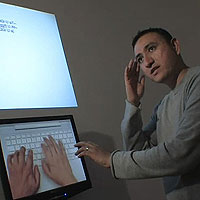
Bay Area video artist Jesus Aguilar is exploring the intersection between language and technology. Drawing his inspiration simultaneously from video artist pioneers of the 1970s and the Internet, Aguilar is developing an artistic process that examines communication in the 21st century. Spark visits Aguilar at the Headlands Center for the Arts, where the young artist talks about some of his latest projects.

Much of Aguilar’s work explores how we interface with information via computers and the Internet. Several pieces in “No Entropy,” Aguilar’s solo show at the Stephen Wirtz Gallery in San Francisco, overlay multiple modes of communication to unveil the conditions of our experience of information in the digital age.

In “Dante’s Inferno in 8 Minutes 34 Seconds,” the entire text of the epic poem scrolls by in just over eight-and-a-half minutes, at a rate impossible to register not only by the viewer, but also by the camera that captures the transmission. The piece, along with the similarly crafted “The Odyssey of Homer in 8 Minutes 44 Seconds,” represents both the fleeting nature and the omnipresence of information in a world in which all accumulated human endeavor is subjected to the same process of coding.

In “ABC, 123,” Aguilar overlays two registers of communication. The video shows Aguilar’s finger carefully impressing letters and numbers on a computer screen and the liquid crystal display’s momentary retention of a trace of the artist’s actions. The artist’s hand and the digital medium create an interaction that is all the more poignant for the tension it creates.

Even as these experiments with digital media and the transmission of information speak of the present digital age, for Aguilar they also hearken back to the 1960s and 1970s, when artists like Joan Jonas and Nam June Paik were wrestling with the technology of video, which held the promise of making everyone not only a consumer of televisual technology, but also a producer. As did the generation of artists that came before him, Aguilar uses his work to come to grips with a fundamental shift in the way we experience and interact with the ever-changing terms of the world around us.

Jesus Aguilar was born in San Lucas de O’Campo, Durango, Mexico, and currently lives in San Jose. In 1999, he graduated from San Jose State University with a B.F.A. and subsequently earned an M.F.A. in video, multimedia and photography from Mills College. In 2006, he received the M.F.A. Studio Residency Award from the Headlands Center for the Arts and the Herringer Prize for Excellence in Studio Art.

Array

  • Array
  • Array
  • Array

Kathy Aoki

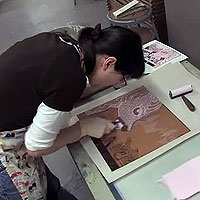
Kathy Aoki describes herself as a sneaky feminist. Teddy bears, butterflies and cherub-faced girls populate the prints and sculptures in her latest series, “Modern Girlhood.” But while the seemingly innocent and cartoon-like characters in her work wear exuberant smiles, sinister things are happening all around. Bulldozers mow down stuffed animals. A giant tube of lip gloss becomes the latest civic monument added to an otherwise pristine outdoor landscape.

“The work I make is showing this messed-up system that’s perpetuated by the media that makes girls want to conform and buy into this cuteness,” Aoki explains when Spark visits her Santa Clara studio while she prepares for a solo exhibition at the LMAN gallery in Los Angeles. And although her message is a bold one, Aoki’s use of anime-inspired images and candy colors yields results that are more likely to provoke conversation than arguments.

The ideas for Aoki’s linoleum cut prints and installation pieces have their roots in both the past and the present. The daughter of two Yale-educated doctors, Aoki recalls how her own mother struggled with being a female in a male-dominated profession. But she also finds inspiration from current-day phenomena, like the Cartoon Network’s popular “Powerpuff Girls” television show and everyday representations of women in magazines and the media.

“I try to use humor and pattern and color, things that will attract an audience that might not necessarily want to stick around for strong feminist messages. I have a hard time myself looking at angry feminist work, and I feel it often puts a wall between the artist and the viewer,” she says.

After studying French at the University of California at Berkeley, Aoki earned an M.F.A. in printmaking from Washington University in St. Louis, Mo. She has received numerous fellowships and awards, including the San Francisco Arts Commission’s Public Art Award for her 2004 Market Street kiosk poster series depicting super heroes performing random acts of kindness. Her work appears in the permanent collections of the San Francisco Museum of Modern Art, Harvard University Art Museums, the New York Public Library and many others. She is currently an assistant professor in studio and computer art at Santa Clara University.

  • Array
  • Array

M dot Strange

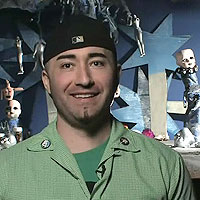
Despite his sudden rise to international fame, Michael Belmont, aka M dot Strange, advocates that life is simply better with ice cream. His feature-length film “We Are the Strange” is about two outcasts who risk going to the evil city to get ice cream. Among many things, they encounter monster ambushes, giant robot attacks, and explosions.

What started as a project in Belmont’s bedroom, “We Are the Strange” premiered at the Sundance Film Festival in January 2007 after the movie trailer’s overwhelming popularity on YouTube. To show his gratitude, Belmont has been offering a series of tutorials on YouTube to create his particular style of animation, which he’s dubbed “Str8nime” — a fusion of 8-bit videogame culture, Japanese anime, and of course, a healthy dose of strangeness. Spark visits the San Jose filmmaker and his cast of characters.

  • Array
  • Array
  • Array

Pandit Chitresh Das

Editor’s note: Pandit Chitresh Das passed away on January 4, 2015.

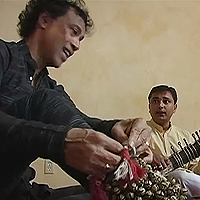
Pandit Chitresh Das was born in Calcutta, India, in 1944. At age 9, he began studying kathak under teacher and guru Pandit Ram Narayan Misra. In 1970, Das was brought to the United States on a Whitney Fellowship. A year later, Ustad Ali Akbar Khan brought Das to the Ali Khan College of Music in San Rafael to teach kathak.

In 1980 Das created the Chhandam School of Kathak Dance and the Chitresh Das Dance Company. It grew to five Bay Area locations as well as schools in Boston, Canada and India. Spark visits with Das and discusses his personal history and his work, including his school and, more recently, the Kathak Festival and Symposium.

A classical dance from northern India, kathak is improvisational and takes a lifetime to learn. “Kathak” comes from the word “katha,” meaning “to tell stories.” Kathak has two main elements, storytelling and abstract dance. A solo kathak dance can last several hours, progressing through various specific elements. The dancer, who wears about five pounds of bells around the ankles, recites a spontaneous rhythmic phrase that is repeated back by the musicians.

For centuries, the form has been passed from guru to disciple. Das has passed this traditional dance form to a broad range of students. His classes involve not only dance, but also history, philosophy and math. Das has also taken the art to a new level through the creation of kathak yoga, a meditation technique in which participants dance, drum and sing simultaneously.

In 2006, the Chitresh Das Dance Company organized a three-day festival of kathak dance at Yerba Buena Center for the Arts in San Francisco. The largest kathak festival ever to take place outside of India, it brought together dancers from all over the world and incorporated both traditional and innovative elements. Das performed with Emmy Award-winning tap dancer Jason Samuels Smith in “India Jazz Suites,” which has since received a Bay Area Dance Award and the Isadora Duncan Dance Award for Best Ensemble Performance.

Array

  • Array
  • Array

Mark Jackson

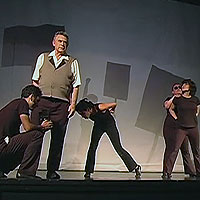
From Stanislavsky to “The Bugs Bunny/Road Runner Hour,” movement intersecting with drama is the primary interest of writer, director and actor Mark Jackson, one of the Bay Area’s most exciting and original young playwrights. With “American $uicide,” a commission for the Magic Theater and the Z Space Studio New Works Initiative, he satirizes Americans’ fascination with their 15 minutes of fame. Spark visits with Jackson during rehearsal for his adaptation of the 1929 Nikolai Erdman play.

A graduate of San Francisco State University’s theater arts program, Jackson has created a brand of physical theater that integrates the theories of gesture and biomechanics that he studied under Gennadi Bogdanov and at the Saratoga International Theater Institute. Jackson, who has a flair for perceptive commentary on contemporary society, uses a modern sensibility to create dramatic works that present age-old ideas of theater in a fresh light.

Jackson first received widespread critical attention when he founded San Francisco’s Art Street Theatre in 1995. In his nine-year stint as the company’s artistic director, he created seven new plays, including “I Am Hamlet,” for which he won his first Bay Area Critics Circle Award in 2002. Jackson’s reinventions of classic plays, such as “R&J” and “Io, Princess of Argos!,” drew inspiration from sources as varied as Greek tragedy and Shakespeare.

For his acclaimed “Death of Meyerhold,” which premiered in 2003 at Berkeley’s Shotgun Players, Jackson turned to the work of legendary and revolutionary theater director Vselovod Meyerhold to craft a powerful and heady mix of dance, commedia, kabuki and circus. In 2004, following the success of “Meyerhold” — which won him a second Bay Area Critics Circle Award — Jackson accepted a fellowship from the Alexander von Humboldt Foundation to study at the Mime Centrum in Berlin, where he continued to explore the relationship between dance and theater.

Jackson returned to the Bay Area scene directing highly regarded productions of Oscar Wilde’s “Salome” for the Aurora Theatre Company, Bertolt Brecht’s “Caucasian Chalk Circle” for A.C.T.’s MFA program and “The Forest War” for the Shotgun Players. Jackson wrote as well as directed “The Forest War,” a Kabuki-inspired morality tale with echoes of current-day politics.

  • Array
  • Array
  • Array

Carlos Baron

A childhood in Chile marked by both the lyricism of Pablo Neruda’s poetic legacy and the violence of the Pinochet regime flavors the experiences that poet and playwright Carlos Baron has brought to his writings over decades as an exile from his homeland. Spark follows Baron as he and a group of young actors rehearse and perform his play “Poeta Pan” in San Francisco and in Chile.

“Poeta Pan,” or “Bread Poet,” is an evocation of Baron’s Chilean roots through the poetry of Neruda. A multifaceted collaboration with Latin jazz flutist John Calloway, Rafael Manriquez and choreographer Martha Zepeda, the play calls up comparisons between September 11, 2001, and the Pinochet coup d’etat that occurred 28 years earlier on the same date.

After studying sociology and theater arts at the University of California at Berkeley in the late 1960s and early 1970s, Baron returned briefly to Chile to defend the Salvador Allende government, for which he was imprisoned. Upon returning to the Bay Area, in 1975 he helped to found La Peña Cultural Center in Berkeley. La Peña provides, among other things, a cultural meeting ground for Chilean exiles. Baron was the center’s first cultural coordinator.

Multiculturalism and Latino theater remain the primary interests of Baron, who was also the theater and dance coordinator for the Mission Cultural Center and founder of San Francisco’s Teatro Latino. As a professor of theater arts at San Francisco State University, Baron not only has helped to expand La Raza and multicultural studies at the university, but also directs the university’s Teatro Arcoiris, or Rainbow Theater, a multicultural theater workshop.

An activist and an actor, Baron has worked with Berkeley Rep, the Magic Theatre and San Jose Repertory Theater. He has also had a hand in radio and television for many years, as a programmer for both KPFA and KPOO, and has consulted for Antenna Theater, Intercultura and the “McNeil/Lehrer NewsHour,” among others. Also a poet and a professional storyteller, Baron has exhibited his impassioned work at festivals in Cuba, Chile and the United States.

Array

  • Array
  • Array
  • Array

Julia Parker

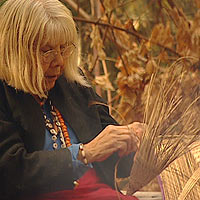
For Julia Parker, weaving baskets connects her to the lives and traditions of her ancestors, telling the story of a people that for more than 4,000 years populated villages throughout the Yosemite Valley. In the Spark episode ” Legacies,” Parker guides viewers through the area where her village had once been as she explains the traditional process of making her baskets.

Born in 1929 in Sonoma County of the Coast Miwok and Kashaya Pomo peoples of the Yosemite, Parker moved to the Yosemite Valley in 1949 to live in the village of her husband, of Miwok Paiute descent. As a young woman, Parker was compelled to learn everything she could about the old ways of basket weaving. She studied basketry with the elders of her village, including her husband’s grandmother Lucy Telles. Telles was a highly innovative and celebrated weaver, whose masterpiece — a colossal 3-foot-by-19-inch storage basket — is now on display at the Yosemite Museum. Parker remained in her husband’s Yosemite Valley village until 1969, when the government bulldozed the region to make way for campsites.

Concerned that these ancient methods of making baskets would die out with the weavers of Telles’s generation, Parker dedicated her life to passing on the knowledge and skills she’d gained. Since 1960, Parker has demonstrated basket weaving behind Yosemite’s Indian Museum, in the same spot where Telles used to weave and sell her baskets and beadwork to tourists. She graciously answers visitors’ questions in an effort to share her culture with others.

Parker is an innovator in her own right, with samples of her work in the Smithsonian Institution and in the collection of the Queen of England. Her baskets demonstrate a staggering complexity of design, that is unparalleled in the work of her colleagues. She makes every one of her baskets by first collecting the needed grasses and sticks, then treating them with moisture and heat in order to make them supple. She also prepares the dyes from natural materials. And since there are no established patterns for different types of baskets, the entire design of the basket has to be formed in Parker’s mind before she begins weaving. The process is slow and labor-intensive, which means that a single basket can take several months, sometimes well over a year to complete.

Parker, now in her 70s, has inspired her daughter Lucy Parker and granddaughter Ursula Jones to continue making traditional basketry. Spark follows Parker and her family as they make the 350-mile journey to see the work of their ancestors at the Phoebe A. Hearst Museum of Anthropology at UC Berkeley, which houses approximately 9,000 baskets.

Array

  • Array
  • Array
  • Array
  • Array

Josephine Taylor

San Francisco artist Josephine Taylor makes large-scale drawings in pencil and ink. Her work is narrative and is related to being in the dream state and recalling childhood memories. Spark visits Taylor in her studio to see the process behind her imagery.

Taylor earned a B.A. in religious studies and East Indian translation languages from the University of Colorado and an M.F.A. in painting from the San Francisco Art Institute. She was awarded a residency at the Headlands Center for the Arts and a SFMOMA SECA Award in 2004.

  • Array

Philip Kan Gotanda

Philip Kan Gotanda, one of America’s leading playwrights, has created an extensive body of work about the Asian American experience. Stories of identity, race, conflict, pain, joy and love resonate through his work. Spark talks with Gotanda at the American Conservatory Theater, where his play “After the War” is being staged.

Commissioned by A.C.T., “After the War” is set post-World War II in a boarding house in San Francisco’s Japantown. The diverse cast of characters, including Japanese Americans, African Americans, poor whites and a Russian Jew, portray, from their very different points of view, the interracial conflicts that arose out of the Japanese American internment.

In his work, Gotanda, whose parents were sent to an internment camp in 1942, tells the particulars of his own life experiences, his struggle with identity and the history of Japanese American society. He says, “You should write because you have something to say.”

In his late teens, Gotanda traveled to Japan, looking for a place where he could find “racial anonymity.” Instead, he was regarded not as Japanese, but as a sansei, a third-generation Japanese American. Gotanda returned to the United States, graduated from the University of California at Santa Barbara and earned a law degree from Hastings College of Law. While working at the North Beach-Chinatown Legal Aid Society in San Francisco, he wrote his first play, a musical entitled “The Avocado Kid, or Zen in the Art of Guacamole,” based on a classic Japanese children’s tale.

Gotanda has also worked with the Asian American Theater Company, Berkeley Repertory Theatre, Campo Santo, the East West Players, the Manhattan Theatre Club, the Mark Taper Forum, the New York Shakespeare Festival and the San Jose Repertory Theatre, among many others. He is also a noted filmmaker whose works include “The Kiss,” “Drinking Tea” and “Life Tastes Good.”

Array

  • Array
  • Array
  • Array

Janice Garrett

Since its founding in 2001, the San Francisco-based Janice Garrett & Dancers has rapidly become one of the most respected small modern dance troupes in the Bay Area. Garrett’s choreography is notable as much for its craftsmanship as for its dazzling speed, musical clarity and wit. Spark follows Garrett and her dancers on the road to their sixth San Francisco season and reveals why all the hard work and sacrifices are worth it.

Garrett came to dance relatively late, at the age of 23, after she had already graduated with a B.S. in mathematics from Stanford. She subsequently studied dance at Mills College, then, in 1980, moved to New York, where she joined the modern dance company of Dan Wagoner, an alumnus of the Martha Graham, Merce Cunningham and Paul Taylor companies.

After 10 years in New York, Garrett returned to the Bay Area, although she continued to work extensively in Europe, choreographing pieces for the Scottish Dance Theatre, London Contemporary’s 4D Performance Group, the London Contemporary Dance School and the School for Modern Dance in Denmark. At the London Contemporary Dance Theater, she collaborated with British director and choreographer Jonathan Lunn on a range of productions and built a reputation for whimsical, kinetic dances.

In 2001, Garrett put together an evening of her own work at San Francisco’s ODC Theater, assembling a group of eight local dancers who would later form the core of her own company, Janice Garrett & Dancers. In only a few short years, her company attracted substantial attention, garnering five nominations from the Isadora Duncan Dance Awards. Garrett herself was nominated in 2004 as one of Dance Magazine’s “25 to Watch,” and demand for her skills and talent grew, abroad as a teacher for Rambert Dance Company, DV8 Physical Theatre and Matthew Bourne’s New Adventures and at home as a teacher for ODC Commons.

Garrett’s work, which has been described by one critic as “exuberantly fluid,” draws not only on her wealth of experience as a choreographer, but also on events in her life. The patterns and connections that tie lives together forms a theme in her work, and it’s an interest that she pursues in her capacity as director of performing arts for the Center for Changing Systems, where she develops new and innovative models of communication and nonlinear decision making.

  • Array
  • Array

Jess Curtis

Choreographer Jess Curtis founded Jess Curtis/Gravity in 2000. He’s had a hand in creating bodies of work with companies such as San Francisco’s Contraband and the Franco-American Circus project Cie Cahin Caha, Cirque Batard. Along the way he has been commissioned to make works across Europe and has won numerous awards.

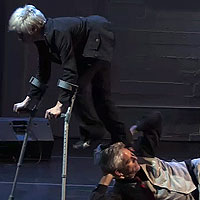
Spark visits with Curtis as he premieres a work called “Under the Radar” at San Francisco’s counterPULSE. “Under the Radar” is a cabaret piece focusing on the issues of visibility, ability and disability and features an international cast of disabled and non-disabled performers.

  • Array
  • Array