Asides

Bay Unity Music Project (BUMP)

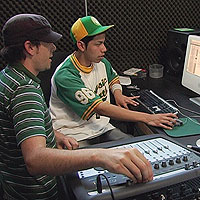
What with budget cuts depleting funding for arts and music programs statewide, traditional student bands in California’s public schools are getting fewer and farther between. But that doesn’t mean students have stopped making music. In an innovative after-school program, West Oakland’s McClymonds High School has found a relatively cost-effective way to teach music theory and immerse students in the arts. Instead of forming a band, students involved in the Bay Unity Music Project (BUMP) run their own micro recording label.

BUMP was founded by co-directors Patrick Huang and Matthew Meschery, who began working as a substitute Spanish teacher at the high school and noticed that there wasn’t a music program for students. A trained sound engineer with recording industry experience, Meschery began volunteering his time to develop BUMP.

First, Huang and Meschery set up a digital music production lab for students and began teaching them how to compose their own digital tracks. It was an instant hit with the high school kids. Raised on hip hop and R&B, the kids were eager to combine their newfound skills with rapping and lyric composition. Meschery then brought in hip hop industry professionals as vocal coaches to work with the students on techniques ranging from freestyling to beatboxing. Later, the program became a part of Youth Sounds, an Oakland-based media and arts organization serving low-income teens that merged with the Bay Area Video Coalition in 2006.

Three times a year, 15 to 20 students audition to participate in the program, which produces two CDs annually. Proceeds from sales of the CDs fund student field trips to recording studios and offset program costs. Students are responsible for everything from producing the music to packaging and promoting the final product. They learn to use standard industry software for digital music composition and recording. Along with real-world technical skills, BUMP participants come away with the knowledge that they have the creativity and confidence to create their own music and follow careers in the entertainment industry.

“It’s great to create a product where [students] are like, ‘Oh, wait, I can do that. I can do the same thing’ as this artist or that artist they hear on the radio,” Meschery tells Spark.

In 2006, BUMP released “True 2 Life, Vol. 2” and produced a CD-release concert to showcase the record label’s work.

  • Array
  • Array

Bruce Beasley

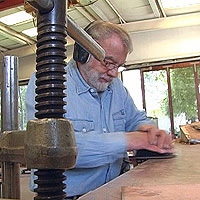
Since the mid 1960s veteran Bay Area artist Bruce Beasley has remained at the forefront of modern sculpture. Beasley’s large-scale geometric pieces articulate a powerful visual language that has won the artist critical acclaim and sustained a career that has spanned over four decades. Spark visits Beasley at his West Oakland studio to catch a glimpse of this sculptor at work.

Beasley’s work enjoyed critical success from a very early point. In 1962, when the artist was only 22 years old, the Museum of Modern Art in New York acquired one of his sculptures, making him the youngest artist ever to have his or her work in the museum’s collection. But despite this early success, Beasley has continued to challenge himself, experimenting with new materials and forms.

While his early pieces were executed in cast aluminum, in the late 1960s, Beasley began experimenting with molded transparent acrylic. Since he was working with a relatively new material, largely unexplored by artists, Beasley began research on the substance, eventually discovering new techniques for working with the medium. He developed a casting technique that was eventually adopted by NASA in the development of the first acrylic undersea submersible.

With each new material, Beasley strives to find forms appropriate to his new medium. As he began working with cast bronze, the fluid organic forms characteristic of the acrylic pieces gave way to intersecting geometric volumes. Beasley now designs his sculptures on a computer, planning, rotating and moving sculptural elements until he finds the right composition. Beasley’s computer model is then reduced to a pattern with which to make accurate cuts into sheet metal.

Throughout his career, Beasley has been guided by organic forms readily found in nature. His extensive collection of animal skulls has been an unending source of inspiration and instruction, outlining elegant forms, transitions, and textures. The bones provide a basis for all his sculpture, suggesting a set of solutions to formal problems.

Born in Los Angles. Bruce Beasley attended Dartmouth College before completing his B.A. at the University of California, Berkeley in 1962. His work can be found in museums and public collections internationally, including the Museum of Modern Art, New York, the Solomon R. Guggenheim Museum, the Djerassi Foundation, and in the collection of Kleinewefers GmbH, Krefeld, Germany. His sculpture garden is open by special appointment and available for tours by arts and cultural groups. He plans to turn this complex into a West Oakland outpost of the Oakland Museum of California after his death. This will be a home for his work as well as a resource and workspace for the sculpture community.

Array

  • Array

Crude

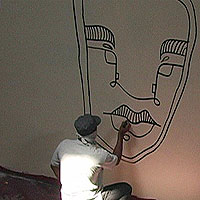
©rude is a tag artist whose mark is recognizable as an African mask, which was influenced by his research into outsider art as well as American folk art.

Gang Situ

Music is in the blood for composer Gang Situ, whose mother was a mezzo-soprano with the Shanghai Opera and whose father was the music director and conductor of the Shanghai Philharmonic. Born in 1954 in Shanghai, Situ studied piano and violin at an early age. But as a teenager, Situ — whose given name means “steel” — was swept up in China’s Cultural Revolution and was sent for a four-year “reeducation” that found him harvesting rice and gathering firewood in the countryside. Ironically, the experience would indirectly bolster his love of music, as he and his fellow workers would secretly listen to banned recordings of Western artists, such as David Oistrakh playing Tchaikovsky’s Violin Concerto.

In 1985, Situ arrived in the United States. He had only $40 to his name and spoke only a few words of English. By 1994, just nine years later, he had attracted notice as a composer with his Double Concerto for Violin and Erhu, which has since been performed by more than a dozen orchestras around the world, including the San Francisco Symphony.

Situ’s work embraces the mix of different cultures, finding common ground between what is traditionally thought of as Eastern and Western. In his 1997 “San Francisco Suite,” premiered by the San Francisco Symphony, he created solos for Chinese, Japanese, South American and African American jazz instruments as a way of acknowledging San Francisco’s own multifaceted musical traditions.

A composer of original works for dance as well as orchestra, chorus and chamber, Situ writes music that is not only a reflection of his dual background, but also a meeting ground, a merging of cultural sensibilities. Finding a way toward a natural fusion has been the underlying theme of many of his works, including his 1997 “Common Ground” – created for Dimensions Dance Theater and Lily Cai Chinese Dance as a response to the riots that took place after the 1992 Rodney King trial in Los Angeles – which explored the connection between Chinese and African themes.

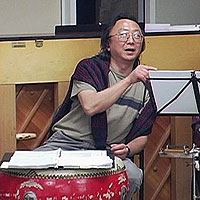
Spark visits with Gang Situ in rehearsal as he imaginatively bridges cultures and time periods with “The Grand Seducers,” an opera that melds Western and Eastern conventions while telling the tale of two notorious womanizers: Mozart’s Don Giovanni and Xi-men Qing, the rakish protagonist of the 13th-century Song Dynasty novel “Water Margin Heroes.”

  • Array
  • Array
  • Array

headRush

The Oakland-based guerrilla performance group headRush is serious when it comes to taking their message to the streets. You can find them performing their brief but high-energy sketches not only in theaters, festivals and cafés, but also on sidewalks and in parking lots. The group brings its brand of urban poetry and satire to audiences wherever it finds them.

The brainchild of a trio of teacher-actors — Rosa González, SimĂłn Hanukai and Xago (LuĂ­s Juarez) — headRush debuted at Oakland’s Jahva House in September 2003. Calling themselves a “psycho-politico spoken-word theater crew,” González, Hanukai and Juarez hoped to exhort and incite their viewers out of passivity using Chicano “teatro,” a satirical agitprop style made popular in the 1960s by LuĂ­s Valdez and the farmworkers’ El Teatro Campesino. Setting up wherever there is space to move, headRush’s off-the-cuff improvisations and audience involvement recall the immediacy of Campesino’s “actos,” or one-act plays, which might have been performed on the back of flatbed truck or on a picket line.

In fact, El Teatro Campesino was where Xago came to be so deeply involved in Chicano theater. Xago was also instrumental in founding community performance group Los Illegals Comedy Clica and the Salinas hip hop crew Baktun 12. González, an author as well as a performer, is a founding member of Las Man@s, and Hanukai serves as program director of the Destiny Arts Center. Education is a high priority for the three performers, who have all studied theater and taught at middle schools and high schools throughout the Bay Area.

With a focus that promotes making social issues and current events relevant and immediate to a new generation, the dynamic headRush has shown up at colleges, open mic nights, political events and comedy shows. In “Performance Ideas,” Spark follows headRush from a performance of their acto “Throwdown” to the workshops they conduct to help kids explore complex issues through theater and movement.

Array

  • Array

Matt Davignon

Oakland-based musician Matt Davignon has become a fixture in the Bay Area’s bourgeoning experimental music scene. Since the early 1990s, Davignon has been captivating audiences by fashioning compelling soundscapes using sound textures and arrhythmic patterns, as well as processed and found sound. Spark checks in on Davignon as he orchestrates Soundwave/Live Play at the noted San Francisco experimental art space, Artist’s Television Access (ATA).

Experimental music has a reputation for being difficult and inaccessible; some experimental composers have even argued that experimental music’s historical inability to gain a wide audience is a mark of its success. Coming from a background in industrial and noise music, Davignon was surprised to discover that the Bay Area’s experimental music scene has a prevalence of acoustic instrumentation, which he had begun to use in his own compositions. Over the years, Davignon has worked hard to create soundscapes that simultaneously stretch perceived notions of composition and create music that is both interesting and pleasurable for the listener.

Live Play is the first event of the Soundwave series of experimental musical events organized by promoter Alan So. The event at ATA combines acoustic and electronic performances all improvised to a montage of found footage selected by Sarah Lockhart of 21 Grand, Oakland’s center for experimental composition. Invited to be guest curator for the event, Davignon put together three groups of Bay Area musicians to improvise soundtracks for an experimental film, including the duo Myrmyr, Luz Alibi/Mr. Marauder, and a quintet composed of Moe! Staiano, Kanoko Nishi, Lance Grabmiller, David Michalak and Davignon himself.

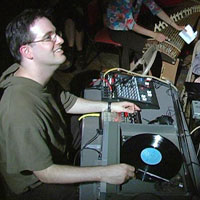
Matt Davignon has developed a unique form of improvisation over the last 10 years. Combining acoustic and electronic elements, he attempts to create dynamic, biological music from seemingly limited source material. Since 2003, he has been working with the drum machine as a primary instrument, processing the sounds with several devices to create a unique sound palette. Davignon uses turntables, prepared guitars, cassette tape recorders, looping devices, and an assortment of household objects and toy instruments in his performances. He has organized events such as the San Francisco Found Objects Festival and Sound/Shift Oakland.

Array

  • Array
  • Array
  • Array
  • Array
  • Array
  • Array

Conspiracy of Beards

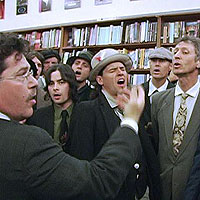
The Conspiracy of Beards is San Francisco’s only male choir that exclusively sings the songs of Leonard Cohen in a cappella form. Cohen is a Canadian poet, novelist, and singer-songwriter. Directed by Daryl Henline, the 30-member group, was founded in 2003.

  • Array

Joe Mangrum

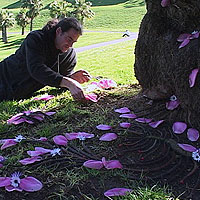
Since the mid-1990s, Joe Mangrum has been making temporary installations from found objects. Often exhibiting his designs in public spaces, Mangrum hopes to catch his viewers off guard, inserting something unexpected into their everyday routines. Spark visits Mangrum as he works on a large-scale piece for Red Ink Studios on San Francisco’s bustling Market Street.

Mangrum began his career as a painter, but after 15 years, he began to feel frustrated with his reliance on the gallery system. Thinking that he would be able to reach a larger audience by making and showing his work outside of the gallery setting, Mangrum began assembling installations in public spaces like sidewalks and parks. He also he sought other media in which to work and decided on objects that he could find easily and in abundance, such as flower petals and beans. Mangrum breaks the vegetation into its core components, then reassembles the parts into elaborate patterns.

His installations often reiterate metaphysical polarities — such as man/nature and life/death — and speak to current world affairs. In 1995, Mangrum had his first gallery exhibition of this type of work at San Francisco State University. The exhibit consisted of five mandalas laid out on the gallery floor: one composed of natural materials, one composed of currency, two composed of computer parts and other industrial symbols, and a fifth, amorphous piece composed of a combination of natural and industrial elements. Mangrum intended this last mandala to suggest that nature and industry could co-exist without monetary exchange.

Spark caught up with Mangrum hard at work on “Birth and Death,” a similar design for San Francisco’s Red Ink Studios. The gallery is located in a storefront on Market Street, so Mangrum’s attenuated process of planning and installing the piece is exposed to passersby. The large installation is divided into two sections: “Birth,” which is composed of natural materials, such as seeds, beans, lentils and sprouts; and “Death,” which is composed of computer parts, bullets and bullet casings, cross-sections of engine tailpipes, and bricks covered in gold leaf. As in earlier works, Mangrum places these two sets of objects in opposition, in hopes of starting a dialogue about the use and abuse of industry and wealth. He also aims to encourage viewers to think more deeply about their surrounding environments.

Joe Mangrum earned a B.F.A. in 1991 from the School of the Art Institute of Chicago. In 2003, he was selected for the Florence Biennale, where he received the Lorenzo de Medici award for his piece addressing war called “Fragile”. Mangrum regularly shows his work in galleries and public spaces around San Francisco.

Array

  • Array
  • Array

Walter Kitundu

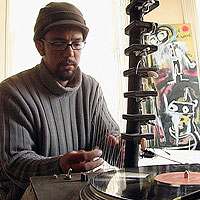
Since the late 1990s, sound artist Walter Kitundu has been creating his own musical instruments, all of which are built around one central element — the phonographic turntable. Kitundu disassembles and reconfigures his turntables to integrate elements from traditional instruments, alternative and unstable power sources, and other technologies, including effect pedals and MIDI equipment. Spark takes a tour of Kitundu’s impressive output as the artist gears up for a solo show at San Francisco’s Luggage Store Gallery. Entitled “LP,” the show features Kitundu’s handmade instruments, alongside diagrams and drawings of ideas about the turntable’s past, present and future as a musical instrument.

Kitundu has not received formal musical training. He was first introduced to making music by Alton Heraldon, a Chicago-based hip hop deejay and turntablist. Kitundu began playing the turntable as a percussion instrument and found the stylus and cartridge to be tremendously sensitive in picking up and amplifying sound. He began work on a series of stylophones, instruments that combined styli as resonators for single strings that could be struck or plucked.

In 2001, Kitundu extended the technology of Stylophones to produce his first phonoharp, which combines multiple strings with a turntable set into a beautifully crafted resonant wooden box. As does the stylophone, the phonoharp receives and amplifies all the sound through the turntable stylus and cartridge.

Kitundu has also developed what he calls “elemental turntables,” record players that are powered by the elements of water, fire or air. Each of these elaborate machines combines a turntable with an elemental power source, which then determines how fast or how consistently a record placed on the turntable will be played. In 2005, Kitundu built an ocean-powered turntable and demonstrated the piece at the Marin Headlands Center for the Arts. Kitundu’s machine featured an accordion and melodica that were powered by the ocean’s waves, alongside an old 78-rpm record player that was driven by the ocean breeze.

Born in Dar es Salaam, Tanzania, Walter Kitundu has an ongoing residency at the Exploratorium Museum of Science in San Francisco. He has been an artist in residence at Skriduklaustur (Iceland), Eagle Rock School (Colorado), the Science Museum of Minnesota and the Singapore Science Centre. Currently, he is developing a geologic sound casting project for volcanically active regions.

Array

  • Array
  • Array
  • Array
  • Array

Ben Rubin

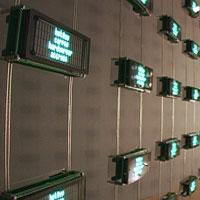
Spark checked out “Listening Post” on view at the San Jose Museum of Art from June 3 through November 26, 2006. Created by media artist Ben Rubin along with statistician Mark Hansen, “Listening Post” takes chat and messages from bulletin boards — thousands and thousands of messages in real time — and displays them on a suspended arc of 231 small text screens. In addition, voices from a text to speech synthesizer can be heard in the speakers that surround the exhibit. “Listening Post” won the 2004 Golden Nica Prize from ARS Electronica.

Based in New York City, Ben Rubin earned a B.A. from Brown University in 1987 and an M.S. in visual studies from the MIT Media Lab in 1989. His work has been included in exhibitions at the Whitney Museum of American Art, the MIT List Visual Arts Center, and the Skirball Center. He has collaborated with many other artists including Laurie Anderson and Ann Hamilton. Mr. Rubin teaches at the Yale School of Art.

  • Array
  • Array
  • Array

Jared Choclatt

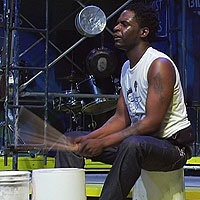
To close their 25th anniversary season, the Lorraine Hansberry Theatre chose a musical extravaganza, Jared “Choclatt” Crawford‘s wildly percussive autobiographical journey “Hit It!” which celebrates the drum-infused music of Big Band sounds, Latin styles, rhythm and blues, soul and today’s hip hop masters. Spark goes behind the scenes as the star, director, cast and crew of “Hit It!” prepare for its world premiere.

The Lorraine Hansberry Theatre was founded in 1985 by artistic director Stanley E. Williams and executive director Quentin Easter. Named for Lorraine Hansberry, the first African American woman to have a play produced on Broadway, the company strove to showcase the work of African American playwrights and give voice to an underrepresented population in Bay Area theater.

Williams and Easter felt that the Bay Area’s rich variety of cultures wasn’t visible on the stages of mainstream theaters. Convinced that these theaters were underestimating theatergoers’ desire to see plays representing diverse cultural experiences, they produced work by playwrights such as Ntozake Shange and August Wilson and commissioned new works by local writers. Their belief has been validated by an audience that consistently fills the 300-seat theater and that considers the Lorraine Hansberry Theatre a beloved and integral part of the Bay Area cultural scene.

At the age of 3, Choclatt Crawford began playing drums. At the age of 12, he found his singing voice. Performing in subway stations and on the sidewalks of New York City, Crawford became one of the New York Bucket Drummers. Crawford caught the attention of Broadway producer George C. Wolfe and tap-dancing prodigy Savion Glover. The two asked him to choreograph the on-stage percussion for “Bring in ‘da Noise, Bring in ‘da Funk” as well as to join the cast as a featured performer.

Opening on Broadway in 1996, “Bring in ‘da Noise, Bring in ‘da Funk” traced centuries of African American history through evocative music and dance. The show had a nearly three-year run, then Crawford moved on to create and star in “Keep Bangin’,” a critically acclaimed musical featuring different drumming styles from around the world.

In “Hit it!” Crawford took his own coming-of-age story and created a musical under the direction of Williams, with choreography by Antonio Naranjo. The show’s book (the text and narrative of the production) is made up of poems by “Bring in ‘da Noise, Bring in ‘da Funk” writer reg E. Gaines that pay homage to jazz history and Manhattan’s African American heritage. The book also includes story segments from Crawford’s life written by AndrĂ© C. AndrĂ©e, who is Crawford’s father and a regular performer at the Lorraine Hansberry Theatre.

As Crawford’s character takes a magical ride through the subways of New York, each subway stop represents a different style of percussion-driven urban music. The audience follows him on an odyssey through the history of drumming, from the Big Band sounds of Chic Webb, Max Roach, Cab Calloway and Buddy Rich to the Latin styles of Tito Puente, Mongo Santamaria and Celia Cruz. Crawford also covers rhythm and blues/soul legends Al Green, Marvin Gaye, Sam Cooke and Aretha Franklin as well as hip hop performers Sheila E., Grand Master Flash, Doug E. Fresh and Run-DMC.

Array

  • Array

San Francisco Conservatory of Music

On April 23, 2006, the San Francisco Conservatory of Music (SFCM) held its final concert at its Sunset District home of 50 years. For conservatory students, faculty and staff, the event was as much a farewell to a building filled with history and memories as it was a new beginning. In the fall of 2006, the 89 year-old conservatory, considered one of the West Coast’s premier institutions for higher music education, will make a much-anticipated move into an eight-story building in the heart of the city, a building that school officials, students and members of the community hope will match the talent that has long been associated with the school with state-of-the-art facilities and adequate space.

Six years in the making, the $80 million project joins two buildings into one facility on Oak Street near the Civic Center, just blocks from some of the city’s most vibrant musical performance spaces, including Davies Symphony Hall and the Opera House. Both venues are visible from the new conservatory’s upper floors. “This is really a view of dreams for our students,” President Colin Murdoch tells Spark as he gazes out a window at the surrounding cityscape.

Keeping its 1914-era historic façade intact, the new building, designed by Simon Martin-Vegue Winkelstein Moris Architects of San Francisco, more than doubles the size of the conservatory’s library, recording studio and computer lab and increases the number of practice rooms from 15 to 33. Students will have access to more than 40 new Steinway and Yamaha pianos and to equipment that will turn out commercial-quality CD recordings. And the new 450-seat concert hall, 140-seat recital hall and 120-seat salon not only come with better acoustics for those at the school, but also translate into many new opportunities to showcase the students’ musical gifts in front of music lovers from all over the Bay Area.

Acoustic upgrades, designed for different types of music and performances, include “floating” rooms isolated from noise both outside the building and in neighboring interior rooms and adjustable sound absorption systems and acoustical climates. The state-of-the-art acoustics were implemented by Kirkegaard Associates, which has previously completed projects for Carnegie Hall, Davies Symphony Hall, Tanglewood, Barbican Concert Hall and many more.

“We spent three years looking almost nonstop for this particular site, and it was one of a kind. It was certainly more money than we had anticipated spending, and it was a larger fund-raising effort than we ever imagined would be possible. But we simply had to do it,” Murdoch says.

In 1917, Ada Clement and Lillian Hodgehead started the Ada Clement Piano School with just three pianos, four studios, two blackboards and 40 students. Though the resources were limited, the student population continued to grow. In 1923, they transformed the school into the San Francisco Conservatory of Music. Since then, the SFCM has grown by leaps and bounds. The school has a preparatory division for young people aged 4 through 18 and programs for undergraduates, graduates and adults who continue to study music. The SFCM is the first conservatory in the United States to add Asian music to the curriculum, to offer a degree in classical guitar and to offer a master’s degree in chamber music.

  • Array

Liebe Wetzel

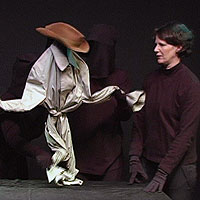
If you were to look up object puppetry in the dictionary, there is a good chance you would find Liebe Wetzel‘s name. In the world of puppetry, Wetzel and her company, Lunatique Fantastique, are pioneers. In Wetzel’s skillful hands, inanimate objects are given breath, movement and focus — the three rules of object puppetry. As she puts it, she is finding the essence of a character in an object. Wetzel’s work is loosely based on Japanese bunraku puppetry, in which the artists dress from head to toe in black so that they disappear and create the illusion that their puppets are moving on their own.

Wetzel was always interested in puppets, but she was not confident in her ability to construct them. This led her to develop a form of object animation that requires nothing more than an interesting object and a manipulator’s skill in bringing it to life. Her first character, for example, was a talented young actress by the name of FomĂ© constructed of a single strip of beige-colored foam.

Spark reveals the secrets behind Wetzel’s puppetry magic and the profound subject matter of her plays, which could be more difficult for traditional theater with live actors. Without dialogue of any kind and with puppets that are nothing more than mere outlines of living characters, Wetzel has the uncanny ability to tell tragic stories with grace and humor. Wetzel is interested in populations that don’t have a voice, such as Japanese Americans who were interned during World War II, people who have polio and women who are victims of sexual abuse.

In her 2006 project titled “Beauty and the Breast,” Wetzel, in collaboration with longtime Bay Area theater director Jayne Wenger, broaches the subject of breast cancer. Produced by Exit Theatre, “Beauty and the Breast” tells the story of Bresty, a bright purple bra who battles breast cancer and makes the difficult decision to have a mastectomy. For this production, Wetzel and Jayne Wenger decided to get rid of the black outfits of the puppet manipulators and expose them, a first for a Wetzel production. Other objects, such as a flowerpot, trowels and handkerchiefs, fill out a cast of characters that may never have realized their full potential if Wetzel hadn’t come along.

Liebe Wetzel, a Texas native, earned a B.A. in biology and biochemistry from Rice University. After surviving a nearly fatal car crash, she decided to follow her dream and began studying acting all across the continent, including at the Cornish College of the Arts in Seattle, the Dell’Arte School of Physical Theatre in Northern California and the Loose Moose Theatre in Calgary, Canada. Since its founding in 2000, Lunatique Fantastique has gained popularity in theater sectors locally and overseas from such plays as “Reframing the Hourglass,” “The Wrapping Paper Caper,” “Objects in Predicaments” and “Snake in the Basement: The Persecution of Rev. Bill Pruitt.” Wetzel’s innovative work has won many awards, including the “San Francisco Bay Guardian” Goldie Award for Best New Theater Talent, as well as Best of Fringe and Top Box Office Hit in the 2001 and 2004 San Francisco Fringe Festival.

  • Array

Basil Twist

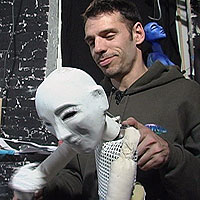
A San Francisco native, Basil Twist first became interested in puppetry through his mother, who was president of the San Francisco Puppeteers Guild. After stints working with designer and Broadway director Julie Taymor and the Swedish Cottage Marionette Theater in New York’s Central Park, Twist became the first American to study at France’s École SupĂ©rieure Nationale des Arts de la Marionnette.

He lives in New York’s Greenwich Village, where he dreams up his shows and constructs puppets in a basement workshop. Spark caught up with Twist in San Francisco, where he was collaborating with dancer Joe Goode and playwright Paula Vogel to stage “The Long Christmas Ride Home” at the Magic Theatre.

Twist first made a splash in 1995 with “The Araneidae Show.” Since then, he has won a Bessie Award for the show and been nominated for a Drama Desk Award for “Tell Tale.” Though well versed in traditional forms, Twist often creates his own blended styles, pushing boundaries to adapt them to new theatrical expectations.

Skilled in a wide variety of animating the inanimate, Twist’s work often brings long-forgotten puppetry forms back to the stage. His 1999 “Dogugaeshi” used more than 700 mobile painted screens — of the style of the same name, one which has nearly disappeared from its native Japanese island of Awaji. And for the 2005 Spoleto Festival, he constructed life-sized marionettes for a return to the lost 18th-century art of puppet opera with the revival of Ottorino Respighi’s “La bella dormente nel bosco.”

In Twist’s version of the beloved Stravinsky ballet “Petrushka,” he created the acrobatic steps of a gamut of fantastical characters using Czech black technique, in which puppeteers clad in black velvet move invisibly in the darkness behind their puppets. And later, he turned to a modified style of Japanese bunraku — making the puppeteers a more integral part of the show as both operators and actors — in “The Long Christmas Ride Home.”

Twist has also developed underwater marionettes for his internationally acclaimed “Symphonie Fantastique,” which was performed in a 1,000-gallon, seven-foot-long aquarium. And he worked with film director Alfonso Cuaron on “Harry Potter and the Prisoner of Azkaban,” using his underwater skills to help animators achieve the underwater flow of the merpeople.

Basil Twist notes that although many people think of puppetry as a children’s art form, it is a deeply resonant and metaphorical practice. For him, puppetry is about giving life and soul to objects and telling the stories of the inanimate, while constantly reinventing the art as he goes along.

  • Array
  • Array
  • Array
  • Array