Asides

Marsh Youth Theater

In the episode “Kids on Stage,” Spark goes behind the scenes as 40 kids from San Francisco tackle the premiere of “Jip, His Story” at Marsh Youth Theater (MYT) in the Mission District. The play is based on the children’s novel of the same name by National Book Award winner Katherine Paterson.

Over 14 weeks, the fifth- through ninth-graders learn to sing, dance and act, many for the first time. They also pitch in with set production, learning the importance of all the jobs behind the scenes. For this production, seventh grader Keith Seales was selected to play the lead role of Jip. Under the direction of Danny Duncan, Seales and the other MYT Mainstage Performance Ensemble members memorized lines and learned to sing and dance to 18 musical numbers.

As program director of MYT, Emily Klion ensures its commitment to making high-quality theater education available to any child who wants to take part, regardless of financial circumstance. In addition to the Mainstage Performance Ensemble, MYT offers a broad range of classes in acting, music and theatrical production, including Flying Poles, a workshop developed by aerialist Jo Keiter, in which students learn to dance off the ground on low flying poles.

More about The Marsh
The Marsh is a unique space dedicated to providing a breeding ground for new performance. It began in 1989 as a Monday night performance series at the Hotel Utah, organized by founder Stephanie Weisman and original collaborator Peggy Howe. In 1990 the series moved to Morty’s in North Beach, then to Café Beano, where The Marsh began presenting more than 150 performances a year. In December 1992, The Marsh moved to its current home on Valencia Street.

The Marsh
themarsh.org
Where: 1062 Valencia St., San Francisco
Phone: (415) 826-5750

Array

  • Array
  • Array
  • Array

Merce Cunningham

mercecunni-headshot

Editor’s note: Merce Cunningham passed away on July 26, 2009.

One of the 20th century’s most original dance-makers, Merce Cunningham has influenced a generation of choreographers with his abstract and complex methods of movement analysis and cerebral yet aesthetic creations. In fact, Cunningham’s love of intellectual engagement and his academic background make his company a natural favorite at colleges and universities. Spark follows the Merce Cunningham Dance Company to Stanford University as he and his dancers take on “Encounter: Merce.”

“Encounter: Merce” was an unusual campuswide interdisciplinary project that took place in March 2005. The event put Cunningham’s decades-long career in context, with exhibits, films, workshops and panel discussions presented not only by the dance division and arts presenter Stanford Lively Arts, but also by the music and visual arts departments and the Stanford School of Medicine.

During the early 1940s, Cunningham performed with the legendary Martha Graham, originating roles in works like “Appalachian Spring” and “El Penitente.” Though he was heavily influenced by the Graham technique of dancing, Cunningham’s own choreography broke away from her mythological, story-based ballets and moved toward a more conceptual approach to dance. By 1953, when his own small troupe of dancers made its formal debut as the Merce Cunningham Dance Company at North Carolina’s progressive Black Mountain College, Cunningham was already crafting works that pioneered new ways of thinking about the mechanics of movement.

Like Cunningham himself, his dancers are often ballet-trained, but their extraordinary physical awareness allows them to tune in to movement with an analytical sensitivity. Cunningham’s love of technology has also led him to experiment with an imaging software program called DanceForms, which he used to create many of his works, but which also allows for an anatomical study of the possible motion of the body.

Over the years, Cunningham has collaborated with a wide range of artists, from Robert Rauschenberg to Radiohead, although he has had no more famous association than with composer John Cage, whom he first met in the early 1940s. With Cage, Cunningham experimented boldly with techniques of dance construction in which the structure relies upon chance procedures, or aleatorics. In his 2003 “Split Sides,” for example, the specific combination of music, set design and even choreographic sequence is determined by a roll of the dice at the start of the show. For Cunningham, these chance encounters of music, dance and art impart a serendipity to his pieces, in his words, allowing “distinct elements to come together to make something that was not possible otherwise.”

  • Array
  • Array
  • Array

Richard Serra

Richard Serra is perhaps the most recognized site-specific artist in the world. He boasts a career that spans four decades, over the course of which he has produced a series of large-scale public and private commissions in locations all over North America and Europe. Spark catches up with Serra as he installs an enormous public work for the University of California, San Francisco’s new campus at Mission Bay.

Serra’s design for UCSF is composed of two steel plates, each nearly 50 feet by 15 feet wide, installed vertically in the main pedestrian walkway. The monoliths program the space around them by dividing the 400-foot-long plaza into thirds. They lean noticeably by approximately 18 inches — roughly two degrees — creating a dramatic impact in relation to the adjacent campus buildings.

From a distance, the plates appear thin, like blades that cut into the ground, but up close, their five-inch width gives them a weight that the viewer may compare with his or her own stature. Serra’s choice of corten steel means that over time the piece will oxidize, first showing a reddish, then deeper purple highlights.

Installing Serra’s work was no simple task. It’s 160-ton weight, combined with the fact that Mission Bay is built on landfill, posed serious challenges to the engineers and installation crew. In order to stabilize the piece, piles were driven more than 200 feet into the ground — over four times the length of the Serra’s monoliths — to provide an adequate structural foundation for the work.

Born in San Francisco, Richard Serra earned both a B.F.A. and an M.F.A. from Yale. He has had solo exhibitions in museums around the world, including the Museum of Modern Art, New York; the Musée Nationale d’Art Moderne, Paris; the Museo Nacional Centro de Arte Reina Sofía, Madrid; and the Museum Haus Lange, Krefeld, Germany. His work can be found in major collections internationally, including the Guggenheim Museum. In 1994, Serra was awarded the Praemium Imperiale by the Japan Art Association and an honorary doctorate of fine arts from the California College of Arts and Crafts (now known as the California College of the Arts), in Oakland.

  • Array
  • Array

Terry Riley

Avant-garde pioneer Terry Riley is one of the best-known composers to emerge in the 20th century. Riley is often credited with the introduction of electronic instrumentation and tape looping in American experimental music. In “Masterworks,” Spark visits with Riley and Kronos Quartet founder David Harrington as they prepare “Cusp of Magic,” a piece written for Kronos to be performed in celebration of Riley’s 70th birthday.

Riley is known as one of the innovators of minimalism in music, a style characterized by the repetition of sound patterns, usually through the use of tape delay and feedback systems. Many of Riley’s earliest compositions are largely based on improvisation, often attenuated to unprecedented durations; in the early 1960s, Riley’s largely unscripted harpsichord performances would run for hours, sometimes spanning the entire night, going until dawn.

Riley’s first masterpiece was the 1964 composition “In C,” which remains his most famous work to date. The piece, which repeats 53 phrases continuously for up to 75 minutes, was written for any combination of instruments. Along with noted avant-garde composer La Monte Young’s contemporaneous “Inside the Dream Syndicate,” Riley’s piece is considered a landmark in minimalist music and one of its most recognizable examples.

“Cusp of Magic,” Riley’s 16th commission for the Kronos Quartet, ventures into new territory for both Riley and Harrington. Two of the piece’s movements use digital samples of children’s toys that Harrington has collected on tour ever since he became a grandfather. The toys provide a cacophony of sound that forms a sonic pun on the word “play,” which refers to both the activity of children and the performance of music.

In addition to the toys, “Cusp of Magic” was written to highlight the Chinese lute, or pipa, and one vocal. Wu Man, a pipa virtuoso known worldwide for her colorful and emotional interpretations, was specifically selected for the composition. The piece had its world premiere in May 2005 at the University of California, Berkeley’s Zellerbach Hall, presented by Cal Performances.

Terry Riley studied composition at the San Francisco Art Institute and the University of California, Berkeley, where he met and began collaborating with classmate Young. Influenced by the musical experimentation of both John Cage and John Coltrane, in the early 1960s he began making musique concrete — soundscapes made from combining a variety of sonic sources, including tape loops and found sounds. Over the last five decades, Riley has collaborated with such notable performers and composers as John Cale, Tony Conrad and Indian vocal master Pandit Pran Nath. His influence can be heard in the work of a wide range of performers, including Can, Kraftwerk, Brian Eno, the Silver Apples, Suicide and Stereolab.

More about the Kronos Quartet
The Kronos Quartet is David Harrington and John Sherba (violins), Hank Dutt (viola), and Jennifer Culp (cello). Harrington formed Kronos in 1973. Since then, they have performed thousands of concerts worldwide, released more than 40 recordings, collaborated with many composers and performers, and commissioned hundreds of works and arrangements for string quartet. They received a Grammy for Best Chamber Music Performance (2004) and the Musicians of the Year award (2003) from Musical America.

Array

  • Array
  • Array
  • Array
  • Array
  • Array
  • Array

Alice Wingwall

When noted photographer and sculptor Alice Wingwall began losing her sight, she became determined to continue making visual art. Now almost completely blind, Wingwall remains a vital visual artist, making lyrical and poignant photo-based works that often express her experience of being without sight. Spark checks in on Wingwall as she works on a new series of architectural photographs.

Wingwall suffers from retinitis pigmentosa, a hereditary degenerative disease of the eye. After all but losing her perception of light a number of years ago, Wingwall discovered that a great deal of her experience of vision happens in her mind. The brain is capable of representing line, color and perspective even without the help of eyesight.

She rarely photographs all alone — she asks colleagues, including her husband, architect Donlyn Lyndon, to look through her lens and describe what they see. During this collaborative process, she describes her “mind’s eye” image and asks if the camera captures this view, using her deep store of memory for other comparison points.

Along with her memory, Wingwall relies to a great degree on her other senses in making her photographs. She may feel the heat of the sun in order to get a sense of the strength and direction of the light source, and she may similarly sense the reflected light radiating from her subject.

Wingwall often uses auto-focus cameras to capture images. In addition, she uses an array of lenses intended to capture her failing sight. Although a 50-millimeter lens renders an image close to what the human eye sees, Wingwall is fond of using wider lenses and panoramic cameras that warp the image and represent her newfound inner vision of the world.

Several of Wingwall’s photographs deal with her experience of working as a visual artist without the aid of sight. Many of her works feature architecture — one of her favorite subjects — superimposed with images of her guide dog, Slater, or his predecessor, Joseph. These images highlight the ways in which her negotiation of the world around her is now mediated through another being, and the intimate relationship that that establishes between her and her dogs.

Alice Wingwall earned an M.F.A. in sculpture from UC Berkeley and was a professor of sculpture and director of the studio arts program at Wellesley College. She has explored many different mediums, and she trained in stained-glass fabrication in Paris. She co-directed a film with Wendy Snyder MacNeil titled “Miss BlindSight/The Wingwall Auditions,” which won Best Independent Film at the 25th anniversary New England Film and Video Festival.

  • Array
  • Array

John Belluso

Editor’s note: John Belluso passed away on February 10, 2006.

Playwright John Belluso brought physical handicap to the stage, front and center. But rather than using his plays to teach his audience a lesson, Belluso’s works are darkly humorous and even sexy. Spark goes backstage at San Francisco’s Magic Theatre when Belluso and director Chris Smith were working on “The Rules of Charity.”

Los Angeles-based Belluso used a wheelchair from the age of 13 and often put his own experiences with disability at the center of his dramatic work. “The Rules of Charity” tells the story of Monty, a middle-aged gay man who suffers from cerebral palsy, a debilitating disease that results from a lack of oxygen at birth. Those who suffer from the disease commonly experience both physical disability and speech impairment, to varying degrees.

In “The Rules of Charity,” although Monty has a slight speech impairment, his disability is expressed primarily through bodily contortions and movements. An able-bodied actor, David Keith, was cast in the lead, a decision that was made in part because of the exceptional physical demands of the role. It was a great responsibility for Keith, who had to render the experience of someone struggling with the disease for his entire life.

For Belluso, “The Rules of Charity” signified more than an isolated theatrical event. He believed that the growing awareness of the rights of the disabled is spawning a cultural movement. Other handicapped people are learning storytelling skills, resulting in more emerging theater dealing with experiences of the disabled.

More about John Belluso
John Belluso was a 2003-2004 National Endowment for the Arts/Theatre Communications Group Playwright-in-Residence at the Atlantic Theatre in New York and received a VSA-Arts Playwright Discovery Award, the John Golden Playwriting Prize and an NYU Tisch School of the Arts Dramatic Writing Program’s Graduate Playwriting Award. In addition, he was director of the Mark Taper Forum’s Other Voice Project, one of the nation’s few professional developmental labs for theater artists with disabilities, and was a member of New Dramatists, the Taper Writer’s Workshop and Ensemble Studio Theatre.

More about the Magic Theatre
Founded by John Lion in 1967, the Magic Theatre has since premiered more than 200 works. The organization is dedicated solely to the development and production of new plays, from both emerging and established playwrights. Magic Theatre plays and playwrights have won two Pulitzer Prizes for Drama, given to Sam Shepard for “Buried Child” in 1979 and to Nilo Cruz in 2003 for “Anna in the Tropics.” Other awards include numerous Bay Area Critics Circle Awards, a Kennedy Center Award, the Los Angeles Drama-Logue Award, the NAACP Image Award and 10 Obie Awards.

Magic Theatre
magictheatre.org
Where: Fort Mason Center, Building D, 3rd Floor, San Francisco
Phone: (415) 441-8001

  • Array
  • Array

NIAD

The facility of the National Institute of Art and Disabilities (NIAD) in Richmond includes an art studio and gallery that serves 50 adult artists of a range of ages and ethnic and socioeconomic backgrounds. Spark visits with the artists in the NIAD’s award-winning day program as they find new forms of expression, independence and dignity.

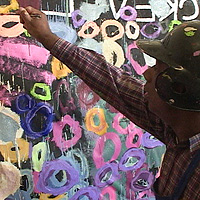
One of the NIAD artists is Mike Starosky, who is fondly known as “Big Mike.” Starosky was diagnosed with schizophrenia and developmental disabilities at 12 years old. Under the guidance of five professional artists, Starosky and his fellow artists learn skills in drawing, painting and printmaking as well as ceramics, textile arts and sculpture.

NIAD teachers demonstrate a variety of approaches and aid the artists in their exploration of different materials and techniques to develop their own individual styles. Weekly classes in independent living skills, including interpersonal social skills, money management, mobility training, self-care and culinary skills, also help the artists to become more self-reliant.

Another important part of the NIAD’s work is its exhibition program. The organization develops and curates up to seven exhibitions a year with art made by its resident artists. Through this program, the artists see their work in a gallery setting, which validates their role as artist and increases their self-esteem. Proceeds from the sales of the art are split with the artist. The NIAD uses its proceeds to fund the exhibition program.

Dr. Elias Katz, a clinical psychologist, and the late Florence Ludins-Katz, an artist and educator, co-founded the NIAD in 1982. The organization has received the Helen Crocker Award from the San Francisco Foundation, the Vineyards Award from the Golden Gate Chapter of the National Association of Fund-Raising Executives, and recognition from the California State Council on Developmental Disabilities and Advocacy Inc. The NIAD was awarded a grant in 1998 from the National Endowment of the Arts to develop a traveling exhibition.

Array

Cheryl E. Leonard

San Francisco musician Cheryl E. Leonard finds her inspiration — and instruments — in the world that surrounds her. Leonard makes music by bowing, tapping, rubbing and otherwise manipulating objects she finds in nature. Spark checks in on this innovative young composer as she prepares a series of five new works entitled “Ziran,” which is Chinese in origin and is used to mean the concept of naturalness.

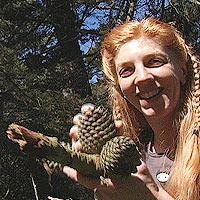
Leonard begins her process by collecting objects with which she can produce unusual sounds. Though Leonard often includes man-made objects in her performances, for “Ziran” she amassed items only from the natural world, such as bark, rocks, pine cones and twigs. Experimenting with the possibilities of these objects, Leonard composed five pieces inspired by different Tang dynasty poems dating as far back as 1,000 years. Leonard has designed each piece to be performed in conjunction with a recital of its corresponding poem.

As Leonard and her musical collaborators prepare for “Ziran,” they struggle to find the right pitches and textures in each of their created instruments. Because of this unusual instrumentation, which produces sounds outside conventional tonal structures, Leonard has devised a unique system of notation capable of communicating the composer’s intentions to the performers.

Cheryl E. Leonard received a B.A. in music composition from Hampshire College in 1991 and an M.A. from Mills College in 1996. In 1999, Leonard’s “The Underwater Flying Machine” was exhibited as part of Lincoln Center’s Day of Homemade Instruments. Recordings of her music are available from Great Hoary Marmot Records, Apraxia Records, 23 Five Inc., Old Gold Records and The Lab. She has received a commission to design sounds for a new exhibit in the Monterey Bay Aquarium.

  • Array
  • Array

Chris Drury

For more than a quarter-century, internationally recognized British artist Chris Drury has used the materials and processes of nature in his work. Drury’s lyrical, often temporary installations mimic patterns that already exist in the natural world. Spark visits with Drury as he prepares a series of works for a six-week residency at the Montalvo Arts Center in Saratoga, California, culminating in a show called “Whorls: Installationsby Chris Drury,” an indoor and outdoor exhibition featuring three site-specific nature-based installations.

Of Drury’s projects at Montalvo, the most ambitious is “Redwood Vortex,” an installation in the redwood groves above the complex. With the help of assistants, Drury created a spiraling vortex of willow branches that surrounds one of the area’s towering redwoods. The installation reaches more than 60 feet above the ground. Drury decided on the spiral form in order to express the flow of sap, which follows a corkscrew movement up the tree’s trunk. The project proved to be no simple task, as the branches that Drury chose turned out to be less supple than expected, and the team spent a month in the redwoods building the vortex.

Much of Drury’s work explores connections between common shapes and movements that can be found in the natural world as well as in our own bodies. In addition to “Redwood Vortex,” Drury produced indoor works for the center’s gallery that examine these concordances. Two of these works are based on the cardiac twist, a double spiral pattern that describes the movement of blood in the human heart, a pattern that can also be found in fingerprints as well as in many places in nature.

For the large “Fingerprint Mural,” Drury projected images of fingerprints onto a wall, then had his assistant paint latex onto the white areas and paint the wall with dirt. When the latex was removed, the result was a series of interwoven fingerprints painted with materials that refer to the pattern’s prevalence in nature. Drury reused the cardiac twist in a floor piece called “Sequoia Whirlpool,” in which sequoia sticks are arranged in a double vortex pattern around a stone, again emphasizing the commonality of the form in both the human body and the natural landscape.

More about Montalvo Arts Center
The Montalvo Arts Center is a nonprofit organization dedicated to forging meaningful connections between art and artists and the communities it serves, through creation, presentation and education. The organization was founded in 1930, when Senator James Duval Phelan left the 175-acre property, including a stunning villa, to the people of California for the encouragement of art, music literature and architecture. In 2005, the organization changed its name from Montalvo to Montalvo Arts Center to commemorate its 75th year as an arts center and to better communicate its mission to expanding local, national and international audiences.

Montalvo
montalvoarts.org
Where: 15400 Montalvo Rd., Saratoga
Phone: (408) 961-5800

Array

  • Array
  • Array

Jim Denevan

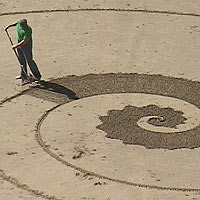
Jim Denevan performs drawings — making temporary sculptures on the sandy beaches of Northern California. Using only a stick and a rake, Denevan’s work is monumental in scale but as fleeting as any live performance. Spark tails Denevan in San Francisco and Santa Cruz as he composes two sand works and talks about his meditations and his process.

It was Denevan’s passion for surfing that led to his vision of the beach as a blank canvas. The shapes he fashions — spirals and other simple geometrics — are familiar, yet their scale and location are particular and proportions amazingly precise. The drawings exist for a few precious hours before they are erased by the incoming tides, and one has to view the drawings from 150 feet up or more in order to see them in their entirety.

Denevan considers process an integral part of his artwork and chooses his locations thoughtfully. In his mind, every step is a kind of temporary sculpture. Denevan then walks for miles, leading his chosen drawing stick in a dance performed to the music of the ocean and the spirit of the place. Denevan says, “My movement has a present. And then where I want to be, that’s the future. … Then the line has a past.”

Jim Denevan, who is also a chef, has received increasing attention in the past few years for both his art and his cooking. Denevan’s work was included in the “Big Deal” exhibition at San Francisco’s Yerba Buena Center for the Arts (January through April 2005), along with artists Scott Snibbe, Christopher Tagg and Johnston Foster. In addition, a feature-length documentary film about Denevan called “Sandman,” directed by award-winning director Chesley Chen, is slated to be released in late 2005.

Array

  • Array
  • Array

Brian Copeland

Brian Copeland has turned painful memories of growing up black in what once was one of America’s most racist suburbs into a confessional performance that is part comedy, part tragedy. Spark checks out Copeland as he performs in one of San Francisco’s longest-running one-man shows, “Not a Genuine Black Man,” at the Mission District venue The Marsh.

In 1971, San Leandro was named one of the most racist communities in the United States. Though the city borders Oakland, whose population at the time was 50 percent African American, San Leandro’s population was 99 percent white. Congressional hearings found that the city was practicing police harassment and housing discrimination to keep it that way. Through a series of federal investigations, media inquiries and court cases, the city’s system of institutionalized racism was eventually dismantled. But Copeland, who was 8 years old when his family moved there in 1972, grew up right in the middle of it.

“Not a Genuine Black Man” is an artistic stretch for Copeland, who is more accustomed to doing stand-up comedy. Over the course of the two-hour monologue, Copeland steps into the roles of more than 25 different characters and deals with topics that the performer never thought he would discuss in public, including his abusive father and his suicide attempt at the age of 35. Copeland’s performance, a unique combination of humor and heart-wrenching tales of suffering and abuse, has captivated audiences and has even garnered interest for a book deal and a television series for HBO.

More about The Marsh
The Marsh is a unique space dedicated to providing a breeding ground for new performance. It began in 1989 as a Monday night performance series at the Hotel Utah, organized by founder Stephanie Weisman and original collaborator Peggy Howe. In 1990 the series moved to Morty’s in North Beach, then to Café Beano, where The Marsh began presenting more than 150 performances a year. In December 1992, The Marsh moved to its current home at 1062 Valencia.

  • Array
  • Array
  • Array

Best of Broadway presents “Lennon”

Decades after John Lennon’s murder in 1980, director Don Scardino is banking on the icon’s continuing popularity. He’s bringing the legendary former Beatle back on stage through a biographical musical based on the performer’s words and recordings. Spark gets a front row seat for the world premiere of “Lennon” at San Francisco’s Orpheum Theatre.

A longtime Lennon fan, Scardino is confident of his musical’s potential to succeed on Broadway after its preliminary run in San Francisco. The project has been six years in the making as Scardino has struggled with the many challenges of the production, including casting the musical’s central figure. Instead of finding one star, Scardino settled on casting nine different actors — both men and women, encompassing a range of ethnicities — who continually trade roles over the course of the performance.

For Lennon fans, one of the musical’s highlights is Scardino’s inclusion of three rare and unpublished Lennon songs. Two of the songs, “India, India” and “I Don’t Want to Lose You,” were never published and exist only on private recordings in the possession of Lennon’s widow, Yoko Ono, who has permitted their debut in Scardino’s production. A third song, “Cookin’ (in the Kitchen of Love),” was recorded by Ringo Starr in 1976, but never by Lennon himself.

San Francisco is the testing ground for “Lennon,” an opportunity for fine-tuning before the musical competes in larger markets like New York. During previews, Scardino was able to identify some of the flaws in his production, but the big test was opening night, when critics got a chance to see the musical for the first time. After the big night, reviews were mixed, but for Scardino and his producers, it is a learning experience, a chance to retool the performance for greater emotion resonance.

More about Best of Broadway
Under the direction of Carole Shorenstein Hays and Scott E. Nederlander, Best of Broadway is committed to bringing high-quality musicals and award-winning plays to the Bay Area. Over the years, local subscribers to Best of Broadway have enjoyed a host of works, from the Tony Award-winning play “Fences” to the U.S. premiere of “Wicked: The Untold Story of the Witches of Oz” and Baz Luhrmann’s production of Puccini’s “La Bohème.” Best of Broadway venues in the San Francisco Bay Area include the Curran Theatre, the Golden Gate Theatre and the Orpheum Theatre.

  • Array
  • Array
  • Array

Berkeley Repertory Theatre presents “The People’s Temple”

Peoples Temple

On November 18, 1978, more than 900 members of the Peoples Temple religious movement, together with their leader, Reverend Jim Jones, died in Jonestown, Guyana, South America. That same day, Bay Area congressman Leo J. Ryan and three journalists were also killed as they were leaving Jonestown. Leigh Fondakowski’s “The People’s Temple” at the Berkeley Repertory Theatre is a production about this tragedy. Spark follows the project from conception to opening night.

David Dower and his wife, Denice Stephenson, attended college with Rebecca Moore, whose sisters Ann and Carolyn were members of Peoples Temple and died at Jonestown. They wanted a way to give meaning to the Jonestown event by presenting it as a theatrical documentary. Stephenson became the play’s researcher/archivist, and Dower, artistic director of San Francisco’s Z Space Studio, commissioned Fondakowski to write and direct “The People’s Temple.”

As a member of the Tectonic Theater Project (TTP) and head writer of “The Laramie Project,” Fondakowski has been working with the documentary theater technique for more than 10 years. Moises Kaufman and members of the TTP have produced plays that blended journalism and theater, thus developing what is now known as documentary theater. This format was chosen to retell this terrifying chapter in history by giving a voice to those who died as well as to the survivors, friends and relatives of Temple members.

Fondakowski, with Greg Pierotti, Steven Wangh and Margo Hall, based the play on historical documents from the Peoples Temple Collection at California Historical Society and more than 75 interviews. Facing the challenge of transforming the wealth of documentary evidence into compelling theater, the team worked for more than three years to stage this material. As Stephen Jones, son of Jim Jones, reflects, “Putting people’s experience on the stage and leaving people in the audience to make their own interpretation of it, I think that is powerful.”

More about Berkeley Repertory Theatre
Michael W. Leibert founded Berkeley Rep in 1968 as a storefront community theater. Winner of the 1997 Tony Award for Outstanding Regional Theater, its national reputation draws theater artists from around the country to work on a variety of productions from September through July. The season consists of seven productions of the finest classic, contemporary and new plays. The Berkeley Rep School of Theatre offers classes and activities for both youth and adults and tours a fully staged professional production to schools throughout the 11-county Greater Bay Area.

Array

  • Array
  • Array
  • Array
  • Array
  • Array
  • Array

Tilly and Iliza Abbe

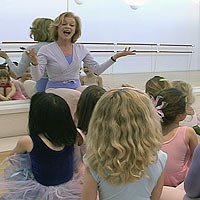
Since 1970, countless generations of youngsters have donned tights and slippers for a weekly ballet class with San Francisco institution Miss Tilly. Teaching preschoolers about dance, however, is much more than pliés and tendus for Tilly Abbe, whose 350 students range from 3 to 7 years old — it’s about giving them skills that will last a lifetime.

Spark visits this veteran teacher at her California Street studios, where she and her daughter Iliza Abbe offer a range of classes in dance, theater, hip hop and yoga, all designed to infuse a love of movement and the arts in their preschool-aged students. Early childhood is a critical time for physical and emotional development, Abbe argues, and she specializes in working with kids at an age when they are not only forming their reflexes and fine motor control skills, but also honing social skills that they’ll need throughout their lives. Indeed, given recent studies that have shown physical fitness is closely tied to a child’s academic abilities and so many parents recognizing the importance of early exposure to the arts, Abbe’s classes are always enormously popular.

A former San Francisco Ballet dancer, who began studying ballet at the age of 11, Abbe discovered early on that she was a born pedagogue with a special love for young children. The daughter of famed war photographer James Abbe, Miss Tilly credits her mother with instilling a passion for teaching. It’s a talent that she has, in turn, passed on to Iliza, who developed a curriculum in theater arts for children when the school moved into its current studios.

Some of their students may go on to dance or perform professionally, but that’s not the point for this mother-daughter team. They hope that all of their students will take with them not only the self-confidence that dance and performance can offer, but also a healthy respect for art and for the abilities of their own bodies. Abbe Studio offers ballet, theater arts (drama and singing) and hip hop classes for young boys and girls.

Abbe Studio
Where: 5499 California St., San Francisco
Phone: (415) 923-9965

  • Array
  • Array
  • Array
  • Array