Asides

Ruth Asawa

Editor’s note: This story was originally published in 2005. Ruth Asawa passed away on Aug. 6, 2013.

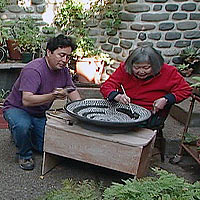
For more than five decades, sculptor Ruth Asawa has been associated with some of the most notable figures in American 20th-century art. As a young woman, she studied at the legendary Black Mountain College under Josef Albers and Buckminster Fuller, alongside John Cage, Merce Cunningham, Robert Rauschenberg and Anni Albers. In addition to producing an impressive body of work, Asawa has been a vocal advocate for arts education.

Asawa’s elegant cast bronze, stainless steel and glass-fiber reinforced sculptures have graced the Bay Area since 1968. As public works of art, their weight and permanence belie the importance of process to the artist, who obsessively manipulates materials to find forms translatable into large-scale works. For Asawa, the path that leads to the production of a finished piece is as important as the work itself. Two of Asawa’s large cast sculptures and fountains began as folded paper, others were modeled from baker’s clay, and her signature wire mesh had their beginnings when she learned a local metal looping technique while visiting Toluca, Mexico as a student volunteer in 1947.

Spark visited Asawa as she and her family assembled an expansive retrospective for the reopening of Golden Gate Park’s de Young Museum in October 2005. In preparation for this exhibition, Asawa’s daughter, Aiko Cuneo, had been busily organizing her mother’s work as well as selecting a variety of drawings and preparatory works. It is a labor of love for Cuneo, whose memories of childhood are interwoven with her mother’s constant art-making.

As a strong supporter of public arts education, Asawa helped found San Francisco’s only public high school devoted to the arts (renamed in 2010 as the Ruth Asawa San Francisco School of the Arts) and spearheaded the Alvarado Arts Program, which brought working artists into San Francisco’s public schools. Asawa has fought hard to enhance the level of arts teaching and curriculum in San Francisco’s public schools. Activism in favor of arts education has become a tradition in Asawa’s family; at time of filming, her son, ceramicist Paul Lanier, was an artist-in-residence at Alvarado Elementary, where the Alvarado Arts Program originated. Lanier attended the school as a child.

Ruth Asawa left Black Mountain College in 1949. Her work has been exhibited internationally and can be found in major collections, including the San Francisco Museum of Modern Art; the de Young Museum; the Museum of Modern Art, New York; the Solomon R. Guggenheim Museum; and Whitney Museum of American Art. She has received numerous awards, including the Fine Arts Gold Medal from the American Institute of Architects and the Award for Outstanding Achievement in the Visual Arts from the Women’s Caucus for Art. In 1982, Feb. 12 was declared Ruth Asawa Day in San Francisco.
Carlos and Salvador Santana

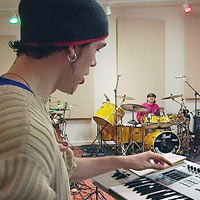
For Salvador Santana, music is the family business. His father is the legendary rock guitarist Carlos Santana, and his uncle Jorge is best known as the leader of the Latin soul band Malo. Also, his paternal grandfather, José Santana, was a prominent Mariachi violinist in San Francisco, and his maternal grandfather was the pioneering R&B guitarist Sanders King. Spark visits with the next generation of the Santana musical dynasty to talk about stepping out from the shadow of his illustrious musical family as the leader of his own band.

Salvador started playing music at a very young age, quickly picking up percussion and guitar. When his father heard the 6-year-old Salvador playing piano to a Thelonious Monk record, he knew his son was destined for a career in music. Now a young man, Salvador is defining his own style of world music, combining jazz instrumentation with a Latin rhythmic sensibility and hip hop vocals. He and his band made their professional debut opening for his father’s group on its European tour in the summer of 2004.

For Salvador, sharing his father’s famous name can be as much a burden as an advantage in the hyper-competitive music industry. Though the Santana name may open record label doors, it also multiplies the pressure on Salvador, who has had to struggle to define himself as a musician in his own right. But Salvador isn’t worried: As long as he’s making music, he knows he’s exactly where he needs to be. Spark trails Salvador into the studio, where he’s been committing his own musical vision to tape, with plans to release a CD.

Salvador Santana has toured with the Salvador Santana Band throughout Eastern and Western Europe and Latin America. In addition to his own CD, he can be heard on his father’s 2005 release “All That I Am,” and on his mother Deborah’s audiobook, “Space Between the Stars: My Journey to an Open Heart.”

  • Array
  • Array
  • Array

Fat-Bottom Revue

fatbottom-headshot

Editor’s note: Heather MacAllister passed away on February 13, 2007.

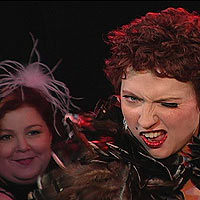
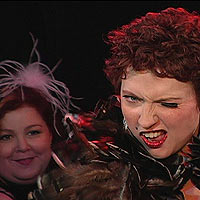
San Francisco’s Fat-Bottom Revue is making it big in the burlesque business — real big. Composed solely of plus-size dancers, the company is the country’s only regularly performing group of its kind. In the episode “Forbidden Territory,” Spark checks out the show and gets an eyeful of all the sexy, hip-grinding, high-kicking action.

Fat-Bottom Revue is the touring company of Big Burlesque, a performance collective of self-described “fat artists and activists.” The show is a spirited revival of the tradition of burlesque performance, a racy style of singing and dancing that saw its zenith in the 1920s. With the proliferation of the modern strip club in the late 1960s, burlesque came to be regarded as tame and old-fashioned and soon died out. In recent years, however, burlesque has enjoyed a resurgence, with a number of clubs opening in metropolitan centers across the country.

Founded by Heather MacAllister (aka RevaLucian), who was a size-acceptance artist and activist dedicated to redefining the contemporary notion of beauty, Big Burlesque challenges Western standards of female beauty including a thin body that is often unattainable, unrealistic and potentially unhealthy for many women. By providing a burlesque act that features only larger-sized women, Fat-Bottom Revue is seeking to widen the current standards of beauty.

  • Array
  • Array

Richard Kamler

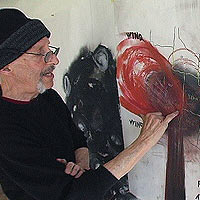
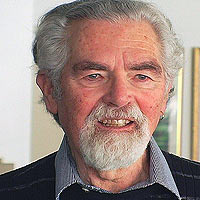
Artist, educator and curator Richard Kamler has gained a reputation for taking on tough subject matter. Since the mid-1970s, Kamler has produced work built on the premise that art can help to effect social change and cultural transformation. Spark visits the artist in the studio as he works on an installation that documents his own battle with cancer.

Kamler is an installation artist whose works are often designed for locations outside the traditional museum or gallery space. “Table of Voices,” which Kamler made in the mid-1990s, was one of several he created for prisons. Installed on Alcatraz Island, the piece brought together recordings of the voices of parents of murdered children with those of the perpetrators. Visitors to the installation could pick up a phone on one side of a long table and hear the voice of a victim’s family member and move to the other side of the table to hear the voice of a convicted murderer. The controversial piece generated a heated public debate that helped to initiate a reconciliation program for offenders and victims.

More recently, Kamler has approached another subject very close to his heart. In 2004, Kamler was diagnosed with thyroid cancer, an event that temporarily suspended his art-making activities. He had his thyroid gland removed before enduring a series of radiation treatments. Kamler was struck with the paradox that the treatment for his cancer was linked to what may have caused the illness in the first place. Having grown up in an area close to numerous government nuclear testing sites, Kamler has come to believe that these tests are responsible for his cancer and that this constitutes a criminal act on the part of the government.

Dedicated to change through art, Kamler is transforming his rage over this negligence into a work of art chronicling his illness alongside the history of government nuclear testing in America. Spark visits Kamler at his studio in the Headlands Center for the Arts as he transforms his meticulous journals into a series of large charcoal drawings to be used in a broad and multilayered installation.

Richard Kamler received a B.A. in 1963 and an M.A. in 1974 from the University of California, Berkeley. He has received numerous awards, including a National Endowment for the Arts Visual Arts Fellowship in the New Genres category, an Alaskan State Arts Council/NEA grant, several California Arts Council Artist-in-Residence awards, and grants from the Gunk Foundation for Public Art, the Institute of Noetic Science and the Potrero Nuevo Fund. He is currently the chair of the visual arts department of the University of San Francisco, where he is also responsible for the art outreach program “Artist as Citizen in Contemporary Society,” which places artists into various communities.

  • Array
  • Array
  • Array

Traveling Jewish Theatre

In its 26th season, the Traveling Jewish Theatre (TJT) takes on its most challenging project to date, addressing the conflict in the Middle East. Spark visits the TJT’s ensemble cast of “Blood Relative,” a collaboratively created play about Israel/Palestine from both perspectives.

TJT’s artistic director, Aaron Davidman, began work on the “Blood Relative” project in 2002, with a research trip to Israel and to the Acco Theatre Festival. There he met actors Ibrahim Miari, a Palestinian who is the son of an Arab Muslim father and a Tunisian Jewish mother, and Meirav Kupperberg, who is Jewish. Both had ensemble theater experience and had worked on projects that dealt with Arab-Jewish issues. Miari’s story became the central theme of “Blood Relative.”

The characters’ stories in “Blood Relative” were developed using TJT’s unique, collaborative technique, which derives stories from a combination of external and internal sources. Interviews were conducted with families on both sides of the conflict. Material was also created from the personal lives and feelings of the play’s actors as well as from meetings with the Jewish Palestinian Dialogue Group, documentary films, and the two holy doctrines of Judaism and Islam — the Torah and the Koran.

All of this research and discovery yields materials that are finessed into a script through discussion and improvisation that goes through many revisions until a final draft takes shape. This process is one that the TJT has been following for more than 25 years — a truly collaborative process through which the performers are deeply invested in the content and the production.

The TJT was founded in 1978. It has created more than 20 original works for the theater and has performed in more than 60 cities worldwide. Its works have covered a range of issues, from the legends of the Hasidim to the assassination of Trotsky; from the politics of the Middle East to African-American/Jewish relations. The TJT acquired its present home in San Francisco’s Project Artaud in 1994, completing a renovation of the space in 1998. The company and its artists have received critical acclaim, including a Lifetime Achievement Award from the National Foundation for Jewish Culture and a Kennedy Center Fund for New American Plays award for “See Under: LOVE,” by Corey Fischer — nominated by the American Theatre Critics Association as one of the best American plays of 2001.

Array

  • Array
  • Array
  • Array

Los Cazadores del Sur

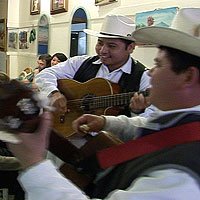
San Francisco’s Mission District is home to numerous roving musicians who perform mostly Mexican music for diners and revelers in the neighborhood’s many bars and restaurants. In the episode “Street Art,” Spark trails the guitar duo of Jacobo Palacios and Rafael Potillo, who go by the name of Los Cazadores del Sur, which translates to “the hunters from the south.”

Coming to the United States from rural Central America — Palacios from Guatemala, Potillo from El Salvador — the two began working as manual laborers, but eventually taught themselves guitar to become street musicians. With a repertoire of more than 80 songs, Palacios and Potillo can play something for everyone, having learned songs from their native countries as well as from South American nations and Mexico.

They are versed in a range of styles, from conjunto, which originated near the Texas border, to northern Mexico’s norteño to the Colombian cumbia, and can play rancheras, corridos and boleros, among other types of songs. In expanding their catalog, Palacios and Potillo have opened their own personal borders, transcending their respective nationalities to become Latinos — cultural citizens of the Spanish-speaking Americas.

Like the Mission’s other troubadours, Los Cazadores frequent taquerias, bars and family restaurants, serenading patrons in the hope that they in turn will show their appreciation with a few dollars. In Latin America, finding audiences by moving from place to place is known as working al talon, meaning literally “on the heel,” and demands a keen knowledge of the ebb and flow of crowds as well as the establishment of good relationships with business owners and fellow musicians.

Though it has its rewards, the life of a street musician is difficult. Los Cazadores regularly work three shifts a day — at lunchtime, and dinnertime, then late night for the bar crowds. In addition, Palacios and Potillo are not free to travel in and out of the country at will, and it has been years since they have been able to visit their families. In the meantime, though, they have surrogate families, composed of the people they see regularly in the Mission — the restaurateurs, servers and patrons whom they serenade every day.

Array

  • Array
  • Array

Union Square Street Performers

San Francisco’s bustling Union Square is home to some of the Bay Area’s most tenacious musicians. Earning their income by entertaining passersby, these performers have adapted themselves to the tricky business of making one’s living on the street. In “Street Art,” Spark takes a stroll downtown to check out a few of the hardest-working artists in the city.

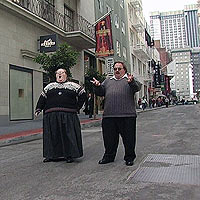
Opera singers Robert Close and Litz Plummer are downtown mainstays that set up shop at the end of Maiden Lane, a pedestrian walkway at the edge of Union Square. Close began singing on the street in 1998, at the end of a six-year stint with “Phantom of the Opera.” Despondent and frustrated that his talents were not being exercised on more challenging material, Close began singing on the streets for the adulation and dollars of bystanders. He chose his spot on Maiden Lane for its acoustics, which allow him to project his powerful tenor up to four blocks away.

In search of work after moving to San Francisco three years ago from North Carolina, Plummer found Close by following his voice. She offered her services as a soprano, and the two have been singing together since. It is not an easy gig — many times the two wonder if they will earn enough money to support themselves — but it allows them to practice their craft before an admiring audience.

Across the square, in front of the much acclaimed A.C.T.’s Geary Theater, Earl Gadsden and his singing group, Bay City Luv, belt out gospel tunes for the throngs of theatergoers before and after the A.C.T. performances. Gadsden has been singing gospel for more than 30 years, ever since he was an altar boy in his church in South Carolina. He moved to San Francisco in 1996 and, finding like-minded musicians, assembled an a cappella group to perform gospel on the streets. For Gadsden, gospel is more than a way to raise a few dollars: Every now and then, everything comes together, and the music connects all those assembled in a common bond.

  • Array
  • Array
  • Array
  • Array

Michael Swaine

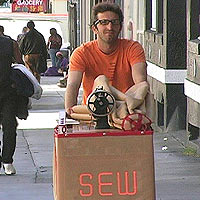
On the 15th of every month, from noon to 6pm, performance artist Michael Swaine sets up shop in San Francisco’s blighted Tenderloin District. Pushing a homemade cart mounted with a treadle-operated sewing machine, Swaine offers his services as a street tailor, mending whatever garments the neighborhood’s denizens bring him. In the episode “Street Art,” Spark visits the artist in action as he makes his monthly rounds.

Swaine’s ongoing tailor piece began as part of “The Generosity Project: Strategies for Exchange in Contemporary Art,” held in 2001 at the California College of Art’s Wattis Institute. Originally titled “Reap What You Sew,” the performance consisted of the artist pushing his cart around the city on a predetermined route for an entire week. Swaine considers the project a collaboration between himself and those whose clothes he patches, mends, hems and darns — an opportunity to create social interaction where there would otherwise be none.

Born in Buffalo, New York, Michael Swaine earned a B.F.A. from New York State College of Ceramics at Alfred University before going on to study advanced ceramics and sculpture at the School of the Art Institute of Chicago. Since 1999, Swaine has collaborated on numerous projects with Amy Franceschini as part of the artists collective Futurefarmers.

  • Array
  • Array
  • Array

David Grisman

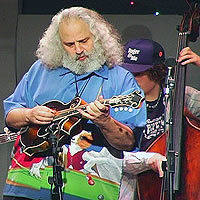
For more than 40 years, mandolinist and composer David Grisman has been one of bluegrass music’s greatest champions. Based in Sonoma County, Grisman has gained a reputation as both a virtuoso mandolinist and one of the world’s leading proponents of traditional acoustic music. Spark checks in on Grisman as he prepares for an evening of old-time bluegrass at Berkeley’s Freight and Salvage Coffee House.

A predominantly Southern style of music, bluegrass is a spirited combination of country, blues and gospel that emerged in the 1940s. As a teenager, Grisman picked up the mandolin after discovering the music of Bill Monroe, who is commonly credited with popularizing bluegrass. By the late 1960s, Grisman began to explore other styles, including jazz, folk and Gypsy music, to create a hybrid form unlike anything that had come before.

In 1975, Grisman founded the David Grisman Quintet, which features Grisman’s mandolin leading in a series of instrumentals that defy easy categorization. Offhandedly naming his new style after a nickname that the Grateful Dead’s Jerry Garcia had given him, Grisman created “dawg” music — a term that remains current in contemporary bluegrass circles.

Like other forms of roots music, bluegrass passes from generation to generation not through formal notation but rather in a live exchange between performers. In an effort to preserve traditional bluegrass, at least once a year he performs an evening of old-time music with his traditional outfit, the David Grisman Bluegrass Experience. It is an event that brings in a wide audience, including bluegrass and country aficionados, folkies, and Dead Heads. Spark is there for the 2004 performance at the Freight and Salvage.

Ever dedicated to preserving acoustic music, Grisman established the Acoustic Disc record label in 1990 in an effort to help establish a recorded legacy of traditional acoustic music from around the world. Since founding Acoustic Disc, Grisman has recorded more than 60 records by almost as many performers and in almost as many genres.

David Grisman was born in New Jersey and began playing bluegrass while attending New York University. While living in Greenwich Village, he recorded with a number of bands, gaining popularity in the burgeoning 1960s folk scene. In 1970, Grisman moved to San Francisco, where he befriended Jerry Garcia and lent his talents to the Grateful Dead classic “American Beauty.” Since then, he has recorded dozens of records, with his own bands and with artists such as Emmylou Harris, Bonnie Raitt, Dolly Parton, Earl Scruggs and Django Reinhardt’s collaborator, jazz violinist Stephane Grappelli.

Array

  • Array
  • Array
  • Array

Elderhostel Tiburon American Music Program

More than 50 seniors have come from all over the country to take part in the Elderhostel Tiburon American Music Program. Hosted by Barry Adler and led by instructors Don Lewis and Jerry Frohmader, the Elderhostel program teaches seniors to sing and play blues, gospel, jazz and ragtime. Over the course of five days, participants learn to write and perform songs in a fun, informative and disarming program. Although some have performed before, many of the seniors that attend Elderhostel’s program are creating music for the first time.

Lewis grew up in Dayton, Ohio, with a musical family and church community as the major focuses in his life. He attended Tuskegee University and played piano and organ at the Greenwood Baptist Church for Martin Luther King’s Freedom Rallies. He has worked in the studio with such legendary music greats as Quincy Jones and Michael Jackson. As a performing artist, he has toured extensively nationally and internationally.

Born in Seattle, Washington, Frohmader is a teacher, composer, performer, conductor and arts administrator. As a professional musician (keyboards and saxophone), he has performed with the New Jersey Symphony and Clark Terry. He presently lives in Corte Madera, where he teaches electronic synthesis, jazz, recording techniques and keyboards privately as well as part time at the College of Marin. He also composes music for television commercials, videos and film.

More about Elderhostel
Founded in 1975, Elderhostel is a nonprofit organization dedicated to providing extraordinary learning adventures for people aged 55 and over. Elderhostel offers a wide variety learning programs in locations that span the globe. The Bay Area Classic Learning is the Elderhostel branch in the Bay Area.

  • Array
  • Array
  • Array

SFJAZZ Collective

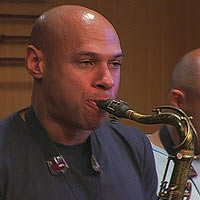
Gathering together some of the best jazz talents in the country, the SFJAZZ Collective meets every year for a two-month residency during which the group’s members rehearse their own compositions as well as those by noted masters. Each year, they get together to practice for their performance at the SFJAZZ Spring Season and the national tour that follows. In the episode “American Music,” Spark visits the ensemble, hard at work as it prepares six compositions by John Coltrane, arranged by Grammy Award-winner Gil Goldstein.

The 2005 octet, assembled by SFJAZZ executive director Randall Kline and artistic director Joshua Redman, is composed of accomplished musicians from around the country, including trumpeter Nicholas Payton, alto saxophonist and flutist Miguel Zenon, pianist Renee Rosnes, Isaac Smith on trombone, bassist Matt Penman, drummer Eric Harland, and Redman himself on tenor sax. But the group’s highlight is vibraphonist Bobby Hutcherson, a veteran player who has recorded with veritable legends of modern jazz, including Sam Rivers, Freddie Hubbard and Herbie Hancock.

Even for such accomplished talents, performing Goldstein’s new arrangements of six Coltrane classics can be overwhelming. The work of Coltrane, who is commonly considered to be the most important jazz composer and performer of the modern era, rarely gets reinterpreted by young musicians. His mature style, characterized by hypnotic, soulful melodies deftly interwoven with bursts of dissonant wailing from his tenor sax, presents the interpreter with a challenge that is exceedingly difficult to meet. On the one hand, to merely copy Coltrane’s sound is to ignore the spirit of individual expression that is central to his work; on the other, a voice as personal and penetrating as Coltrane’s may not be found even in a lifetime of practice and introspection.

Founded in 1983 under the name of Jazz in the City, SFJAZZ is the leading nonprofit jazz organization on the West Coast and the sixth-largest performing arts organization in the Bay Area. Dedicated to encouraging the growth of jazz and jazz audiences in San Francisco and beyond, SFJAZZ presents a wealth of year-round programs, including the internationally acclaimed San Francisco Jazz Festival, the SFJAZZ Spring Season program, and numerous community outreach and educational programs.

  • Array
  • Array
  • Array
  • Array
  • Array

Kid Beyond

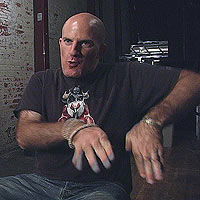
Kid Beyond (aka Andrew Chaikin) is a one-person band — using his mouth as his only musical instrument. He can produce the sounds of instruments, hip hop loops, techno beats, turntable scratches and synthesizers. In the episode “Percussion,” Spark gets into the rhythm with him at “The Vowel Movement: A Beatbox Showcase.”

The art of vocal percussion, also known as human beatboxing, is believed to have begun as an urban art form around the same time as hip hop in the late 1970s and early 1980s, in New York City. The term “beatboxing” is derived from the mimicry of the first generation of drum machines, then known as beatboxes. Beatboxing’s early pioneers include Doug E. Fresh, Biz Markie and Buffy from the Fat Boys.

Kid Beyond takes beatboxing further into the modern day through the use of technology. Using foot pedals designed especially for him by a friend at Emeryville’s Expressions Center for New Media, he records parts of his performance in real time, then loops it back live, thus layering lyrics over his own vocal instrumentation. Kid Beyond has shared the stage with James Brown, Ray Charles, LL Cool J, Spearhead, Run-DMC, KRS-One, Blackalicious and the Neville Brothers.

“The Vowel Movement,” created by Bryan Neuberg (aka Process), Kid Beyond and Tim Barsky, is a monthly show in San Francisco at Studio Z. It’s a forum and a venue for beatboxers of all ages, backgrounds and genders to get on stage and practice the art form as well as try out new sounds and techniques.

  • Array
  • Array
  • Array
  • Array

San Francisco Taiko Dojo

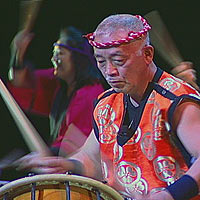
When Grand Master Seiichi Tanaka founded the San Francisco Taiko Dojo in 1968, he brought to American shores an art form more than 4,000 years old. Tanaka now has a devoted following that studies this ancient style of Japanese drumming three nights a week, 52 weeks a year. In the episode, “Percussion,” Spark checks in on Tanaka’s world-renowned studio as his students prepare for the 2004 International Taiko Festival held at UC Berkeley’s Zellerbach Hall.

In ancient Japan, taiko was considered a sacred representation of the voice of Buddha. It was employed in a variety of rituals, including those used to drive away evil spirits from crops, send samurai into battle and define the boundaries of a village. Its thunderous pounding was also believed to incite the clouds to begin to rain.

While taiko finds its roots in these folk traditions, the modern version has evolved into a powerful, sophisticated synthesis of rhythm, harmony and choreography. Tanaka, who has performed with such jazz luminaries as Art Blakey, Max Roach and Tito Puente, has crafted his own style of taiko, which combines traditional songs with Western jazz and Latin rhythms.

At the International Taiko Festival, the San Francisco Taiko Dojo performs a series of works, including Tanaka’s most famous composition, “Tsunami” — a roaring, energetic piece that makes ample use of taiko’s most difficult instrument, the large okedo drum.

The San Francisco Taiko Dojo is composed of approximately 200 students, encompassing a range of ages, ethnicities and skill levels. The first and oldest taiko studio in America, the San Francisco Taiko Dojo enjoys worldwide recognition. In addition, the music of Grand Master Tanaka and San Francisco Taiko Dojo has been featured in major motion picture movies — including “The Right Stuff,” “Rising Sun,” “Return of the Jedi” and “Apocalypse Now.”

Array

  • Array
  • Array
  • Array

Zakir Hussain

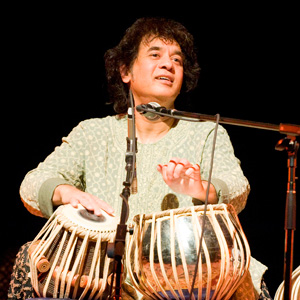
World-renowned tabla player Zakir Hussain has both revolutionized Indian percussion and extended its audience worldwide. Over the course of a career that has spanned more than four decades, Hussain has fused Indian classical music with Western jazz, rock and Latin styles, collaborating with Pharoah Sanders, Tito Puente, Joe Henderson and Van Morrison, among others. Spark checks in on the longtime Bay Area resident as he works with some of the region’s most respected performers.

The son of tabla legend Ustad Alla Rakha, Hussain was a child prodigy. He began his musical education at the age of 7 under the tutelage of his father. By the time he was 12, Hussain was performing professionally, touring with the royalty of Indian classical music, including Ali Akbar Kahn, and later, with his father’s longtime collaborator Ravi Shankar. At the age of 19, Hussain moved to the Bay Area and formed lasting musical relationships with the Grateful Dead’s Jerry Garcia and Mickey Hart.

In 1975, Hussain teamed up with jazz guitarist John McLaughlin and violinist Lakshminarayana Shankar to form Shakti, an ensemble dedicated to fusing jazz with Indian music. He has also been the leader of a number of bands, including the Tal Vadya Rhythm Band, which later became the Diga Rhythm Band, and The Rhythm Experience.

Hussain maintains a grueling touring schedule that has taken him around the globe. Spark catches Hussain’s performance at the San Jose Performing Arts Center, where he and sarode player Alam Khan are accompanied by Indian violinist Kala Ramnath. The event, which attracted an audience of nearly a thousand, reverses the usual instrumental roles as the violin forms a backdrop for Hussain’s percussion.

Ever the innovator, Hussain is relentless in his pursuit of artistic challenges. He has composed film scores, sung, and even acted in a number of films. Spark trails Hussain to the studio of choreographer Alonzo King, who has commissioned him to create and perform a piece for his upcoming tour with the LINES Ballet Company. This will be the first time that an Indian percussionist will perform with a dance ballet — a daunting prospect for Hussain, who will have to fuse Indian music’s improvisational mode with the precise choreography that King has designed for the performance. But Hussain is up to the task — it is an opportunity to explore yet more new territory after decades of experimentation.

  • Array
  • Array
  • Array